As the landscape for service brands becomes increasingly competitive, companies that prioritize customer experience (CX) are the ones that stand out, earning more repeat business and referrals than their competitors. AI has raised the bar for what customers expect: fast responses, personalized service, and consistency at every touchpoint. Services have become commoditized, and switching costs are lower than ever, so frontline experience has become the deciding factor in customer loyalty.
For multi-location service brands, this creates a distinct challenge. A single great location or a single great employee isn't enough. Real competitive advantage comes from delivering that same standard of experience across every team, every location, every time. Inconsistency, more than any single bad interaction, is what erodes trust and drives customers elsewhere.
Let's take a look at 15 examples of brands known for delivering 5-star customer experiences, revealing lessons you can apply to your own business.
Customer experience is the sum of every interaction a customer has with your business, from first contact through post-service follow-up. But it's more than a checklist of touchpoints. CX is the emotional perception customers build over time, shaped by whether your brand consistently delivers on what it promises. That perception drives loyalty, satisfaction, and willingness to recommend you to others.
For a multi-location service business (e.g. a salon chain, a gym franchise, a home services company, a clinic network), this perception is built one location, one appointment, one technician at a time. A customer's sense of your brand comes from their last experience, wherever and with whoever that happened to be.
Understanding and optimizing the various touchpoints in a customer's journey is essential for delivering a superior experience. The primary channels that contribute to CX before, during, and after a purchase include:
The importance of CX is underscored by its significant impact on key business metrics. Companies that excel in customer experience see higher customer lifetime value, improved brand loyalty, and reduced churn rates. Businesses with a strong focus on CX can achieve up to an 80% increase in revenue.
The mechanism behind this is an earned growth flywheel: frontline teams collect feedback, act on it quickly, and that action improves the next customer's experience. Improved experience builds loyalty and repeat visits, which in turn generates reviews and referrals. Referrals lower acquisition costs, freeing up budget to reinvest in the frontline teams who started the cycle. Each turn of the flywheel makes the next one easier and cheaper.
We've chosen a variety of companies across different industries to highlight what an awesome customer experience looks like in action. Each one demonstrates a different piece of the same underlying framework: personalization, convenience, frontline empowerment, and closed-loop feedback all working together.
What they do: Ritz-Carlton is renowned for its luxury personalization, consistently remembering guest preferences and exceeding expectations. From personalized greetings to bespoke room amenities, their attention to detail creates a memorable and unique stay for every guest. Co-Founder Horst Schulze has spoken about how frontline employees, not leadership, build a company's reputation, since every guest interaction is a direct reflection of the brand.
Why it works: This is frontline empowerment in action. Ritz-Carlton trusts individual staff to make judgment calls that create memorable moments, rather than forcing every interaction through a script or an escalation path.
Lesson for service brands: Reputation is built interaction by interaction, not campaign by campaign. Invest in training and trusting your frontline as much as you invest in marketing. Give staff the authority to solve problems on the spot, without needing manager sign-off.
What they do: Amazon's seamless online shopping experience sets the standard in e-commerce. Easy navigation, fast checkout, and a robust recommendation engine make shopping intuitive and convenient.
Why it works: This is convenience and personalization at scale. Amazon uses customer data to reduce friction automatically, rather than asking customers to work harder to get what they want.
Lesson for service brands: Use the data you already have (booking history, past service requests, preferences) to reduce the effort a customer has to put in next time.
Convenience compounds. Small reductions in friction across many touchpoints add up to a meaningfully better experience.
What they do: Since day one, the JiffyLube approach has been to focus on consistent customer experience over a race to the bottom on prices or louder marketing. JiffyLube uses AskNicely to capture real-time customer feedback across its locations, allowing it to continually improve service at the local level.
Why it works: This is closed-loop feedback in practice. Feedback is collected consistently and routed back to the people who can act on it, rather than sitting in a quarterly report.
Lesson for service brands: Consistency beats a louder marketing message. Customers remember how reliably good the experience was, not how loud the ad was. Real-time feedback only creates value when it reaches frontline teams fast enough for them to act on it.
Learn more about the JiffyLube success story here.
What they do: Zappos is famous for its exceptional customer service, with a focus on exceeding customer needs and fostering loyalty. Its commitment to a customer-first approach, including free returns and 24/7 customer support, shows the impact of going above and beyond.
Why it works: This is proactive, always-available communication. Removing the barriers customers usually expect (return fees, limited support hours) builds trust before a problem even happens.
Lesson for service brands: Identify the one or two policies that create the most customer anxiety, and remove them. Availability itself is a form of care. Being reachable when customers need you matters as much as what you say when they reach you. A pattern you'll notice in the best CX brands
A few consistent threads run through these examples so far:
What they do: Disney's immersive and engaging brand experience is built on storytelling and creating lasting memories. From theme parks to customer service, every touchpoint is designed to feel consistently magical. Former VP of the Magic Kingdom, Dan Cockerell, built a daily habit of walking the park to talk with employees and guests directly, gathering firsthand insight into what was working and what wasn't.
Why it works: This is frontline listening as a management practice, not a survey. Leadership stayed close enough to the frontline to catch issues and wins in real time.
Lesson for service brands: Leaders who regularly engage directly with frontline staff and customers catch problems faster than those relying only on reports.
Recognizing frontline staff in the moment reinforces the behavior you want repeated.
What they do: Apple's commitment to innovation extends beyond its products to its customer service. With a reputation for exceptional support and a seamless ecosystem, Apple ensures that every interaction with its brand feels connected and considered.
Why it works: This is consistency across an entire ecosystem. Support quality doesn't vary much by store or channel, which builds trust that the brand will behave the same way everywhere.
Lesson for service brands: Customers judge your brand by your most inconsistent location, not your best one. Standardizing training and service standards protects the whole brand.
Solving the customer's actual problem, not just the ticket in front of you, is what earns long-term trust.
What they do: Warby Parker offers seamless online and offline integration, with virtual try-on tools, affordable pricing, and free home try-on. Its physical stores also focus on exceptional customer service, creating a cohesive shopping experience regardless of channel.
Why it works: This is omnichannel consistency. A customer can move between digital and physical touchpoints without the experience resetting or contradicting itself.
Lesson for service brands: Make sure your digital and in-person experiences reflect the same brand promise. A customer shouldn't get a better (or worse) experience depending on the channel. Lowering the risk of trying your service (like a free trial) builds confidence before the customer has even committed.
What they do: Sephora's personalized beauty experience utilizes a loyalty program with tailored recommendations, beauty consultations, and in-store events. Its customer-facing staff are known to be highly knowledgeable, building trust directly at the point of service.
Why it works: This is personalization plus frontline expertise working together. Data-driven recommendations are reinforced by genuinely skilled staff, so the personalization feels credible rather than automated.
Lesson for service brands: Personalization lands best when your frontline team is knowledgeable enough to back it up in person. Loyalty programs work best when they're paired with real expertise, not just points and discounts.
What they do: USAA provides customer service tailored for military families, with dedicated support representatives who understand their unique needs. This focus on personalized and empathetic service fosters trust among its customer base.
Why it works: This is human connection as a differentiator. USAA prioritizes representatives who genuinely understand their customers' context over generic efficiency metrics.
Lesson for service brands: Understanding the specific context of your customer base (their constraints, their urgency, their history) builds trust faster than speed alone. Empathy is a trainable skill. Hire and coach for it deliberately, not incidentally.
What they do: LEGO builds a lifelong connection with customers through a fun and interactive brand experience. Beyond the product, it engages customers with content, events, and a strong focus on community building.
Why it works: This is relationship-building beyond the transaction. The brand experience continues long after the point of sale, which keeps customers engaged between purchases.
Lesson for service brands: Look for ways to stay connected with customers between service visits, not just during them. Community and shared identity extend loyalty well past the last transaction.
What they do: DUCA, a member-focused Canadian credit union with 19 branches serving 93,000 members, used to rely on small focus groups and sporadic email surveys run by outside consultants to gauge member sentiment. The feedback was inconsistent and often outdated by the time anyone saw it. After bringing on AskNicely, DUCA built a structured, real-time feedback system that gives both frontline staff and leadership a live view of the member experience across every channel and branch.
Why it works: This is closed-loop feedback and consistency working together across a multi-location network. Instead of feedback trickling in from disconnected sources, DUCA's frontline and leadership teams now see the same real-time data, which lets them catch issues early and recognize employees delivering great service, branch by branch.
Lesson for service brands: Structured, real-time feedback beats sporadic surveys, even well-intentioned ones, because outdated data can't drive timely action. Plus, giving frontline teams direct access to their own feedback creates accountability and gives you a natural way to recognize top performers instead of only catching problems.
Learn more about the Duca success story here.
What they do: Starbucks creates a personalized and convenient customer experience through its mobile app, loyalty program, and efficient in-store interactions. Customers can order ahead, customize their drinks, and earn rewards. VP of Customer Service Christine McHugh has emphasized asking customers directly for feedback and spending time with frontline teams, since they understand customers better than anyone else in the business.
Why it works: This combines personalization at scale with a genuine frontline listening habit, so the data and the human insight reinforce each other.
Lesson for service brands: Talk to your frontline teams regularly. They see patterns in customer behavior before those patterns show up in a dashboard.
Convenience features (ordering ahead, customization) only build loyalty if the in-person experience is just as strong.
What they do: Southwest Airlines has redefined the airline industry with its customer-centric approach and commitment to going the extra mile. In one widely shared story, an employee personally delivered a phone a customer had left behind at the gate. An AskNicely's team member has described this kind of moment as the product of "unmuting the frontline": actively soliciting frontline input instead of restricting employees to rigid policies.
Why it works: This is frontline empowerment taken to its logical conclusion. Employees aren't just allowed to make judgment calls; they're trusted to act on them without asking permission first.
Lesson for service brands: Policies should guide frontline behavior, not cage it. Build in room for judgment calls. Actively ask frontline employees for input on how to improve service. They usually already know the answer.
What they do: Chick-fil-A's dedication to customer satisfaction is evident in its "second-mile service" philosophy, where employees strive to exceed expectations at every opportunity. Its friendly staff, efficient service, and consistent food quality have earned a loyal following.
Why it works: This is a codified, repeatable standard of frontline behavior. "Second-mile service" gives every employee a clear, consistent bar to aim for, which is what makes the experience so reliable across thousands of locations.
Lesson for service brands: A simple, memorable service philosophy is easier to train and repeat consistently than a long list of individual rules. Consistency at scale comes from culture and training, not from monitoring alone.
What they do: Big Blue Bug Solutions, a family-owned pest control company with nearly a century of history in New England, wanted to expand into new states without losing the trusted, personal reputation it had built in its home markets. Manual phone surveys run by a small call center couldn't keep up. After adopting AskNicely, the company now sends surveys shortly after every service visit, analyzes feedback immediately, and routes it straight to supervisors and technicians.
Why it works: This is speed to insight and frontline coaching working together during a period of rapid growth. Feedback gets contextualized before it reaches technicians, so criticism lands as coaching rather than as a raw complaint, and results are tied directly to performance incentives that reward consistent service.
Lesson for service brands: When you're expanding into new markets, scalable feedback collection matters more than ever. Manual processes that worked at a small scale quickly become a bottleneck. Tying feedback to recognition and incentives, not just to monitoring, gives frontline teams a reason to care about the score, not just see it.
Learn more about the Big Blue Solutions success story here.
While the specifics of a best-in-class customer experience vary by company, audience, and channel, certain fundamentals now apply across every service brand.
Personalization used to be a differentiator. Now it's the baseline. Customers benchmark every local interaction against the best digital experiences they've had anywhere, regardless of industry. A gym member expects the same tailored recommendations from their front desk that they get from a streaming service.
AI makes this achievable without adding headcount. Instead of hiring more staff to track individual preferences, service brands can use customer history and feedback data to surface what each person needs, right when a frontline employee needs to know it.
Efficiency and convenience remain crucial in a fast-paced world. Customers expect seamless, quick interactions, whether navigating a website, completing a purchase, or accessing support. Streamlining processes and reducing friction points significantly enhances the overall customer experience.
Proactive communication means anticipating customer needs and addressing them before they become issues. Keeping customers informed and engaged through timely updates, notifications, and follow-ups builds trust and prevents frustration before it starts.
Despite advances in technology, the human touch remains the vital component of a great customer experience. Empathy, active listening, and genuine interactions create strong emotional connections, making customers feel appreciated and respected. AI can surface what a customer needs and when, but it can't replace the judgment and warmth of a frontline employee handling the moment itself. AI augments empathy; it doesn't substitute for it.
Exceeding expectations means going above and beyond to surprise and delight customers. Unexpected perks, exceptional service, and thoughtful gestures leave a lasting positive impression and differentiate a brand from its competitors.
For multi-location service brands, the biggest threat to CX isn't any single bad interaction. It's variability. One location delivers a five-star experience while another, running the same playbook, falls short, and the customer has no way of knowing which one they'll get next time.
Human variability is the root cause: different training, different tenure, different managers, different habits. Closing that gap requires real-time visibility into how each team and location is actually performing, paired with coaching and recognition that reinforces the standard you want everywhere, not just at your best sites.
Collecting feedback is the easy part. The competitive advantage comes from how fast that feedback turns into action. Most CX programs fail not because they lack data, but because insights arrive too late, after the customer has churned and the team has already moved on to the next interaction.
Customers expect immediate resolution, not a follow-up next week.
Frontline coaching works best when it's tied to a specific, recent interaction the employee can still recall clearly.
Unresolved issues compound quickly, showing up in reviews and lost repeat visits before a business even realizes there's a pattern.
Survey fatigue sets in fast when customers see no evidence that their input changes anything.
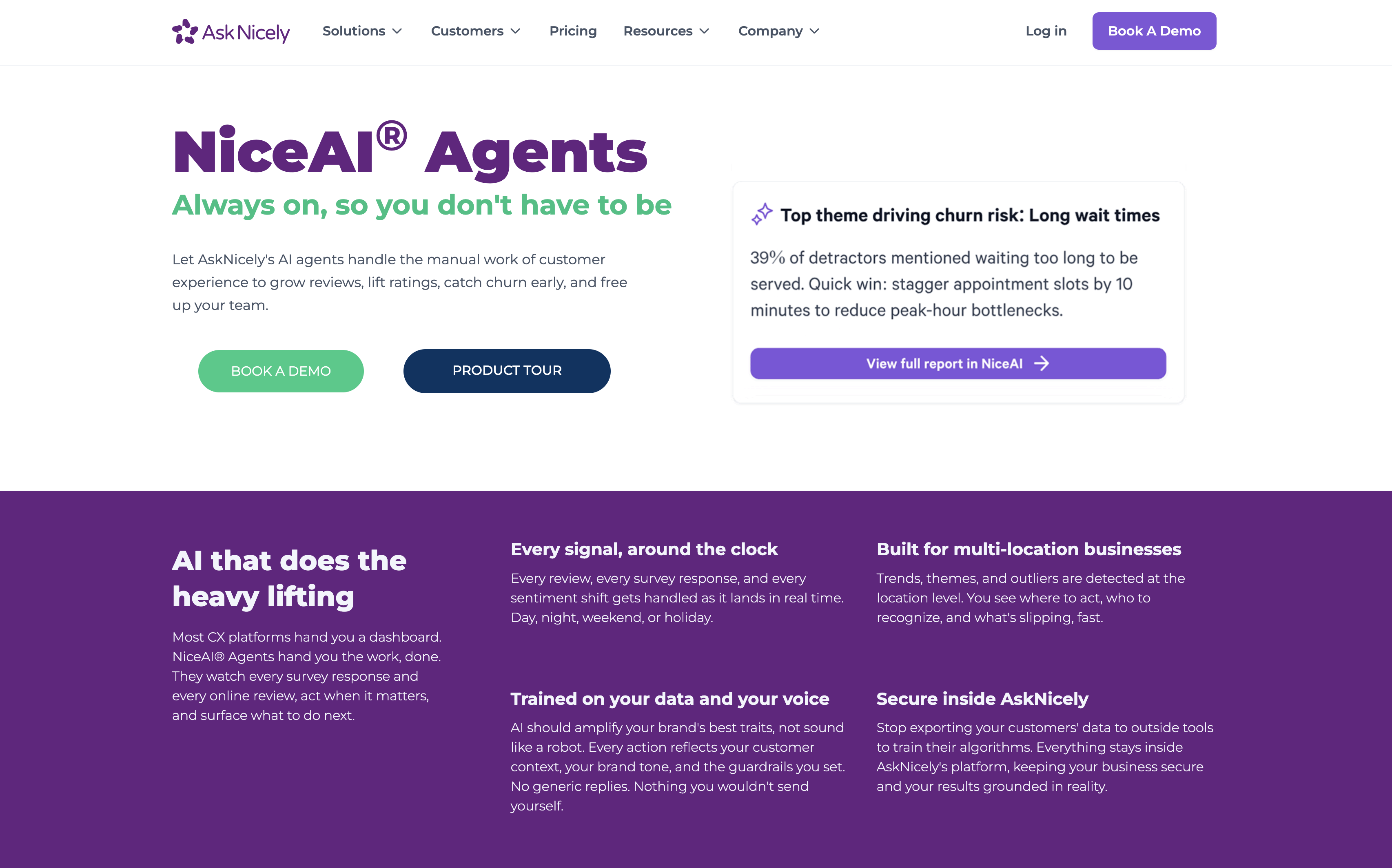
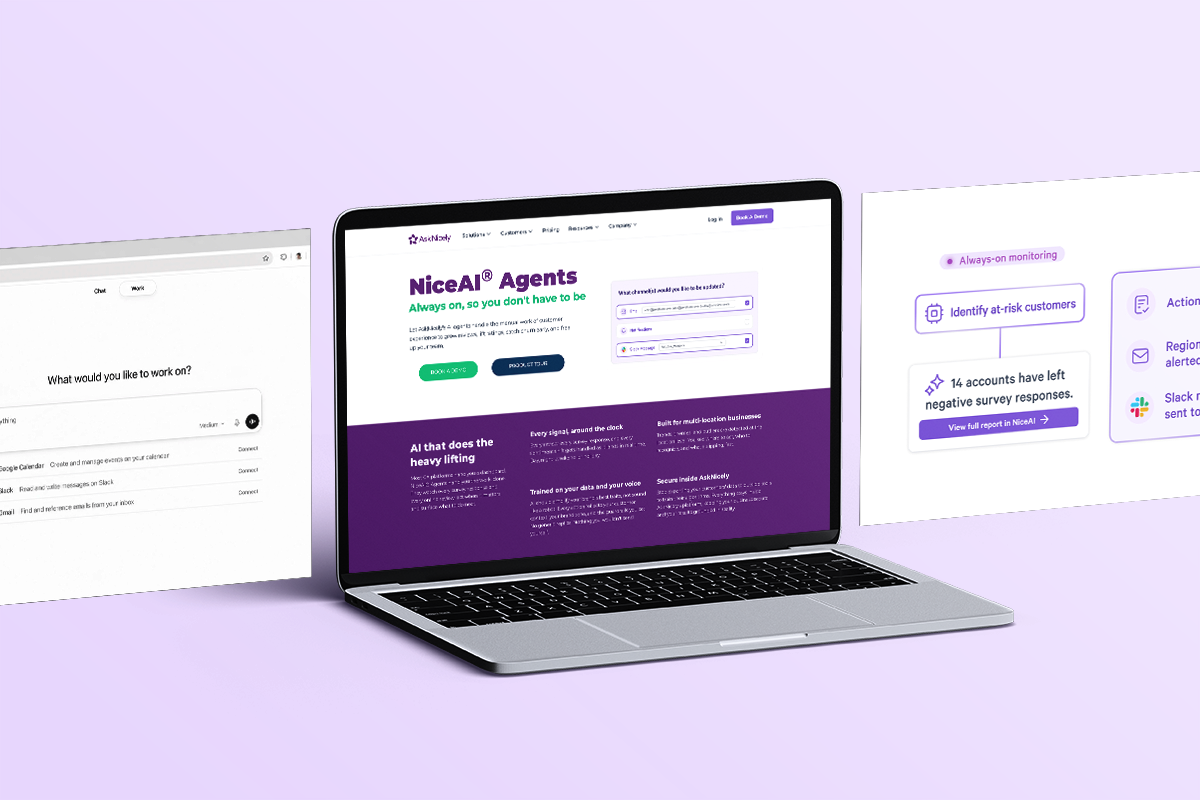
This is where AI changes what's possible. NiceAI auto-detects themes across customer feedback without manual tagging, and generates plain-language summaries instantly, so teams understand "why" without combing through comments one at a time. It adapts follow-up questions in real time, gathering richer context without asking customers to fill out longer surveys. And it moderates raw feedback into coaching-ready input, so managers can act on it directly instead of translating it first.
The result is a tighter loop: faster resolution, more specific coaching, and feedback that visibly leads to change.
Improving customer experience can be challenging, with teams often grappling with fragmented customer journeys, data silos, and inconsistent training. With the right approach, any service brand can close these gaps and turn feedback into a genuine competitive advantage.
Understanding the customer journey is essential for identifying where to focus improvement efforts. Map out the key stages, from initial awareness through post-service follow-up, and use that map to spot where friction happens. This is also the point to identify where AI or self-serve tools (booking, reminders, simple FAQs) can remove friction on their own, freeing your frontline team to focus on the moments that actually need a human touch.
A single annual survey tells you how customers felt months ago, not how they feel today. Modern CX teams have moved away from that model toward continuous, real-time feedback: ongoing pulse surveys measuring NPS, CSAT, or Customer Effort Score at the moments that matter most.
Adaptive tools like Dynamic Surveys take this further by adjusting follow-up questions in real time based on how a customer responds. Instead of asking every customer the same long list of questions, the survey asks fewer, smarter questions and still surfaces richer context. This directly addresses survey fatigue, since customers are more willing to respond when the questions feel relevant to their specific experience.
Feedback only creates value once it reaches the people who can act on it. Employees need three things: clarity on what's expected, the tools to see how they're doing, and recognition when they get it right.
In practice, this looks like personal scorecards showing an individual's or location's recent scores, specific coaching tips tied to real customer comments, praise and recognition shared when a customer highlights great service, and local goals that give teams something concrete to work toward. This is the same pattern behind Disney's frontline walks and Southwest's "unmuting the frontline": feedback flows to the people doing the work, not just to a dashboard leadership checks quarterly.
An omnichannel approach ensures a seamless, consistent experience across every customer touchpoint, online or offline. Integrating your channels means a customer's history and preferences travel with them, whether they're booking on an app, calling in, or walking into a location. This consistency is what prevents the experience from resetting every time a customer switches channels.
Generic CRMs and dashboards can store data, but they don't necessarily help a frontline team act on it. The more useful shift is toward CX platforms built specifically around frontline workflows: surfacing the right insight to the right person, at the right location, at the right time, rather than leaving managers to dig through reports to find it themselves.
Regularly measuring CX metrics like CSAT and NPS is vital for tracking performance, but the real advantage comes from how fast you can turn that measurement into understanding. This is where NiceAI functions as a CX analyst and editor working alongside your team: it detects themes automatically across incoming feedback, summarizes trends in plain English so teams don't have to interpret raw data themselves, personalizes follow-up questions through Dynamic Surveys to get more context without more surveys, and moderates comments to keep feedback constructive and coaching-ready.
By implementing these practices, service brands can move from occasionally measuring customer experience to continuously improving it.
AskNicely gives multi-location service brands the tools to collect feedback, understand it fast, respond meaningfully, and transform frontline performance, all in one continuous loop rather than a series of disconnected steps.
Dynamic Surveys adapt follow-up questions in real time based on how a customer responds, so you get richer, more relevant context without lengthening the survey. A customer who leaves a low score gets asked a more specific follow-up; a customer who leaves a high score isn't stopped with unnecessary questions. This reduces survey fatigue while increasing the depth of what you learn from each response.
AI Themes automatically detects recurring topics across incoming feedback, so patterns surface without anyone manually tagging comments. AI Insights turns that data into plain-language summaries, explaining what's changing and why, so managers and leadership can understand trends at a glance instead of combing through raw comments.
Smart Routing sends feedback directly to the right person or team, so issues reach whoever can actually act on them. AI Response Moderation turns messy, unfiltered comments into coaching-ready input, preserving the core message a customer is communicating while removing personal attacks or overly charged language. This makes it possible to share real feedback with frontline staff without demoralizing them.
Focus Areas give teams AI-recommended goals based on what feedback shows actually needs attention, along with visible progress tracking so employees can see how they're improving. Praise makes recognition automatic, surfacing great feedback to the employee who earned it, reinforcing the behavior you want repeated across every location.
Consistency: Every location gets visibility into the same standards, closing the gap between your best site and your average one.
Accountability: Scorecards and Focus Areas give individual teams clear, specific ownership over their own performance, not just a company-wide average.
Speed: Feedback moves from customer to frontline action in hours, not weeks, before an issue has a chance to compound into a lost customer.
Earned growth: Faster action on feedback improves the next customer's experience, which builds the loyalty and referrals that lower your acquisition costs over time.
Ready to elevate your customer experience? Book a demo with AskNicely today and discover how our platform can help your business thrive.
Net promoter score, CSAT, and CES answer different questions, so the strongest customer experience strategy uses all three as complementary KPIs rather than picking just one. NPS is the right choice when your goal is understanding long-term brand loyalty, while CSAT fits when you need to gauge service quality right after a specific interaction, and CES is best when the goal is identifying and reducing friction in a process.
In practice, that might look like sending a CSAT survey right after a service appointment, a CES survey after a support team interaction, and an NPS survey on a regular cadence to track loyal customers over time. Because no single metric tells the whole story, mapping the full customer journey usually requires combining all three rather than relying on just one. A dropping NPS score, for example, is a signal to check your CES data to find out where the friction is actually happening.
Artificial intelligence works best in this context as an amplifier of your frontline team, not a replacement for it. Used well, automation takes over the repetitive analytical work, like detecting themes across hundreds of customer interactions or summarizing sentiment, freeing up your support team to spend their time on the parts of service that actually require empathy and judgment. Self-service tools can also handle simple, low-stakes requests (booking, rescheduling, basic FAQs), which raises customer expectations for speed without pulling a human away from the moments that matter most. The risk isn't AI itself, but using it to replace direct human contact rather than to prepare for it. Kept in its proper role, AI can raise consistency without customers ever feeling like they're talking to a machine.
A common rule of thumb is to base survey frequency on how often customers already interact with your business and divide that by two, so monthly interactions warrant a survey roughly every other month. Transactional surveys are the exception: for something like a single service appointment, it's fine to ask for feedback every time, as long as the survey itself stays short, ideally around four questions or fewer.
The bigger risk isn't asking too often, it's asking the same generic questions regardless of context. Research has found that only about 9% of people take the time to answer long surveys thoughtfully, and 70% have abandoned a survey before finishing it. To optimize response rates and customer engagement, adaptive surveys that adjust their follow-up questions based on a customer's actual response work better, since customers answer fewer, more relevant questions instead of a fixed long list.
Closed-loop feedback means every piece of customer feedback is followed by a visible response, either back to the customer, to the frontline team, or both, rather than sitting unread in a dashboard. It's a foundational habit of good customer experience management: a simple way to implement it is that when a customer gives a low score, that feedback routes automatically to the manager or employee involved within the same day, prompting a direct follow-up and tracking whether the issue gets resolved. Big Blue Bug Solutions is a good example of this in practice: feedback is analyzed and acted on within 24 hours, and detractors get a direct call, which is part of why the company has built a reputation for fast, high-quality service recovery even while expanding into new markets. Done consistently, this habit is what turns a single positive customer experience into loyal customers who stick around.
The clearest way is to connect CX metrics directly to financial outcomes leadership already tracks, rather than presenting satisfaction scores on their own. Businesses that prioritize customer experience have been shown to grow revenue 1.7 times faster than those that don't, with roughly a 2.3 times increase in customer lifetime value on average.
A 2024 Forrester study found that "customer-obsessed" companies saw 41% faster revenue growth and 51% better customer retention compared to less CX-focused peers. Part of the case worth making explicitly: a positive customer experience doesn't just retain existing customers, it also generates word-of-mouth that brings in new customers at a lower acquisition cost. To make the case internally, tie a specific initiative (say, faster response times at underperforming locations) to a measurable outcome like reduced churn or increased repeat visits at those same locations, so leadership sees a direct line from the investment to the result.
NiceAI is built directly into AskNicely's platform and works from a business's own live customer feedback, letting managers ask plain-language questions about customer sentiment and get answers grounded in their company's actual data. ChatGPT, by contrast, is a general-purpose artificial intelligence assistant with no built-in connection to a business's customer experience management systems, reviews, or frontline workflows. NiceAI is purpose-built automation designed to turn free-text survey responses into insights that help businesses identify key issues and take targeted action, and features like Dynamic Surveys, AI Themes, and Focus Areas are built to optimize the exact workflows a service brand already uses to manage feedback and coach frontline teams. In short, NiceAI is an embedded, data-grounded tool for a specific job, while ChatGPT is a general assistant that would need to be manually fed a business's feedback data to do anything similar.