Customer service and customer experience are often used interchangeably, but there are important differences between the distinct concepts.
At a high level, good customer service is about the direct support and assistance customers receive during interactions with your business. Customer experience, on the other hand, is the full journey – every touchpoint, every channel, every visit, and every impression, from first contact to long after the transaction is complete. Customer service is a critical part of that journey, but it’s only one piece of a much bigger picture.
Why does this matter now? Because customer expectations have fundamentally changed. Today’s customers expect faster, more personalized, lower-effort experiences across every location, channel, and interaction. Artificial intelligence (AI) is rapidly raising the bar for both service speed and quality of experience, and in that shift, the gap between CX leaders and laggards is widening fast.
For multi-location and multi-channel brands, the real challenge is in delivering good service in isolated moments. Creating a consistent, high-quality customer experience everywhere, every time, is no easy feat. But treating customer service and customer experience as the same thing leads to fragmented strategies, disconnected improvements, and missed growth opportunities.
With that in mind, let’s explore the real differences between customer service and customer experience, how they work together, and how to strengthen both. You’ll learn how to improve service where it matters most, design better end-to-end experiences, and connect the two into a cohesive strategy that drives loyalty, repeat business, referrals, and long-term growth.
Customer service refers to the direct, interaction-level support between a customer and a customer-facing team member during the purchasing process and beyond. It’s typically reactive, focused on responding to issues, questions, and problems as they arise. In everyday B2C service settings like clinics, gyms, home services, and franchise businesses, this shows up in moments like booking appointments, handling billing questions, resolving service issues, managing cancellations, or supporting returns and refunds.
From resolving technical problems to fixing scheduling mistakes or service failures, customer service is a critical touchpoint that shapes how customers feel about your brand in the moments that matter most.
Today, customer service is delivered across multiple channels such as phone, email, live chat, social media, in-app messaging, and in-person interactions. AI-assisted service is now part of that mix too, through chatbots, self-serve tools, and agent copilots that help teams respond faster and more accurately. But while AI can handle speed, scale, and efficiency, customer-facing humans still own the most emotional, high-stakes interactions when customers are frustrated, confused, stressed, or upset.
With so many channels in the mix, omnichannel customer support is critical. Customers expect seamless service across platforms and locations, and businesses that consistently meet that expectation are far more likely to build trust and brand loyalty.
Quick response times are mission-critical. Customers expect timely help when they reach out with an issue, and delays can quickly lead to frustration, dissatisfaction, and ultimately customer churn.
Excellent customer service doesn’t exist without excellent communication. Customers value clear, concise, easy-to-understand information, whether it’s explaining a service, outlining a process, or resolving a problem.
Empathy creates emotional connection. When customers feel heard and understood, even negative experiences can turn into positive brand moments. This is where human service still matters most.
Consistency means delivering the same quality of service across every location, channel, and interaction, regardless of which branch, team member, or platform the customer engages with. This is one of the hardest elements to get right due to human variability, training gaps, and operational differences, but it’s also one of the most powerful drivers of trust and loyalty in multi-location businesses.
Customers should be able to reach support through their preferred channels – phone, email, chat, social media, or in person. Easy access to help is foundational to a strong service experience.
To continuously improve your customer service, performance needs to be measured, not guessed.
Customer experience (CX) is the overall perception customers form about your brand based on every interaction they have with it, across every touchpoint, channel, and stage of the journey. Unlike customer service, which is typically reactive, CX is proactive by design. It’s about intentionally shaping how customers feel before, during, and after they engage with your business.
CX includes everything from your website, booking flows, and digital communications to in-person service, follow-ups, loyalty programs, and post-purchase support. For service-based businesses, many of these moments still happen in physical locations and are delivered by frontline teams in local branches.
At the same time, AI is increasingly shaping the “before and after” of the experience, powering personalized communications, smarter recommendations, predictive insights, and more relevant engagement at scale.
At its core, CX is built through touchpoints, every moment a customer interacts with your brand. Mapping the customer journey from first awareness to long-term loyalty helps businesses identify where friction exists, where value is created, and where experiences break down. The goal isn’t just satisfaction in isolated moments, but a connected, consistent experience that feels effortless, human, and intentional from end to end.
Customers now expect personalization as a baseline, not a bonus. They want experiences that reflect their needs, preferences, history, and context. AI enables brands to deliver this at scale, using data to personalize communication, recommendations, and experiences without bloating teams or complexity.
Great CX means creating a consistent, low-friction experience across every channel and interaction—online and offline. Customers shouldn’t feel like they’re dealing with different businesses when they move between locations, platforms, or touchpoints.
The best experiences prevent problems before they happen. Predictive insights and data-driven signals now allow brands to anticipate needs, surface issues early, and engage customers before frustration sets in, through timely messages, reminders, offers, and support.
Strong CX builds emotional loyalty, not just functional satisfaction. When customers feel understood, valued, and cared for, they’re more likely to stay, return, and advocate for your brand.
A mature CX strategy is built on continuous listening. Feedback isn’t just collected, it’s analyzed, shared, and turned into action. This creates a cycle of improvement that aligns real customer needs with operational change.
Beyond quantitative metrics, some of the most valuable CX insights come from qualitative feedback, e.g., open-text comments, reviews, and survey responses. For service and multi-location brands, this is often where the real story lives. AI-driven theme detection now makes it possible to turn thousands of unstructured comments into clear, actionable signals (by location, region, channel, or team helping businesses identify emerging issues, experience gaps, and improvement opportunities earlier, not after problems scale.
Customer service and customer experience are often conflated, but they represent different aspects of a customer’s interaction with a brand.
The main difference is that customer service refers specifically to the direct assistance and support provided to customers during their interactions with a company. It’s typically reactive, addressing customer inquiries, issues, or problems as they arise. For example, resolving a problem with an order or answering a question about a product falls under customer service.
On the other hand, customer experience encompasses the overall perception and satisfaction a customer has with a brand throughout their entire journey. This includes every interaction and point of contact, from initial awareness and purchase to post-purchase support and follow-up. CX is proactive, aiming to create positive impressions at every stage and build a comprehensive understanding of how customers feel about the brand.
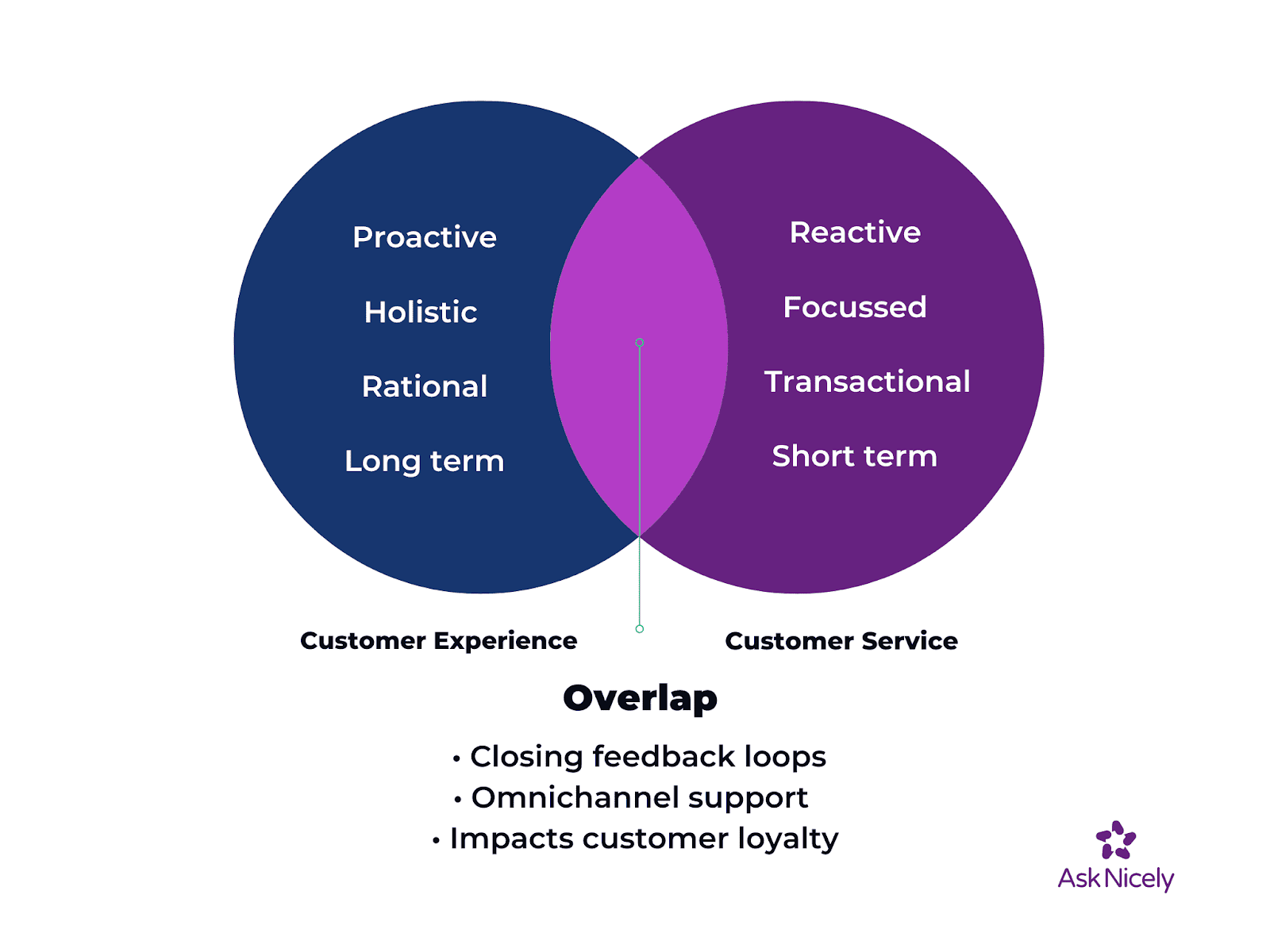
It’s important to understand that customer service is a crucial component of customer experience, but it is just one part of the larger picture. While excellent customer service can enhance the overall customer experience, creating a positive and memorable customer journey requires a broader focus on all touchpoints and interactions with the brand.
Providing excellent customer service and creating a superior customer experience are critical for any people-powered business aiming for long-term success. Both directly influence loyalty, revenue, and the overall health of your brand.
Here’s why they matter:
Exceptional service and experience keep customers coming back, reducing the cost of acquiring new ones. Businesses with strong retention programs can see revenue increases of 5–10% or more.
A great customer experience fosters loyalty, encouraging repeat purchases and deeper engagement. Loyalty programs backed by attentive service often see higher participation and customer lifetime value.
Consistently positive experiences strengthen your brand. Companies like First Commonwealth and Schweiger Dermatology Group have earned trust and admiration by delivering memorable, reliable experiences at every touchpoint.
In crowded markets, experience is a key differentiator. A superior CX can make your brand stand out, attracting new customers and keeping them from defecting to competitors.
Businesses that prioritize CX often see a direct revenue impact on their bottom line. Improving satisfaction, reducing friction, and increasing loyalty all contribute to higher sales.
Satisfied customers are more likely to return and recommend your brand. Companies like Schweiger Dermatology Group experienced a 3x increase in positive reviews on Google since their focus on CX using AskNicely.
Providing consistently excellent service lowers churn. Retaining customers is often five times less expensive than acquiring new ones, making CX a high-leverage investment.
Engaging with customers and tracking their experiences provides actionable insights into preferences, behaviors, and pain points. Data-driven improvements help refine offerings and strengthen overall strategy.
A strong CX focus often leads to higher employee engagement. Frontline staff who see the impact of their work on customer satisfaction—and who receive visibility and recognition for it- are more motivated, perform better, and stay longer. Programs like AskNicely Transform help organizations close the loop, linking employee actions directly to measurable customer outcomes.
Improving both customer service and customer experience isn’t a one-time project, it’s an ongoing, continuous improvement loop. When done well, it drives loyalty, uncovers actionable insights, and strengthens your competitive position.
Think of it as a repeating cycle: Set standards → Collect feedback → Understand → Act locally → Recognize → Repeat.
Here’s how to put that into practice:
A unified strategy ensures that customer service and experience work together to achieve your broader business goals. Align journey-level CX objectives with frontline service standards so that every interaction, from booking to post-service follow-up, consistently reflects your brand. This alignment ensures that improvements at the individual touchpoint level contribute to a seamless, high-quality overall experience.
Invest in training that goes beyond initial onboarding. Teach communication skills, empathy, problem-solving, and brand standards, but also embed AI-powered, in-the-moment coaching. Micro-coaching tools can provide feedback based on real customer comments, location-level trends, and individual performance scorecards, giving employees actionable insights exactly when and where they need them. This approach helps teams continuously refine service and deliver consistent experiences across locations.
Feedback is the operating system for continuous improvement. Move from periodic surveys to always-on listening, collecting input at every relevant touchpoint. Modern CX platforms and AI tools—like NiceAI Dynamic Surveys—reduce survey fatigue while capturing richer context and deeper insights. Use feedback to uncover patterns, understand emerging issues, and track how changes impact satisfaction over time.
Frontline teams are the ones delivering the experience, especially in multi-location service brands. Empower employees with real-time feedback, decision-making authority, and access to insights at their location or team level. Engaged, informed employees are more likely to consistently deliver excellent service, maintain brand standards, and contribute to a positive customer experience wherever it happens.
The right technology doesn’t just produce dashboards for HQ, it pushes insights to the people who can act on them, in the tools they already use (email, Slack, Teams, TVs). AI can help you:
By combining automation with the human touch, you can free employees to focus on interactions that matter most while ensuring consistent, measurable improvements across all locations and channels.
By following this loop: setting standards, collecting and analyzing feedback, acting locally, and recognizing successes, service brands create a living system of improvement. Every iteration strengthens both customer service and customer experience, turning everyday interactions into moments that build loyalty, trust, and growth.
AskNicely is an intuitive platform trusted by leading organizations worldwide to improve both customer service and overall customer experience. Its suite of features supports a continuous improvement loop, making it easy to capture insights, act locally, and recognize team performance, while leveraging AI to surface trends and context that would take hours to analyze manually.
AskNicely enables you to collect feedback across multiple channels—email, web, SMS, and in-app—using NPS, CSAT, CES, or 5-star surveys. NiceAI Dynamic Surveys allow adaptive follow-ups, capturing richer, contextual feedback without survey fatigue.
For multi-location service brands, Ops and CX leaders can quickly see which locations are off-track, why they’re underperforming (via NiceAI Themes), and what customers are actually saying (via NiceAI Insights Summaries). Thousands of comments are distilled into plain-English summaries, so you don’t have to dig through pages of text to understand trends or pain points.
AskNicely helps you benchmark performance across locations, teams, or channels. NiceAI Themes + AI Insights/Summaries detect emerging trends faster than traditional analysis, highlighting recurring issues and opportunities for improvement.
The platform is designed for local action: feedback is routed to the right branch or team member. AI Response Moderation transforms raw, emotional customer comments into constructive, actionable coaching material that frontline teams can use to improve interactions immediately.
Streamline follow-ups and issue resolution with AskNicely’s built-in workflow and escalation tools. NiceAI Response Moderation ensures that every comment is actionable and coachable, helping teams respond appropriately while preserving the voice and emotion of the customer. This accelerates closing the loop and reinforces accountability at the location level.
AskNicely helps you turn insights into action through gamification, visibility, and recognition. Focus areas are highlighted for each team, while Praise & Recognition features motivate employees by celebrating wins. Continuous loops allow you to confirm improvements, ensuring that actions taken today translate into measurable results tomorrow.
AskNicely connects seamlessly with your existing tools—CRMs, Slack, Teams, dashboards, and more. Insights are pushed to the people who can act in the moment, ensuring that feedback doesn’t just sit in HQ dashboards but drives real change at the frontline.
For additional resources, explore AskNicely’s library of blogs and guides, packed with actionable tips for boosting employee engagement and elevating customer experience.
Yes. Customer service is about individual interactions, while customer experience (CX) is about the overall journey. For example, a hotel receptionist might resolve check-in issues quickly (excellent service), but if the booking system repeatedly overcharges guests or the website is confusing, the overall experience suffers. Studies show that 52% of customers will abandon a brand after a bad experience, even if isolated interactions were positive (PwC, 2023). Good service alone doesn’t fix systemic pain points that affect the full journey.
CX failures can occur outside direct service interactions. Examples include a gym app that frequently crashes during class bookings, a clinic’s website being hard to navigate, or inconsistent signage and wayfinding in franchise locations. These issues frustrate customers even if staff interactions are excellent.
Consistency requires a mix of standardized processes, local accountability, and real-time visibility. HQ can set CX standards, but local managers and frontline teams execute them in practice. Tools like AskNicely allow branches to track location-level NPS or CSAT, monitor trends with AI-driven insights, and apply feedback locally to maintain consistent experiences. Regular training, micro-coaching, and recognition programs also reinforce standards across dispersed teams.
AI automates and enhances parts of both CS and CX without replacing humans. Chatbots, self-serve tools, and AI copilots can resolve routine inquiries quickly (CS), while predictive analytics, personalized recommendations, and AI-driven sentiment analysis shape the broader experience (CX).
This usually indicates that individual interactions are strong, but the overall journey still has friction points. Investigate touchpoints outside frontline service, like digital interfaces, fulfillment processes, or multi-location inconsistencies. Use AI-driven insights to analyze open-text feedback and identify recurring themes. Acting on systemic issues, not just service wins, is key to improving CX holistically.
A closed-loop process starts with always-on listening to capture feedback across channels, then AI-assisted analysis to identify trends and root causes. Next, route actionable insights to the right frontline team or manager, act locally, and recognize improvements publicly to reinforce positive behaviors. Repeat this loop continuously, tracking impact on both service-level metrics (CSAT, FRT) and journey-level metrics (NPS, CES).
Results can appear within weeks for small, targeted changes, like resolving recurring booking errors or addressing specific pain points flagged by feedback. But broader initiatives across multi-location brands typically take 3–6 months to show measurable improvements in NPS, CSAT, or retention.