


Multi-location service businesses face a challenge no single-site competitor does. The customer experience is only as strong as the frontline team delivering it in that moment, at that location, on that shift, and consistency across all of them is what separates the businesses that scale from the ones that don't. The future of customer experience won't be won by a single flagship store or a standout regional manager. It will be decided by whether every location, every shift, and every frontline team member can deliver the same standard, building the customer loyalty that turns a single good visit into a long-term customer journey.
Five predictions shape what's ahead for service businesses for 2027 and beyond. Each one points to the same conclusion: the future of CX will be decided by how consistently organizations turn customer feedback into daily frontline behavior across every location and shift.
CX strategy has become table stakes. Every service business now has a survey program, a feedback loop, and a dashboard tracking NPS or CSAT. What separates the businesses that grow from the ones that stall is execution, and execution happens on the frontline, in the moment the service is delivered, not in a boardroom reviewing last quarter's scores.
Take a pest control company sending a technician to a customer's home. The technician shows up on time, explains the treatment plan clearly, and follows up to confirm the problem is resolved. That single visit determines whether the customer renews next season, refers a neighbor, or leaves a public review. Punctuality, tone, and follow-through aren't peripheral to the brand, they are the brand, delivered one appointment at a time.
This is what makes consistency the hardest problem in multi-location CX. Human performance varies by location, by manager, by shift. One branch trains its team well and retains customers at a high rate. Another location, running the same playbook on paper, underperforms because a manager is disengaged or a new hire hasn't been coached. That variation shows up as churn, negative reviews, and growth the business earned the right to capture but never did.
The first shift is a move away from CX as a periodic check-in and toward CX as a daily operating practice. A daily operating practice means short feedback loops, frontline coaching rituals, team-level ownership of outcomes, and follow-through that customers and employees can actually see.
Legacy CX ran on quarterly surveys and static reports. A business collected feedback, compiled it into a deck, and presented it to leadership weeks after the interactions it described. By the time anyone acted, the moment was gone and the customer had already formed an opinion. Modern CX runs on continuous signals – feedback captured close to the interaction, routed immediately to the team that owns it, and closed with a visible action rather than filed away.
This shift matters because it connects directly to outcomes leaders are already measuring. Daily operating practice produces more consistent service quality across locations, faster service recovery when something goes wrong, stronger customer loyalty built on reliability rather than one good visit, and higher earned growth from referrals and repeat business.
Plenty of service businesses have a strong CX strategy on paper and weak execution in practice. The strategy sets the right priorities, but the feedback and insights that should drive daily decisions stay centralized, reviewed by a CX team or regional director rather than reaching the people who can act on them in the moment.
A few operational gaps consistently block execution. Feedback doesn't get routed to the specific location or team it concerns, so the people best positioned to respond never see it. No one is named as the owner of follow-up, so a piece of negative feedback sits unanswered because everyone assumes someone else will handle it. Response cycles run too slowly to catch the customer while the experience is still fresh, turning a recoverable moment into a lost one. And without a coaching loop built on real feedback, the same issue repeats at the same location month after month.
The principle underneath all of this is straightforward: CX improves when frontline teams can see feedback in context, own the response, and get coached on what to repeat and what to change.
CX becomes part of everyday team performance when it shows up in the same places other performance metrics do: location goals, manager coaching conversations, recognition for great service, and clear expectations tied to real customer feedback rather than abstract standards.
In high-performing service teams, CX is day-to-day operational management, handled with the same rigor as scheduling, inventory, or safety. Operationally, "good" looks consistent and unglamorous. Teams review feedback in a brief, regular cadence rather than a sprawling monthly report. Each location has a clear local owner responsible for following up on issues. Progress on recurring problems is visible, not buried in a dashboard nobody opens. And team members get shoutouts when feedback shows they delivered great service, reinforcing the behaviors leadership wants repeated.
This is where CX and employee experience connect. When teams get recognized for great service, motivation goes up, coaching sticks, and customer experience becomes easier to deliver consistently, because the people delivering it want to.
The second shift is in what feedback is used for. Historically, customer feedback rolled up into a marketing metric, a number reported to leadership to demonstrate the brand was performing well. That's changed completely. Feedback is becoming operational performance data that managers use directly to coach, recognize, and improve their teams. A better performing team retains more customers and helps revenue grow, meaning that operational performance data ties directly to the bottom line.
The difference matters. Insights explain what is happening and why, the kind of analysis that goes into a leadership report. Performance data tells a specific team what to do next and how to improve, right now, at their location. Multi-location service businesses need both, but only one of them changes behavior in the moment.
Scores are great, but context is greater.
Consider a service business with a strong overall NPS. Leadership sees the number, is satisfied, and moves on. But underneath that healthy average, two locations are consistently generating detractor feedback about wait times or poor follow-through. The aggregate score hides the problem because it's averaged out by strong performance elsewhere. Meanwhile, those two locations are quietly losing customers to churn and collecting the negative reviews that show up in local search results.
Real improvement requires context an aggregate score can't provide: who had the experience, which location and team was involved, what actually happened during the interaction, and whether follow-up and coaching occurred afterward to prevent the same issue from repeating.
When feedback is measured at the team level, it enables things an aggregate score never could. Managers can coach on specific, named issues instead of general reminders to "do better." Locations can be benchmarked against each other fairly, with comparisons that account for role and shift rather than lumping everyone together. Improvement loops run faster because a manager can see a problem and address it the same week, not the same quarter.
This connects directly to the multi-location reality: consistency only improves when measurement and accountability exist at the same level where service is actually delivered (the location, the team, the shift) not several layers above it.
For operations teams, team-level feedback data becomes an early warning system. Repeat issues by location, team, or job type surface before they escalate into refund requests, churn, or public reviews that damage local reputation.
The cost impact is concrete and easy to explain to a CFO. Catching issues early means fewer repeat customer contacts, less rework sent back to already-stretched teams, fewer refunds issued to smooth things over, fewer complaints that escalate to a manager or corporate, and less time spent firefighting problems that could have been prevented at the source.
This is the shift in practice: operations moves from reactive issue handling, responding after damage is done, to proactive performance management, catching and correcting problems while they're still small and local.
The third shift addresses a problem most multi-location businesses know well: CX responsibility is scattered across teams that don't talk to each other. Operations owns service delivery, support handles complaints after the fact, marketing owns the brand promise and the review presence, and location leadership manages the people actually doing the work. When a customer has a bad experience, it can take days to figure out who's responsible for fixing it, and by then the moment for service recovery has passed.
Siloed teams create handoffs, and handoffs are where speed and accountability go to die. A complaint filed with support might never reach the location manager who could have prevented it. A pattern marketing notices in reviews might never reach operations, who could fix the root cause. The result is inconsistent service across locations and across channels, with each team working from a partial picture of the customer journey.
Future CX performance depends on shared ownership across operations, support, marketing, and location leadership, with frontline execution as the common thread that ties every function back to the same outcome.
Coordination starts with the flow of feedback itself. Feedback gets collected in real time, close to the interaction. It's routed automatically to the right location or role, rather than landing in a general inbox someone has to triage. It's reviewed as part of existing team routines, not a separate meeting nobody has time for. And it's tracked through closed-loop follow-up, so there's a record of what was said, what was done, and whether it worked.
This kind of coordination produces faster fixes, because the team closest to the problem sees it immediately. It reduces handoffs, because feedback goes directly to the owner instead of passing through multiple departments first. And it cuts down on repeat mistakes, because coaching and process changes happen where the work actually occurs, not in a report reviewed weeks later.
The role of central teams is changing. Rather than owning every customer interaction, central functions set the standards and provide visibility, defining what good service looks like and making performance visible across locations. Ownership for acting on feedback sits with local managers and frontline teams, the people who can respond immediately rather than escalate and wait.
This shift ties directly to outcomes leaders care about. Shared accountability makes service quality more predictable across locations, because the people closest to the customer are also the people responsible for the result. Predictable service builds customer loyalty, and customer loyalty reduces churn.
Service consistency means delivering the same quality experience regardless of location, team, or shift. It's the hardest outcome for multi-location businesses to achieve, because it depends on dozens or hundreds of individual performances lining up with each other.
Cross-functional coordination reduces the variation that breaks consistency. When operations, support, marketing, and location leadership work from the same feedback and the same follow-up process, fewer things fall through the gaps between teams. Standards stay consistent because everyone is accountable to the same visible data, not their own siloed version of it.
The payoff connects back to earned growth. Consistency drives repeat business, because customers know what to expect, it drives better reviews, because fewer interactions fall short and it builds a stronger reputation across every location. Plus, it lowers churn, because customers aren't gambling on which version of the business they'll get this time.
The fourth shift is about timing. Reactive support acts after a customer complains — a ticket comes in, someone responds, and the business hopes the customer sticks around. Or worse, the customer skips the ticket and complains directly in a public review! Proactive customer experience acts before the issue escalates, catching problems early enough that most customers never need to file a complaint at all.
Reactive support doesn't scale in a multi-location business. A single-location business might absorb a wave of complaints about the same issue and fix it once. A multi-location business faces the same issue independently at every site, and reactive support multiplies both ticket volume and reputation risk, because the same root cause repeats across locations until someone routes it back into frontline coaching and operational fixes. Without that link, every location learns the lesson the hard way, on its own timeline.
The reactive pattern is familiar: a ticket comes in, then a complaint, then a negative review, then a refund, then an escalation to a manager. Then it happens again, at the same location or a different one, because the root cause was never addressed, it was only ever resolved for the one customer who complained loudly enough.
Experience prevention breaks that cycle. Operationally, it means spotting recurring issues early, often before they reach the ticket stage. It means assigning a clear owner to the issue rather than letting it sit unclaimed, fixing the root cause, not just the individual complaint and it means coaching the specific behavior that caused the problem. It also means confirming resolution through follow-up, so the business knows the fix actually worked rather than assuming it did.
This changes what support is for. Instead of a firefighting function that reacts to whatever comes in, support becomes a feedback-driven quality loop that feeds problems upstream to the people who can prevent them from recurring.
Real-time feedback works as an early warning system. It surfaces dissatisfaction while a customer is still willing to give the business a chance to fix it, before they quietly churn or leave a public review instead of raising the issue directly.
When that signal arrives, the action sequence matters. First, fast follow-up with the customer, closing the loop while the experience is still fresh enough to save. Second, coaching for the team involved, so the specific behavior that caused the issue gets corrected. Third, a process fix that addresses the root cause across every location where it could occur, not just the one where it was caught. That third step is what prevents the same problem from resurfacing at a different site next month.
The fifth shift is about the role AI plays. The future of CX depends on combining human judgment (the ability to read a situation, show empathy, and make a call in the moment) with machine assistance that handles the volume and speed humans can't match alone.
Grounded in frontline reality, AI's value is straightforward: it improves speed, clarity, and prioritization so teams spend less time sorting through feedback and more time acting on it. A manager no longer needs to read every response manually to find the ones that matter. The system surfaces them first.
AI helps teams understand customer context before an interaction even begins. Rather than starting cold, a frontline team member can see relevant history (prior issues, sentiment trends, or specific preferences) before they pick up the phone or walk into the room.
Early signals also help teams prioritize. When AI flags which customers and issues need attention first, teams spend less time guessing where to focus and more time addressing what matters most. That prioritization improves consistency, because the highest-risk issues get caught regardless of which manager or location happens to notice them first.
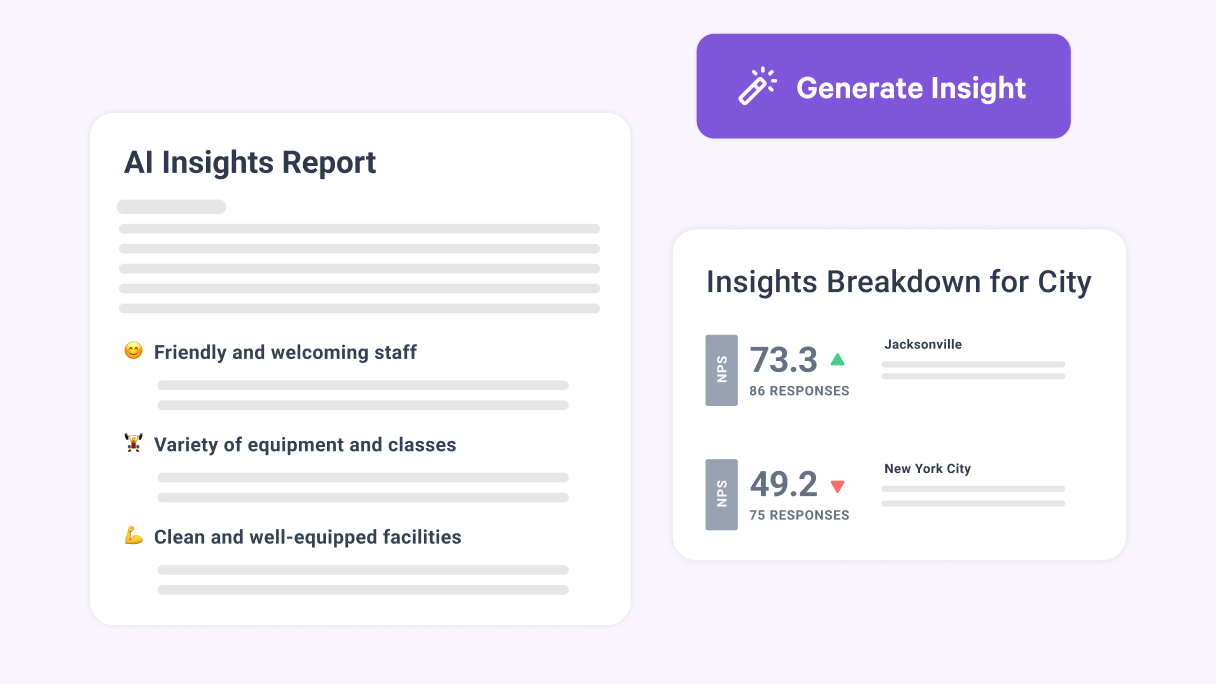
Future service journeys will move fluidly across in-person, phone, and digital channels, often within a single customer relationship. A customer might start with a text message, follow up by phone, and finish the interaction in person, and expect the business to remember all of it.
Unified context reduces friction on both sides. Customers spend less time repeating an explanation they've already given and teams spend less time working blind through a handoff, because the context travels with the customer instead of resetting at every channel switch.
Voice and conversational tools play a smaller but useful supporting role here. In support and field settings especially, they can reduce the time a team member spends searching for information mid-interaction, letting them stay focused on the customer instead of the system.
None of this works without trust. Customers will share feedback and personal context only when they trust how that data is used, stored, and acted on. A business that's vague about its data practices will get less honest, less useful feedback, and less of it.
The operational benefit of getting this right is concrete. Clear data practices and responsible use of AI reduce risk for the business, and they give teams the confidence to act on feedback without second-guessing whether they're using it appropriately.
CX stacks are evolving from disconnected tools into coordinated systems that support frontline execution. For years, a typical stack meant a CRM to store customer records, a support platform to handle tickets, an analytics tool to track scores, a reviews platform to manage reputation, and a separate feedback tool to run surveys. Each system did its job in isolation, and someone had to manually connect the dots between them.
The modern stack is action-driven and integration-focussed instead. Feedback flows directly into coaching conversations, recognition moments, and operational fixes, reaching the people who can act on it while the interaction is still recent enough to matter.
Feedback platforms occupy a specific position in the stack: between systems of record and systems of action. A CRM stores who the customer is and what happened historically. Support and operations tools are where teams actually do something in response. The feedback layer sits between them, turning what the CRM knows into something a frontline team can act on today.
In service businesses, this middle layer is the differentiator. It determines whether CX stays centralized, reviewed by a regional team, reported upward, acted on slowly, or becomes locally executable, reaching the manager and team who can respond immediately at the location where the feedback originated.
Closed-loop feedback, in one sentence: collect feedback, route it to the right owner, act on it, and confirm the outcome through follow-up.
This matters at scale in a way it doesn't for a single-location business. Without closed-loop execution, multi-location consistency breaks down. Some locations will happen to have a manager who reads every response and follows up diligently, while others won't, and the difference has nothing to do with the feedback itself. Customer loyalty ends up dependent on which manager a customer happens to deal with, rather than on a repeatable system the whole business can rely on. Closed-loop feedback is what turns individual diligence into organizational infrastructure.
AskNicely is award-winning CX management software, built to turn real-time customer feedback into daily frontline action, coaching, and recognition across every location a service business operates. Where legacy CX tools stop at reporting, AskNicely is built for the execution layer – the layer that decides whether a strategy on paper actually shows up in how a technician, a server, or a branch manager treats the next customer.
AskNicely captures real-time customer sentiment through conversational, AI-powered surveys that dig deeper than a standard rating and response, yielding richer feedback and higher response rates. NiceAI® then analyzes that feedback instantly, surfacing actionable insights at every level of the organization, from customer-facing teams to senior leadership, so managers can spot risks early and know exactly where to focus coaching without added admin or guesswork.
That visibility is built for the reality of multi-location businesses specifically. Insights reach everyone who needs them: head office, the branch manager, and the individual frontline employee delivering the service. Managers can see exactly where performance is strong and where it's slipping at the location level, so coaching and recognition go where they'll drive the biggest lift in service consistency, rather than being spread evenly across a team when only one or two behaviors actually need to change.
That's what closes the loop between customer feedback and daily frontline behavior, at every location, every shift, turning a CX strategy into something a team can actually act on.
If your business is managing CX across multiple locations and feeling the gap between strategy and frontline execution, we'd be glad to show you how AskNicely supports closed-loop action for frontline teams. Book a demo to see it in action.
Start by shortening the gap between when an issue happens and when someone finds out about it. Real-time feedback collected right after an interaction — rather than a delayed survey — gives managers a chance to intervene before a customer churns or leaves a public review. Automation helps close that gap, routing signals to the right owner the moment they appear instead of waiting for someone to notice. The payoff is real: customers are 2.4 times more likely to stay with a brand that solves their problems quickly.
The biggest barrier is that feedback and accountability sit at different levels of the organization. Insights get reviewed centrally, but the people who can act on them are at the location level, and the gap between the two is where consistency breaks down. Customer expectations don't vary by location even when service does: 90% of customers expect consistent experiences across channels, and disjointed interactions often lead to frustration and disengagement, and businesses that fail to integrate their channels keep only one-third of their customers on average. Without a system that routes feedback and customer data to the specific location and owner responsible, every site ends up solving the same problems independently, if at all.
Track retention, repeat purchase rate, and review sentiment alongside operational metrics like ticket volume and service recovery speed. The financial case is strong: a 5% increase in customer retention can boost profits by 25% to 95%, and 89% of customers are more likely to purchase again after a positive interaction. For a multi-location business, the clearest ROI signal is often location-level: comparing NPS or CSAT trends against churn and review volume at each site shows exactly where frontline coaching investment is paying off, and where operational fixes actually optimize the customer journey rather than just the metric.
No single department should own it end to end. Central teams, often marketing or a dedicated CX function, should set standards and maintain visibility across locations, while day-to-day ownership sits with local managers and frontline teams who can act immediately on customer needs as they surface. This mirrors how leading organizations are already treating frontline empowerment: 63% of frontline workers are concerned that they have failed to receive feedback that improves their performance, which points to a structural problem, feedback exists, but ownership for acting on it isn't clearly assigned at the level where it matters.
A modern platform needs to do more than collect and report on feedback. Look for real-time feedback collection across every touchpoint, automatic routing to the right location or team, closed-loop follow-up tracking, team-level performance data, and artificial intelligence that helps prioritize which issues need attention first. Increasingly, that means machine learning models that surface patterns a manager would otherwise have to find manually, plus generative AI that can summarize open-ended feedback into something a team can act on in seconds. A platform that stops at a dashboard leaves the hardest part, turning insight into daily frontline action, as manual work for already-stretched managers.
Early signals, like faster service recovery and fewer repeat complaints at a given location, typically show up within weeks once a closed-loop feedback process is in place, because the fix is immediate and local. Broader outcomes like reduced churn, stronger reviews, and higher repeat business take longer to materialize, generally a couple of quarters, since they depend on sustained consistency across many interactions and channels, including social media, where sentiment shows up publicly and fast. The compounding nature of good service supports the wait: customers who have a positive experience are more likely to share it, with 72% telling six or more people about it.
Feedback becomes actionable when it's tied to a specific team, routed to a named owner, and reviewed on a short, regular cadence rather than a quarterly report. AI-driven prioritization helps here too, flagging which responses need a human follow-up and which are routine enough for a contact center or conversational AI tool, like a chatbot, to handle first. That division of labor matters: the goal isn't replacing frontline judgment with automation, it's freeing people up to spend more time on the personalized experiences that actually build loyalty. Given that only 38% of consumers feel the employees they interact with understand their needs, connecting feedback directly to coaching moments remains one of the highest-leverage fixes a multi-location business can make.


