AI customer feedback tools: Top platforms & key benefits
Feedback is easy to collect. The hard part is knowing what to do with it.
Your team probably has plenty of survey results, reviews, support tickets, and social comments. It might be sitting in a dashboard somewhere, waiting for someone with time to dive into it all. Meanwhile, the customer experience continues unchanged, good and bad.
That gap between data and insights is what AI-powered feedback tools are built to close. They help spot trends, flag urgent issues, and give frontline teams the context they need to act fast.
The difference between the platforms is in what happens after the feedback comes in. Some go deep on analytics. Some ping you when things go sideways. And a few actually connect the dots between what customers feel and what your team does next.
We looked at the top artificial intelligence (AI) customer feedback platforms so you don't have to:
Your customer feedback comes in many forms, solicited and unsolicited. It comes from survey responses, app store reviews, support tickets, social comments, and other messy, unstructured forms that can be difficult to read manually at scale.
AI feedback tools can help you make sense of it all. Using natural language processing, they scan everything customers say, find the patterns, and surface what actually matters. They can even help users query their data and make more informed decisions.
Benefits of AI customer feedback tools
Understanding customer sentiment and acting on it faster than your competition, with the help of AI, can be a key differentiator that leads to a meaningful competitive advantage.
Catch at-risk customers before they walk: Sentiment shifts happen gradually. AI tools can help spot those patterns early, giving your team a chance to step in before a frustrated customer becomes a lost one.
Stop waiting weeks for answers: Manual analysis is slow. AI turns feedback into prioritized action items in real time, so your frontline team isn't working off last quarter's data when today's customers need help now.
Do more without hiring more: Intelligent workflows let your team deliver personalized follow-ups across thousands of interactions, without thousands of hours of manual work.
Build products customers actually want: When feedback from every touchpoint feeds into your roadmap, you can stop guessing. Your improvements are grounded in what real customers said, not what someone assumed they meant.
How to choose AI customer feedback tools
Collecting feedback can sometimes be the easier part of changing the customer experience. The real question is: what does the platform do with feedback?
Does it reach the right people instantly? Feedback that sits in a report helps no one. Look for tools that automatically route insights to the right team, location, or individual, so action happens at the moment it matters, not in the next monthly review.
Is it built for frontline teams? Analytics dashboards are useful for ops leaders. But the people actually delivering customer experiences need something simpler: clear guidance, coaching nudges, and recognition when they get it right. If your frontline team needs training just to use the tool, it's the wrong tool.
Does it capture feedback wherever customers talk? Customers give feedback on their terms across email, SMS, web, and social. Your platform should follow them there, and smart routing should make sure urgent responses land with whoever can actually fix the problem.
Will it surface problems before they become patterns? The best platforms don't just report what happened, they flag what's emerging. Trend detection and theme analysis should be automatic, not a manual exercise you run once a quarter.
Does it fit into how your team already works? A feedback tool that lives outside your existing workflows gets ignored. Look for deep integrations with your CRM, helpdesk, and messaging tools, so feedback becomes part of daily decisions, not a separate tab nobody opens.
Comparing the top AI customer feedback tools
The right AI customer feedback tool can help you capture customer sentiment at every touchpoint, turn it into clear actions, and build customer loyalty over time. Here’s a breakdown of some of the top AI survey tools, their features, use cases, pricing, pros and cons, and more:
AskNicely
Chattermill
Thematic
Siena
Sprig
unitQ
Products & features
NiceAI; multi-channel surveys; dashboards; case management; employee activation; review prompts
Three bundles; free plan available; contact for full pricing
Custom pricing by size, volume; quote after demo
Ideal customer
B2C multi-location services focused on frontline activation and earned growth
Mid-market/enterprise with large feedback volumes needing text analytics
Mid/large enterprises with ≥2k verbatims needing AI analysis
eCommerce/retail with high ticket volume needing AI support
SaaS product teams needing in-app insights with minimal engineering
Product-led companies needing real-time analysis and prioritization
Pros
Easy setup; automation; live alerts; team engagement; CRM integrations
Category leader; multi-language analysis; fast insights; anomaly detection
Time savings; accuracy; clear score analytics; easy dashboards; integrations
AI stability; post-purchase excellence; personalization; multi-channel
Quick setup; AI themes; real-time feedback; high volume scaling
Data unification; actionable insights; smart alerts; one-click RCA
Cons
Demo-only eval; annual contracts; response-based pricing; not for HIPAA
Enterprise pricing; training needed; overwhelming for small teams
Minimum data needs; $25k entry price
Limited industry focus; fewer analytics; variable costs; change required
Free plan limits; SDK integration needs; multiple bundles required
Complex setup; integration effort; excessive for low volume
What is AskNicely?
AskNicely is a customer experience platform built for service businesses that know feedback is only useful if they actually do something with it.
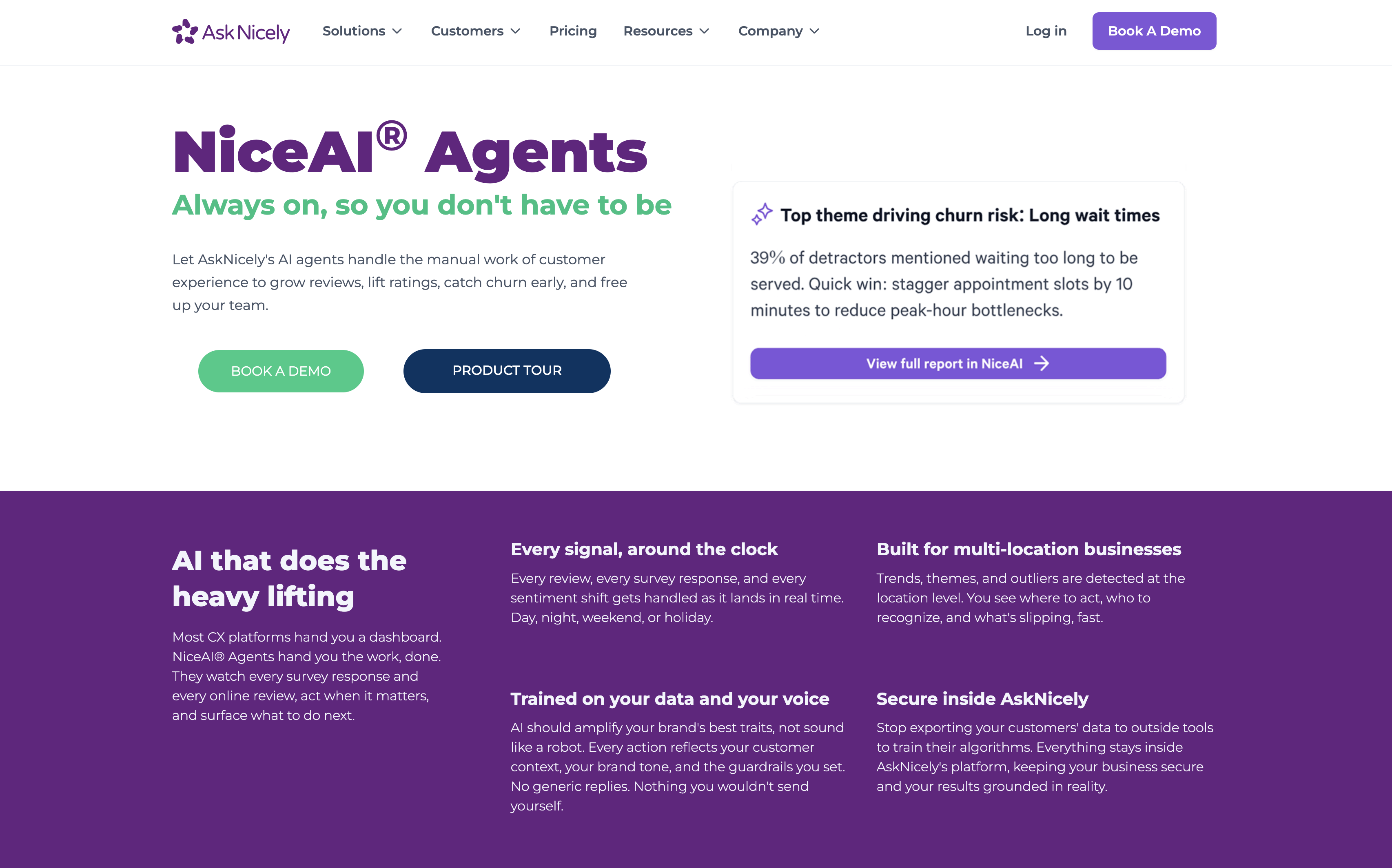
AskNicely integrated generative AI with NiceAI and Ask NiceAI® to help businesses get the most out of their data. It asks smarter questions, adapting in real time based on who the customer is and what they've experienced before. That means richer responses, more relevant context, and a clearer picture of what's actually happening on the ground.
When the feedback comes in, NiceAI condenses it into sharp, actionable summaries, so your team isn't wading through hundreds of responses to find the signal. Key trends surface automatically, and the insights land with the people who can act on them. Not just leadership. But the frontline teams deliver experiences every single day. Then they can use Ask NiceAI to query the data and insights to get to the depths of the feedback.
The result is a shorter gap between "a customer had a problem" and "we fixed it."
AskNicely - Key products and features
NiceAI: AI-powered assistant that revolutionizes feedback collection with dynamic questions that adapt in real-time based on customer data. Provides feedback summaries, sentiment analysis, and moderates offensive feedback by transforming it into constructive criticism.
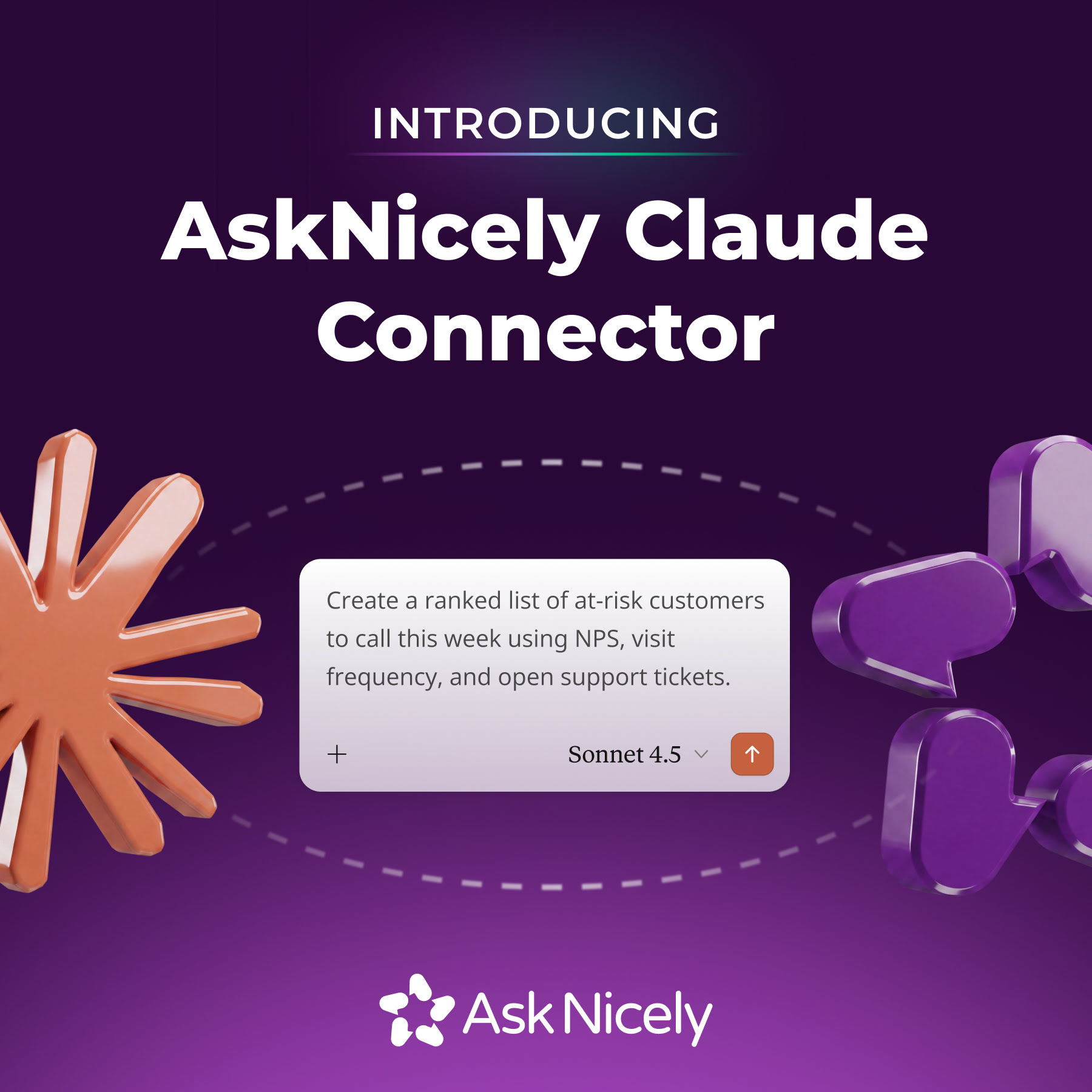
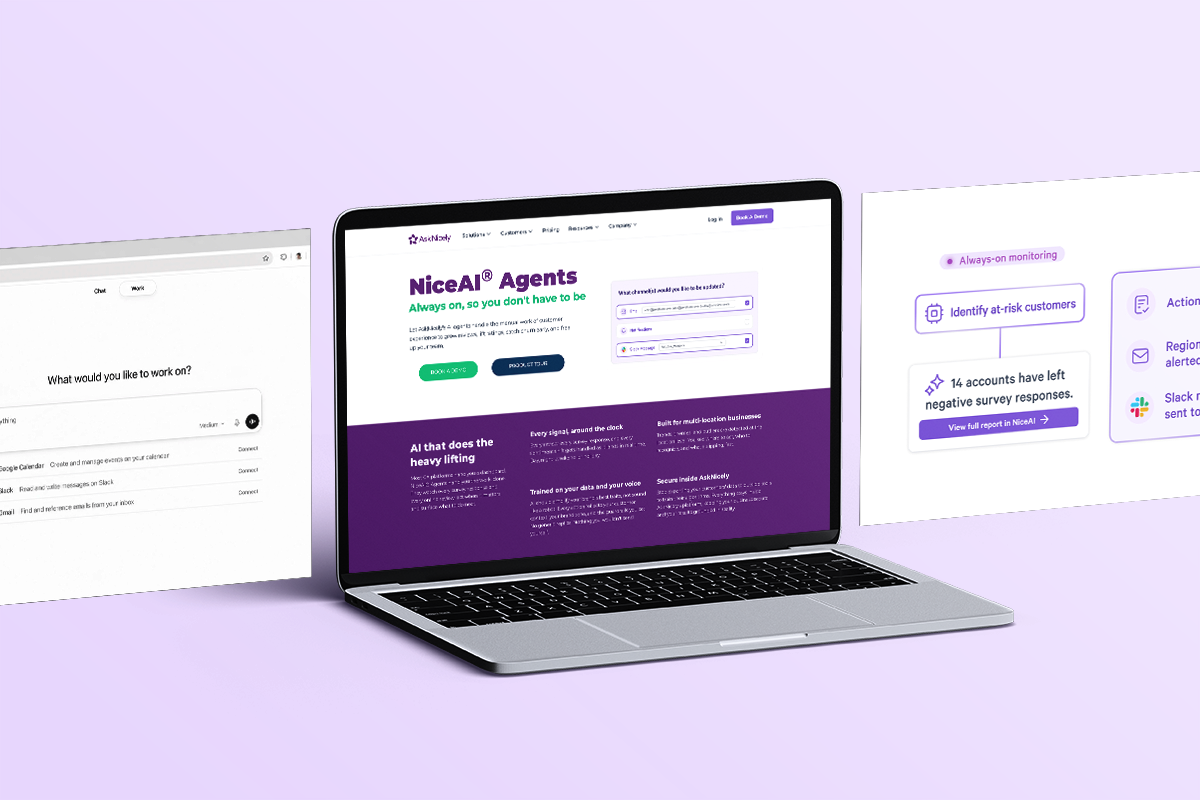
Ask NiceAI: This addition to our NiceAI features allows users to get even more out of their customer feedback and review data with an AI-powered chat feature embedded right in the product. AskNicely users can use Ask NiceAI to query their feedback, then watch as NiceAI analyzes surveys, reviews, and location data to surface insights, help guide action, and orchestrate AI agents. With Ask NiceAI, users can ask questions of their customer data in natural language and then instantly visualize trends, CX performance, and drivers of churn. Dynamic charts and on-the-fly analysis can help offer deeper insights and uncover unknown patterns.
Feedback analytics: Comprehensive analytics platform featuring AI text analysis with NLP to identify themes, real-time dashboards for tracking NPS/CSAT scores, and data segmentation tools. Includes performance leaderboards and presentation-ready reports for stakeholder communication.
Customer feedback management: Automated workflows for managing and responding to customer feedback with streamlined visibility and communication. Integrates with Slack and Intercom to enable direct responses and rapid issue resolution.
Employee activation: Frontline enablement tools, including personalized dashboards, report cards, and coaching playbooks that aggregate customer insights by topic. Features: AskNicely TV provides real-time performance displays, and a mobile app allows for access anywhere.
Multi-channel survey data collection: Flexible feedback collection across email, SMS, web embeds, mobile apps, and in-store kiosks. Includes survey builder with customizable templates, conversational styles, and QR code surveys for easy engagement.
AskNicely - Key use cases
Multi-location service consistency: Tracks performance metrics across regions and teams to ensure uniform service quality. Enables location-specific analysis and recommendations to standardize customer experiences.
Frontline team performance management: Connects customer feedback directly to individual employees through scorecards and coaching insights. Automates recognition and coaching based on feedback to improve service delivery.
Reputation and review management: Identifies happy customers and prompts them to leave positive customer reviews on Google and other platforms. Transforms satisfied customers into advocates while addressing negative feedback internally.
Customer issue resolution: Enables rapid response to grievances through automated workflows and real-time alerts. Routes feedback to appropriate team members and tracks resolution from receipt through completion.
CX performance measurement: Centralizes NPS, CSAT, and 5-star rating tracking with automated collection and analysis. Provides actionable insights that connect frontline performance to business outcomes, such as retention and revenue growth.
AskNicely pricing
AskNicely offers tiered plans that grow with organisational needs. All plans include core survey capability and automated workflows, while higher‑tier plans add advanced analytics, real‑time dashboards, integration options, review and testimonial generation, in‑app and white‑label surveys, API access, and frontline coaching tools. Pricing scales based on survey response volume and feature set, and plans are typically quoted through AskNicely’s sales team. A personalised demo is available to help organisations choose the right plan.
Who they're ideal for
AskNicely is ideal for B2C service businesses with multiple locations, particularly in healthcare, home services, education, finance, and franchise systems. The platform serves organizations that depend on frontline workers to deliver customer experiences, struggle with inconsistent service quality across teams, and want to turn feedback into action rather than just gather insights. Companies seeking to improve retention, reputation, and earned growth through customer experience improvements will find the most value.
Pros of AskNicely
Ease of use and implementation: Intuitive interface with customizable surveys makes gathering insights straightforward. CRM integration is smooth and requires minimal setup time.
Automation capabilities: Automatically imports customer information, sends surveys based on triggers, and provides automated response capabilities. Saves significant time compared to manual processes and ensures timely feedback collection.
Real-time feedback and alerts: Live updates and real-time alerts enable teams to address concerns swiftly. The platform allows direct replies to survey responses, creating opportunities to help customers with poor experiences immediately.
Team engagement features: TV screen display for live results creates motivation through performance visibility. Modernizes and simplifies traditional survey collection by keeping feedback live and constantly updating.
Cons of AskNicely
Demo-based evaluation: Rather than offering a free trial, AskNicely provides tailored demos and guided onboarding for teams to see the platform in action with relevant integrations before committing.
Response-based pricing: Pricing scales with the number of survey responses, making it easy for smaller teams to start affordably. Larger organizations should review projected volume to pick the right tier and avoid unexpected costs.
What customers are saying:
Big Blue Bug Solutions, a family-owned pest control business with nearly a century of roots in New England, needed to grow fast without losing the trust they'd spent generations building. Doubling in size in five years is ambitious. Doing it while keeping your customer experience intact? That's where most businesses stumble.
Before AskNicely, feedback came through a small call center running manual phone surveys. Slow, inconsistent, and not exactly built for scale.
After implementing AskNicely, everything changed:
Surveys go out automatically after every service visit
Feedback is analyzed and acted on within 24 hours
Detractors get a direct call — fast, personal service recovery that builds loyalty
Technicians receive curated feedback tied to performance incentives, driving healthy competition and better service
The results?
80 average NPS
20% survey response rate — with over 4,000 responses in 2024
"We're proud of how far we've come, and AskNicely has been instrumental in helping us drive customer impact and operational alignment. Exceptional customer experience is the glue that holds everything together for us."— Luis Marulanda, Chief Strategy Officer, Big Blue Bug Solutions
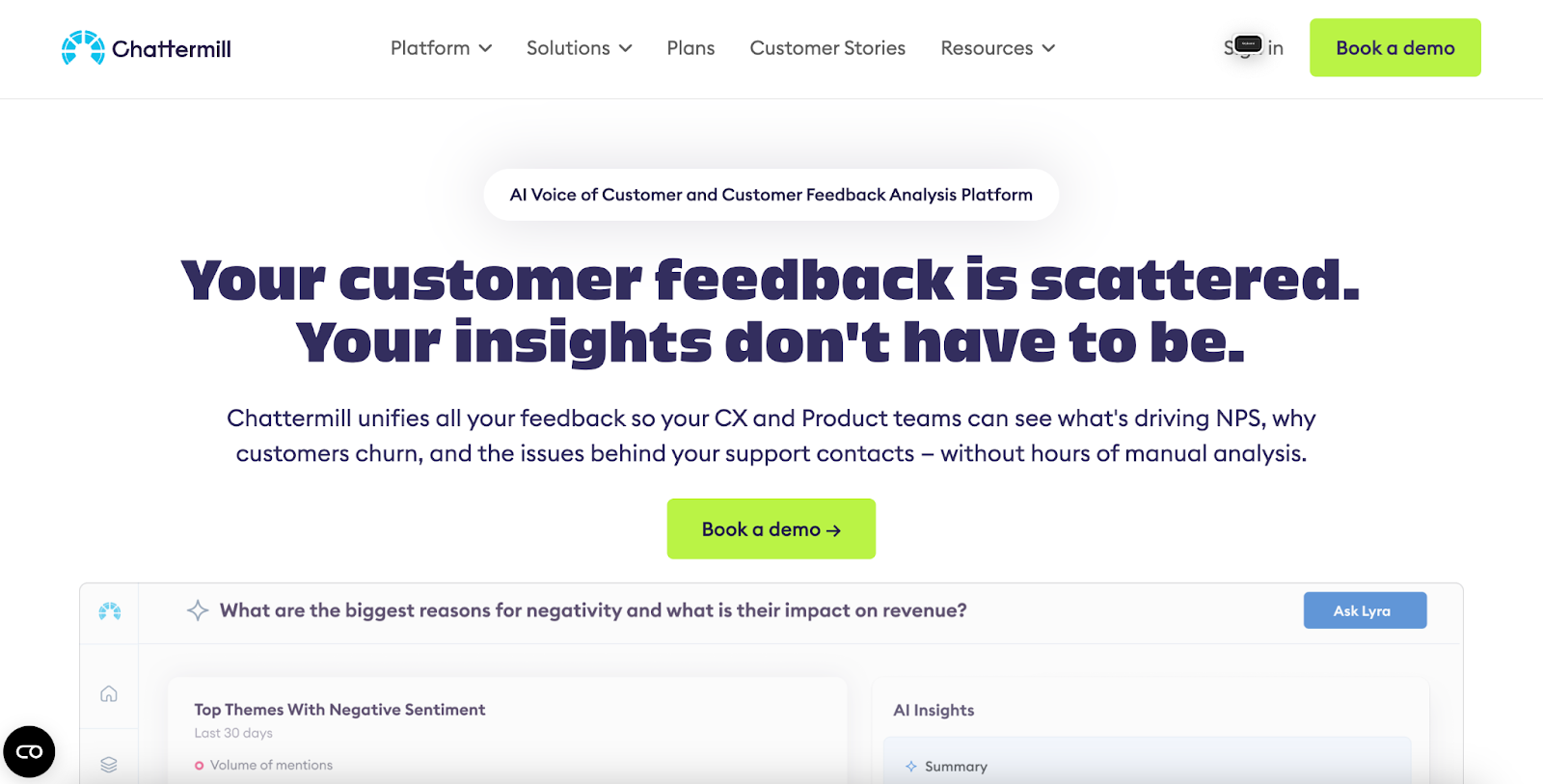
Chattermill is an AI-powered customer feedback analytics platform that unifies and analyzes feedback from multiple sources to deliver actionable insights. The platform uses machine learning and AI to automatically categorize, analyze, and surface insights from unstructured feedback data across surveys, reviews, support tickets, social media, and voice calls.
Chattermill - Key products and features
Customer feedback analytics platform: Unifies feedback from all sources and automatically analyzes large volumes of unstructured text to understand the voice of the customer. Uses machine learning models to categorize feedback and supports 100+ languages with automatic translation.
Lyra AI engine: Automatically analyzes unstructured text with high accuracy at scale. Leverages multiple LLM models, including GPT-4 to deliver precise, contextually intelligent customer insights from feedback.
Insight assistant: Uses GPT-powered technology to transform support tickets, chat conversations, and surveys into digestible summaries. Analyzes feedback 10x faster and helps prioritize customer concerns by identifying pressing issues and frequently mentioned phrases.
Automated alerts & anomaly detection: Provides real-time notifications when important events occur or anomalies are detected in feedback data. Catches potential issues early, such as safety incidents, supply shortages, or sentiment drops, before escalation.
Impact analysis: Tracks and analyzes drivers of changes in key metrics like NPS, CSAT, and sentiment scores. Enables teams to understand the "why" behind score changes and slice data by customer segments, verticals, or products in real-time.
Custom dashboards: Provides real-time, automatically updating dashboards customizable for different teams and use cases. Teams monitor trends, track changes over time, and export dashboards, ensuring organization-wide access to insights.
Chattermill - Key use cases
Automated feedback analysis: Eliminates manual tagging and categorization by automatically analyzing and organizing customer feedback from any source and language. Saves hundreds of hours previously spent copying feedback into spreadsheets and manually tagging conversations.
Product issue detection: Helps Product and Engineering teams identify bugs, product defects, and emerging issues faster through automated analysis. Teams prioritize feature development and roadmap decisions based on quantified user pain points and requested features.
Support data analysis: Analyzes unstructured text from support emails and chat conversations to identify contact reasons and reduce contact volume. Helps teams understand why customers reach out and improves self-help resources based on insights.
Metric driver analysis: Uncovers root causes behind changes in NPS, CSAT, retention, and churn metrics. Teams track underlying drivers of KPIs and understand what specific issues impact customer satisfaction and business metrics.
Cross-functional insight sharing: Enables CX, Product, Support, Operations, and Leadership teams to access relevant insights through customized views. Breaks down data silos and aligns teams around customer feedback with automated workflows and Slack integrations.
Chattermill pricing
Chattermill offers three plans, namely Pro, Team, and Enterprise, where the pricing is based on data source integrations and data credits, instead of the number of seats, allowing unlimited users for self-service access.
Who they're ideal for
Chattermill is ideal for enterprise and mid-market companies in retail & ecommerce, financial services, travel & hospitality, consumer subscription services, and utilities needing to analyze large volumes of customer feedback at scale. The platform serves teams across CX, Product, Engineering, Support, Operations, and Revenue functions requiring granular customer insights to drive strategic decisions and improve customer experience metrics.
Pros of Chattermill
Voice of customer excellence: Named 2025 Top Voice of Customer Platform with 4.5/5 stars from 77 reviews. Users value the platform's ability to capture and analyze customer voice effectively.
Strong user satisfaction: Maintains over 130+ five-star reviews across review platforms. High volume of positive ratings indicates consistent user satisfaction with platform capabilities.
Reliance on data volume: Works best for organizations with high volumes of customer feedback. Companies with smaller datasets may not fully realize the value of the platform.
What is Thematic?
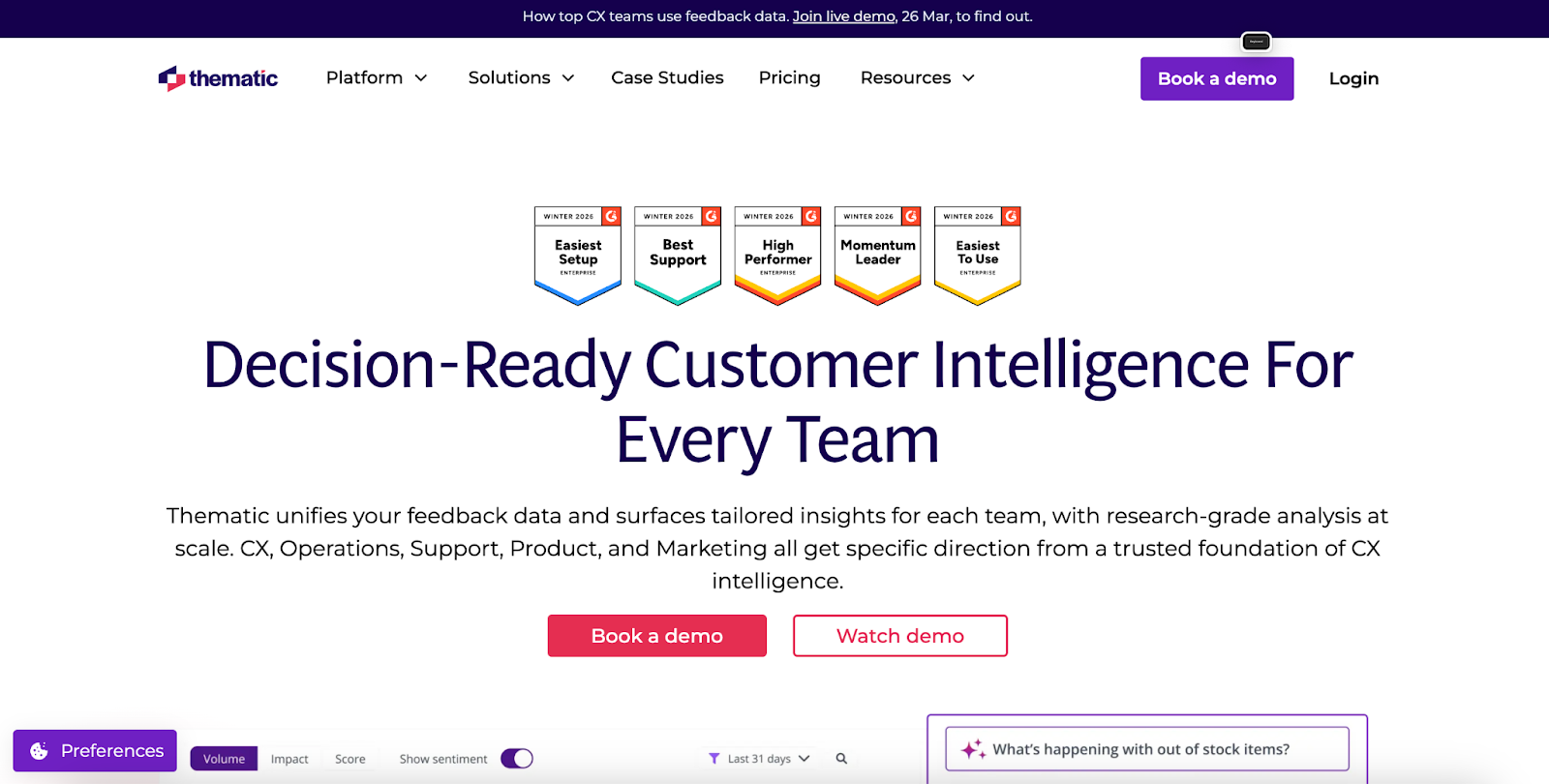
Thematic is an AI-powered feedback analytics platform that automatically transforms unstructured customer feedback into actionable insights. The platform specializes in analyzing text from surveys, reviews, support conversations, and other feedback channels to identify themes, sentiment, and trends without manual coding.
Thematic - Key products and features
AI-powered thematic analysis engine: Automatically identifies and categorizes themes and sub-themes from thousands of feedback comments in minutes. Uses self-supervised AI to discover patterns without pre-training, uncovering both known and unknown customer issues.
Theme editor: Provides human-in-the-loop control allowing users to review, refine, and merge AI-generated themes. Ensures accuracy while maintaining the speed of automated analysis and aligns taxonomies with business needs.
Thematic answers: Natural language interface allowing users to ask questions in plain English and receive detailed summaries with visualizations. Provides answers with source attribution and enables analysis across up to 10 datasets simultaneously.
Score change analysis: Uses waterfall charts to explain why metrics like NPS or CSAT changed over time. Identifies which themes drive score improvements or declines and quantifies their impact.
Personalized dashboards: Creates customizable dashboards with interactive graphs for different departments and teams. Provides high-level overviews and the ability to drill down into specific issues.
One-click integrations: Connects directly with platforms like Qualtrics, SurveyMonkey, Intercom, Reddit, and App Store reviews. Enables automatic data ingestion from multiple feedback sources without additional cost.
Thematic - Key use cases
Product feedback analysis: Identifies bugs, UX issues, and feature requests as they emerge in customer feedback. Teams monitor real-time feedback on new features and track post-launch issues to improve product development.
Customer experience optimization: Uncovers root causes of CX metric changes and identifies pain points before they cause churn. Platform helps prioritize issues by their impact on key metrics like NPS, ARR, and LTV.
Insights process automation: Eliminates manual coding of verbatims and reduces analysis time from weeks to hours. Research teams connect feedback across multiple sources and export coded data for further analysis.
Cross-channel feedback aggregation: Combines feedback from surveys, support chat, app reviews, social media, and community forums. Provides a complete view of the voice of the customer across all touchpoints.
Impact and ROI measurement: Quantifies how specific themes affect business metrics and validates hypotheses for growth experiments. Teams track the effectiveness of initiatives through trend analysis and benchmarking.
Thematic pricing
Foundation Plan: $25,000 per year
Up to 25,000 comments
Up to 3 datasets
Full platform access, including thematic and sentiment analysis, advanced analysis tools, dashboards, workflows, summarizer, Thematic Answers, and API/integrations
Thematic is ideal for mid-to-large enterprises with significant volumes of customer feedback needing to transform unstructured data into insights at scale. The platform serves insights analysts, researchers, product managers, and CX teams wanting to eliminate manual coding while maintaining control over analysis accuracy. Organizations building customer-led strategies and requiring SOC 2 Type II and GDPR compliance will find the platform particularly suitable.
Pros of Thematic
Exceptional customer support: Customer Success team is frequently praised for outstanding support and white-glove service. Team, led by a former customer, assists with theme curation.
Time savings: Reduces report generation time from weeks to one day for organization-wide reports. Transforms feedback at scale into insights faster than businesses make decisions.
Ease of use: Minimal training required with intuitive interface. The platform enables a meaningful understanding of unstructured data effectively and efficiently.
ROI and value delivery: Delivers 543% ROI in providing timely and quality insights. Users report it as "ultimate unlock" for understanding unstructured data meaningfully.
Cons of Thematic
Minimum data requirements: Works best with at least 2,000 rows of verbatim text, which may exclude smaller organizations. Threshold requirement limits accessibility for businesses with lower feedback volumes.
Pricing entry point: The Foundation plan starts at $25,000 per year, with a 25,000 comment limit. The pricing structure may be prohibitive for smaller companies or those just starting their feedback analysis journey.
Built for analysts, not frontline teams: Thematic is a powerful insights tool — but those insights don't easily reach the people who need them most. There's no mechanism to push feedback to frontline staff, coach in the moment, or close the loop at the point of service. If your goal is to change what happens on the ground, you'll need something more than a great dashboard.
What is Siena?
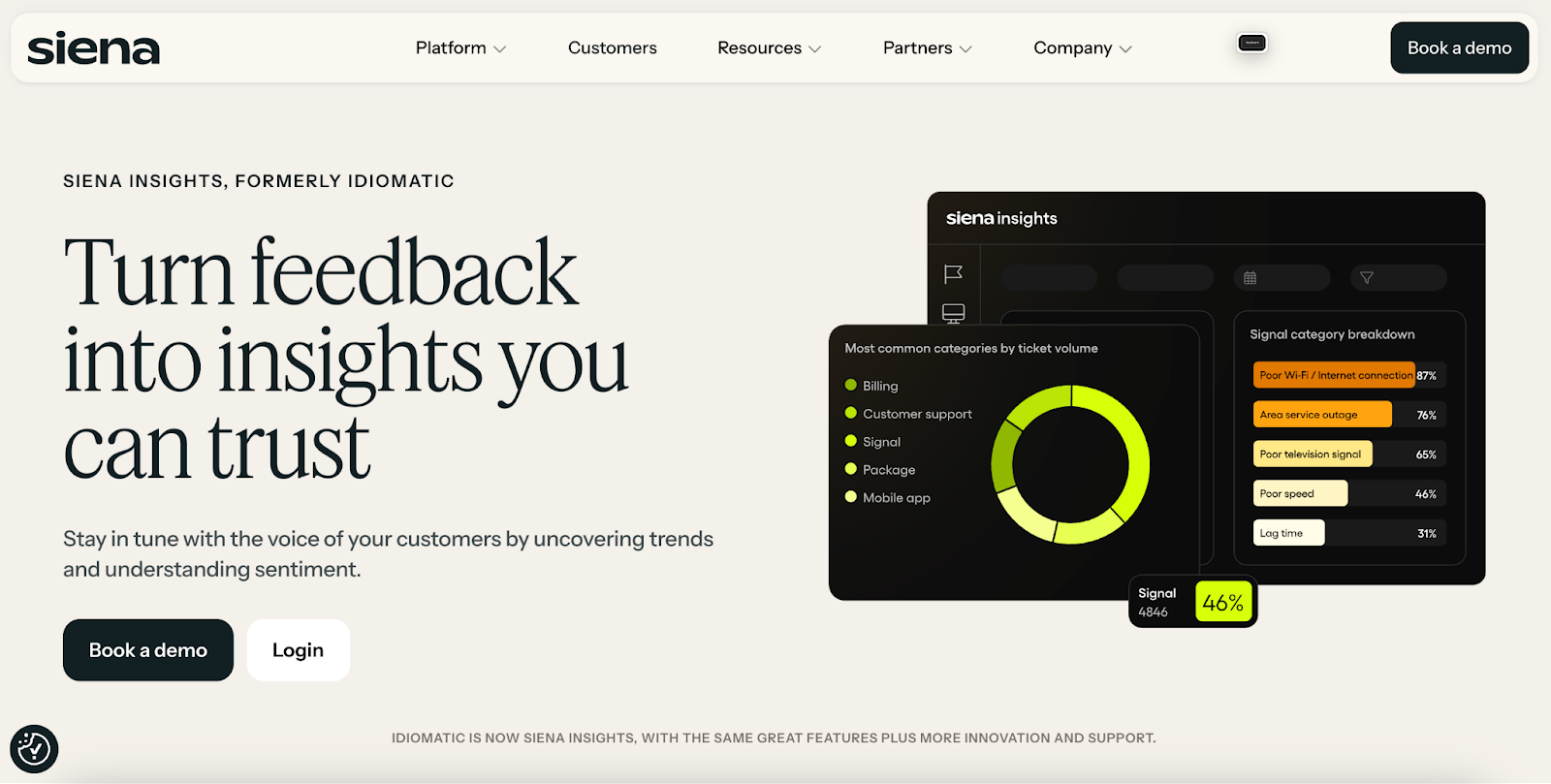
Siena is an AI-powered customer service platform providing autonomous agents for handling customer interactions across multiple channels. The platform specializes in eCommerce support with features for automated customer service, review management, and customer intelligence.
Siena - Key products and features
Customer service agent: AI agent built specifically for eCommerce, automating customer support conversations with consistent, on-brand responses. Handles complex post-purchase requests like order tracking, returns, and refunds seamlessly.
Reviews Agent: AI-powered review management system automatically moderating content, generating personalized review responses, and transforming reviews into customer intelligence. Analyzes reviews against brand guidelines and provides location-specific responses boosting SEO rankings.
Memory intelligence layer: System capturing and remembering customer details from every interaction, building 360° customer profiles. Designed to enable personalized future interactions by remembering preferences, feedback, and purchase history without requiring customers to repeat information.
AI-native architecture: Purpose-built AI designed from the ground up for customer support rather than as an add-on feature. Ensures stable performance at scale with predictable, policy-aligned interactions and transparent control mechanisms.
Siena - Key use cases
Automated review moderation: Automatically approves or flags reviews based on brand guidelines with 24/7 consistent protection. Eliminates manual review processes while maintaining brand standards and compliance.
Personalized customer support: Leverages customer history and preferences to provide context-aware responses across all touchpoints. System remembers past interactions, sizing preferences, and feedback to deliver tailored recommendations.
Social engagement and moderation: Manages social channel conversations by answering product questions and capturing buying intent. Converts community activity into eCommerce growth through automated engagement.
Subscription management: Simplifies how customers manage subscriptions with options to skip, pause, or swap products. Reduces cancellations while increasing order value through intelligent recommendations.
Siena pricing
Platform fee: $500/month for access to the core AI engine and unlimited sandbox
Automation pack: $0.90 per automated ticket
Support & implementation: Expert onboarding with dedicated Slack support included
Pricing based on ticket volume and team structure, with customized quotes available.
Who they're ideal for
Fast-growing e-commerce and retail brands needing to scale customer support efficiently while maintaining quality. Companies with high ticket volumes looking to automate routine inquiries while allowing human agents to focus on complex issues.
Pros of Siena
AI-native design: Built from the ground up as an AI-first platform, making it more stable and effective than add-on AI features in legacy systems.
Strong e-commerce focus: Specialized in post-purchase customer interactions like order tracking, refunds, and subscriptions, reducing manual agent workloads.
Personalized engagement: Memory Intelligence Layer enables truly personalized responses that improve over time by remembering customer preferences and history.
Multi-channel coverage: Automates responses across reviews, social channels, and direct support, helping brands deliver consistent experiences everywhere customers engage.
Requires cultural alignment: Shifting from human-first to AI-first customer service can be a significant adjustment for teams, requiring change management.
What is Sprig?
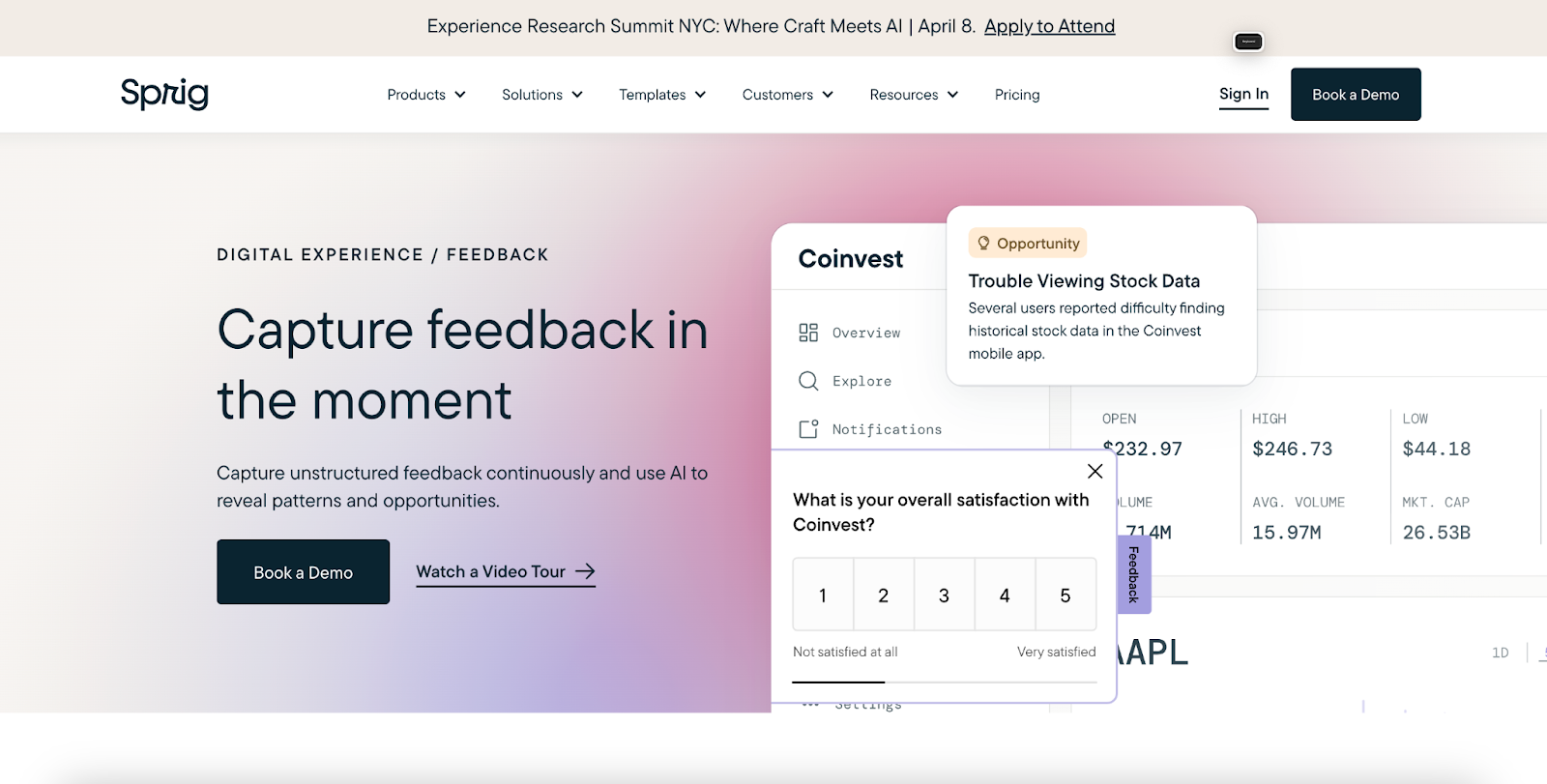
Sprig is an AI-powered customer feedback and user research platform helping teams capture, analyze, and act on user insights at scale. The platform combines surveys, feedback collection, and behavioral analytics with AI-driven analysis to help product teams understand customer experiences and make data-backed decisions.
Sprig - Key products and features
AI Insights: Automatically surfaces patterns and pain points from study results in real-time. AI clusters feedback and session data into clear themes, enabling teams to focus on analysis rather than manual sorting.
In-product surveys: No-code survey builder allowing teams to launch targeted surveys without developer support. Features precise targeting based on user attributes, behaviors, and events to capture feedback at the right moment.
Feedback buttons: Always-on feedback collection captures unstructured user input continuously. Includes AI-powered theme clustering, revealing patterns and opportunities from open-text responses.
Long-form surveys: Advanced multi-page surveys with features like skip logic, quotas, MaxDiff, and randomization. Shareable via links with zero developer setup required, designed as a modern alternative to legacy survey platforms.
Session replays: Visual recordings of user interactions within products, identifying friction points. Connects directly with feedback data, providing context behind user responses.
Heatmaps: Visual representation of user interactions showing where users click, move, and scroll. AI automatically analyzes heatmap data, surfacing actionable themes in user behavior.
Sprig - Key use cases
Uncover customer pain points: Launch targeted in-product surveys identifying specific areas where users experience difficulty. AI analyzes feedback themes to prioritize high-impact opportunities for improvement.
Measure customer satisfaction: Automatically track NPS and CSAT scores through always-on feedback mechanisms. Capture satisfaction metrics at scale directly within product experience.
Optimize conversion flows: Identify barriers causing user drop-off in conversion funnels. Combine behavioral data with user feedback to understand and address conversion obstacles.
Validate product features: Test new features by capturing real-time feedback as users interact with them. Get specific, contextual input guiding feature iterations and improvements.
Influence product roadmaps: Collect insights from power users about desired features and improvements. Use AI-analyzed feedback to prioritize development efforts based on user demand.
Research Core: Includes long-form surveys and AI insights
Digital Experience: Includes in-product surveys and feedback buttons
Digital Behavior: Includes session replays and heatmaps
Free plan with limited access available. The company offers the Starter plan for smaller teams. Customers can start with one bundle and expand to the full platform over time.
Who they're ideal for
Sprig is ideal for product teams, UX researchers, designers, and customer experience teams at technology companies needing to capture user insights at scale. Platform particularly suited for teams looking to replace legacy survey tools like Qualtrics or SurveyMonkey with modern, AI-powered alternatives requiring minimal engineering support.
Pros of Sprig
Easy setup and implementation: Users get the platform running quickly, with typically fast mobile app integration. No-code approach means teams launch studies without developer involvement after initial setup.
AI-powered analysis: AI capabilities automatically analyze feedback and surface themes, saving significant time on manual analysis. Teams focus on interpreting insights rather than sorting through raw data.
Real-time insights: Captures feedback at the moment of user interaction rather than relying on recall. Provides more accurate and contextual insights about user experiences.
Scalable feedback collection: Enables teams to gather hundreds of responses per week and achieve 3x more customer feedback. Platform handles high volumes of data efficiently.
Cons of Sprig
Limited free plan: Free plan offers restricted access to features, which may not be sufficient for comprehensive testing before committing to paid tiers.
Initial integration required: While the Research Core requires no setup, the Digital Experience and Digital Behavior bundles require lightweight SDK integration. Initial technical requirements may delay implementation for some teams.
Bundle limitations: Teams may need to purchase multiple packages to access all desired functionality. Could increase costs for teams wanting comprehensive capabilities.
What is unitQ?
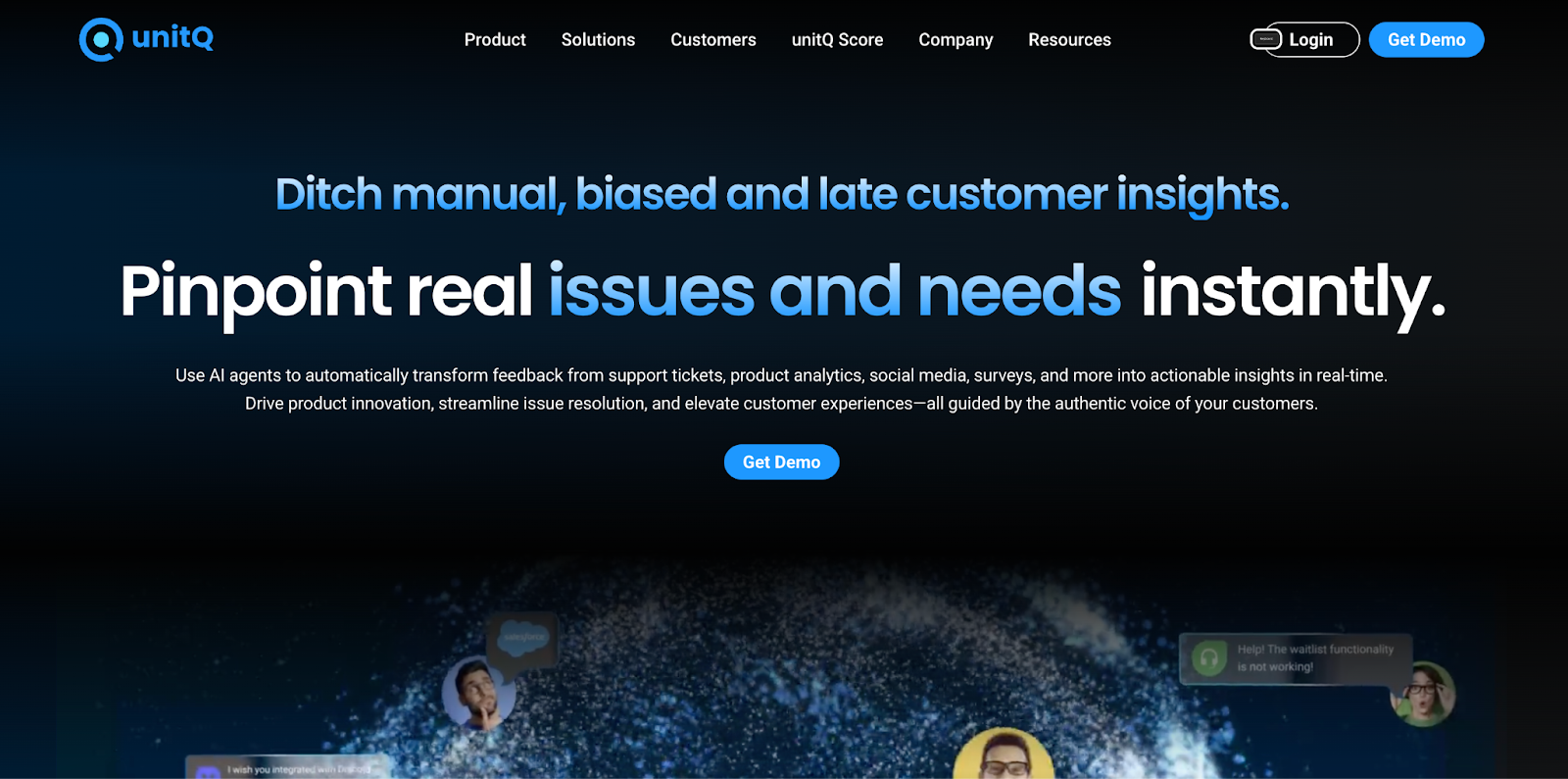
unitQ is an AI-powered customer feedback analysis platform that transforms siloed customer data into actionable insights in real-time. The platform combines AI agents with human supervision to help businesses understand customer sentiment across all touchpoints and improve their products, services, and customer experience.
unitQ - Key products and features
agentQ - Autonomous AI assistant: A conversational AI interface that answers business-critical questions by analyzing customer feedback and engagement data from all sources, providing actionable recommendations with citations for verification.
Real-time feedback aggregation: Centralizes customer feedback from support conversations, social media, app reviews, surveys, and user analytics to create a comprehensive view of customer sentiment across all touchpoints.
AI-powered categorization: Uses AI agents and natural language processing (NLP) to classify customer signals using a custom multi-tier taxonomy tailored to each business. Automatically assigns categories and writes them back to support or engineering tickets for skill-based routing.
Root cause analysis (RCA): Provides one-click root cause analysis of emerging pain points, identifying patterns among impacted users and generating steps to reproduce issues with affected environments and configurations.
Real-time alerts and monitoring: Sends automatic alerts to Slack, Microsoft Teams, or PagerDuty when feedback data spikes outside expected ranges. Machine learning accounts for seasonality to reduce false positives.
Impact analysis: Simulates how resolving customer issues improves key metrics like CSAT, NPS, and ARR to help teams prioritize fixes based on business impact.
unitQ - Key use cases
Issue monitoring & resolution: Reduces time-to-fix by detecting bugs through customer feedback before internal monitoring catches them. Creates automatic tickets and validates solutions through ongoing feedback monitoring.
Product development acceleration: Increases retention by providing customer insights combined with product analytics. Enables teams to research customer needs, prioritize launches, and monitor reactions to new features.
Support optimization: Reduces support tickets through proactive issue resolution and automated categorization. Provides comprehensive views across support data, chatbots, calls, and social media.
Customer journey analysis: Optimizes customer interactions by consolidating feedback channels and identifying friction points in real-time. Creates dashboards showcasing insights for different segments to drive targeted improvements.
Competitive analysis: Monitors competitor feedback from App Store reviews, Reddit, and review sites. Benchmarks products against competitors and identifies pain points in rival offerings.
unitQ pricing
unitQ offers custom pricing based on company size, data volume, and use cases. Pricing is typically structured around the number of feedback sources integrated, data volume processed, and level of support required. Mid-market and enterprise customers can expect custom quotes following a demo. Smaller businesses may find costs high relative to usage, as unitQ is primarily designed for companies with significant feedback data.
Who they're ideal for
unitQ excels for product-focused companies and enterprises making data-driven decisions based on customer feedback at scale. This includes businesses with complex products across multiple platforms, companies prioritizing customer experience and retention, and organizations reducing support costs while improving quality through proactive issue detection.
Pros of unitQ
Comprehensive data integration: unitQ pulls together feedback from support tickets, app reviews, social media, and surveys into a single unified dashboard, eliminating the need to check multiple platforms for customer insights.
Actionable AI-driven insights: The platform's AI agents provide specific recommendations rather than raw data. agentQ answers complex business questions and provides clear next steps with valuable insights.
Real-time alert system: Automated alerting helps teams stay ahead of emerging issues before they escalate. The system's ability to account for seasonality reduces alert fatigue.
Root cause analysis capabilities: One-click root cause analysis speeds up issue resolution by automatically identifying patterns and providing detailed technical information for engineering teams.
Cons of unitQ
Learning curve for advanced features: Fully leveraging unitQ's capabilities requires significant time investment to understand the platform's taxonomy system and customization options.
Integration complexity: Setting up integrations with existing tech stacks like Salesforce, Zendesk, HubSpot, or Intercom can be complex. Initial configuration of data sources and workflows may require technical expertise.
Scale requirements: The platform may be overkill for smaller companies with limited feedback volume. Organizations need sufficient data to benefit from AI-powered analytics and pattern detection.
The bottom line
Every platform on this list does something well. Chattermill goes deep on analytics, Thematic is built for researchers who live in data, Siena handles e-commerce support at scale, Sprig gives product teams real-time user insight and unitQ connects feedback to engineering priorities fast.
But there's a difference between understanding your customers and actually doing something about it.
Most of these tools are built to surface insights, and they do that well. What they don't do as well is close the loop. The feedback gets analyzed, the dashboard gets updated, and somewhere between the insight and the action, nothing changes for the customer standing in front of your frontline team right now.
That's the gap AskNicely is built for.
If your business runs on people delivering experiences — in person, in the field, across locations — then the tool that matters isn't the one with the best dashboard. It's the one that gets the right information to the right person fast enough to make a difference.
Feedback shouldn't end with a report. It should start a conversation, coach a team member, trigger a follow-up, and build the kind of experience that keeps customers coming back.