You probably already know that online reviews influence potential customers. But there's a newer, less visible audience reading every word your customers write about you, and it isn't human.
The AI models powering tools like ChatGPT, Claude, Gemini, Copilot, and Perplexity have been trained on vast pools of public web content, and that includes the reviews sitting right now on your Google Business profile, your Yelp page, and your G2 listing. When someone asks an AI assistant to recommend a service, suggest a software tool, or compare local businesses, the answer it gives has been shaped, at least in part, by what your customers wrote in those reviews.
This changes something fundamental about why reviews matter. For years, the advice was simple: get more of them, keep your star rating high, and respond to the bad ones. That still holds. But the stakes have quietly shifted. Your reviews are no longer just social proof for human browsers, they're signals that AI systems are reading, interpreting, and acting on, often before a potential customer ever reaches your website.
The businesses that understand this early will have a real advantage. Those that don't risk having their reputation quietly misrepresented, or worse, ignored entirely in an AI-mediated world where they never even get to make their case.
To understand why your reviews matter to AI, it helps to know a little about how these systems work, not at a technical level, but at a practical one.
Large language models like the ones powering ChatGPT or Gemini are trained on enormous datasets scraped from the public internet. That training process is where they develop their understanding of the world — including their understanding of businesses, brands, and industries. Review platforms are a significant part of that public web, which means the collective voice of your customers has almost certainly fed into how AI understands your business category, your competitors, and your brand directly.
But training data is only part of the story. Many AI tools now use a technique called Retrieval-Augmented Generation, or RAG, which allows them to pull in live or recent web content when generating a response. In plain terms: even if a model was trained before your most recent reviews were written, it may still be retrieving and referencing them in real time. Rather than a snapshot frozen in time, your review profile is a live feed that AI systems can tap into right now.
What AI reads in your reviews goes well beyond star ratings, too. These models are sophisticated readers of language and sentiment. They pick up on patterns — whether customers consistently mention long wait times, whether service language is warm or transactional, whether complaints are acknowledged or ignored. A cluster of reviews praising your onboarding but flagging your support team will register as a nuanced signal, not just a number. That's a more complex and more revealing picture of your business than a 4.2-star average tells.
Not long ago, the customer journey had a fairly predictable shape. Someone heard about your business, searched for it online, landed on your website, read a few reviews, and made a decision. You had touchpoints along the way, a chance to make an impression, answer objections, and tell your story.
As AskNicely CEO, Tony Ward points out:
“The buyer's journey has shifted. For years, being found online meant ranking on page one of Google. Savvy business operators obsessed over local SEO, map placements, and click-through rates. This isn’t to say those fundamentals have disappeared, but they aren’t the entire picture anymore, either.”
AI assistants are increasingly becoming the first stop, not Google. When someone types "best accountant for small businesses in Austin" or "most reliable CRM for a sales team of ten" into an AI tool, they often get a direct answer, a recommendation, a comparison, or a confident summary without ever clicking through to a website. The AI has already done the research on their behalf. Your website, your messaging, your carefully crafted value proposition: none of it factors in if the AI's answer doesn't include you.
This creates what marketers are starting to call a dark funnel problem. Customers are forming opinions about your business (and sometimes ruling you out entirely) through channels you can't see, can't track, and currently have very little ability to influence directly.
What you do have control over, however, is your public review record. That's the material AI is working from. A thin review profile, a run of outdated feedback, or a pattern of unresolved complaints isn't just a minor blemish on your Google listing anymore. It's potentially the basis on which an AI system forms and shares its view of your business to thousands of people asking the right question at the right moment.
The reputational stakes, in other words, have compounded. And most businesses haven't caught up to that yet.
If the response to all of this is "fine, we'll just go get more reviews," it's worth pausing on that instinct. Volume matters, but it's no longer the whole game, and in some cases, chasing numbers without attention to quality can actively work against you.
Recency is one of the clearest signals AI systems and review platforms weigh heavily. A business with 400 reviews, most of them three years old, presents a very different profile to a retrieval system than one with 80 reviews spread consistently across the last twelve months. Stale feedback suggests a stale business. It also raises a quiet question that AI and customers will draw their own conclusions about: why has no one said anything lately?
Specificity is another dimension that separates useful reviews from noise. A review that says "great service, would recommend" is nearly worthless as a signal. A review that says "the onboarding team walked us through setup over two calls, and we were fully up and running within a week" is rich with information — about your process, your people, your product, and your customer experience. AI models are better equipped to extract and represent that kind of detail. Generic praise blends into the background; specific, textured feedback stands out.
Authenticity is the third factor, and it's becoming harder to game. Platforms like Google and Yelp have long used filters to detect suspicious review patterns: sudden spikes, accounts with no history, clusters of similarly worded feedback. AI systems are developing similar sensitivities. Incentivised reviews, review gating (the practice of only directing happy customers to leave public feedback) and coordinated review campaigns all carry growing risks, both algorithmically and reputationally. If a pattern looks manufactured, it increasingly gets treated that way.
The implication for businesses is straightforward, if not always easy: the goal isn't more reviews, it's better ones. Authentic, recent, specific feedback from real customers is worth far more than a padded star count, and in an AI-mediated landscape, the difference between the two is becoming harder to hide.
Here's a pattern most businesses will recognize. A customer has a genuinely positive experience, they're satisfied, maybe even delighted. They mean to leave a review. Life gets in the way. They never do. Meanwhile, a customer who had a frustrating afternoon finds the time without any prompting at all.
Public reviews, by their nature, are a self-selected sample. The customers who show up there are disproportionately the ones at the emotional extremes – highly satisfied, or genuinely upset. The broad middle, the quietly happy majority who would recommend you to a friend but never think to post about it, is almost entirely absent from your public profile.
This means the picture AI builds of your business may be structurally skewed before a single fake review enters the equation. The customers who represent your everyday experience, your typical quality, your actual service standard, are leaving no trace in the places that matter most.
Real-time feedback tools close that gap. Platforms like AskNicely are designed to capture feedback systematically, at scale, from the full breadth of your customer base — not just the ones motivated enough to find your Google listing and write a paragraph unprompted. NPS surveys, CSAT scores, and post-interaction feedback requests reach the customers who would otherwise stay quiet. They surface the promoters who genuinely love what you do but have never been asked to say so publicly.
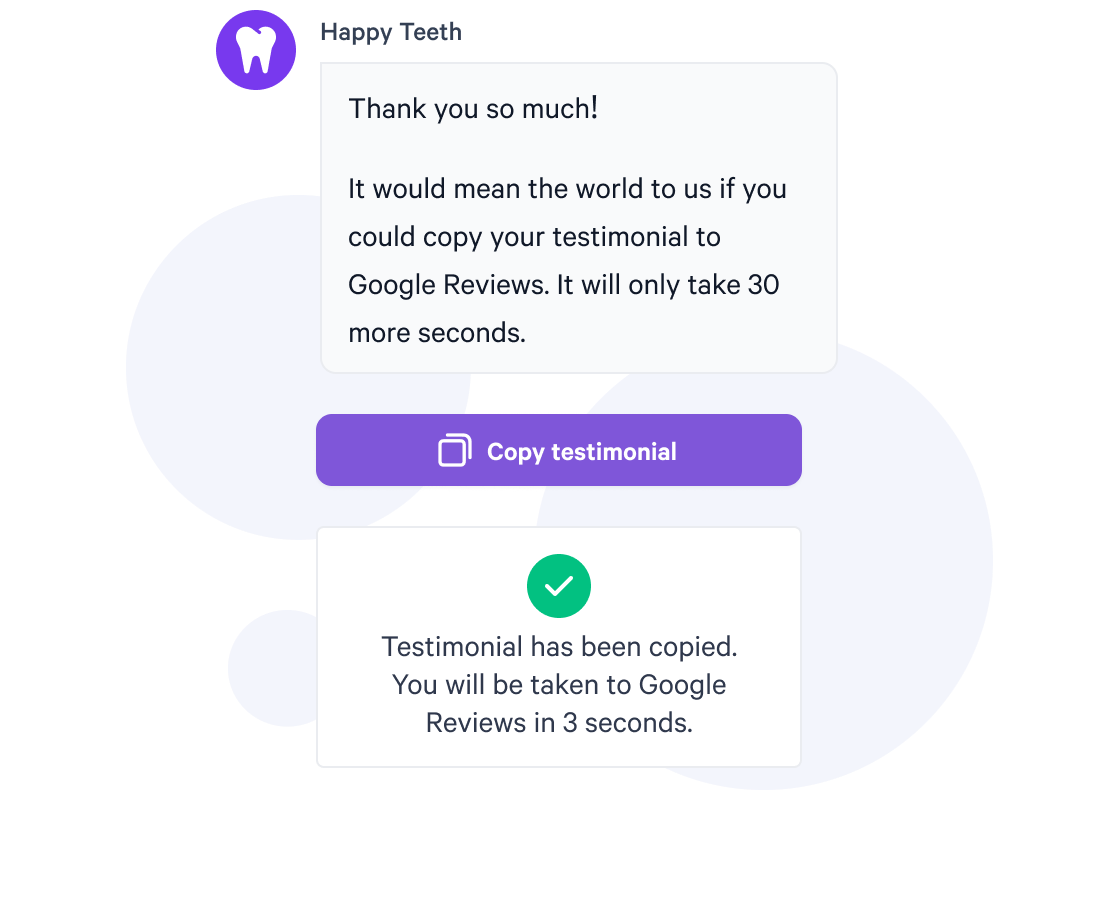
That's a resource most businesses are sitting on without realising it. The customers willing to leave a detailed, authentic, specific public review (exactly the kind that carries weight with AI systems) are already in your database. They've already told you, privately, that they're happy. The missing step is simply creating a clear, well-timed path from that private sentiment to a public record.
Bridging that gap makes the public picture of your business a more accurate one, and accuracy, increasingly, is what AI is optimised to reward.
There's a temptation, once you understand how much your review profile matters, to focus entirely on the collection side of the problem – asking more often, asking smarter, building a pipeline from happy customers to public feedback. That work is real and worth doing. But it rests on a foundation that has to come first: the experience itself.
No review strategy fixes a mediocre customer experience. And increasingly, attempts to paper over a weak experience with an aggressive review collection effort are self-defeating, because the customers who do respond will reflect what they actually felt, and AI systems are getting better at reading the gap between a polished star rating and what the underlying language is actually saying.
The businesses with the strongest review profiles aren't winning because they're better at asking. They're winning because they've built feedback loops that run all the way through the organisation, from the customer-facing moment back to the people and processes responsible for delivering it. Reviews are the output. The experience is the input. Improving the output without touching the input is a short-term fix at best.
This is where the real value of first-party feedback tools comes in — and it goes well beyond identifying promoters to nudge toward Google. Platforms like AskNicely are designed to capture feedback at the moment of experience, across every touchpoint in the customer journey, and route it to the people who can act on it. A frontline team that sees customer sentiment in real time, tied to specific interactions, can course-correct quickly. A leadership team that tracks NPS trends over time can identify systemic issues before they calcify into a pattern of public complaints.
That kind of inside-out improvement changes the nature of the reviews that follow. When customers feel genuinely heard, when a piece of feedback they shared privately leads to a visible change in how they're treated, their public advocacy becomes something different. It's not just satisfaction. It's trust. And trust, expressed in specific and authentic language by real customers, is exactly the signal that carries weight with both human readers and the AI systems learning from them.
The goal, in other words, isn't to manufacture a great review profile. It's to build an experience worth reviewing, and then make sure the people who've had it know that their voice matters. The reviews take care of themselves from there.
If the inside-out work is underway — if feedback is being collected systematically, routed to the right people, and actually changing how the experience is delivered, then the external piece becomes much more straightforward. You're not trying to spin a story. You're trying to make sure the story that already exists gets told loudly enough, and specifically enough, to register where it matters.
Tools like Perplexity, Claude, ChatGPT, and Gemini can actually help here: search your brand name and see what they say. Treat the result as a reputation audit. What AI tells a curious stranger about your business today is a reasonable proxy for what it will tell a prospective customer tomorrow.
The businesses that accumulate strong review profiles aren't doing anything magical. They ask, reliably, at the right moment. Post-purchase, post-onboarding, post-support interaction: these are the windows when customer sentiment is highest and the motivation to share it is most accessible. A well-timed, low-friction request dramatically outperforms a generic "please leave us a review" buried in a monthly newsletter.
NPS and CSAT surveys tell you which customers are already thinking positively about you. A promoter who gives you a 9 or 10 on an NPS survey and then receives a simple, personalised invitation to share that experience publicly is far more likely to follow through than a cold ask. You're not manufacturing enthusiasm, you're giving existing enthusiasm a place to go.
Prioritise quality signals over volume. Coach customers, gently, toward specificity. A review prompt that asks "what did we do that made the biggest difference for you?" will generate more useful responses than one that simply says "tell us about your experience." Or even better, take it to the next level with dynamic surveys that use AI to tailor questions to your customers’ responses as they share. If your customer shares that your team’s friendliness was the difference maker, for example, your survey could automatically say, “Thanks! Glad to hear our staff was friendly. Can you tell us something specific you loved?” Answers with context like that are what AI models crave.
Stay consistent over time. A spike of reviews followed by months of silence is a worse signal than a slower, steady stream. Whatever process you build, build it to run continuously, because recency is one of the factors you can control most directly, and it's one that compounds in your favour the longer you maintain it.
The line between "customer feedback" and "AI training data" has effectively disappeared. Every review your customers leave in public is now doing double duty; influencing the humans who read it directly, and shaping the AI systems that will summarise, recommend, and rank businesses for the next generation of buyers.
But the businesses that will come out ahead in that world are the ones who recognise that the fundamentals haven't changed, they've just raised the stakes. Listen to your customers. Fix what they tell you. Make the experience genuinely worth talking about. Then make it easy for them to talk about it.
Do that consistently, and your review profile stops being something you manage and starts being something that builds itself, a compounding record of real experiences, told in specific and authentic language, that both humans and AI systems are optimised to trust and reward.
Your customers already have opinions about you. The question is whether those opinions are making it into the record accurately, specifically, and consistently enough to tell the story your business actually deserves. In a world where AI is increasingly the first thing a potential customer consults, that record is your visibility.
That's exactly the problem AskNicely is built to solve. From capturing real-time feedback at every touchpoint, to identifying your happiest customers, to creating a clear path from private satisfaction to public advocacy — AskNicely gives you the infrastructure to turn your customer experience into your most powerful marketing asset. Not by manufacturing a better story, but by making sure the true one gets told.
Curious? Book a demo here.