Google reviews can make or break a local service business. A competitor with a 4.5-star average and 200 online reviews will outrank you and out-convert you, even if your service is objectively better. Yet most businesses leave their review strategy to chance: a verbal ask here, a follow-up email there, and crossing their fingers.
Based on what we've seen working across hundreds of service businesses, here's how to build a consistent, scalable review program that compounds over time.
The 16 strategies at a glance:
Before diving into tactics, it's worth understanding the dynamics at play, because the data has shifted meaningfully in the last few years.
73% of consumers only trust reviews written in the last 30 days, and 83% say recency is a prerequisite for trusting a business at all. That single finding changes everything about how review strategy should be structured. It's not enough to have 500 reviews if 490 of them are from 18 months ago.
Review recency also directly affects your local Google search rankings. A business with fewer total reviews but a consistent flow of new ones will often outrank a competitor with a larger but stagnant review count. Local SEO research consistently shows that review velocity — the pace at which you receive new customer reviews — is a more powerful signal than raw volume.
Additional data points to consider:
Schweiger Dermatology Group is one of the largest dermatology practices in the Northeast with 90+ offices across New York, New Jersey, Pennsylvania, and Connecticut, over 250 patient providers, and more than one million patient visits per year.
The challenge: As Schweiger grew, maintaining a consistent patient experience across hundreds of providers became increasingly difficult. Julie Gessin, Chief Operating Officer, recognized that great medical training alone wasn't enough. Patients expected an excellent experience on top of excellent care, and whether a review was one star or five stars depended heavily on how well-coached and empowered each provider felt. Before AskNicely, Schweiger relied on SurveyMonkey and third-party review sites — a fragmented approach that made it impossible to spot trends, coach providers in real time, or start acting on feedback before it became a public complaint.
What they did: Schweiger implemented AskNicely's CX platform to collect post-visit NPS feedback at scale and feed it directly back to providers in real time. They shared positive feedback company-wide to celebrate and reinforce the right behaviors. Patient experience scores became a fixture in weekly manager meetings, with real-life examples from patient feedback used to coach the team. Crucially, satisfied patients were routed to leaving public Google reviews, while less satisfied ones were flagged to the team so they could recover the relationship before it went public.
The results:
Beyond reviews, businesses that reach this level of feedback maturity use AskNicely to actively coach frontline teams and see compounding returns. AskNicely's 2022 State of Frontline Survey found that service brands at this stage achieve 64% greater revenue improvement, 60% greater employee efficiency improvement, and 133% greater customer satisfaction improvement compared to those without a structured feedback program.
As Gessin puts it: "Your feedback is only as good as your ability to act on it."
The lesson: The 3x increase in reviews wasn't the result of bombarding patients with review requests. It was the downstream outcome of a system that improved the experience, recognized providers who delivered it well, and made it easy for happy patients to tell the world. Reviews became a lagging indicator of a culture that had genuinely changed.
Timing is the single biggest lever in review conversion rates. The best moment to request reviews is immediately after a positive interaction, when the experience is fresh, the customer's goodwill is highest, and they haven't yet been distracted by the rest of their day.
For appointment-based or field service businesses (both large and small businesses), this means automating post-visit requests to go out within hours of job completion. The longer you wait, the lower the conversion rate.
What this looks like in practice: A plumbing company sends an SMS review request automatically when a technician marks a job as complete in their CRM. The customer receives a message while they're still thinking about how smoothly the job went.
This is where the strategy becomes meaningfully more sophisticated, and where AskNicely customers see disproportionate results.
Rather than blasting every customer with a review request (more on why that's dangerous in the mistakes section below), best-practice automation works like this:
This approach does two things simultaneously: it increases the volume of positive public reviews while protecting your brand from negative reviews appearing on Google before your team has had a chance to resolve the issue.
The timing of that follow-up to promoters matters, too. Asking within 24 hours of a positive NPS response consistently outperforms requests sent at 48 or 72 hours.
Given that 73% of consumers only trust reviews from the last 30 days, a strategy built on occasional bursts of review activity is structurally flawed.
Think of your review flow the way you'd think about your social media presence: a week with no posts hurts, but a week with thirty posts followed by silence hurts more because it creates an unnatural pattern that both consumers and Google's algorithm notice.
The target: At least a handful of new reviews per week regularly. Businesses that achieve this compound their advantages over time; competitors who batch reviews in quarterly pushes are perpetually playing catch-up on recency.
This is one of the strongest arguments for automation. Manual review request campaigns create bursts of reviews. Automated, event-triggered requests tied to transactions produce the consistent cadence that sustains rankings.
Every extra step between a satisfied customer and a published review costs you conversions. The review request should include a direct link that takes the customer straight to the review compose screen, not your Google Business Profile homepage.
Tactics that reduce friction:
If a customer has to search for your business on Google to leave a review, you've already lost most of them.
Three table-stakes items that underpin everything else:
Complete your profile: Business name, address, phone number, hours, and category should all be accurate and consistent with your website and other directories. Inconsistencies erode local SEO trust and create friction for customers trying to leave reviews. Ensure your Google account is set up with Google Maps, Google Ads, and a working Google review link.
Choose the right category: Your primary category significantly affects which searches Google matches you to. Take time to research which category your highest-ranking local competitors use.
Add quality photos: Profiles with photos receive substantially more clicks and engagement than those without. Regular photo updates also signal to Google that your profile is actively maintained.
These aren't exciting tactics, but they are prerequisites. A review strategy built on a poorly optimized profile is like driving with the handbrake on.
Telling your customer-facing teams to "Ask your customers for reviews" is not training. Instead, you should train your staff on exactly what to say, when to say it, and how to make the ask feel natural rather than transactional.
Sample verbal script for a service completion:
"I'm really glad everything went well today. If you have a minute, an honest Google review makes a huge difference for us — it helps other people in [city] find us when they need [service type]. I'll send you a quick link. It only takes about 90 seconds."
Key principles for the verbal ask:
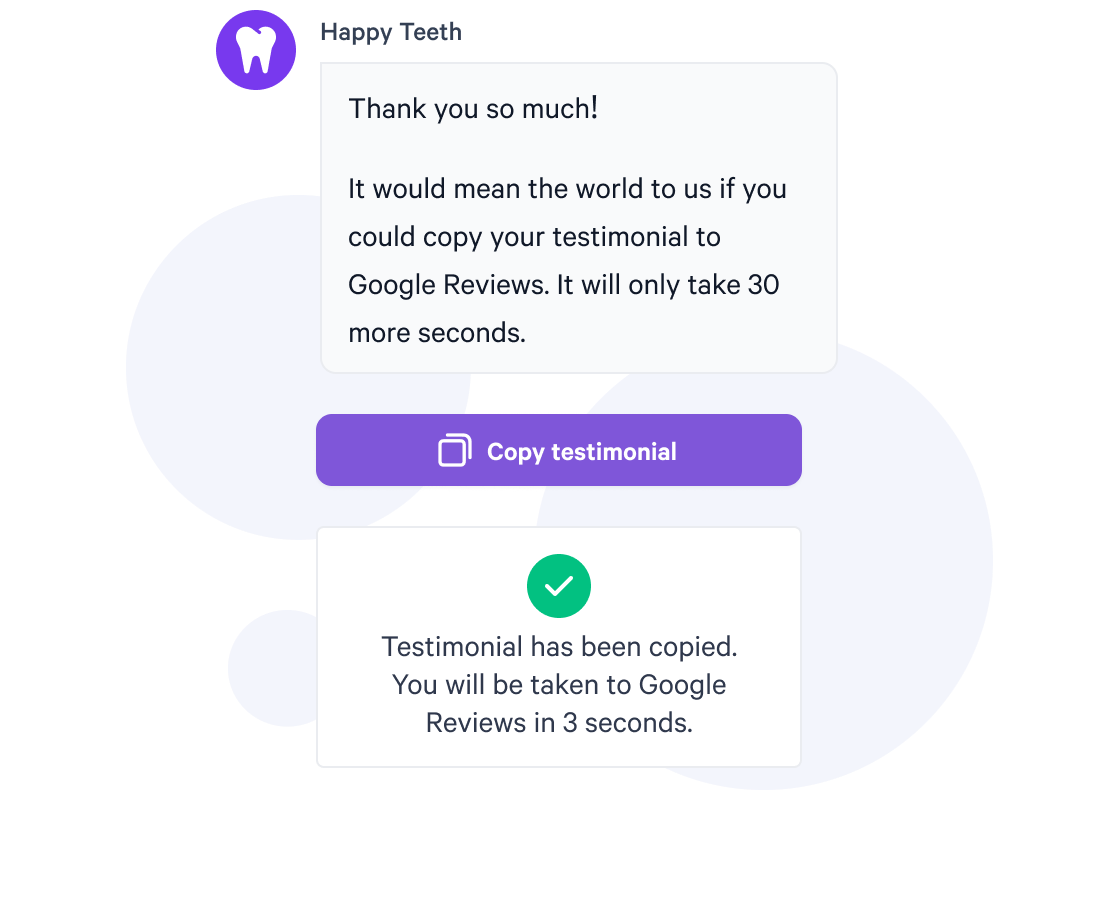
Train staff to use AskNicely review request:
With the Review Request feature, you can leverage positive customer feedback in real time, ensuring your happy customers share their positive experiences with the world.
Here’s how it works:
Every outbound email from your team is a low-effort touchpoint. A simple CTA in the email signature — "Happy with our service? Leave us a Google review [link]" — puts the ask in front of customers who are already engaged without requiring any additional effort.
Similarly, service invoices and receipts (both digital and paper) should include a review link or QR code. The customer is reviewing your work mentally at that moment anyway; make it easy to turn that thought into a public review.
Don't let great reviews sit unseen. Sharing customer reviews on social media, your website, and email newsletters serves two purposes: it builds trust with prospects who haven't used you yet, and it signals to existing customers that reviews don’t go unnoticed and are valued, making them more likely to write one.
Practically: Screenshot a strong review, design a simple graphic around it, and share it on Instagram, LinkedIn, or Facebook. Tag the reviewer if they're comfortable with it. A "Review of the Week" series creates ongoing content and a positive feedback loop.
Managing review requests manually at any kind of scale, across multiple locations, multiple staff members, and hundreds of weekly transactions, is essentially impossible to do consistently. Reputation management software (including AskNicely) handles:
The ROI tends to be straightforward: more consistent review flow, higher average ratings, and less time spent manually chasing feedback.
Anything that doesn't get measured doesn't get managed. If review volume, average rating, and review recency aren't on your team's dashboard (alongside revenue, NPS, and customer retention) they'll always be deprioritized.
Specific metrics worth tracking:
The last metric is particularly useful for diagnosing problems. A low conversion rate usually points to one of three issues: poor timing, too much friction, or the wrong customers being asked.
Google's policies on review incentivisation are clear: you cannot offer rewards in exchange for positive reviews. This means no "leave us a 5-star review and get 10% off your next service." This violates Google's terms and, if detected, can result in reviews being removed or your profile being penalized. You should avoid fake reviews at all costs.
What you can do:
The ethical line: Any incentive must be decoupled from the valence of the review. You're rewarding the act of leaving feedback, not the content of it.
Consumers expect businesses to respond to their reviews. A business with 200 reviews and no responses looks unengaged; a business with 50 reviews and thoughtful responses to each one looks customer-obsessed.
For positive reviews: Don't use copy-paste responses. Mention something specific from the review. "Thanks for the kind words, Maria — really glad the technician could fit you in on short notice!" takes 15 extra seconds and signals genuine attention.
For negative reviews: Resist defensiveness. The audience for your response isn't the reviewer; it's the thousands of future customers reading it. A calm, professional, solution-oriented response to a 1-star review can actually increase conversion — it demonstrates that you handle problems well.
Template for responding to a negative review:
"Hi [Name], thank you for sharing this feedback. I'm sorry your experience didn't reflect the standard we hold ourselves to. I'd really like to understand what happened and make it right — please reach out to [contact] directly, and I'll personally make sure we sort this out."
Short, non-defensive, solution-oriented, and it takes the conversation private.
Not all reviews tell you the same thing, and treating them as a single undifferentiated pile means missing the signal inside the noise. Segmenting reviews by location, service type, staff member, or time period can reveal patterns that would otherwise stay hidden, a particular location consistently underperforming, a specific service generating disproportionate complaints, or a new team member who's quietly becoming your best source of 5-star feedback.
This kind of analysis is especially valuable for multi-location businesses. A 4.3-star average across 20 locations might mask one location sitting at 3.6, dragging the others down, a problem that's invisible at the aggregate level but obvious once you segment.
Practically, build a habit of reviewing your feedback data by segment at least monthly. If you're using a platform like AskNicely, this view is built in. If you're doing it manually, export your reviews periodically and tag them by the relevant categories for your business.
The fastest way to convert a borderline experience into a positive review is to address the customer's concern before they leave, or within hours of their leaving. Frontline staff who receive real-time feedback and have the authority to act on it can recover a situation that would otherwise become a 2-star review.
This requires two things most businesses don't invest in together: the right data reaching the right people quickly, and frontline staff who feel empowered (not just obligated) to respond. The Schweiger model is instructive here — providers received patient sentiment directly on their devices, not filtered through a manager a week later. That immediacy changed how providers thought about every interaction.
For businesses without a formal NPS system, a simpler version works: brief your frontline team before every shift on any unresolved feedback from the previous day, and give them a clear script for following up with customers who expressed dissatisfaction.
Your website and any customer-facing portals are already places where satisfied customers spend time checking job status, viewing invoices, and accessing business information. Embedding a review prompt in these environments catches customers at a moment of active engagement with your brand, when their experience is front of mind.
Practically, this might look like a banner on the post-service summary page ("Happy with how it went? Tell others →"), a prompt in the invoice confirmation email, or a persistent widget in the customer portal sidebar. The goal is to meet customers where they already are rather than relying solely on outbound requests.
This channel often has higher conversion rates than cold outbound SMS or email because the customer is already logged in, already engaged, and the ask feels like a natural extension of the interaction rather than an interruption.
Every tip in this guide assumes a baseline: your service is good enough that customers want to tell people about it. If the underlying experience is mediocre, no amount of review automation will build a sustainable reputation. It will produce a temporarily inflated rating and a steady stream of negative reviews that offset the positive ones.
The most effective review strategy is a continuous investment in customer experience: collecting internal feedback systematically, sharing it with frontline teams in real time, and building a culture where every interaction is treated as an opportunity to earn a recommendation.
Schweiger Dermatology's results weren't just about sending automated messages after appointments. Each provider received real-time patient sentiment directly on their phones and iPads, seeing exactly what they were doing well and where they could improve, day by day. Patient experience scores ran on TV dashboards in offices. Team meetings were built around real examples from patient feedback. "Your feedback is only as good as your ability to act on it," Gessin says — and the reviews tripled as a result. They were a byproduct of a culture of continuous improvement, not a campaign.
If you're not filtering by NPS score or satisfaction indicator before sending review requests, some percentage of your unhappy customers are receiving an invitation to share their bad reviews with the world. This is one of the most avoidable own-goals in reputation management.
Batching requests rather than maintaining cadence. A campaign that generates 50 reviews in a week, followed by silence, creates an unnatural pattern and does nothing for your recency signals. Worse, it looks suspicious to Google's algorithm and may trigger review filtering.
As noted above, offering rewards in exchange for positive reviews violates Google's policies. Businesses that do this can have reviews removed in bulk, wiping out months of effort overnight.
Ignoring negative reviews. Unanswered negative reviews are more damaging than the reviews themselves. Every unanswered complaint is a signal to future customers that you don't listen or care.
A review request sent three weeks after service — when the experience has faded, the customer has moved on, and your brand is no longer top of mind — has a fraction of the conversion rate of one sent within 24 hours. If your process relies on staff manually remembering to follow up, requests will consistently go out too late.
A review request that reads as a mass email gets treated like one. Personalized requests (using the customer's name, referencing the specific service, acknowledging the technician or advisor they worked with) convert at meaningfully higher rates.
Hi [First Name], thanks again for choosing [Business Name] today. If you have 90 seconds, we'd really appreciate an honest review on Google — it helps other [city] residents find us when they need [service type]. Here's a direct link: [Review Link]. Thanks so much, [Staff Name]
Subject: How was your experience with [Business Name]?
Hi [First Name],
Thanks for the kind words on our recent survey — really glad to hear [reference specific service/detail if available].
If you'd be willing to share that experience on Google, it makes a real difference. It takes about two minutes and helps us continue doing what we love. Here's a direct link: [Review Link]
Thanks so much, [Name], [Title] [Business Name]
"I'm really glad everything went smoothly today. If you ever have a spare minute, an honest Google review genuinely helps people in [neighborhood/city] find us when they need [service type]. I'll shoot you a quick link — it only takes about 90 seconds. Thanks so much for trusting us."
Getting a single review is easy. Getting 20 new reviews every week, consistently, across multiple locations, from the right customers at the right moment — that requires infrastructure.
AskNicely's Review Request feature connects directly to your Google Business Profile and automates the entire workflow: post-service NPS survey, smart routing based on satisfaction score, personalized review request to promoters, and real-time alerts when new reviews go live so your team can respond quickly.
The results speak for themselves. Schweiger Dermatology Group used this exact approach to achieve a 3x increase in Google reviews across 90+ locations, maintaining a 4.5-star average at scale.
If you're manually managing review requests today, or not managing them at all, the gap between where you are and where a well-run competitor can get to is significant — and it widens every week.