CX leaders know the impact of better customer experiences, but translating that impact into executive-approved investment is often the biggest barrier. If you’ve ever struggled to secure buy-in for CX initiatives, you’re not alone: research by Forrester shows that 86% of companies that invest in CX see measurable returns, yet many leaders still hesitate to allocate budget without clear, business-focused proof.
CX leaders know that failing to quantify the ROI of CX investments can lead to stalled initiatives, budget cuts, and a weakened competitive advantage. On the other hand, getting it right opens the door to faster stakeholder buy-in, more effective budget allocation, and a stronger, long-term business case for CX.
But making the case to leadership requires more than metrics like satisfaction scores, it demands translating CX improvements into outcomes executives already track: customer lifetime value (CLV), churn reduction, and revenue growth.
This guide helps CX leaders do two things: measure CX ROI accurately and sell that ROI upward with confidence. You’ll learn how to connect CX improvements to financial outcomes, arm yourself with data-driven proof points, and secure the leadership support needed to drive sustainable business growth.
Customer experience ROI represents the financial return on investments made to improve customer experiences. It connects the impact of CX efforts to real business outcomes like cost savings, increased revenue, and improved customer retention. Understanding CX ROI allows business leaders to make strategic decisions on resource allocation, ensuring investments drive growth and profitability.
Effectively measuring CX ROI helps multi-location service brands gain a competitive edge by turning customer experience improvements into tangible business value. When CX investments can be directly linked to outcomes like reduced operational costs, higher sales, and stronger customer loyalty, organizations can secure executive buy-in and create a clear path for long-term success.
Before presenting to leadership, you need to understand exactly what returns customer experience delivers, and how to articulate them in terms executives care about: cost efficiency, revenue growth, and long-term business value. CX improvements don’t just enhance satisfaction, they directly impact metrics that matter to decision-makers, making it easier to secure investment and support.
Calculate your customer retention rate using our free calculator below:
When presenting CX ROI to leadership, you’ll often encounter a familiar challenge: executives want hard numbers. Cost savings, revenue lift, and retention rates are easy to defend because they show up directly in financial reports. Metrics like customer sentiment, brand perception, and emotional loyalty, on the other hand, are sometimes dismissed as “soft.”
That’s a mistake, and one you need to be prepared to address.
The reality is that sustainable CX ROI is a both/and equation, not an either/or debate. Quantitative metrics provide the proof. Qualitative insights provide the explanation. Together, they tell a complete business story.
For example, churn rate is a hard metric that shows revenue loss after it happens. Sentiment data tells you where revenue risk is building before churn hits the P&L. Brand perception signals pricing power and competitive differentiation long before margin erosion shows up in financial statements. Emotional loyalty predicts repeat purchases and advocacy before those behaviors fully materialize in sales reports.
When communicating with executives, frame it this way:
Without quantitative data, your CX strategy lacks credibility. Without qualitative insight, it lacks direction.
Balancing both ensures leadership sees not just the financial impact of CX investments today, but also the early warning indicators and growth levers that protect long-term enterprise value.
Customer experience leaders often speak in metrics like net promoter score (NPS), customer satisfaction (CSAT), and retention rate. Executives speak in terms of revenue growth, market share, margin, and shareholder value. Securing investment depends on your ability to translate between the two.
This section is about speaking the language of leadership.
To make CX ROI resonate at the board level, anchor every experience metric to a financial or strategic outcome:
When CX metrics are tied to these outcomes, they stop being service indicators and become growth levers.
Below are practical examples you can adapt directly into leadership presentations or budget proposals:
These scenarios reposition CX from a service initiative to a strategic safeguard and growth engine.
Leadership urgency increases when you frame CX in today’s realities:
The cost of inaction is no longer neutral. Poor experiences erode market share, inflate operational costs, and weaken competitive positioning.
Positioning CX ROI as a response to these pressures reframes investment as risk mitigation and growth enablement.
When you connect CX outcomes to board-level priorities and explain the urgency clearly, you shift the conversation from “Can we afford to invest in CX?” to “Can we afford not to?”
Building a compelling CX investment is all about presenting a risk-adjusted growth strategy. Leadership teams don’t approve initiatives because they sound valuable. They approve initiatives that clearly outline risk, required investment, expected return, and consequences of inaction.
To secure buy-in, your business case needs to anticipate objections and answer them with operational data and customer evidence, not opinion.
Use this five-part structure when building your proposal or board deck:
Start with evidence.
Example framing:
“Customer feedback shows recurring friction in onboarding and billing. These two journeys account for 42% of negative sentiment and correlate with 18% higher churn in affected segments.”
This anchors your case in measurable exposure instead of abstract improvement.
Clearly outline what is needed:
Be transparent about costs and scope. Executives respond better to controlled, phased investment than open-ended transformation language.
Example framing:
“This initiative requires a phased investment over two quarters, focused on frontline enablement and digital journey improvements.”
Translate improvements into financial impact.
Tie each expected outcome to a tracked business metric.
Example framing:
“A 2-point reduction in churn within our top-value segment protects $4.2M in annual recurring revenue.”
Quantitative metrics validate performance. Qualitative feedback explains why performance improves. Use both.
Leadership needs clarity on when returns materialize.
Position CX as both a quick operational win and a long-term growth driver.
This is often the most persuasive element.
If nothing changes:
Example framing:
“If churn increases by just one additional point next year, we risk losing $2M in predictable revenue, without offsetting acquisition growth.”
Inaction has a measurable cost. Make it visible.
Read more: The cost of inaction: What poor CX is really costing you
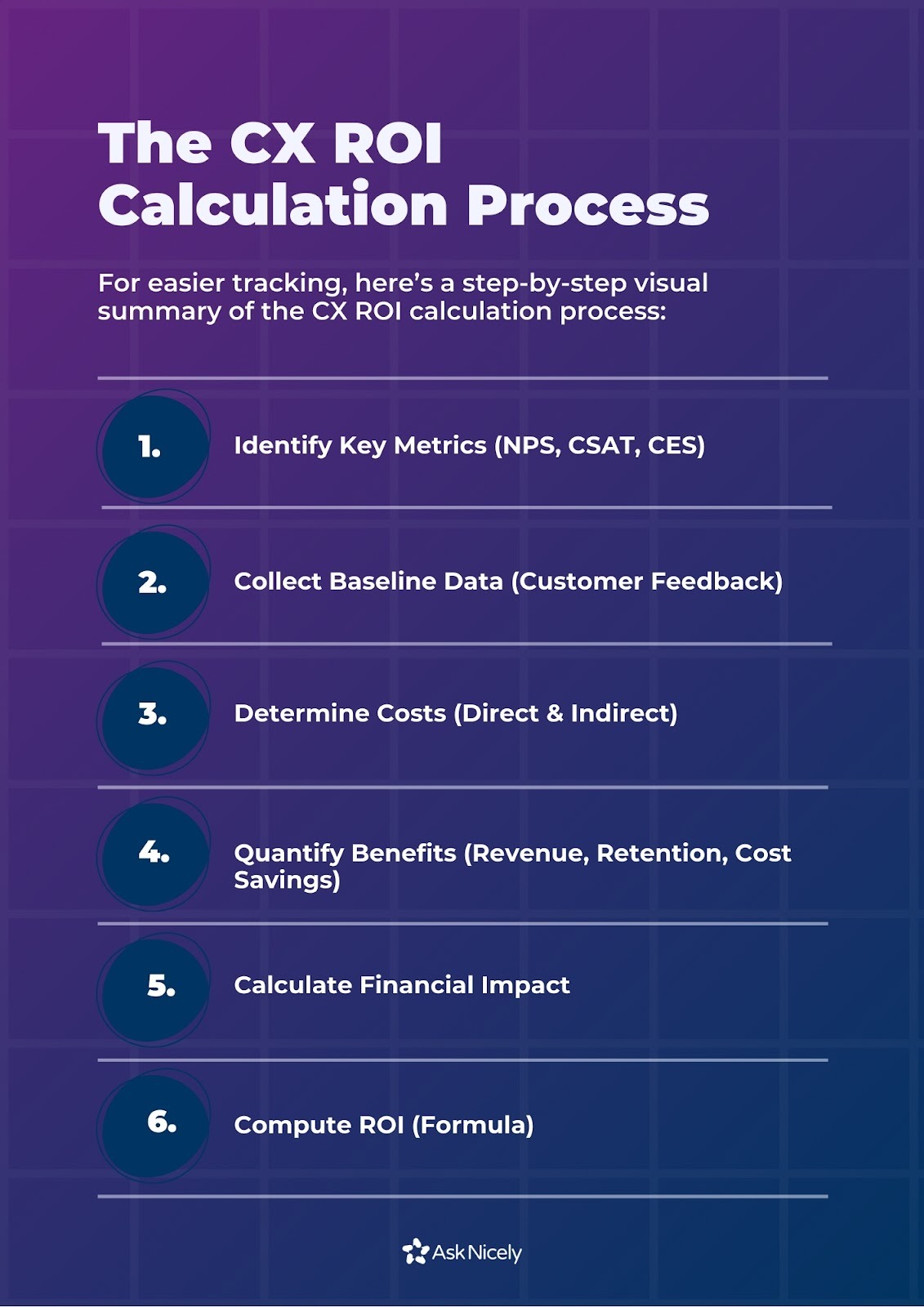
While every company approaches customer experience improvements differently, calculating the ROI of these initiatives follows some common steps. These steps will help link your CX efforts to financial outcomes, ensuring the investments are measurable and justifiable.
When calculating CX ROI, it’s important to consider both direct and indirect costs. It's about the money spent on tools and technologies, but it's also about the time, resources, and opportunity costs associated with these initiatives.
We’ve included a handy ROI calculator at the end of this guide that will help you easily apply these steps and calculate your own CX ROI. But before jumping into that, let’s walk through the process so you can better understand the methodology behind it.
Here’s a practical breakdown of the steps involved in calculating CX ROI:
To secure executive buy-in, you need to choose metrics that resonate with your specific leadership audience. CX metrics are conversation starters that connect experience improvements to board-level priorities.
Different executives care about different outcomes. Match your metrics accordingly:
Choose metrics not just based on what you can measure, but on what leadership already tracks.
Baseline data is your credibility anchor. Without a clear “before” snapshot, you cannot present a compelling “after” story.
Leadership won’t fund improvements without evidence of measurable change.
Baseline metrics turn: “We believe CX is improving” into “CX scores increased 15% in six months, directly correlating with a 2-point churn reduction.”
Go beyond averages.
Document:
This protects you against skepticism, re-forecasting pressure, and budget clawbacks. When finance asks, “How do we know this worked?” Your baseline data provides the proof.
No baseline = no defensible ROI story.
CX spending should be positioned as revenue protection, not a discretionary software expense.
Break costs into:
Direct costs:
Indirect costs:
But don’t stop at listing costs. Tie each line item to an expected financial outcome.
Instead of: “We’re investing $50,000 in CX software.” Frame it as: “We’re investing $50,000 to reduce churn by 15%, protecting $200,000 in recurring revenue annually.”
Address the “why software?” objection clearly. Manual feedback programs rely on lagging surveys and static reports. Automated, real-time systems like AskNicely enable frontline accountability, faster issue resolution, and continuous visibility, turning feedback into action, not just insight.
The alternative to investment isn’t zero cost, it’s ongoing revenue leakage caused by unresolved friction and inconsistent experiences.
Executives don’t invest in categories, they invest in outcomes. Translate CX improvements into dollar impact.
Here’s how to convert common benefits into financial terms:
Map each outcome directly to executive dashboards:
Quantitative metrics prove the impact. Qualitative feedback explains the drivers behind it.
This step is more than arithmetic, it’s business storytelling with numbers.
Yes, you calculate:
Then subtract total costs.
If your benefits equal $150,000 and costs equal $60,000, the $90,000 net impact means:
Address timing clearly:
Provide comparison anchors to make the impact tangible:
Numbers are persuasive. Context makes them strategic.
Use the standard formula: ROI = (total benefits – total costs) / total costs × 100
But present it simply for executives.
Instead of: “ROI is 150%.”, say: “For every $1 we invest, we generate $2.50 in return.”
Contextualize your number:
Include a sensitivity analysis to build confidence: “Even if projected benefits are 50% lower than expected, we still achieve a 75% ROI.” This demonstrates disciplined forecasting and reduces perceived risk—two factors executives prioritize.
ROI is not a one-time calculation, it’s an ongoing credibility system.
Once leadership approves the investment, continuous monitoring protects that trust.
Ongoing tracking:
Executive framing:
“We committed to reducing churn by 2 points. Here’s the month-over-month progress and corrective actions where needed.”
Continuous listening creates a feedback loop:
Static surveys erode trust. Feedback sits unused, wins go unnoticed, and ROI narratives fade. Continuous monitoring keeps CX visible, measurable, and strategically relevant.
And most importantly, it positions you for future investment conversations with confidence and credibility.
If the CEO thinks in strategy, the CFO thinks in risk, cash flow, and fiscal discipline. Winning CFO approval requires more than enthusiasm for customer experience, it requires a defensible financial case built to withstand scrutiny.
CFOs don’t fund “experience improvements.” They fund initiatives that protect revenue, improve margins, and deliver predictable returns within a clear time horizon.
Here’s the five-part framework they expect.
Start with financial exposure. Instead of: “Our CX scores need improvement.” lead with: “Our churn rate increased by 1.5 points last year, putting $3.2M in recurring revenue at risk. Support escalations are up 18%, increasing cost-to-serve.”
Quantify the cost of doing nothing:
CFO lens: What is the financial risk if we don’t act?
When inaction has a visible cost, investment becomes a risk-reduction strategy.
CFOs want transparency and scope control.
Break down:
Separate one-time costs from recurring costs. Present phased investment where possible.
Example framing:
“Initial investment: $85,000 (one-time).
Ongoing annual cost: $40,000.
Scope limited to frontline enablement and journey optimization in two high-value segments.”
Clarity reduces perceived financial risk.
Overly optimistic projections undermine credibility. CFOs expect conservative modeling.
Document:
Example:
“We modeled a 1-point churn reduction, despite industry benchmarks suggesting 2–3 points are achievable. At one point, we protected $1.1M in annual recurring revenue.”
CFOs don’t just evaluate return, they evaluate execution risk.
Address:
Example:
“If churn reduction does not reach 1 point by Q3, we will reallocate resources toward the two highest-risk segments identified through feedback data.”
Demonstrating active risk management increases financial confidence.
Define:
Example:
“We will report retention, support cost per ticket, and NPS movement quarterly. Target: 1-point churn reduction within two fiscal quarters.”
CFOs fund accountability, not ambiguity.
Ground every response in data, benchmarks, and historical performance—not opinion.
CFOs think in quarters and fiscal years. Calculate and present the payback period clearly.
Payback period formula:
Initial Investment ÷ Annual Net Benefit
Example:
Payback period = 1.2 years (approximately 14 months)
Executive framing: “The initial investment is recovered in 14 months. After that, the program generates approximately $100,000 in annual net benefit.”
This shifts the conversation from cost to capital recovery and long-term yield.
Sophisticated financial proposals include scenario modeling:
Position it clearly: “Even under conservative downside assumptions, the initiative delivers a positive return.”
This builds CFO confidence because it demonstrates disciplined analysis and downside awareness.
A CFO-friendly business case is not about proving CX is valuable, it’s about proving the investment is financially rational, risk-managed, and aligned to fiscal timelines.
When you frame CX as revenue protection with predictable payback and scenario-tested returns, you move from persuasion to prudence, and that’s what earns financial approval.
Use our calculator to see how improving your net promoter score (NPS) or customer satisfaction score (CSAT) could impact your bottom line. We used industry benchmarks for NPS, CSAT, cost of acquisition, and two-year growth rate. All you need to do is input your annual revenue and number of customers (estimates are welcome!) to see the return on your investment in customer experience management.
Calculating the ROI of customer experience is an important first step, but the real challenge lies in presenting that data to leadership in a way that resonates with decision-makers. Communicating CX ROI requires translating complex data into clear, actionable insights that directly align with the broader business strategy. Unfortunately, many teams face obstacles when trying to effectively measure and communicate CX ROI to their leaders.
Securing leadership buy-in for CX initiatives isn’t just about presenting data—it’s about overcoming predictable hurdles that can derail even the most well-intentioned programs. Understanding these challenges and addressing them proactively strengthens your case.
Lack of clear metrics:
A common trap is tracking too many KPIs without prioritizing the ones that truly drive business outcomes. This “everything matters, nothing matters” problem makes it hard to show leadership how CX investments impact revenue, retention, or margin.
How to address it: Focus on 2–3 north star metrics that align with executive priorities.
For example:
By highlighting the metrics executives care about, you turn CX measurement into a language leadership understands.
Data silos
Fragmented data creates conflicting stories. CX, sales, and finance teams may report different customer numbers, eroding trust in your analysis and slowing decision-making.
How to address it: Create a single source of truth by integrating CX platforms with existing business intelligence tools. Consolidate data from feedback, CRM, and operational systems so you can present a cohesive, enterprise-wide view of CX impact. Leadership is far more likely to approve initiatives when the story is clear and consistent.
Attribution issues
CFOs and finance teams often challenge CX ROI with the “correlation vs. causation” question. If churn drops or revenue grows, how do you know CX caused it and not external factors?
How to address it: Use control groups, A/B testing, or time-series analysis to isolate CX impact. For example: “Location A implemented a new CX program, while Location B did not. After normalizing for seasonality and promotions, we observed a 3-point retention lift attributable to the CX improvements.”
This data-driven approach builds credibility with skeptical executives.
Resistance to change
Some leaders hesitate to invest in CX because it feels intangible or risky. The fear:
“What if we spend and see no return?”
How to address it: Reframe CX as risk mitigation, not discretionary spending.
Quantify the cost of doing nothing:
“If we don’t act, we risk losing X customers annually to competitors with superior experiences—translating into $Y of lost revenue.”
By framing CX as protecting existing revenue, reducing churn, and enabling growth, you shift the conversation from optional to essential.
Overcoming CX challenges is about enabling leadership to see CX as a strategic driver of business value. Programs that rely solely on process improvements may stall; those that combine data, alignment, and proof points scale and earn long-term investment. The following strategies help you turn obstacles into a leadership-ready business case.
Present clear and compelling data
Leadership is numbers-driven. To make your case compelling, present clear, concise data demonstrating the financial impact of your CX efforts. CX software can be invaluable here: tracking real-time metrics, customer feedback, and sentiment analysis provides a comprehensive view of how CX initiatives drive results.
Example: Present a chart comparing customer satisfaction scores before and after implementing a new CX strategy. This simple before-and-after comparison immediately shows leadership the tangible impact of your efforts.
Align with business goals
To win leadership buy-in, position CX as a strategic enabler of broader business objectives. Whether the priority is revenue growth, retention, or operational efficiency, link CX improvements directly to these goals so executives can see the connection.
Example: “By improving customer satisfaction, we have seen a 20% increase in repeat purchases, directly contributing to our revenue growth target of 15% this year.”
This language translates CX improvements into financially meaningful outcomes that resonate with leadership.
Highlight success stories and case studies
Real-world examples make CX ROI tangible. Sharing stories from similar companies or even internal initiatives helps leadership visualize the potential impact of investment.
Example: “After implementing a new CX initiative in our onboarding team, customer retention increased by 12%, generating an additional $200,000 in revenue last quarter.”
Concrete examples like this provide executives with a clear line of sight from CX action to financial result, strengthening the case for further investment.
Even the strongest CX business case can meet resistance. Executives often raise the same objections, but with a structured response framework, you can validate their concern, provide evidence, and pivot to the business opportunity. Use this four-part approach consistently:
Here’s how it works in practice:
Objection: “CX is too soft to measure.”
Objection: “We can't afford it right now.”
Objection: “Our customers are already satisfied.”
Objection: “ROI takes too long.”
Objection: “We tried CX before, and it didn't work.”
Objection: “How do we know this won't just be another dashboard no one uses?”
Objection: “What if competitors aren't investing in this?”
Refer to the AskNicely customer stories page to see real‑world examples of what successful CX investment looks like, and the tangible rewards it delivers. These case studies show how companies across industries have overcome the very objections outlined above, translated experience improvements into financial outcomes, and secured executive support by speaking the language of leadership. Use these stories not just as proof points, but as inspiration for how to frame your own CX investment narrative in terms that resonate with CFOs, COOs, and CEOs alike.
When it comes to proving the ROI of customer experience investments, the right CX software can be a game-changer. While there are many tools available, a CX program like AskNicely offers a structured approach that makes it easier for teams to systematically collect, analyze, and act on customer feedback. By leveraging CX software, you can turn insights into measurable financial outcomes and address the key challenges of proving ROI, selecting metrics, and communicating value to leadership.
AskNicely simplifies the process of gathering customer feedback with customizable email, web, or SMS surveys. This flexibility makes it easier to consistently collect actionable data across different customer touchpoints. Regular feedback helps ensure you're measuring the right key CX metrics—something that’s critical when demonstrating ROI.
How DUCA transformed its feedback strategy with AskNicely
It’s not enough to just gather feedback, you need to analyze it in a meaningful way. AskNicely’s platform allows you to compare performance across locations, teams, or departments, helping you spot trends and identify areas for improvement. With the addition of the AI theme analysis feature, you can use artificial intelligence to detect recurring themes in customer feedback. This enables you to act faster and focus on the most important customer needs, ensuring that your CX initiatives have a direct impact on customer loyalty and retention.
“It's been awesome to see how AI can categorize a phrase from a customer into a theme. I’ve uncovered new insights that I otherwise wouldn't have and it’s meaningfully reduced manual tracking.” – Damaris D. Sirop, VP Director Member Experience - First Commonwealth Federal Credit Union
Driving CX improvements requires more than just tools — it requires an engaged team. AskNicely’s Transform feature helps gamify customer service by turning customer feedback into real-time recognition and coaching opportunities for frontline employees. This keeps employees motivated and focused on delivering exceptional customer experiences, which in turn, supports a culture of continuous improvement.
Frontline accountability and appreciation: The secret weapon driving awesome CX at Moxie
AskNicely’s integrations with CRM systems, customer support platforms, and other critical business tools offer a comprehensive view of customer data. This seamless integration enables you to correlate feedback with business outcomes like revenue, customer retention, and service efficiency, making it easier to attribute CX improvements to financial results. By breaking down data silos, you can provide leadership with the transparency they need to make informed decisions.
Explore how customer experience management can boost your revenue.
ROI timelines vary depending on the scope of the initiative. Quick wins, such as reducing customer effort through self-service improvements, can show measurable operational savings within 3–6 months. Broader initiatives like loyalty programs or journey redesigns often take 12–18 months to impact retention, revenue, and lifetime value significantly.
Customer satisfaction scores (CSAT) measure how happy customers are with a specific interaction or product. CX ROI, on the other hand, translates those improvements into financial and operational outcomes, such as reduced churn, increased revenue, or lower service costs. Think of CSAT as an indicator of performance, while CX ROI demonstrates the business value of acting on those indicators.
Start by selecting one or two metrics aligned with business priorities, such as NPS for loyalty or CES for operational efficiency. Establish a baseline by collecting initial feedback and tracking current performance. Then identify a small, high-impact CX initiative (like improving onboarding or support processes) so you can measure improvements over time. Document results clearly to build the first proof points for leadership buy-in.
Absolutely. CX ROI is not solely about expensive software or large-scale programs. Small businesses can focus on targeted, high-impact initiatives, like streamlining a single customer journey, improving email response times, or adding follow-up feedback loops. Even modest investments can drive measurable benefits.
Employee experience (EX) and customer experience are tightly linked. Engaged, empowered employees deliver more consistent, high-quality interactions, which drives higher satisfaction, loyalty, and retention.
CX ROI should be recalculated quarterly or at least semi-annually, especially after implementing major initiatives. Continuous tracking helps identify whether improvements are translating into revenue, reduced costs, or retention gains. Frequent updates also provide a real-time view for leadership, ensuring that investments remain justified and allowing adjustments if ROI trends dip unexpectedly.
Not all CX improvements deliver instant revenue impact. Some benefits—like increased loyalty, referrals, or brand reputation—compound over time. Frame these as long-term value creation for leadership: for instance, a smoother onboarding process may not immediately boost revenue, but it can reduce churn by 5–10% over a year, protecting recurring revenue and lowering acquisition costs. Pair early wins (like reduced support costs) with long-term gains to maintain credibility.