Every interaction with a customer is an opportunity to make an impression. That impression can lead to loyalty or send them searching for alternatives. Customers want personalized, seamless experiences across every channel, and they’re more willing than ever to share their opinions. As a result, businesses have more feedback than ever before available. From surveys and reviews to social media and customer support conversations, and all the while, AI is rapidly reshaping how feedback is captured, analyzed, and acted on.
But collecting feedback is only one piece of the puzzle. A true customer feedback system is a coordinated combination of people, processes, and technology working together to turn insight into action. Many organizations over-invest in gathering data while under-investing in the workflows, accountability, and follow-through required to improve the customer experience.
Making sense of high volumes of user feedback and connecting it to real business outcomes can quickly overwhelm even the most organized teams. Without a clear strategy, valuable insights get buried and opportunities to strengthen loyalty slip through the cracks.
With that in mind, let’s explore what modern customer feedback systems really look like, the different types available, the benefits they deliver, and how to design a system that doesn’t just collect customer feedback, but drives meaningful, measurable action.
A customer feedback system is a centralized platform that collects, processes, and provides actionable insights from feedback gathered across multiple channels. It serves as the backbone for understanding customer sentiment, identifying pain points, and prioritizing areas for improvement. These systems streamline the entire feedback process, from gathering input via customer feedback surveys, reviews, or social media, to analyzing and interpreting the data, and ultimately taking action based on the insights.
At its core, a customer feedback system has two interconnected components:
These two elements must work together. The best tools in the world will fail without clear workflows and accountability. At the same time, even the most thoughtful processes break down without technology that can capture feedback at scale, surface insights quickly, and distribute them to the right people in real time.
You can think of it as a simple loop:
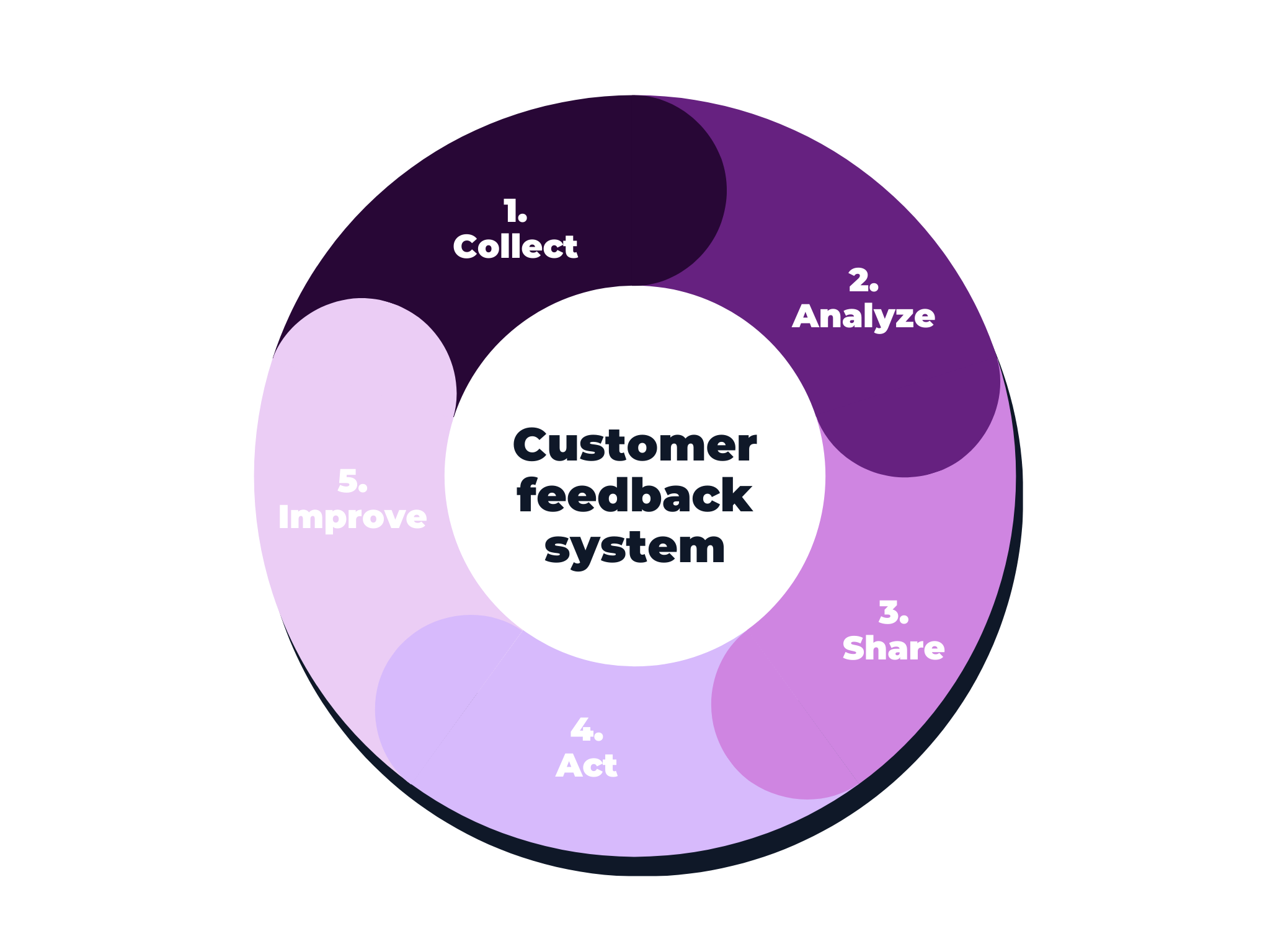
Distinguishing between tools and processes matters because many organizations over-focus on collection (sending more surveys, adding more channels) while under-investing in what happens next.
Real impact comes when feedback doesn’t just sit in a report; it directly empowers frontline teams to respond, resolve service issues, and consistently improve experiences.
A well-designed customer feedback system brings everything together: it captures customer sentiment across touchpoints, turns raw data into meaningful insights, and embeds action into daily operations, helping teams stay aligned, manage feedback overload, and continuously raise the bar on customer experience.
Modern customer feedback systems rarely rely on a single channel. Instead, they combine multiple sources of feedback to capture different moments across the customer journey. The right mix depends on your industry, how customers interact with you, and what stage of the journey you’re trying to understand.
For example, a hospitality brand may prioritize real-time, on-site feedback, while a SaaS company may lean heavily on in-product prompts and behavioral data. Combining channels yields a more comprehensive and less biased understanding of the customer experience. Some channels capture in-the-moment reactions, while others reveal long-term sentiment or hidden friction points.
Below are some of the most common feedback channels and how to use them effectively.
Real-time feedback systems collect input during or directly after an interaction. This approach is especially effective in retail, hospitality, field services, healthcare, and other in-person or service-based environments.
The key advantage is speed. When customers share feedback in the moment, their recall is sharper and more detailed, leading to more accurate insights. Just as importantly, issues can be escalated and resolved quickly, often before they turn into negative reviews or churn.
Real-time feedback works best when there’s a clear workflow for rapid follow-up and service recovery.
Post-interaction surveys are sent after a specific transactional event, such as a support ticket, appointment, delivery, or purchase. These short surveys typically focus on service quality and ease of experience.
They’re particularly useful for diagnosing performance at individual touchpoints, for example, measuring support agent effectiveness or identifying friction in onboarding. Because they’re tied to a specific interaction, they help teams pinpoint exactly where improvements are needed.
When paired with strong close-the-loop processes, post-interaction surveys become a powerful operational tool, not just a reporting mechanism.
Relationship surveys, such as net promoter score (NPS), customer effort score (CES), and periodic pulse surveys, measure overall sentiment and loyalty over time. Rather than focusing on one transaction, they assess the health of the broader customer relationship.
These surveys are valuable for identifying long-term trends in satisfaction, loyalty, and brand perception. They help leadership teams understand whether customer experience improvements are driving measurable change.
However, static once-a-year surveys may miss in-the-moment issues that require faster action. While they provide valuable longitudinal data, they’re most effective when complemented by more frequent, transactional feedback channels.
In-app and in-product feedback systems are embedded directly into a web platform or mobile app. They allow customers to share feedback without leaving the experience.
This channel is especially powerful for SaaS and digital-first businesses. It captures “micro-moments” of friction, for example, immediately after a feature is used or when a workflow is abandoned.
Behavior-based targeting makes this channel even more effective. Triggering a short survey after a specific action (or lack of action) provides context-rich insights that generic surveys often miss.
Not all feedback is solicited. Public reviews and social media conversations offer unfiltered insights into how customers perceive your brand.
Monitoring platforms, like LinkedIn, Instagram, Google Reviews, or industry review sites, help you track sentiment, identify emerging themes, and respond proactively to concerns. Categorizing reviews by sentiment (positive, neutral, negative) and theme (service, pricing, product quality) can reveal patterns that structured surveys might overlook.
Including a simple visual example of review sentiment categories can help teams quickly grasp how this data contributes to the broader feedback system.
Not all feedback is voiced. Some of the most important signals are implicit, revealed through customer actions rather than words.
This data often already exists within your business systems, including:
On their own, behavioral metrics tell you what is happening. Explicit feedback, from surveys and reviews, tells you why. Connecting the two is critical for diagnosing root causes and designing effective improvements.
Customer feedback systems are entering a new phase. AI is fundamentally reshaping how feedback is gathered, interpreted, and acted on, moving systems from passive reporting tools to proactive engines for improvement.
In the past, feedback platforms primarily helped teams collect data and build dashboards. In 2026 and beyond, the focus shifts to speed, intelligence, and embedded action. Systems won’t just tell you what customers said, they’ll help you understand why it matters, what to do next, and who should do it.
Here are the key trends shaping the future of customer feedback systems:
Most customer feedback lives in open-text responses, reviews, chat logs, and support conversations. Historically, analyzing this data required manual tagging or basic keyword tracking. AI changes that completely.
Modern systems can now instantly process thousands of comments to:
This matters because faster insight leads to faster, more accurate action. Instead of waiting for quarterly reports, frontline teams can identify patterns as they form and respond before small issues escalate into churn or reputation damage.
Static surveys are giving way to dynamic, adaptive experiences. AI-powered dynamic surveys tailor questions based on prior responses, known customer data, or recent behaviors.
For example:
This approach reduces friction, increases relevance, and improves response quality. Customers feel heard because the questions reflect their experience, not a generic script.
The result is richer insights without increasing survey length, and more precise data that teams can act on confidently.
Traditional feedback systems report on what has already happened. The next generation will anticipate what’s likely to happen next.
By combining survey data with behavioral signals (such as declining usage, rising support tickets, or delayed renewals), AI models can identify early warning signs of churn. At the same time, they can surface the strongest drivers of loyalty, the experiences that turn customers into advocates.
This shift from reactive to predictive enables organizations to intervene earlier, prioritize the right accounts, and allocate resources more strategically.
The future of feedback isn’t more dashboards, it’s embedded action.
AI-powered systems are increasingly capable of:
This moves feedback out of leadership reports and into daily frontline operations. When insights are delivered in real time (with clear ownership and recommended next steps), teams can resolve issues faster and build stronger customer relationships.
The organizations that win won’t just analyze feedback better; they’ll empower frontline teams to act on it consistently.
As technology accelerates, so do customer expectations. Customers increasingly expect quick acknowledgment when they share feedback — especially if it’s negative. Delayed or generic responses can undermine trust just as much as the original issue.
AI enables scalable, personalized loop closure by:
When acknowledgment and action happen quickly, customers feel heard. And when issues are resolved promptly, loyalty strengthens, even after a poor experience.
Looking ahead, the most effective customer feedback systems will blend human judgment with AI-driven intelligence. They’ll connect collection, interpretation, and action into one continuous loop, turning feedback into a living, operational asset rather than a static reporting exercise.
While strategy and workflows define how feedback is used, the right tools and technology determine whether that system can operate at scale. This section focuses on the core capabilities your technology stack should provide to support the full feedback loop: collection → analytics → action → recognition → improvement → ongoing workflows.
There are several categories of customer feedback tools available today — including survey platforms, review management solutions, social listening tools, product analytics systems, and dedicated CX platforms. The most effective systems unify these capabilities rather than treating them as disconnected point solutions.
Below are the must-have features to look for.
An effective feedback system should centralize input from across the customer journey — surveys, online reviews, support tickets, social mentions, and even operational or behavioral data.
Without centralization, data silos form. Marketing sees one version of the customer, operations sees another, and customer-facing teams see none of it in real time. The result is inconsistent experiences and fragmented decision-making.
A strong system creates a single source of truth by unifying structured survey responses with unstructured reviews, tickets, and behavioral signals, giving teams a holistic, reliable view of the customer experience.
In fast-paced, service-based environments, speed matters. When negative feedback surfaces (especially after a service visit, appointment, or support interaction), teams need immediate visibility. Real-time alerts ensure urgent issues are routed to the right person without delay.
Automated escalation workflows can prioritize high-risk responses (such as low satisfaction scores or negative sentiment), assign ownership, and track follow-up. This capability is critical for effective service recovery and protecting customer relationships before dissatisfaction turns into churn or public complaints.
Manual tagging and spreadsheet-based analysis are no longer sufficient, especially as feedback volume grows.
AI-powered analytics can instantly:
This reduces noise and surfaces what matters most. Instead of spending hours categorizing comments, teams can focus on root causes and improvement initiatives.
Generic surveys often produce generic insights. Modern feedback tools should support branching logic and dynamic question sets that adapt based on responses, behavior, or customer history. Personalization increases relevance, improves response quality, and reduces survey fatigue.
As customer experience expectations rise, personalization in feedback collection becomes just as important as personalization in marketing or service delivery.
Seamless integrations with CRM platforms, helpdesk tools, scheduling systems, and operational software such as Salesforce, Hubspot, and Slack ensure feedback appears within the context of daily workflows.
For example:
These integrations reduce friction, eliminate duplicate work, and enable true closed-loop action, where feedback leads directly to measurable change.
Different teams need different lenses. Operations leaders may focus on location-level performance while CX teams may track trends across segments.
Effective systems provide customizable, role-based dashboards with clear, simple visualizations. The goal isn’t more data, it’s clarity. Segmentation tools should allow teams to filter by region, team, product line, customer type, or timeframe to uncover meaningful patterns quickly.
An effective feedback system includes built-in workflows that:
When employees see feedback in real time and are empowered to act on it, improvement becomes a daily habit rather than a quarterly initiative. Recognition reinforces what’s working, while coaching addresses gaps immediately.
This is where feedback systems create lasting cultural impact: by embedding continuous improvement into everyday operations and empowering the people closest to the customer to take meaningful action.
Choosing the right customer feedback system is crucial for ensuring seamless data collection, actionable insights, and team adoption. Mismatched tools can lead to data fragmentation, low team adoption, and missed opportunities to improve customer experience. To avoid these pitfalls, follow a step-by-step process to select the best feedback system for your organization:
Before evaluating different feedback systems, it's important to clearly define your goals. Are you aiming to improve customer satisfaction, enhance loyalty, reduce churn, or identify new product development opportunities? Your system should align with these specific goals. For instance, if your primary objective is to track customer satisfaction, tools that focus on CSAT or NPS might be your top choice. Define your key performance indicators (KPIs) based on these goals to guide your tool selection and ensure you measure the right metrics for success.
Different organizations have different needs:
Assess your CX maturity and volume of feedback to ensure the system can scale with your organization without creating bottlenecks or overwhelming teams.
A system that leadership loves but frontline employees ignore won’t drive improvement. Evaluate:
The goal is seamless adoption: employees should feel empowered to collect, respond to, and act on feedback as part of their daily workflow, rather than treating it as an extra task.
Not all AI is created equal. Look for meaningful AI features that:
Avoid tools that overhype AI without delivering actionable insights. Effective AI should accelerate decision-making, reduce noise, and enable teams to act faster and more confidently.
Your customer feedback system will need to integrate with other tools your team already uses, such as customer relationship management software, marketing platforms, or helpdesk solutions. Evaluate your integration requirements to ensure that the feedback system can connect seamlessly with these platforms. Without proper integration, feedback might be siloed, and you could lose valuable insights. For example, linking customer feedback to sales or support systems can help identify customer pain points more quickly and inform the development of new solutions.
A vendor’s support and partnership can be just as important as the technology itself. Prioritize companies that:
AskNicely, for example, consistently receives praise on G2 for its support and collaborative approach, showing that long-term partnership can be a differentiator as much as customer feedback software features.
Following this framework ensures your organization chooses a customer feedback system that fits your goals, scales with your operations, drives adoption, and ultimately translates customer insights into meaningful action.
A customer feedback system only works when people, processes, and tools are aligned. Now that you’ve evaluated the right technology, it’s time to focus on operationalizing it across your teams. The following step-by-step guidance ensures feedback becomes a living part of your organization rather than a static report.
Start by reviewing how feedback is collected today: surveys, online reviews, frontline conversations, support tickets, or operational data. Identify where information gets stuck, perhaps unread, unanalyzed, unactioned, or not shared with the right teams.
This mapping prevents over-engineering and highlights the real gaps in your system, so you can target improvements where they matter most.
Clarity is key. Decide:
A simple responsibility table or RACI chart can reduce dropped balls, ensure consistency, and make accountability visible across the organization.
Embed feedback into everyday operations through regular, repeatable rituals:
These routines make the system “stick” and reinforce a culture of continuous improvement.
Frontline employees are closest to the customer and can resolve many issues immediately. Give them:
AskNicely’s philosophy emphasizes that empowering frontline teams is central to driving measurable CX improvements.
Pilot your system with a single location, team, or workflow before rolling it out broadly. Small, early wins:
This incremental approach works particularly well for multi-location or high-volume organizations.
Communicate back to customers using a “You said, we did” approach. Closing the loop:
Visible action reinforces a customer-centric culture and strengthens loyalty.
A feedback system is not static. Periodically review:
Regular refinement ensures your system remains healthy, responsive, and aligned with evolving customer expectations.
Following these steps transforms feedback from a passive measurement into an active engine for improvement, ensuring insights are captured, acted upon, and leveraged to create better experiences across every touchpoint.
AskNicely combines people, processes, and technology into a single, cohesive customer feedback management system — closing the gap between collecting feedback and actually improving customer experience at scale. Designed for businesses of all sizes, our platform helps teams capture, understand, and act on feedback in real time, driving stronger customer satisfaction and loyalty.
Here’s how AskNicely brings a modern feedback system to life:
AskNicely empowers businesses across industries — from retail to healthcare, hospitality to technology — to transform raw feedback into actionable insights and measurable outcomes.
See the impact for yourself: book a demo to explore how AskNicely can help your team capture feedback, take action, and improve customer experience at scale.
A system works when it leads to actionable change and measurable improvement.
Track:
Semantic grouping of feedback can help you identify recurring themes, making it easier to spot patterns and take action. For instance, a startup using a feedback management tool noticed higher retention after grouping comments about onboarding issues and resolving them.
KPIs should link insights to business outcomes:
Using survey templates or pop-ups across touchpoints can increase response rates and ensure your KPIs reflect a representative view of the customer experience.
Meaningful AI goes beyond dashboards:
Product managers often use these capabilities to align feedback with the product roadmap, ensuring feature improvements or fixes match real user needs.
AI prioritizes high-impact issues by analyzing:
For example, feedback from forums and focus groups can be combined with survey data to identify urgent UX issues, allowing teams to take immediate action.
Adoption depends on simplicity and relevance:
Startups and larger organizations alike see higher engagement when frontline staff feel empowered to act and recognize the impact of their interventions.
Feedback is most effective when it informs action:
Product managers and CX leaders often use this approach to reinforce behaviors that improve user experience.
Focus on functionality and real-world use cases:
Asking these questions ensures the platform is not only functional but also aligned with your operational goals and roadmap.