Think about the last time a service experience genuinely impressed you.
Chances are, it wasn't the company's flashy website that did it. It wasn't their logo on the van, the confirmation emails, or the booking flow. It was a person. Someone who showed up, did the work, and made you feel like you were in good hands.
Now flip it. Think about the last time a service experience let you down. Same story, different ending. Someone showed up, and something was off. Maybe they seemed rushed, distracted, like they were just getting through the job.
That's the frontline effect. And for most field service businesses, it's the biggest brand variable they're not optimizing.
You can pour money into marketing, build big customer acquisition campaigns, and build a beautiful brand, but if the person standing in your customer's driveway doesn't feel connected to what you stand for and have clear guidance to deliver exceptional customer experiences, none of it matters. That moment is your brand. And it's happening dozens, hundreds, maybe thousands of times a day across your crews and contractors, mostly unseen, mostly untracked, mostly uncoached.
The businesses pulling ahead in field service are the ones who've figured out how to make every person on the frontline, employee or contractor, feel like they're part of something worth representing. And they've built the feedback loops to prove it's working.
There’s a disconnect happening inside most field service businesses. The people at the top care deeply about the brand. They’ve written the values, designed the uniforms, and built the training manual. They know exactly what a great customer experience should look and feel like. Meanwhile, the people actually delivering that experience ( the technicians, the crews, the contractors) are often the least connected to any of it. Not because they don’t care, but because nobody’s built the bridge.
In most field service operations, there’s a significant gap between what leadership intends and what customers actually experience. A study by Bain & Company found that 80% of companies believe they deliver superior customer experience, but only 8% of customers agree. That gap lives on the frontline.
And contractors make this even more complicated. They’re not on the payroll, and they might work across multiple brands in a single week. So where does your brand fit in their sense of accountability? For many businesses, the honest answer is: it doesn’t. Contractors fall into a gray zone where culture, coaching, and customer feedback rarely reach them, even though, from the customer’s perspective, they are the brand.
The irony? The problem isn’t motivation, it’s connection. Frontline workers don’t have visibility into how their work lands with customers. They don’t get the feedback, and they don’t see the ripple effect of that one great interaction, or that one moment that went sideways.
That disconnect affects employee engagement and retention too. When frontline workers can clearly see the impact they’re having, they’re more likely to feel valued, motivated, and invested in the business. That matters even more in industries with highly skilled workforces, where replacing experienced technicians, clinicians, or specialists can be costly and time-consuming. Gallup estimates that replacing technical employees can cost up to 80% of their annual salary, while disengaged teams experience significantly higher turnover rates. In sectors already facing labor shortages, retaining great people is just as important as winning new customers.
When you close that gap, connecting frontline behavior to real customer outcomes, something shifts. Teams become more engaged, customer experience becomes more consistent, and employees feel a stronger sense of ownership over the work they do. That’s the opportunity, and it all starts with rethinking how feedback flows through your business.
Most field service businesses approach frontline brand standards the same way. You onboard new starters with a handbook, you run a training session — maybe in person, maybe a video module. You cover the basics: how to greet a customer, how to leave a site clean, what to do if something goes wrong. You tick the box. And then you send people out into the field and hope it sticks.
It doesn't. Not consistently. Not over time.
That's not a criticism of the people doing the training or the people receiving it. It's just the reality of how humans work. A one-time onboarding session, no matter how well-designed, isn't enough to shape behavior in high-pressure, high-variability environments. Every job is different and every customer is different. The gap between "what I was told in training" and "what I do when I'm under pressure at 4pm on a Friday" is enormous, and it's in that gap where brand standards quietly erode.
The traditional approach also has a timing problem. Feedback, when it exists at all, tends to arrive late. A Google review three days after the job, a complaint landing in the inbox a week later, a quarterly performance review that condenses months of work into a single conversation. By the time any of this reaches the frontline worker, the moment has passed. The connection between their behavior and the customer's experience has dissolved, and what remains doesn't feel relevant enough to change anything.
The contractor gap compounds this further. Permanent staff may get inconsistent feedback, but contractors often get none at all. They complete the job, move on, and never learn whether the customer was delighted or disappointed.
What actually changes behavior isn't more training. It's better feedback, faster. A technician finishing a job and getting a notification that their customer left a glowing comment about how clearly they explained the work, and feeling that in real time. A crew leader watching their team's scores tick up over a month and understanding exactly why. A contractor realizing, through their own data, that customers consistently rate them lower on communication, and deciding to do something about it. These are the moments that stick.
Training can't replicate that kind of feedback loop, and building one isn't as complicated as it sounds. It simply requires capturing customer sentiment at the right moment — immediately after the service interaction — and routing it back to the people who can actually act on it, before the experience fades and the opportunity closes.
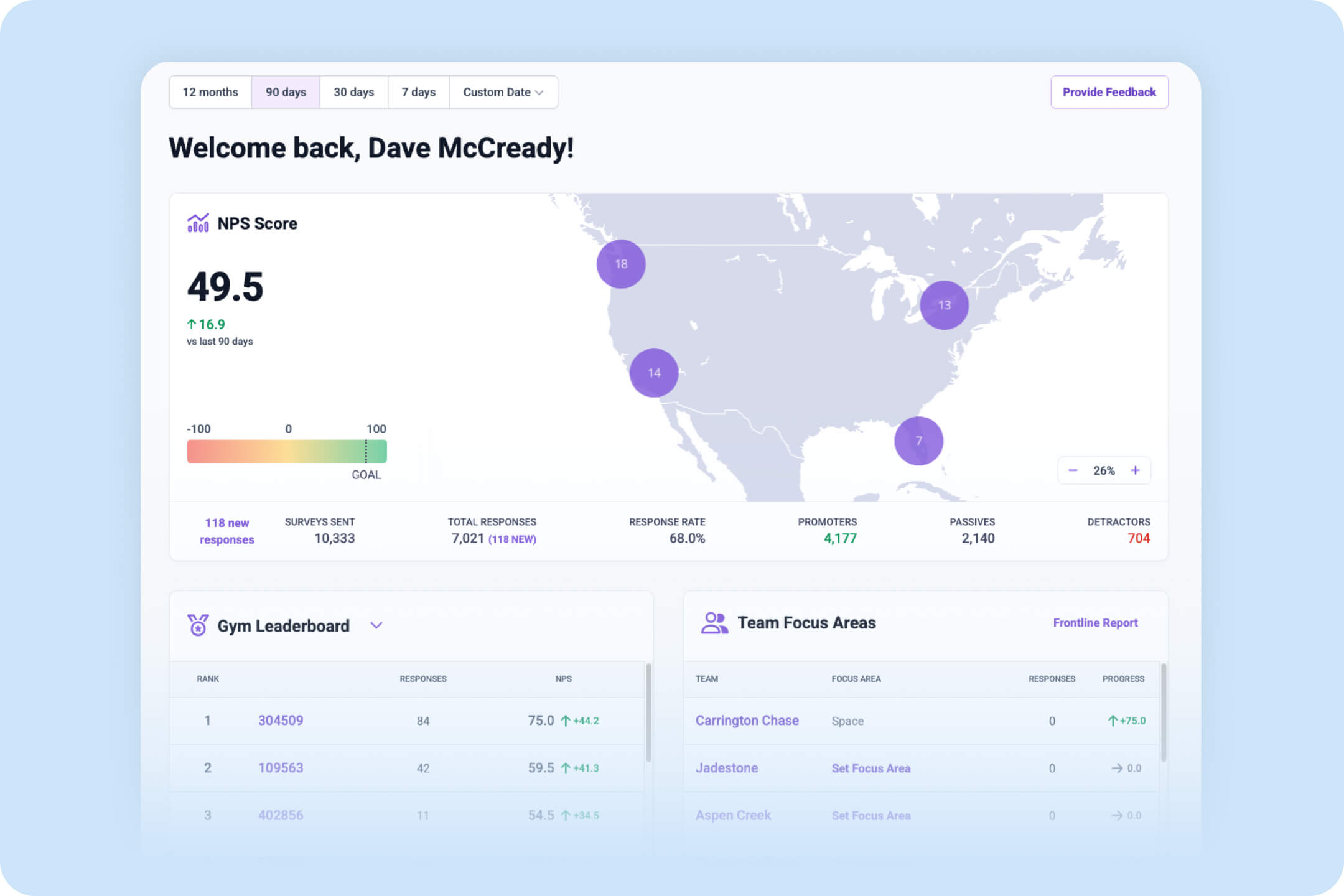
That's exactly what AskNicely is built to do. Automated surveys go out the moment a job is complete, while the experience is still fresh, so the feedback that comes back is fast, specific, and tied to a real interaction rather than a vague impression formed days later. Frontline workers and their managers see it quickly enough to do something, which makes customers more satisfied too. Happier customers and a more connected staff make for better outcomes all around.
Big Blue Bug Solutions — a family-owned pest control business with nearly a century of history and deep roots in New England — had spent decades earning the kind of loyalty that doesn't come from marketing. It comes from showing up reliably, doing the job well, and treating customers like people rather than service tickets. Which is exactly what makes expansion so precarious: the brand that customers in Rhode Island and Massachusetts had come to trust was, in practice, the behavior of specific people on specific days. When Big Blue Bug set out to double in size within five years — pushing into Maine, New Hampshire, and Vermont — the central question was whether they could replicate the experience those technicians delivered.
Their existing feedback system couldn't answer that question. Manual phone surveys run through a small call center were too slow, too inconsistent, and too limited in scale to tell them where the experience was landing well and where it was quietly falling short. When Luis Marulanda, their Chief Strategy Officer, introduced AskNicely in 2020, that changed. Surveys went out automatically after every service visit, responses came back fast enough for crews and contractors to act on, and feedback was routed to supervisors who could use it for coaching before the moment passed.
Critically, they also tied survey results to performance incentives — quarterly and bi-annual bonuses — which made brand representation tangible for frontline workers rather than something handed down in a memo.
By 2024, they had a 20% survey response rate, over 4,000 responses, and an average NPS of 80, making them a best-practice leader in customer experience across the pest control industry. The brand had scaled because the behavior had scaled, and the behavior had scaled because they could finally see it clearly enough to manage it.
Here's something most businesses get backwards. Customer feedback gets collected, dashboards get built, NPS trends get tracked, boards get updated — and all of that has its place. But if the feedback never makes it back to the person who actually delivered the experience, you've missed the most powerful thing it can do: motivate..
Consider what it means for a technician to finish a job and see a notification telling them their last customer just wrote: "James was brilliant — took the time to explain everything, left the place spotless, and was just a really decent human being." That moment costs nothing and takes seconds, but it does something that no performance review, no training session, and no motivational speech ever quite manages. It connects a person's effort directly to someone else's experience of it, in real time, without any intermediary smoothing out the edges. It makes the work feel real in a way that end-of-quarter summaries simply can't.
AskNicely calls this the frontline feedback loop, and it's the engine behind some of the most significant CX transformations we've seen in field service. When feedback flows back to frontline workers quickly and consistently, the same three things tend to happen.
Ownership goes up: Workers who can see their own scores and read their own customer comments stop waiting to be told how they're doing and start self-correcting, noticing patterns, asking questions, with accountability that feels intrinsic rather than imposed.
Recognition becomes specific and earned: Rather than the generic "great job everyone" that lands flat because it doesn't mean anything to anyone in particular — when feedback is tied to individual interactions, you can say "Sophie's customers have mentioned her communication three weeks in a row, let's talk about that in the team meeting," and that's the kind of recognition that builds identity, that makes someone proud to wear the logo, that sticks.
The third thing that happens is also the one that tends to surprise people most: the customer experience improves without any additional training, not because workers are being watched, but because they're being seen. There's a profound difference between the two. Being watched creates compliance; people performing to a standard because someone might be checking. Being seen creates engagement, a sense that the work matters and that the person doing it matters, and engaged frontline workers deliver experiences that no operations manual could ever fully script.
Businesses that treat feedback purely as a management tool will always be chasing their tail — reacting, reviewing, reporting in cycles that never quite close the gap between what leadership sees and what customers experience. The ones that treat it as frontline fuel tend to find that improvement becomes self-sustaining, compounding job by job and crew by crew, without anyone having to mandate it from above.
Everything we've talked about so far — feedback loops, real-time recognition, frontline accountability — is really in service of one thing. Culture.
Not culture in the abstract, ping-pong-table, values-on-the-wall sense. Culture in the practical, day-to-day sense. The shared understanding of what good looks like, the expectation that every job matters, the feeling — and this is the one that's hardest to manufacture and easiest to lose — that the work you do means something.
That feeling is brand pride. And in field service, it's the difference between a crew that does the job and a crew that delivers the experience.
The good news is that brand pride isn't something you can instill through a memo or a team-building day. It grows organically, but only when the right conditions exist. And those conditions are more straightforward than most leaders think.
People need to be seen. Not monitored. Not evaluated. Seen. There's a world of difference between a manager who reviews NPS scores in a spreadsheet and a manager who pulls a technician aside to say: "Mrs. Henderson called you out by name this week. She said you were the best tradesperson she's ever had in her home. I just wanted you to know that." One is reporting. The other is recognition. Only one of them changes how someone shows up to work the next morning.
AskNicely's platform is built around making these moments happen at scale. When a customer leaves a great score, the right people find out fast.
People need to understand the why. Brand standards without context are just rules. Rules get followed grudgingly, interpreted loosely, and abandoned under pressure. But when a frontline worker understands that the way they greet a customer affects whether that customer books again, refers a friend, or leaves a review that shapes the business's reputation, the behavior has meaning.
This is where leadership communication matters enormously. The businesses building genuine brand pride on the frontline are the ones where leaders talk openly about customer feedback — not just when things go wrong, but when things go right. They share the reviews in team meetings, they celebrate the names, they close the loop so workers can see the direct line between what they do and how the business grows.
And people need to feel like the brand is worth representing. This one cuts both ways. You can build all the feedback infrastructure in the world, but if your frontline workers don't believe in the company they're working for — if they feel undervalued, undertrained, or invisible — no amount of real-time NPS data will fix it. Brand pride starts with how you treat the people who carry your brand into the world.
The flywheel, when it's spinning, looks like this: frontline workers feel seen and valued, so they show up engaged. Engaged workers deliver better experiences. Better experiences generate stronger reviews and higher retention. The business grows. Workers feel the impact of their contribution. Pride deepens. And the whole thing accelerates — not because of a campaign or a relaunch, but because of thousands of small moments, handled well, by people who genuinely care.
Ultimately, your brand is not what you say it is. It's what your crews and contractors do, every day, in front of real customers in real moments.
The businesses that understand this, and build systems to support it, are not only delivering better customer experiences, they're building something more durable: a frontline culture where people take pride in the work, where feedback flows freely, and where every job is an opportunity to reinforce what the brand stands for.
Ready to see how AskNicely helps field service businesses turn frontline feedback into brand performance? Book a demo or explore how teams like yours are already making it work.