Most organizations want frontline employees to deliver exceptional customer experiences. They invest in training programs, roll out new technologies, and develop detailed service standards.
But there's a problem: even the most motivated employees struggle to deliver great service when they're constantly battling friction.
Not the kind of friction that shows up in annual strategy reviews or transformation roadmaps. The small, everyday frustrations that quietly drain time, energy, and focus from frontline teams.
Maybe it's switching between multiple systems to find customer information. Waiting for approvals to solve a simple issue. Re-entering the same data twice. Searching for answers that should be easy to find.
Individually, these obstacles seem insignificant. But together, they create a steady stream of interruptions that make employees' jobs harder than they need to be.
While leaders often focus on improving the customer journey, the employee journey receives far less attention. Yet every customer interaction is shaped by the tools, processes, and policies employees navigate behind the scenes. When those systems create unnecessary effort, customers eventually feel the impact too.
The good news is that reducing friction doesn't always require a major transformation initiative. In many cases, the most effective improvements are surprisingly small.
A one-minute task eliminated. An approval process simplified. A piece of information made easier to access.
These micro-improvements may seem minor in isolation, but their impact compounds over time. They help employees work more efficiently, feel more empowered, and spend more time doing what matters most: helping customers.
With that, here are 10 practical ways organizations can reduce friction for frontline employees and create better experiences for both teams and customers.
When organizations look for ways to improve performance, they often search for big opportunities: new technology platforms, major process redesigns, or company-wide change initiatives.
Those efforts can be valuable, but they often overlook a simple reality: frontline employees experience work one interaction at a time.
Every task is shaped by dozens of small processes, tools, and decisions. When those moments are smooth, employees can focus on serving customers. When they're not, friction accumulates.
The challenge is that friction is rarely dramatic. It's not a system outage or a major operational failure. It's the extra click. The duplicate form. The missing information. The approval that takes longer than it should.
These small inefficiencies often go unnoticed by leadership because they don't create immediate crises. But for frontline teams, they can happen dozens of times a day.
Over time, that has a measurable impact.
Employees spend less time helping customers and more time navigating internal processes. Frustration increases, productivity declines and service becomes inconsistent. Eventually, customer experience suffers too.
This is why employee effort and customer effort are so closely connected. The harder it is for employees to do their jobs, the harder it becomes for customers to get what they need.
Organizations that consistently improve frontline experiences understand this relationship. Rather than waiting for large-scale transformation projects, they create a culture of continuous improvement, one that encourages teams to identify small obstacles and remove them quickly.
The most effective organizations don't just ask, "How can we improve the customer experience?"
They also ask, "What's getting in the way of our employees delivering it?"
Few things frustrate frontline employees more than doing the same work twice.
Yet duplicate data entry remains surprisingly common across many organizations. A customer service representative updates information in a CRM, then records the same details in a ticketing system. A field technician completes a job report, then enters the same notes into another platform for billing purposes. A healthcare provider documents patient feedback in one system while updating records in another.
While each additional step may only take a minute or two, the cumulative impact is significant.
Beyond the obvious time cost, duplicate data entry increases cognitive load and creates more opportunities for errors. Employees become focused on administrative tasks rather than customer interactions, and valuable time that could be spent solving problems or building relationships is lost.
The solution isn't always a major technology overhaul. Often, organizations can reduce friction by identifying where information is being entered multiple times and finding ways to streamline those workflows.
That might mean:
The goal is simple: collect information once and make it accessible wherever it's needed.
Frontline employees can't deliver personalized, efficient service if they have to play detective every time they interact with a customer.
Yet in many organizations, customer information is scattered across multiple systems, spreadsheets, email threads, and notes. A customer calls with a question, and the employee has to jump between platforms to piece together their history, previous interactions, and outstanding issues.
The result is wasted time for employees and a frustrating experience for customers.
Most customers don't care that one department uses a different system than another. They expect businesses to know who they are and understand their history. When employees have to ask customers to repeat information they've already provided, it creates friction on both sides of the interaction.
This challenge becomes even more pronounced in multi-location businesses and service organizations, where customers may interact with different employees over time. Without easy access to shared information, continuity breaks down and service becomes inconsistent.
Creating a single source of truth for customer information helps eliminate this friction.
That doesn't necessarily mean replacing every existing system. In many cases, it means ensuring employees can quickly access the information they need from one central location, whether that's through integrations, shared dashboards, or consolidated customer profiles.
The most valuable information often includes:
When this information is easy to find, employees can spend less time searching and more time solving problems.
This is where customer feedback can play an especially important role. Feedback often contains valuable context about customer expectations, recurring issues, and past experiences. When frontline teams can see that information alongside other customer records, they're better equipped to provide informed, personalized service.
One of the fastest ways to slow down frontline employees is to require approval for decisions that don't actually need it.
It often starts with good intentions: protecting quality, managing risk, or ensuring consistency. Over time, however, approval layers tend to multiply. What was once a simple decision becomes a process that requires manager sign-off, supervisor review, or escalation to another team.
For frontline employees, this creates a predictable kind of friction: they can see the right solution, but they can't act on it immediately.
From a customer perspective, this delay is even more noticeable. A small issue that could have been resolved in minutes instead stretches into hours or days while someone waits for approval. In many cases, the customer doesn't care about internal governance structures, they just want a fast, effective resolution.
The key is to distinguish between decisions that require control and those that can be safely delegated.
Many organizations find that a significant portion of approvals fall into low-risk, repeatable categories, such as:
When clear guardrails are in place, frontline teams can be empowered to make these decisions themselves. This reduces bottlenecks and speeds up resolution times without sacrificing accountability.
Importantly, removing unnecessary approvals also changes the employee experience. It signals trust. Employees feel more ownership over outcomes and are less likely to experience frustration when trying to do the right thing for customers.
In high-performing organizations, decision-making authority is pushed as close to the customer as possible. Managers shift from being gatekeepers to being coaches, supporting teams rather than slowing them down.
The result is a more responsive organization, where customers get faster answers and employees spend less time waiting for permission to act.
Frontline employees often don’t find out how a customer felt about an interaction until long after it happened, if they find out at all.
By then, the moment has passed. The context is gone, and any opportunity to reinforce good behaviour or correct an issue has been lost.
This delay creates a quiet but persistent form of friction. Employees are left guessing whether their work is meeting expectations, and managers are left relying on lagging indicators to understand performance.
Real-time feedback changes that dynamic.
When customer feedback is shared quickly and directly with the people involved, it closes the gap between action and outcome. Employees can see the immediate impact of what they’ve done, whether positive or negative, and adjust accordingly.
This has a few important effects:
Feedback becomes part of the workflow, not something that sits in a monthly report.
When paired with recognition, real-time feedback becomes even more powerful. Positive customer comments can be shared instantly, reinforcing behaviours that drive great experiences and boosting morale in the moment.
Frontline employees spend a surprising amount of time answering the same questions over and over again.
Policies, pricing rules, product details, process steps, tTroubleshooting instructions, the list goes on. Even when employees know the answer, they often still need to pause, search, or double-check to make sure they’re responding correctly.
That repeated effort creates friction in two ways. First, it slows down service. Second, it increases cognitive load - employees are constantly switching between helping customers and trying to locate information.
Over time, this slows confidence as much as it slows speed.
A simple way to reduce this friction is to standardize and centralize answers to the questions that come up most often.
This typically involves building a clear, searchable knowledge base designed specifically for frontline use. Not a dense internal wiki, but something practical, structured, and easy to navigate in the flow of work.
The most effective systems tend to focus on:
When employees don’t have to rely on memory or dig through multiple systems, they can respond faster and more consistently. It also reduces variation in service, since everyone is working from the same source of truth.
For new employees, the impact is even greater. A well-structured knowledge base shortens onboarding time and reduces early-stage uncertainty, helping them become confident contributors more quickly.
What starts as coordination turns into routine status updates. What begins as alignment becomes repetition. And over time, employees find themselves spending more time talking about work than actually doing it.
For frontline teams especially, this creates a real trade-off. Every hour in a meeting is an hour not spent serving customers, resolving issues, or supporting colleagues on the ground.
We’re not saying meetings are not important – many are essential for coaching, problem-solving, and alignment. The issue is when meetings are used to compensate for a lack of visibility into day-to-day operations.
When leaders don’t have clear access to what’s happening in real time, meetings often become the default way to “stay informed.”
A more effective approach is to replace recurring status meetings with clearer, more accessible operational visibility.
This might include:
When information is easy to access, the need for frequent check-ins decreases naturally.
This shift also changes how frontline leaders spend their time. Instead of sitting in meetings, they can focus on coaching teams, removing blockers, and improving service quality where it matters most.
Frontline work is increasingly shaped by systems that are capable of doing far more than they were even just a few years ago. AI has shifted automation from simple rule-based workflows to tools that can understand, generate, and act on information in context.
Yet in many organizations, frontline employees are still stuck doing manual administrative work that modern AI could easily handle.
Scheduling follow-ups, summarizing interactions, drafting responses, updating multiple systems with the same information, surfacing trends, building templates… These tasks don’t require human judgment in most cases, but they still consume a significant portion of the day.
This is where AI-driven automation creates real friction reduction, not by replacing employees, but by absorbing the low-value work that surrounds their core role.
Some of the most effective applications include:
The key shift is that AI doesn’t just execute predefined steps, it helps interpret what’s happening in real time and reduces the amount of manual interpretation employees need to do themselves.
For frontline teams, this has a direct impact on cognitive load. Instead of switching between systems and translating conversations into structured data, they can focus on the customer interaction itself, while AI handles the translation layer in the background.
It also improves speed and consistency. AI-generated summaries and suggestions ensure that critical information is captured more reliably, reducing gaps between what happened and what gets recorded.
Frontline employees rarely lack feedback when something goes wrong. But when something goes right, recognition is often delayed, diluted, or lost entirely.
Traditional performance cycles tend to separate effort from acknowledgement. By the time positive customer interactions are reviewed in a quarterly report or annual appraisal, the moment that created them has long passed.
That delay creates a subtle form of friction. Employees don’t always know which behaviours are driving success, and the connection between their actions and positive outcomes becomes harder to see.
Immediate recognition changes that dynamic.
When positive customer feedback is surfaced in real time and shared directly with employees, it reinforces the exact behaviours that created the experience. Instead of abstract performance scores, employees see real customer voices tied to specific interactions.
This can take several forms:
The timing is what makes the difference. Recognition delivered in the moment feels more meaningful, more personal, and more actionable.
Frontline employees are often surrounded by metrics.
Dashboards, scorecards, KPIs, targets, and reports all compete for attention. The intention is usually good - measure performance, improve accountability, and drive better outcomes.
But in practice, too many metrics often create the opposite effect. Instead of clarity, employees experience noise. Instead of focus, they get fragmentation.
This is a subtle but important form of friction. Employees spend time interpreting metrics, prioritizing competing signals, and trying to reconcile different definitions of success. In some cases, they end up optimizing for what is easiest to measure rather than what creates the best customer experience.
A simpler approach is to reduce the number of core metrics and align them more closely with customer outcomes.
Rather than tracking dozens of disconnected indicators, high-performing organizations often focus on a small set of meaningful measures, such as:
When these metrics are clearly defined and consistently communicated, they become easier for frontline teams to understand and act on.
Ultimately, the goal of metrics isn’t to measure everything. It’s to guide behaviour in a way that supports better customer experiences without creating unnecessary cognitive load for employees.
Some of the most valuable operational insights never make it into formal systems. They show up in passing comments, quick complaints, or small moments of frustration from frontline employees who know exactly what is slowing things down but have nowhere structured to raise it.
Over time, this creates a blind spot. Leaders focus on dashboards and formal feedback loops, while everyday friction remains invisible.
A simple friction reporting channel is a great solution.
The idea is to make it easy for frontline employees to flag small, recurring issues in the flow of work.
These are often things like:
The key is simplicity. If reporting friction takes more effort than experiencing it, employees won’t use it.
The most effective approaches are lightweight and embedded into existing workflows. This could be a one-click feedback option, a simple form, or even a regular prompt built into team routines asking: “What slowed you down this week?”
What matters most is what happens next. Friction reporting only builds trust if employees can see that their input leads to action. Even small fixes, like removing a redundant step or clarifying a confusing instruction, signal that feedback is being taken seriously.
Over time, this creates a compounding effect. Employees become more engaged in identifying improvements, leaders gain better visibility into operational blockers, and small issues are resolved before they become systemic problems.
The fastest way to improve customer experience isn’t always to add more. It’s often to take friction away.
Frontline experience is often treated as something that requires large-scale transformation to improve. New systems, new structures, new strategies.
But many of the most meaningful gains don’t come from big changes. They come from removing small, repeated moments of friction that accumulate throughout the workday. But together, they shape how work feels for frontline employees, and how consistently they can deliver great customer experiences.
The organisations that make the most progress in customer experience tend to share a common mindset: they pay attention to the details. They look closely at how work actually happens, not just how it is designed to happen. And they treat small improvements as a continuous practice, not a one-off initiative.
This is where momentum builds. When employees spend less time navigating internal friction, they spend more time focusing on putting smiles on their customers’ faces.
__
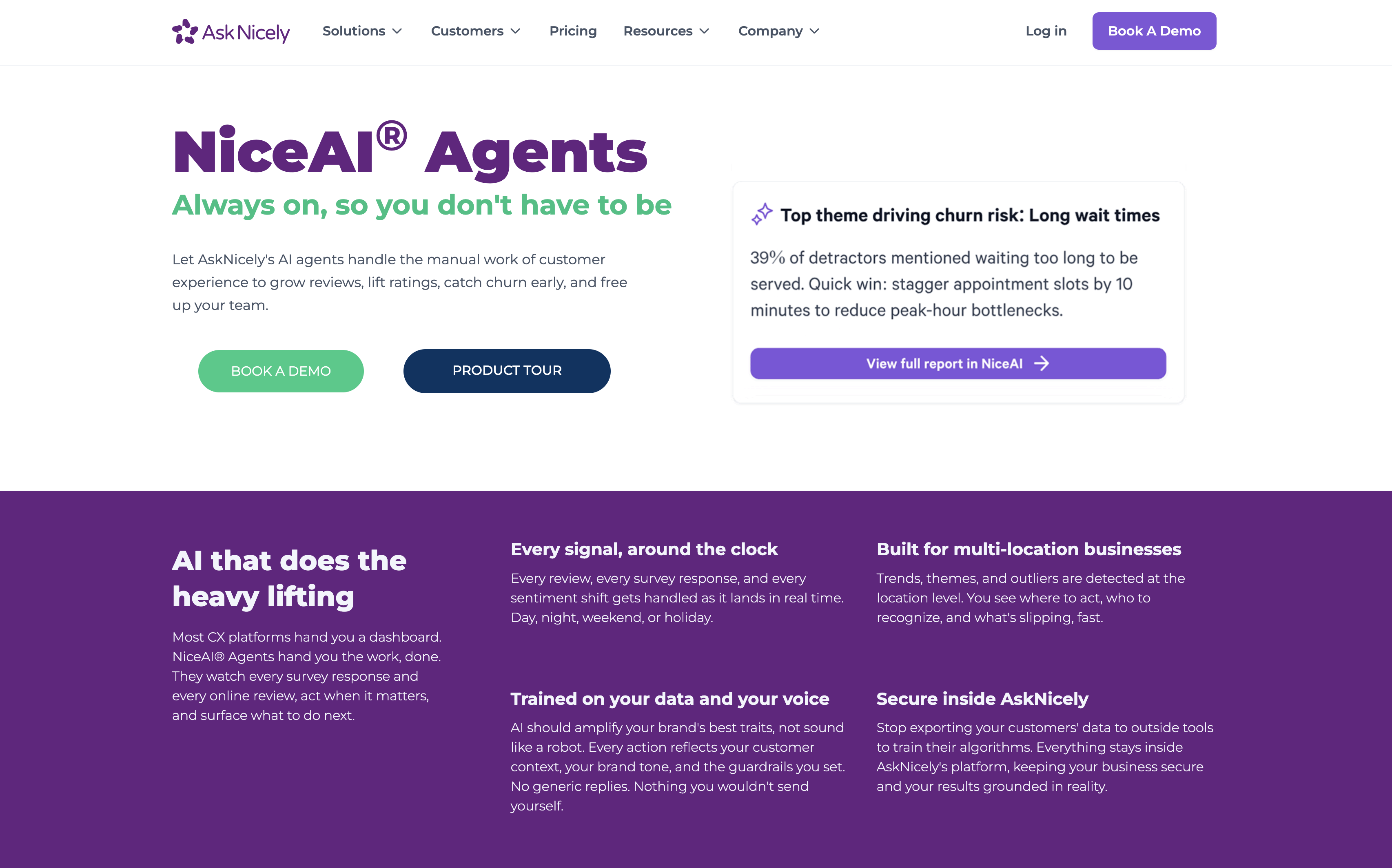
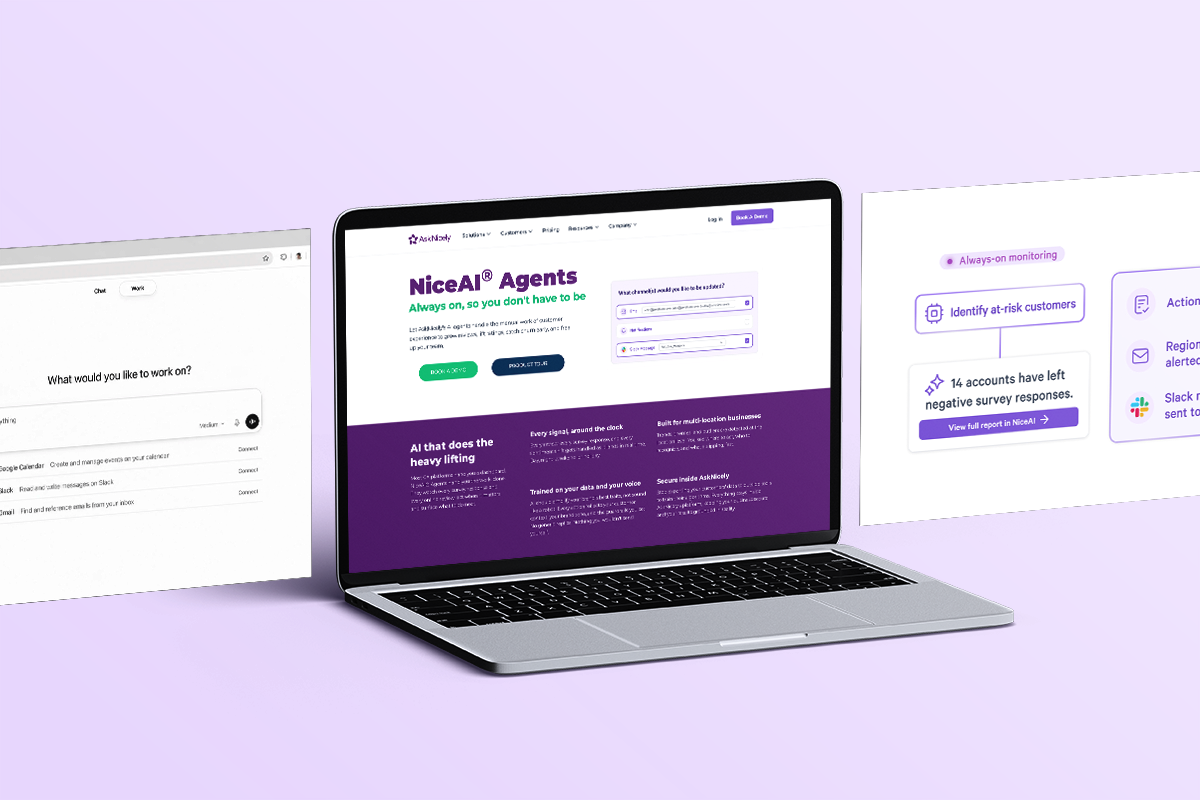
AskNicely helps organizations identify and remove friction by connecting real-time customer feedback to frontline teams. Powered by the latest AI technology, it surfaces what's working, flags what's not, and delivers the insights and recommended next steps your team needs to act, before small issues become big ones. The result is a faster, smarter feedback loop between customers and the people serving them, so frontline teams spend less time navigating systems and more time creating experiences worth talking about.
If you’re ready to help your teams spend less time navigating systems and more time creating great customer experiences, book a demo with AskNicely.