When AskNicely analyzed NPS data across thousands of service brand interactions, a pattern emerged that reframes the conventional wisdom about customer satisfaction: the gap between meeting customer expectations and exceeding them has never been larger, and neither has the reward for closing it.
Customers today don't compare you only to your direct competitors. They compare you to the best service experience they've had anywhere. The pest control company that calls back within 24 hours is competing, experientially, with the hotel that upgraded their room without being asked. The credit union that knows your name is competing with the e-commerce platform that already knew what you wanted before you searched.
This context shift is what makes the data so striking. Service brands that move their NPS by even 10–15 points see measurable downstream effects: higher retention, improved customer loyalty, more referrals, and employees who take greater pride in their work. First Commonwealth Federal Credit Union, for example, recorded an 11-point NPS gain over five months after restructuring how they collected and acted on member feedback — gains that translated directly into a reduction in member churn and an influx of unsolicited testimonials they now call "love letters."
The question isn't whether exceeding customer expectations matters. The data is unambiguous. The question is how to do it consistently, at scale, with the resources you actually have.
Customer expectations are the baseline standards customers hold when interacting with a brand. They're shaped by every touchpoint in that customer's life, not just previous interactions with your company. When expectations are met or exceeded, customers are more likely to stay loyal, refer others, and increase their spend. When they're not, the cost is real: dissatisfaction, churn, and negative word-of-mouth that spreads faster than the positive kind.
Three methods consistently give brands the clearest picture of where they stand:
Reputation Report: See how you rank online vs. competitors
Get your free AskNicely Reputation Report to uncover what customers really think and how your business compares to the competition.
The business case is concrete: higher customer retention and lifetime value.
Customers whose expectations are consistently exceeded renew, re-purchase, and expand their relationship with your brand over time.
The most common failure in customer feedback programs isn't collecting too little data. It's collecting data that never makes it to the people who can act on it.
Before implementing AskNicely, First Commonwealth Credit Union gathered member feedback, but frontline staff received minimal information and no clear direction. The feedback sat at the leadership level, disconnected from daily service decisions. After restructuring their program, each financial center began scoring on member experience, feedback went directly to frontline associates via a mobile app, and coaching became specific and timely rather than generic and quarterly. The result: an 11-point NPS increase in five months and a culture where service improvement is continuous rather than episodic.
Implementation note: The test for a healthy feedback loop is simple: can a frontline employee read this week's feedback and know exactly what to do differently tomorrow? If the answer is no, the loop is broken somewhere between collection and delivery.
Connecting customer satisfaction scores to employee recognition and compensation creates alignment between what customers value and what employees prioritize. Done well, it motivates customer service teams and surfaces your best performers. Done poorly, it creates gaming behavior or anxiety that actually degrades service.
Big Blue Bug Solutions — a New England pest control company that expanded aggressively into new states — tied survey results to quarterly and bi-annual bonuses for their field technicians. Crucially, they didn't push raw feedback directly to technicians. Instead, supervisors reviewed and contextualized negative comments before sharing them, ensuring that critical feedback was constructive rather than demoralizing. The system contributed to an average NPS of 80 and a 20% survey response rate, with over 4,000 responses collected in 2024.
Most service recovery happens reactively: a customer complains, you respond. The brands that exceed expectations flip this model and reach out before the complaint escalates into churn.
Big Blue Bug Solutions addresses negative feedback within 24 hours — detractors receive direct calls as a matter of process, not exception. This kind of rapid, personal follow-up does two things: it salvages individual relationships, and it signals to the broader customer base (through reviews and word-of-mouth) that the company takes service seriously.
First Commonwealth faced a similar challenge with member churn. Members who didn't receive the level of service they expected were quietly leaving, without ever formally complaining. By identifying experience gaps through structured feedback and acting on them quickly, they were able to intervene before dissatisfaction became departure.
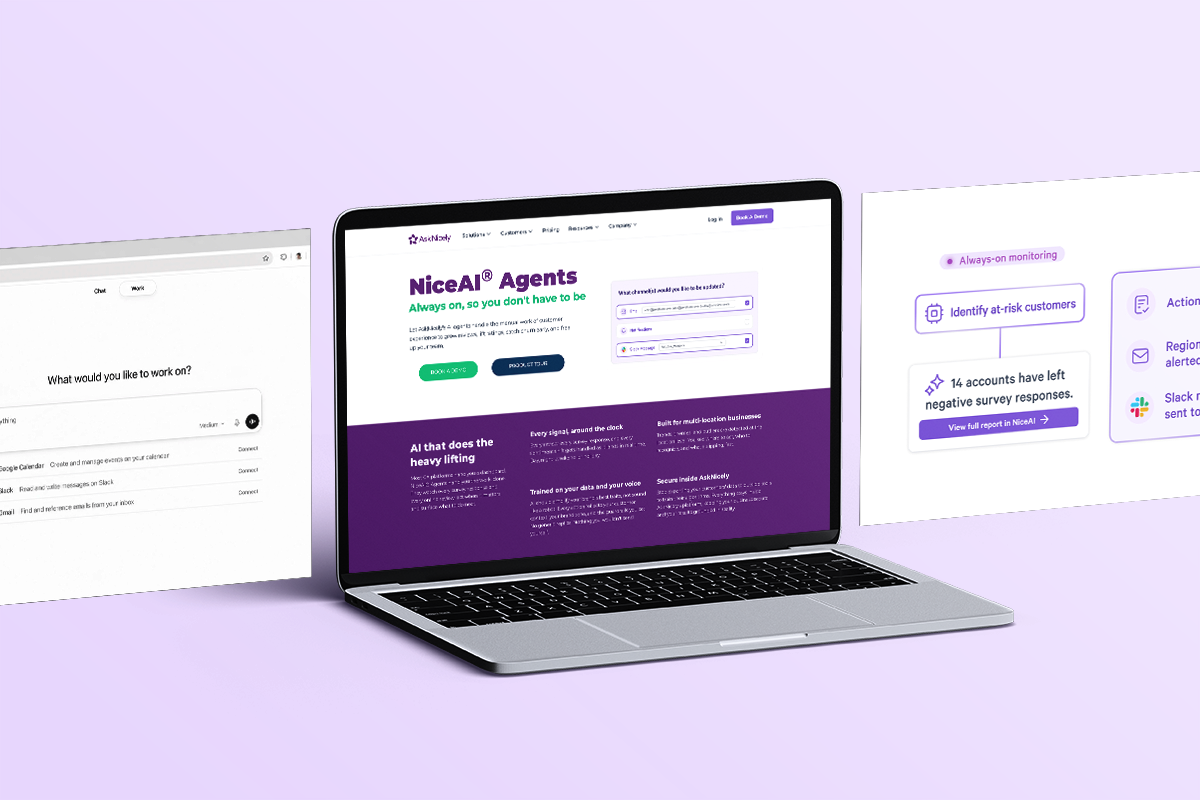
The common thread in both cases is speed — and speed at scale requires more than good intentions. This is where NiceAI® changes the equation. Rather than waiting for a manager to manually review feedback and identify at-risk customers, NiceAI continuously monitors customer sentiment across every location and channel, flagging emerging issues while they're still easy to fix. When a pattern of dissatisfaction starts forming (even before individual customers escalate) NiceAI surfaces it and suggests follow-up responses, so your team can act before the problem becomes a pattern and the pattern becomes churn.
Personalization is increasingly a baseline expectation. The challenge for most service brands is delivering personalized experiences without a team of analysts or unlimited time.
CRM systems and customer engagement platforms solve this by capturing behavioral data (purchase history, service interactions, communication preferences) that makes personalization systematic rather than improvised. A technician who arrives knowing a customer's service history, preferred contact method, and any previous complaints doesn't just seem prepared. They are prepared, and the customer notices.
The same logic applies to proactive outreach. Automated triggers (a check-in survey after a service visit, a reminder before a subscription renewal, a follow-up when a customer hasn't engaged in 90 days) feel personal even when they're automated, because the timing and content are relevant to that specific customer's situation.
Scaling consideration: personalization technology is most effective when frontline staff understand what data they're working with and why it matters. Training employees to use CRM data as a service tool — not just an administrative one — is often the missing step.
Customers interact with brands across more channels than ever: phone, email, app, in person, and social media. The experience breaks down when people have to repeat themselves, re-explain context, or get inconsistent answers depending on which channel they use.
For multi-location service brands, this is particularly acute. A customer who had a great experience at one branch expects the same experience at another. A customer who reported a problem via email expects the technician who shows up to already know about it.
Seamless omnichannel experiences require integrating systems so that history, customer preferences, and open issues are visible regardless of where the next interaction happens. It also requires consistency in service standards and training across all touchpoints — which is precisely what both First Commonwealth and Big Blue Bug Solutions used location-level feedback scoring to maintain.
Policy and procedure are necessary. They're also insufficient for exceptional service. The moments that generate "love letters" — the unexpected upgrade, the problem resolved before it was asked about, the genuinely personalized gesture — rarely fit neatly inside a script.
Empowering frontline employees to exercise judgment in service of customers requires two things: clear boundaries on what they're authorized to do, and a culture where using that authority is celebrated rather than scrutinized. Employees who fear being second-guessed for going the extra mile don't go the extra mile.
Lendmark Financial Services learned this the hard way. With over 450 branches across 21 states, they had thousands of loan consultants interacting with customers every day, but no consistent way to show those employees what "good" looked like, recognize it when it happened, or coach toward it when it didn't. Feedback only reached frontline staff when something went wrong. Great work went unacknowledged. The result was exactly what you'd expect: inconsistent service delivery, and a workforce with no clear signal about what they were supposed to be doing differently.
After implementing AskNicely, Lendmark flipped this dynamic entirely. Real-time customer feedback went directly to loan consultants, giving them an immediate view of how their customers actually experienced each interaction. Managers received their own dashboards, broken down by region and branch, with coaching prompts tied to specific feedback rather than generic performance reviews. When a loan consultant delivered an exceptional experience, they were recognized automatically, in the moment, not in a quarterly all-hands meeting.
The response was striking. When Lendmark's CMO Ethan Andelman called a branch in North Georgia to check in, he mentioned that the branch manager had already opened the AskNicely app 27 times. Her reply: "Am I obsessed or what!?" That's not the reaction of someone enduring a new corporate initiative. That's an employee who finally has the information and recognition she needs to take pride in her work.
The outcomes followed: during Lendmark's pilot period, 80% of locations saw an NPS increase, with an average gain of 15 points. Across all 450 branches, 50% have seen an NPS increase — with an average improvement of 39 points.
The lesson isn't that technology empowers frontline employees. It's that employees make better judgment calls when they can see the results of their decisions, understand what excellent service looks like in their specific context, and trust that going the extra mile will be noticed. Remove the recognition and the feedback, and you remove the foundation that good judgment is built on.
Reactive service will always have a ceiling. The brands that consistently exceed expectations develop the ability to act on what customers haven't said yet, identifying patterns that predict dissatisfaction, churn risk, or unmet needs before they surface as complaints.
The challenge is that most service brands are swimming in data but starved for insight. Survey responses pile up. NPS scores shift. Feedback arrives across dozens of locations and channels. But translating all of that into a clear answer — what's actually changing, why, and what should we do about it right now — typically requires an analyst, a BI tool, and time that frontline managers don't have.
NiceAI® is built specifically to close that gap. Rather than waiting for someone to build a report or notice a trend, NiceAI continuously analyzes feedback across every location and channel, surfacing what's shifting and explaining why — in plain language, without requiring any technical expertise to interpret. A regional manager who wants to know why CSAT dropped at three branches this month doesn't need to export data into a spreadsheet. They can ask the question directly and get an answer with supporting visuals in seconds.
This matters most at the early warning stage. Purchase frequency drops, declining survey response rates, recurring service call patterns — these are all signals that something is wrong before a customer says so explicitly. NiceAI's AI Insights feature detects these emerging issues while they're still small, flags them for the relevant teams, and suggests specific follow-up actions.
For multi-location service brands, this capability compounds. A problem that looks like an isolated incident at one branch might be a system-level issue appearing at five — but that pattern is invisible unless someone is looking across all five simultaneously. NiceAI does that continuously, so your teams spend less time analyzing and more time actually fixing things.
Not every customer interaction needs a human being. Customers who can quickly find answers, manage their accounts, or troubleshoot problems on their own or with the help of chatbots often have better satisfaction scores than those who had to call, as long as the self-service experience is actually good.
Well-organized knowledge bases, FAQs, and instructional content reduce friction, demonstrate respect for customer autonomy, and free up frontline staff for the interactions that genuinely require human judgment. The key word is "well-organized": a knowledge base that buries answers or requires multiple searches to find basic information adds friction rather than removing it.
Knowing the strategies is one thing. Putting them into practice — with limited resources, competing priorities, and teams that need to be brought along — is another. Here's what the first 30–90 days of a customer experience improvement initiative actually look like, and where the common pitfalls are.
The temptation is to lead with values and vision: "We're going to be a customer-centric organization." The problem is that culture change without operational change is just messaging.
Start instead with the mechanics: What feedback are you collecting? Where does it go? Who acts on it? If the answers to those questions are vague, the culture initiative will stall because employees won't have the information they need to behave differently.
First Commonwealth's transformation started by restructuring how feedback reached frontline teams and the culture shift followed from the operational change.
Not every strategy is equally high-leverage. For most service brands, the highest-priority investments are:
Everything else — personalization at scale, omnichannel integration, predictive analytics — builds on this foundation. Starting there gives you quick wins that builds trust, momentum and organizational buy-in.
Frontline employees are the ones who actually deliver the experience. Their skepticism or resistance to new programs is one of the most common reasons customer experience initiatives fail.
The most effective approach is involving frontline staff early: share feedback data with them before you share it with leadership, ask for their perspective on what's causing the problems the data reveals, and make it clear that feedback is a tool for their professional development, not a surveillance mechanism.
Big Blue Bug Solutions' decision to have supervisors contextualize negative feedback before sharing it with technicians reflects this principle
What "empathy employee training" actually means in practice
Generic empathy training (workshops on active listening, role-playing scripts) produces limited results because it abstracts from the specific situations employees face.
Effective empathy development uses real customer feedback as the curriculum. When a frontline associate reads a member's description of how a service failure made them feel, then discusses with their team how the situation could have been handled differently, the learning is immediate and contextualized.
Customer experience improvement without measurable goals becomes a perpetual initiative rather than a program with momentum. Set specific targets, e.g., NPS score by location, detractor callback rate within 24 hours, number of promoter referral requests, survey response rate, and review them on a consistent cadence.
KPIs create a shared language for progress that keeps teams aligned and gives leadership visibility into what's working.
Exceeding customer expectations is an ongoing commitment to staying close to customers as their needs evolve, acting on what you learn, and building the operational infrastructure that makes excellent customer service repeatable rather than accidental.
The brands that sustain it share a common characteristic: they treat customer feedback as a daily operating input. They've built systems that close the loop between what customers experience and what employees do next.
AskNicely is a tool specifically designed to help service brands exceed customer expectations every time. With powerful features like automated NPS surveys, AI categorization, easy-to-understand analytics dashboards, and automated workflows, you can identify trends, measure customer satisfaction, and track performance across all touchpoints.
Ready to see how AskNicely can help your business exceed customer expectations? Book a demo today to discover how our platform can help you improve customer satisfaction and drive long-term growth.