A customer feedback report is a structured summary of customer opinions, satisfaction scores, and key trends collected through surveys, reviews, or direct interactions, and it's one of the most powerful tools a service business can have.
Across the CX landscape, AI-driven analysis and real-time feedback loops are transforming how we turn raw customer sentiment into strategic action, making it easier than ever to spot patterns, prioritize improvements, and close the loop with customers before issues escalate.
Dealing with fragmented data, identifying actionable insights, and enabling cross-departmental collaboration still posed challenges to taking action. In fact, nearly 43% of CX professionals cite the lack of consolidated data and insights as a major hurdle to success.
That's exactly where customer feedback reports come in. By structuring feedback into digestible, actionable formats, they empower teams across the business to make informed decisions, whether it's refining a product, improving service quality, or building a more engaging customer journey.
So let's explore what makes a great feedback report, and how tools like AskNicely make acting on it effortless.
A customer feedback report is a structured document that compiles insights gathered from various feedback channels into a comprehensive and digestible summary. Its purpose is to distill large volumes of data into actionable insights, making it easier for teams across an organization to track performance, identify trends, and prioritize improvements. These reports help businesses stay aligned with customer needs and expectations, and ensure that teams are collecting feedback and acting on it effectively.
Typically, a customer feedback report includes key sections, including:
These reports are valuable to various departments within a service brand. For example, customer success teams use them to monitor satisfaction and retention trends, product development teams rely on feedback to refine offerings, and marketing teams analyze feedback to enhance messaging and campaigns. Streamlining feedback into an easy-to-digest format ensures that customer feedback reports result in insights that inform data-driven decisions across the entire company.
Service businesses are nothing without the people who make each service a stellar experience. One of the benefits of human interaction is that it’s as varied as the individual. But that brings natural inconsistencies across different locations and experiences.
One front desk associate at a fitness studio might greet every member by name; another might barely look up from the screen. One healthcare clinic might run on time and communicate clearly while another branch location across town might leave patients waiting with no explanation.
Even elite companies are vulnerable to this. A customer who has ten positive experiences can have their loyalty shaken by a single poor one, and in people-driven industries, that risk multiplies across every shift, every location, and every new hire. For multi-location businesses like franchise retail chains, healthcare clinic networks, or boutique fitness studios, maintaining a consistent customer experience isn't just a quality issue. It's a fundamental operational challenge.
This is where customer feedback reports become essential. Rather than relying on anecdotal manager observations or waiting for complaints to surface, feedback reports give leaders a structured, data-driven view of where experiences are falling short and where they're excelling. Patterns that would otherwise stay hidden become visible and actionable. If one salon branch consistently receives lower satisfaction scores around wait times, for example, a manager can pinpoint that specific location, investigate the root cause, and implement a fix, before it costs them customers. Equally importantly, when one location is outperforming the rest, that behavior can be identified, celebrated, documented, and replicated across the network.
AskNicely customer Schweiger Dermatology Group discovered that one of their busy providers was moving quickly through appointments, and their patient reported feeling rushed. “The patient shouted out on AskNicely that they felt rushed so it helped us to identify this issue, slow things down, and ultimately make the patient satisfied throughout the entire process.” Annie Lotito, Regional Manager at Schweiger told AskNicely.
In customer experience, timing is everything. A dissatisfied customer who doesn't hear from you within hours is already writing a mental goodbye, or worse, a public review. Waiting days or weeks to analyze feedback isn't just slow, it's costly. By the time insights surface through traditional reporting cycles, the customers those insights could have saved are often already gone.
Real-time feedback changes that equation entirely. With a platform like AskNicely, surveys trigger automatically the moment a service interaction ends, and insights reach frontline managers within minutes, not in the next quarterly review. That immediacy transforms feedback from a retrospective report card into a live operational tool.
The practical impact is significant. When a customer flags a frustrating experience right after their appointment, a manager can follow up the same day, turning a near-churn moment into a loyalty-building one. When an employee delivers an exceptional experience and a glowing score follows, that recognition can happen in real time, reinforcing the exact behaviors that drive great service. The gap between "something happened" and "we did something about it" shrinks from weeks to hours.
The downstream benefits compound quickly:
Simply put, the businesses that act on feedback fastest grow fastest.
The executive summary provides a high-level overview of the key findings from the feedback, offering a snapshot of the most critical insights. This section serves the highlights for senior leadership and other stakeholders, so it should focus on the most impactful takeaways — such as trends in customer sentiment, major pain points, and opportunities for improvement. A strong executive summary sets the tone for the rest of the report, highlighting the urgency and significance of the findings.
Data visualization plays a crucial role in turning raw feedback data into easy-to-understand insights. This includes charts, graphs, and infographics that visually represent key metrics such as customer satisfaction scores (CSAT), net promoter scores (NPS), sentiment analysis, or product usage trends. By using data visualization, teams can quickly identify patterns and trends that might otherwise be hidden in large datasets, making the report more digestible and impactful for decision-makers.
The analysis section presents data and explains the context and meaning behind the numbers. This section helps readers understand what the data reveals about the customer experience, highlighting strengths and weaknesses, and explaining how feedback connects to specific customer pain points or business objectives. It often includes comparisons to past performance, benchmarks, or industry standards to provide further insight.
Traditionally, the analysis stage required someone to manually sift through hundreds or sometimes thousands of individual responses, looking for patterns and synthesizing findings. That process was time-consuming, inconsistent, and prone to confirmation bias. The shift to AI-driven analysis has fundamentally changed what's possible.
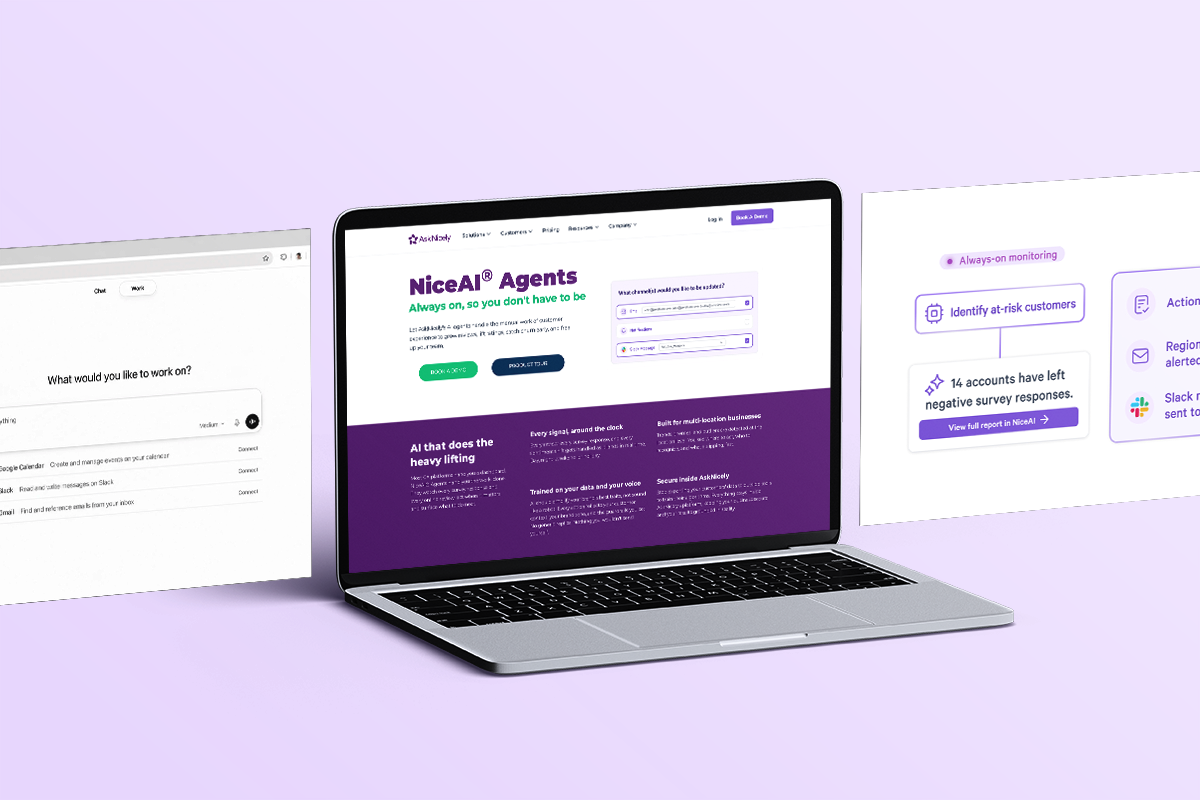
AskNicely's NiceAI automatically groups incoming feedback into meaningful themes (such as pricing concerns, service speed, staff behavior, or facility quality) without anyone having to read every response individually. Instead of a wall of raw comments, leaders see clean, plain-language summaries that tell them exactly what customers are talking about and how sentiment around each theme is trending. Or you can simply use Ask NiceAI to query your feedback like an AI chatbot and get answers instantly.
The benefits go beyond saving time. Because AI applies the same logic consistently across every piece of feedback, it removes the human tendency to over-index on the most recent or most vocal responses. It also surfaces emerging issues earlier — a subtle uptick in complaints about wait times at a specific location, for example, can be flagged before it becomes a pattern visible to the naked eye. The result is an analysis that's faster, fairer, and more actionable than anything a manual process can reliably deliver.
Data without direction is just noise. A feedback report that ends with charts and sentiment scores, however well-designed, has only done half the job. The real value of a customer feedback report lies in what happens next: the decisions it triggers, the behaviors it changes, and the improvements it drives.
This means translating findings into specific, assigned, time-bound actions. Not "we should improve wait times," but "Branch manager at location X will implement a new check-in process by the end of the month, and we'll track satisfaction scores over the following four weeks to measure impact." The difference between a report that collects dust and one that drives change usually comes down to three things:
AskNicely supports exactly this kind of follow-through. Focus areas allow leaders to align feedback themes directly to business goals, ensuring the right issues are being prioritized at an organizational level rather than addressed ad hoc.
Coaching playbooks give managers a structured framework for turning feedback into frontline development, so when a pattern of low scores around a specific behavior emerges, managers have a clear, consistent way to address it with their teams.
Hot tip: Each feedback report should close with two to three clear, measurable actions: specific enough to assign, trackable enough to evaluate, and impactful enough to matter.
Customer feedback reports can take many different formats depending on the type of feedback being collected and the objectives of the team. Below are examples of several common types of customer feedback reports, each serving a unique purpose and providing insights that can guide decision-making. These reports help teams focus on specific areas of improvement and align their strategies accordingly.
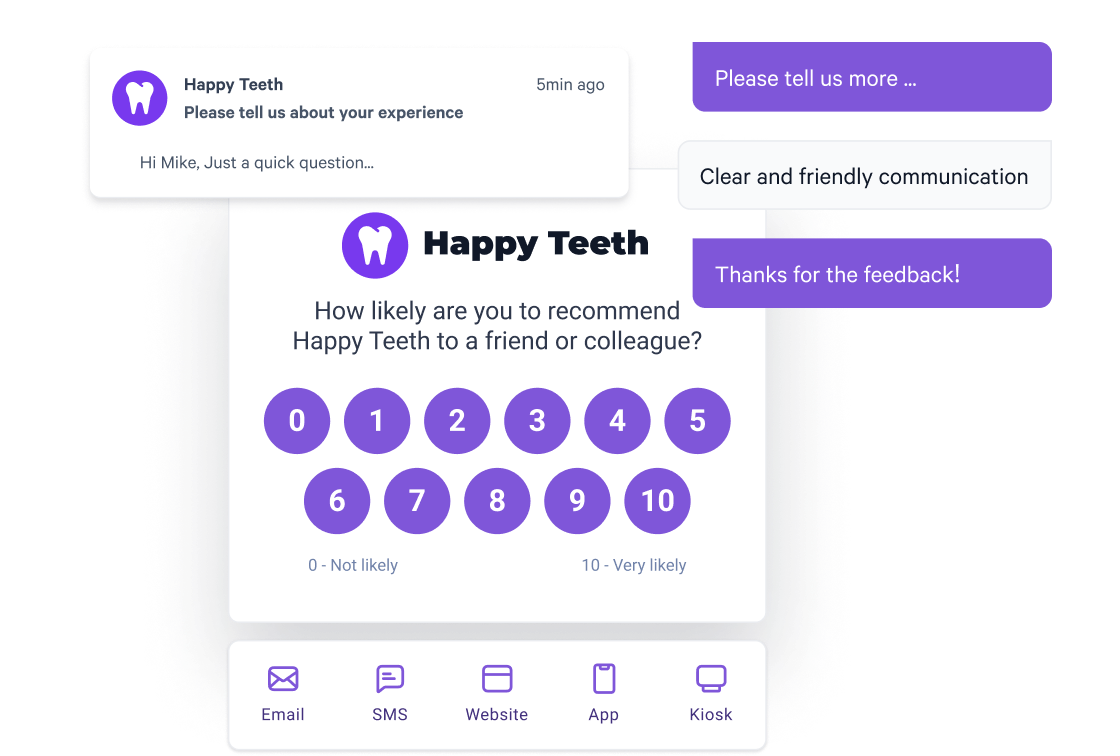
Net promoter score reports measure customer loyalty and satisfaction by gauging the likelihood of customers recommending your product or service. These reports typically feature a breakdown of scores into three categories: Promoters (9 to 10), Passives (7 to 8), and Detractors (0 to 6).
An NPS report often includes:
This type of report is crucial for identifying customer loyalty drivers and improving overall satisfaction.
Start creating your own NPS surveys using our template below:
Product feedback reports focus on gathering feedback related to specific products or features. These reports typically include customer suggestions, pain points, and overall satisfaction with the product and contain more qualitative feedback than quantitative data.
An effective product feedback report includes:
These reports are invaluable for product development teams looking to prioritize updates and enhance the user experience.
Customer service performance reports assess the effectiveness of customer service teams based on customer feedback from support tickets, chats, or calls. They often measure metrics like response time, issue resolution rates, and customer satisfaction with the service received.
A customer service performance report may include survey questions like:
These reports help customer service teams identify opportunities for training, process improvement, and ways to enhance the overall customer support experience.
Each report type serves as a valuable tool for different departments, providing them with the valuable insights they need to refine strategies and achieve better outcomes for the customer base.
Most feedback reporting focuses upward, giving leadership a view of what's happening on the ground. But some of the most powerful CX improvements happen when frontline staff and branch managers can see their own performance data and take direct ownership of it.
AskNicely's frontline empowerment tools are built around exactly this principle. Through net promoter scores (NPS) and customer satisfaction scores (CSAT), individual employees and branch managers get access to their own personal performance scorecards - a real-time view of how customers are rating their specific interactions. Rather than waiting for a top-down review, staff can see where they're excelling and where there's room to improve, creating a culture of continuous self-development rather than reactive correction.
This visibility also unlocks two powerful motivational tools. Praise features allow managers to formally recognize standout performance directly within the platform, turning a great customer score into a moment of team-wide acknowledgment. Leaderboards introduce a healthy competitive element, giving teams and locations a transparent ranking that encourages friendly rivalry around service quality.
For multi-location businesses, the impact compounds quickly. A franchise, for example, can automatically surface its top-rated stores every week, celebrate what those locations are doing well, and use AskNicely's automated digest reports to share those insights across the network — turning individual success into a replicable standard. Over time, this gamified approach to performance builds a frontline culture where delivering great customer experiences becomes a source of genuine pride.
Each report type serves as a valuable tool for different teams and roles, providing the insights needed to refine strategies and achieve better outcomes across the entire customer base.
Creating effective customer feedback reports can be challenging, especially when trying to summarize large volumes of feedback, identify biases in interpretation, and overcome internal resistance to acting on insights. However, following a set of best practices can help ensure that reports are not only informative but also actionable, ultimately driving improvements across the business.
Not everyone reading a feedback report needs the same information. A one-size-fits-all report risks burying the insights that matter most to each audience under data that's irrelevant to their day-to-day decisions. The most effective feedback reports are tailored, delivering the right insights to the right people in the right format.
Consider how needs differ across roles. An operations leader overseeing multiple locations primarily needs consistent data — which branches are underperforming, where service standards are slipping, and how performance compares across the network. A CX leader is more focused on overall sentiment trends, tracking whether customer satisfaction is improving over time, and identifying systemic issues that cut across departments. Frontline staff, meanwhile, benefit most from personal performance feedback — clear, direct insight into how their own interactions are landing with customers, and what they can do differently.
The sheer volume of customer feedback that modern businesses generate has long outpaced any team's ability to manually analyze it. Reading through hundreds of open-ended survey responses to find common themes is tedious and unreliable. Human analysts naturally gravitate toward the most recent, most dramatic, or most familiar feedback, often missing the quieter patterns that matter just as much.
Modern AI tools solve this by analyzing large datasets in seconds and surfacing the themes, trends, and anomalies that would take a person hours to find, if they found them at all. Instead of manually reading 1,000 reviews to understand what's driving dissatisfaction, AI can flag the top three recurring complaints instantly, complete with frequency data and sentiment scores. Emerging issues get caught earlier, analysis stays consistent regardless of volume, and teams spend their time acting on insights rather than hunting for them. AskNicely's NiceAI is built to do exactly this: turning raw feedback into clear, plain-language summaries that are ready to act on from the moment they arrive.
Customer feedback reports should be clear and to the point. Avoid overwhelming your audience with too much information or jargon. The goal is to highlight key insights and present them in a way that is easy to digest. Use bullet points, headers, and visuals to break down complex data and ensure that the most important takeaways stand out.
A clear and concise report increases the likelihood of engagement and action from stakeholders, who are often short on time and resources.
Using consistent metrics and key performance indicators (KPIs) across reports helps track performance over time and allows for easier comparison between different periods or feedback sets. Stick to established KPIs, such as NPS, CSAT, or customer effort score (CES), so that insights can be benchmarked effectively.
This consistency helps teams understand trends and identify areas where specific KPIs need attention or improvement. Using feedback tools for collection can be extremely beneficial here.
Creating customer feedback reports should not be a siloed task. Involve cross-departmental teams in the process, including customer success, marketing, product development, and operations. By including input from various departments, you ensure that the report captures a holistic view of the customer experience and addresses the needs of each team.
After creating and distributing the feedback report, it's essential to follow up on the insights and track how the recommended changes are being implemented. Share the actions being taken in response to the feedback with both internal teams and customers where appropriate.
Communicating these actions helps build trust with customers and shows them that their feedback is valued and acted upon, ultimately improving engagement and loyalty.
Customer experience isn't shaped in boardrooms, it's shaped in the moments when a staff member greets a customer, handles a complaint, or goes the extra mile at the end of a long shift. When frontline teams have visibility into how customers are responding to their work, they're better equipped — and more motivated — to improve it.
When it comes to acting on feedback, speed matters more than perfection. A customer who raises a concern and hears nothing for two weeks has already made up their mind about your brand. A customer who receives a thoughtful response within 24 hours is far more likely to give you another chance, and to remember that you listened.
The benchmark worth aiming for is simple: respond to negative feedback within 24 hours. This doesn't require a complete solution to the underlying issue, just an acknowledgment that the feedback has been received and is being taken seriously. AskNicely supports this through automated follow-up workflows and response templates that make closing the loop fast and consistent, even at scale. When detractors feel heard quickly, the dynamic shifts, and a fast, genuine response is often all it takes to turn a frustrated customer into a loyal one.
Not all feedback tools are built the same. Many can collect survey responses and generate a report, as we know from the AskNicely state of customer experience report, collecting data is only the beginning. What separates a basic feedback tool from a platform that actually drives improvement is how well it supports speed, frontline empowerment, and real-time action across your entire organization.
The right platform doesn't just tell you what customers think. It gets that information to the right people fast enough to do something about it, equips frontline teams to take ownership of their performance, and uses intelligence to surface what matters most without requiring hours of manual analysis.
Below are the four qualities that define a modern customer feedback platform:
The window between a customer experience and a customer's willingness to act on it is short. Surveys sent hours or days after an interaction see dramatically lower response rates and less accurate recall. More importantly, feedback that takes days to reach the right person is feedback that arrives too late to change anything.
A modern feedback platform collects responses immediately, through email, SMS, or web, triggered automatically the moment a service interaction ends. But collection speed is only half the equation. Routing matters just as much.
AskNicely automatically sends feedback to the right team or manager the instant it arrives, so a low score at a specific location doesn't sit in a central dashboard waiting for someone to notice it. It lands directly with the person who can act on it, often within minutes of the customer submitting their response. That immediacy transforms the feedback loop from a reporting mechanism into a real-time operational tool.
Most feedback platforms are designed to inform leadership. They produce dashboards and reports that give executives a view of what's happening across the business, which is valuable, but incomplete. The people who most directly influence customer experience aren't in the boardroom. They're on the floor, at the front desk, and in the field, and they need feedback too.
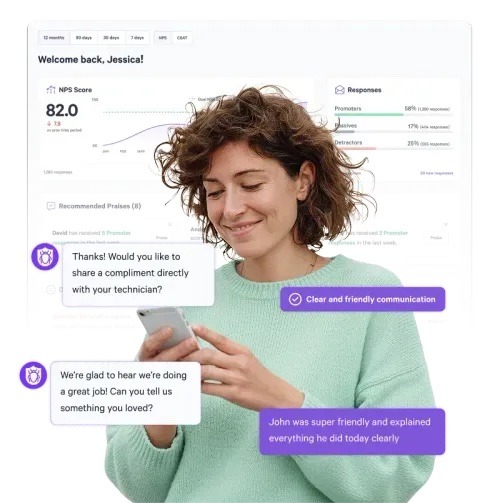
AskNicely is built around the principle that CX improvement happens when frontline staff are empowered, not just observed. NPS dashboards give individual employees and branch managers a real-time view of their own performance scores, so they can take personal ownership of their customer interactions rather than waiting for a top-down review. Focus areas align individual and team efforts to broader business goals, ensuring that improvement is directed where it matters most.
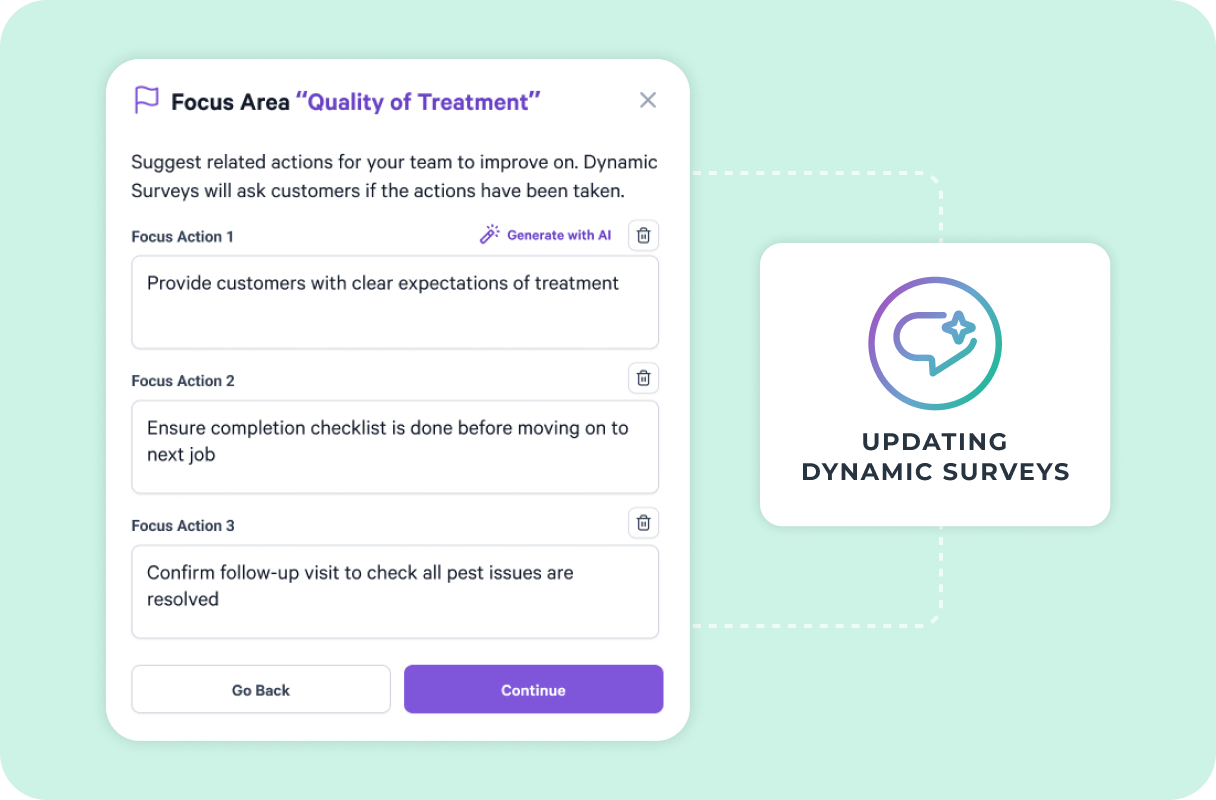
The difference is the shift from passive reporting (where data flows upward and sits in a report) to active empowerment, where insights flow outward to the people best positioned to act on them.
Some platforms offer AI as an add-on: a premium tier feature or a separate analytics module that sits alongside the core product. That approach tends to create friction: data has to be exported, processed separately, and reinterpreted before it's useful. By the time insights surface, the moment to act has often passed.
In AskNicely, AI isn't a bolt-on; it's embedded throughout the workflow. NiceAI automatically themes and summarizes incoming feedback as it arrives, groups responses into meaningful categories like service speed, staff behavior, or pricing, and delivers plain-language summaries that require no analytical expertise to interpret. This means that every user, from a regional operations manager to a first-time branch supervisor, gets intelligent, ready-to-act insights without needing a data team behind them.
This stands in contrast to enterprise platforms like Qualtrics and Medallia, which are powerful but built for large analytics teams with the time and expertise to configure complex models and interpret raw outputs. SurveyMonkey, on the other hand, offers simplicity but limited depth, making it better suited for one-off surveys than ongoing CX management. AskNicely sits in a distinct position: AI-powered depth, without the enterprise complexity — designed for businesses that need smart insights fast, not six-month implementation timelines.
Generic feedback platforms are built for generic use cases. They work reasonably well for collecting responses and visualizing data, but they're not designed with the specific operational challenges of multi-location, people-driven businesses in mind.
Franchises, service chains, healthcare clinic networks, hospitality groups, and boutique fitness brands all share the same core challenge: delivering a consistent customer experience across multiple locations, managed by different people, operating under varying conditions. That's a fundamentally different problem from managing feedback for a single product or a centralized customer service team.
Your chosen platform should reflect this. Reporting should be structured around locations and teams, not just aggregate scores. Managers at individual branches should be able to see and act on their own data, while regional leaders can compare performance across their portfolio.
Customer expectations aren't standing still, and neither is the technology that helps businesses meet them. The way service businesses collect, analyze, and act on feedback is undergoing a fundamental shift, moving from periodic measurement to continuous intelligence, and from top-down reporting to frontline-first empowerment.
Here's where things are heading:
Today, most feedback is reactive. A customer has an experience, receives a survey, submits a response, and that response informs what a business does next. The cycle works, but it's always catching up. By the time a pattern of dissatisfaction surfaces in a report, some of the customers behind it have already quietly moved on.
The next frontier is predictive feedback: using AI not just to analyze what customers said, but to anticipate what they're about to do. By identifying behavioral signals that precede dissatisfaction — a drop in survey response rates from previously engaged customers, a subtle shift in the language used in open-ended comments, a location that's trending downward week-over-week before scores become critical — AI can flag churn risk before it becomes reality.
If a cohort of repeat customers suddenly stops leaving reviews, for example, that silence is itself a signal worth investigating. Proactive businesses will use these early warnings to intervene before the relationship breaks down, rather than apologizing after it already has.
This shift from reactive measurement to proactive experience design represents a meaningful competitive advantage, and it's the direction the most sophisticated CX platforms are already moving toward.
For a long time, the rhythm of customer feedback was defined by the rhythm of reporting cycles. Feedback was collected, compiled into a monthly or quarterly report, presented to leadership, and then (if things went well) translated into action plans that might take effect weeks later. By the standards of today's customer expectations, that cadence is simply too slow.
The shift to real-time dashboards and automated digests has fundamentally changed what's possible. Rather than waiting for a scheduled review to learn that satisfaction at a particular location has been declining, managers can see that trend as it develops, and respond to it the same week or the same day. Feedback becomes a continuous signal rather than a periodic snapshot, and performance management becomes an ongoing conversation rather than a quarterly debrief.
This has meaningful implications for how service businesses are run. When frontline staff receive daily or weekly feedback summaries rather than an annual review, improvement becomes iterative and habitual rather than infrequent and high-stakes. When operations leaders can monitor consistency across locations in real time, they can intervene early rather than course-correct late. The businesses that will lead on customer experience in the coming years won't be the ones with the most sophisticated quarterly reports, they'll be the ones that have made continuous feedback a core part of how they operate every single day.
Every major advancement in CX technology over the past decade has focused on giving leadership better visibility — more data, better dashboards, smarter analytics. That investment has been valuable. But it has also left a gap: the people who most directly shape customer experiences have largely been left out of the feedback loop.
That is changing. The next frontier in customer experience isn't better executive reporting, it's deeper and more genuine frontline empowerment. Service businesses are beginning to recognize that sustainable CX improvement doesn't come from the top down; it comes from building a culture where every employee understands how their behavior affects the customer, has access to feedback about their own performance, and is motivated to improve. When a front desk associate can see their own satisfaction scores, when a branch manager receives a real-time alert after a poor experience, and when high performers are publicly recognized for the impact they're having, customer experience stops being an abstract organizational priority and starts being something people genuinely care about on a personal level.
AskNicely is a customer experience management platform designed to help service businesses collect, analyze, and act on customer feedback, in real time, at every level of the organization. With powerful tools for gathering insights through NPS, CSAT, and CES surveys, AskNicely transforms raw customer sentiment into the kind of actionable intelligence that drives meaningful, measurable improvement across every touchpoint.
Our platform makes it easy to track customer sentiment over time, identify emerging trends, and prioritize the changes that will have the greatest impact.
NiceAI automatically surfaces themes, flags risks, and generates plain-language summaries so your team spends less time analyzing and more time acting.
Dynamic Surveys adapt to each respondent in real time — adjusting questions based on previous answers to capture richer, more relevant feedback without survey fatigue. And with smart integrations across CRM, scheduling, helpdesk, and team communication tools, AskNicely fits into the workflows your teams already use, rather than asking them to build new ones around it.
Getting started is straightforward:
Customer feedback is only as valuable as what you do with it. With AskNicely, every piece of feedback becomes an opportunity to improve, and every improvement compounds into a customer experience that retains more, grows more, and earns more.
Keen to keep learning? Find everything you need to elevate your customer experience, whether you're just getting started or looking to go deeper, on the AskNicely resource hub.
A good customer feedback report goes beyond presenting data, it turns customer insights into a clear story that leads to action. The strongest reports combine quantitative metrics like NPS, CSAT, and CES with qualitative insights drawn from open-ended questions in customer feedback surveys and customer satisfaction surveys.
Effective reports also pull signals from multiple sources, including feedback forms, customer reviews, and even comments gathered through social media, to provide a fuller picture of the customer experience.
Just as importantly, the report should be structured for its audience. Leaders may want high-level trends and strategic implications, while frontline teams need specific examples and actions tied to operational improvements. The best reports close with clear recommendations tied to ongoing initiatives and a practical roadmap for improvement.
If a feedback report doesn’t influence a decision, improve feedback collection, or prompt action from the team, it hasn’t done its job.
The honest answer is: more often than most businesses currently do.
While a formal monthly or quarterly report is still valuable for strategic reviews, waiting weeks to identify issues in customer feedback surveys or customer satisfaction surveys is too slow for service businesses where experiences happen daily.
Best practice is to combine continuous, real-time dashboards powered by modern customer feedback tools with structured monthly summaries for leadership. This allows frontline managers to review feedback from rating scales, open-ended questions, and feedback forms daily or weekly, identify patterns, and act quickly.
Many organizations also segment feedback by location, team, or stage in the customer journey, such as during onboarding, to pinpoint where improvements will have the greatest impact.
Research from Bain & Company suggests that companies who close the feedback loop faster significantly outperform peers on customer retention, which means the cadence of reporting should be driven by how quickly your team can act, not simply by how often a report appears on the calendar.
AI removes the two biggest constraints in traditional feedback analysis: time and consistency.
Manually reviewing hundreds of responses from customer feedback surveys, feedback forms, and customer satisfaction surveys is slow and difficult to scale. It’s also prone to bias, the same analyst may interpret responses differently depending on context or workload.
AI-powered customer feedback tools change this by analyzing thousands of responses in seconds. They group comments from open-ended questions into meaningful themes, identify sentiment, and surface emerging patterns across customer reviews, survey responses, and other feedback collection channels.
A practical example: instead of a manager spending hours reading responses to understand why satisfaction dropped last week, AI can quickly highlight that “62% of negative comments mention long wait times during onboarding.” These insights give teams immediate direction on where to focus their improvement initiatives.
The core difference is focus. Platforms like Qualtrics and Medallia are powerful research systems designed primarily for enterprise analytics teams. They support deep research projects but often require significant setup, specialized expertise, and long implementation timelines.
SurveyMonkey, on the other hand, makes it easy to create simple feedback forms and customer feedback surveys, but it’s better suited to one-off surveys than continuous CX management.
AskNicely sits in a different category of customer feedback tools. It’s purpose-built for multi-location, service-based businesses that need to collect customer feedback continuously and turn it into action quickly. The platform makes it easy to deploy customer satisfaction surveys, analyze rating scales, surface insights from open-ended questions, and share results directly with frontline teams.
Where other platforms focus on gathering data, AskNicely emphasizes operational functionality, helping teams understand what customers are saying and what to do next.
Earned growth refers to revenue generated through loyalty, customers who stay longer, return more often, and recommend your business to others.
Research from Bain & Company, the firm that developed the Net Promoter framework, consistently shows that Promoters — customers who rate their experience a 9 or 10 — generate significantly more revenue over time and are far more likely to bring in new customers through referrals.
Customer feedback reports help businesses unlock this growth by turning feedback into actionable customer insights. By analyzing patterns across customer reviews, customer feedback surveys, and other feedback collection channels, organizations can identify what consistently creates happy customers, and replicate those experiences across locations.
For example, a franchise brand might segment feedback by location to identify which teams generate the highest NPS and strongest customer retention. By studying those behaviors and incorporating them into training, onboarding, and operational initiatives, the company can scale the practices that create loyal customers. Feedback reports provide the roadmap for building repeatable, referral-driven growth.