Medallia alternatives: Platforms for better customer experience
A smarter customer experience platform doesn’t have to come with complexity. This guide breaks down the top Medallia alternatives, highlighting what each does best, how they’re priced, and where they shine, so you can choose a solution that helps your teams collect feedback effortlessly, understand what matters most to customers, and take action that lifts your experience every day.
Medallia alternatives are customer experience management platforms that enable businesses to collect, analyze, and act on customer feedback across multiple touchpoints without the complexity and cost often associated with enterprise-grade solutions. These tools combine survey builders, real-time feedback collection, sentiment analysis, and actionable insights delivery to help organizations understand their voice of the customer (VoC) and drive data-driven decisions.
Unlike traditional market research approaches, modern Medallia competitors like AskNicely, Qualtrics, InMoment, and SurveyMonkey offer user-friendly interfaces with seamless CRM integration, omnichannel feedback capabilities, and AI-powered analytics that transform raw customer data into predictive insights about NPS, CSAT, and CES metrics, all while maintaining cost-effective pricing models suitable for businesses beyond just large enterprises.
How to choose Medallia alternatives
The biggest challenge with Medallia competitors isn't finding feature-rich platforms; it's selecting one that drives real frontline action rather than just generating dashboards for headquarters. When evaluating solutions as Medallia alternatives, look beyond surface-level functionality to ensure long-term strategic value:
Frontline enablement and distributed action: The customer experience platform should empower individual team members with personalized scorecards, real-time feedback visibility, and coaching tools. Look for solutions that push insights directly to frontline workers through mobile apps, automated digests, or team dashboards, rather than centralizing everything at headquarters.
Multi-location performance management: Assess whether the platform tracks and compares performance across dozens or hundreds of locations simultaneously. Key capabilities include location-specific goal setting, regional leaderboards, and the ability to identify underperforming sites quickly for corrective action.
Real-time resolution and case management: The system should route customer feedback instantly to appropriate teams with built-in workflow automation. Evaluate response inbox features, smart routing capabilities, and CRM integration for seamless issue resolution.
AI-powered recognition and motivation tools: Look for platforms that automatically surface positive customer comments for team recognition. The solution should incorporate gamification elements, distribute praise through Slack or Teams, and provide dynamic goal recommendations based on actual performance data.
Adaptive survey intelligence: The platform should go beyond static survey templates, offering dynamic surveys that adjust based on team performance, past responses, and current goals. This includes smarter question logic, higher response rates through omnichannel delivery (SMS, email, web), and the ability to trigger follow-up actions automatically based on sentiment analysis.
Top Medallia alternatives
Here's a quick view of the top Medallia alternatives, before we dive into each tool in detail.
Learn: $449/mo; Grow: $849/mo; Transform: $999/mo; Annual, unlimited users; SSO add-on $1,500/yr; Plans >$9,600/yr include CSM & Activation; Most plans have no setup fees.
Ideal Customer
B2C, multi-location service organizations (wellness, home services, hospitality, education, fitness, franchise).
Pros
Easy UI; Strong automation & alerts; Motivates teams (TV/leaderboards); Time savings via consolidation.
Cons
No free trial; Annual contract limits (changes at term end); Response-based pricing/overages; Entry tier lacks Slack/Teams & reviews; Large/custom setups can be complex.
Qualtrics
Products & Features
CX Suite (omnichannel, AI recommendations, workflows); Digital Experience Analytics; Contact Center Analytics; Online Reputation Management; Employee Experience; Strategic Research (including video analytics).
Key Use Cases
Voice of the Customer (VoC) programs; Employee engagement; Brand & reputation monitoring; Digital optimization; Location-based insights.
Pricing
Three suites, priced by interactions (responses, video mins, social/brand) or employee count; Unlimited users; Flexible license allocation.
Ideal Customer
Mid-to-large enterprises with complex, cross-functional experience management needs.
Pros
Broadest coverage (CX/EX/Research); Powerful analytics; Deep integrations.
Cons
Steep learning curve; Can be expensive at scale; Overkill for simple survey needs.
InMoment
Products & Features
XI Platform (unified signals); AI-Powered Active Listening (conversational); Text Analytics (Lexalytics heritage); Closed-Loop management; Reputation Management; Moments mobile app.
Packages include Integrated CX, Surveys, Conversational Intelligence, Reputation, Advanced Analytics & AI, Digital Listening, Employee EX; Service levels range from self-serve to white-glove; ROI claim: 12–25 months.
Strong text analytics; Unified platform view; Usable interface; Responsive support.
Cons
Learning curve for customization/time filters; Cost can rise with modules; Reporting/filtering can feel complex/slow.
Forsta
Products & Features
HX Platform (CX/EX/Research in one); Survey/feedback across channels; Advanced analytics (text/sentiment/voice sentiment); Online qualitative tools (Discussions, InterVu, Vision); Data visualization & reporting; Enterprise branding/white-label.
Key Use Cases
CX management; EX programs (engagement/360/lifecycle); Product testing & pricing studies; Market/consumer research; Digital experience optimization.
Pricing
Quote-only (no trial/freemium); reviewers note pricey; Some advanced question types may require self-host fees.
Ideal Customer
Mid-to-enterprise organizations consolidating CX/EX/Research with advanced analytics & branding control.
Pros
Comprehensive/integrated stack; Strong analytics; Flexible customization/branding; Good support.
Cons
Learning curve; Can be complex for smaller teams; Integration/migration can be challenging.
SurveyMonkey
Products & Features
Genius with AI + AI Analysis Suite; Market Research solutions (Audience, concept/package tests); Forms (including payments via Stripe); 200+ integrations; Advanced analytics (sentiment, stats, text/thematic, multi-survey).
Key Use Cases
CSAT/NPS; Employee feedback/360; Website & product feedback; Event registration & post-event; Market research with audience targeting.
Pricing
Basic free (10 questions / 25 responses); Individual Advantage $39/mo; Team Advantage $30/user/mo (min 3); Team Premier $92/user/mo; Enterprise custom.
Ideal Customer
Teams of all sizes needing fast surveys, integrations, and market research add-ons.
Pros
Very easy to use; Large template library; Reliable; Rich features for logic/branching.
Cons
Free plan limits; Many advanced features in higher tiers; Learning curve for complex logic/API; Annual response caps + overage fees.
GetFeedback
Products & Features
Multi-channel capture (email/SMS/web/app/in-product); Real-time dashboards & CX metrics (NPS/CSAT/CES); AI text analytics; Workflow automation; Integrations (Salesforce, Zendesk, Slack, MS Teams).
Mid-size to enterprise CX teams needing real-time, omnichannel insights (often Salesforce-centric).
Pros
User-friendly builder; Deep Salesforce integration; Responsive support; Mobile-optimized surveys.
Cons
Limited branding depth for some; May need exports for advanced analytics; Pricing can pinch smaller orgs; Learning curve for advanced logic/integrations.
Alchemer
Products & Features
Survey (40+ question types, logic, multilingual); Digital (in-app/web feedback); Pulse (AI text analytics); 400+ integrations (bi-directional); Research services.
Key Use Cases
CX management (NPS/CSAT); Market research (incl. conjoint/MaxDiff); Product development feedback; Support CSAT; Digital journey improvement.
Pricing
Collaborator: $55/mo; Professional: $165/mo; Full Access: $275/mo (max 3 users each); Business Platform: custom; 14-day trial; free plan; nonprofit discounts.
Ideal Customer
Mid-size to enterprise organizations wanting robust surveys/analytics without enterprise complexity.
Pros
Fast onboarding; Intuitive & reliable; Broad functionality; Helpful support.
Cons
Can be pricey vs peers; Reporting customization limits; Some learning curve on complex logic; Sporadic onboarding/support friction.
Reporting depth could be richer; Filters/idea grid can feel clunky at scale; Some performance/mobile gaps; Workflow intuitiveness can lag as usage grows.
Learn: $449/mo; Grow: $849/mo; Transform: $999/mo; Annual, unlimited users; SSO add-on $1,500/yr; Plans >$9,600/yr include CSM & Activation; Most plans have no setup fees
B2C, multi-location service organizations (wellness, home services, hospitality, education, fitness, franchise)
Easy UI; Strong automation & alerts; Motivates teams (TV/leaderboards); Time savings via consolidation
No free trial; Annual contract limits (changes at term end); Response-based pricing/overages; Entry tier lacks Slack/Teams & reviews; Large/custom setups can be complex
Qualtrics
CX Suite (omnichannel, AI recommendations, workflows); Digital Experience Analytics; Contact Center Analytics; Online Reputation Management; Employee Experience; Strategic Research (including video analytics)
Voice of the Customer (VoC) programs; Employee engagement; Brand & reputation monitoring; Digital optimization; Location-based insights
Three suites, priced by interactions (responses, video mins, social/brand) or employee count; Unlimited users; Flexible license allocation
Mid-to-large enterprises with complex, cross-functional experience management needs
Broadest coverage (CX/EX/Research); Powerful analytics; Deep integrations
Steep learning curve; Can be expensive at scale; Overkill for simple survey needs
InMoment
XI Platform (unified signals); AI-Powered Active Listening (conversational); Text Analytics (Lexalytics heritage); Closed-Loop management; Reputation Management; Moments mobile app
Packages include Integrated CX, Surveys, Conversational Intelligence, Reputation, Advanced Analytics & AI, Digital Listening, Employee EX; Service levels range from self-serve to white-glove; ROI claim: 12–25 months
Strong text analytics; Unified platform view; Usable interface; Responsive support
Learning curve for customization/time filters; Cost can rise with modules; Reporting/filtering can feel complex/slow
Forsta
HX Platform (CX/EX/Research in one); Survey/feedback across channels; Advanced analytics (text/sentiment/voice sentiment); Online qualitative tools (Discussions, InterVu, Vision); Data visualization & reporting; Enterprise branding/white-label
CX management; EX programs (engagement/360/lifecycle); Product testing & pricing studies; Market/consumer research; Digital experience optimization
Quote-only (no trial/freemium); reviewers note pricey; Some advanced question types may require self-host fees
Mid-to-enterprise organizations consolidating CX/EX/Research with advanced analytics & branding control
Comprehensive/integrated stack; Strong analytics; Flexible customization/branding; Good support
Learning curve; Can be complex for smaller teams; Integration/migration can be challenging
SurveyMonkey
Genius with AI + AI Analysis Suite; Market Research solutions (Audience, concept/package tests); Forms (including payments via Stripe); 200+ integrations; Advanced analytics (sentiment, stats, text/thematic, multi-survey)
CSAT/NPS; Employee feedback/360; Website & product feedback; Event registration & post-event; Market research with audience targeting
Basic free (10 questions / 25 responses); Individual Advantage: $39/mo; Team Advantage: $30/user/mo (min 3); Team Premier: $92/user/mo; Enterprise: custom
Teams of all sizes needing fast surveys, integrations, and market research add-ons
Very easy to use; Large template library; Reliable; Rich features for logic/branching
Free plan limits; Many advanced features in higher tiers; Learning curve for complex logic/API; Annual response caps + overage fees
GetFeedback
Multi-channel capture (email/SMS/web/app/in-product); Real-time dashboards & CX metrics (NPS/CSAT/CES); AI text analytics; Workflow automation; Integrations (Salesforce, Zendesk, Slack, MS Teams)
Mid-size to enterprise CX teams needing real-time, omnichannel insights (often Salesforce-centric)
User-friendly builder; Deep Salesforce integration; Responsive support; Mobile-optimized surveys
Limited branding depth for some; May need exports for advanced analytics; Pricing can pinch smaller orgs; Learning curve for advanced logic/integrations
Alchemer
Survey (40+ question types, logic, multilingual); Digital (in-app/web feedback); Pulse (AI text analytics); 400+ integrations (bi-directional); Research services
CX management (NPS/CSAT); Market research (incl. conjoint/MaxDiff); Product development feedback; Support CSAT; Digital journey improvement
Collaborator: $55/mo; Professional: $165/mo; Full Access: $275/mo (max 3 users each); Business Platform: custom; 14-day trial; free plan; nonprofit discounts
Mid-size to enterprise organizations wanting robust surveys/analytics without enterprise complexity
Fast onboarding; Intuitive & reliable; Broad functionality; Helpful support
Can be pricey vs peers; Reporting customization limits; Some learning curve on complex logic; Sporadic onboarding/support friction
Reporting depth could be richer; Filters/idea grid can feel clunky at scale; Some performance/mobile gaps; Workflow intuitiveness can lag as usage grows
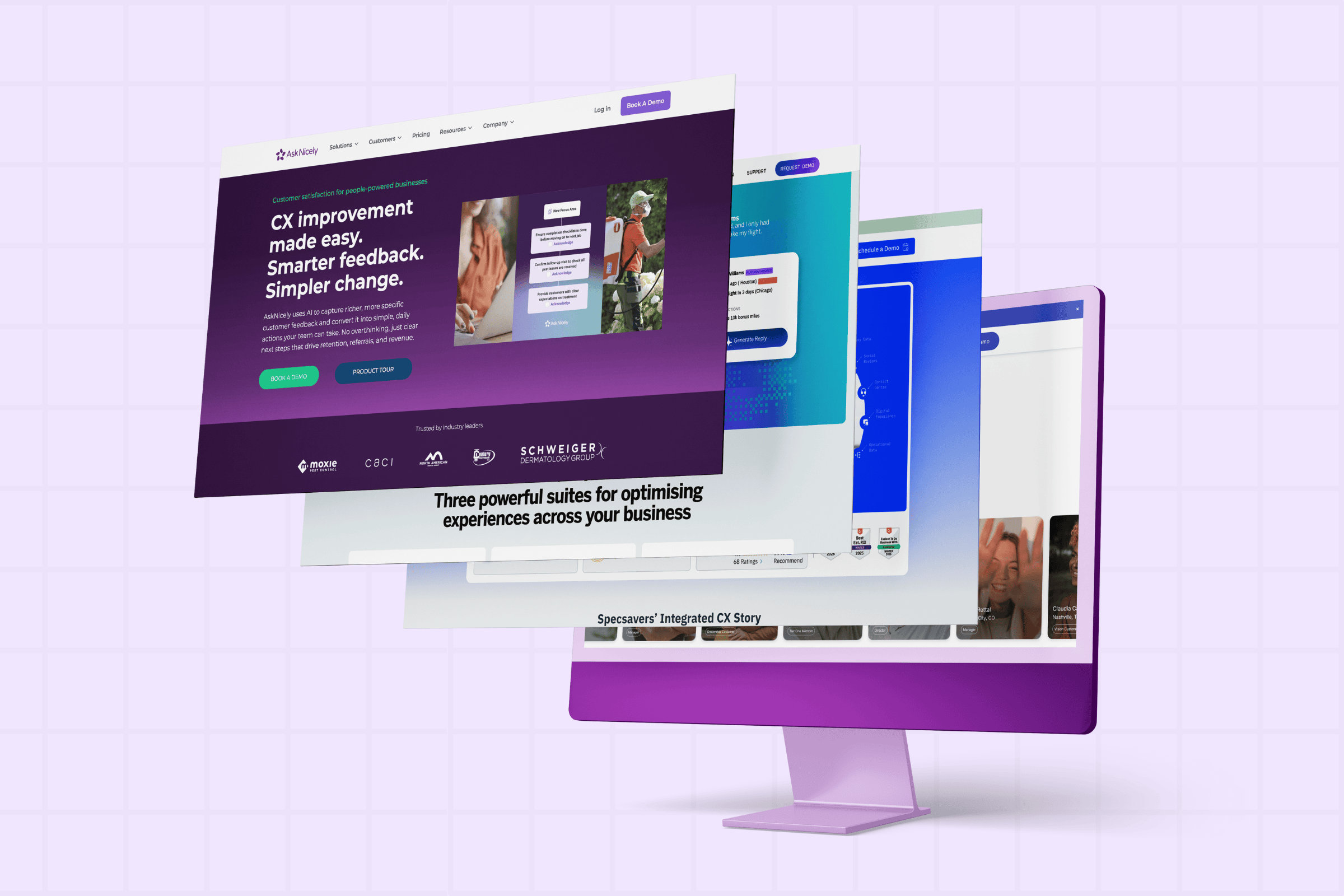
What is AskNicely?
AskNicely is a customer experience platform built for service businesses that want to do more than collect reviews — they want to build world-class customer experiences that generate genuine loyalty, organic referrals, and real business growth. By connecting real-time customer feedback to team performance, AskNicely helps businesses improve every interaction that drives satisfaction and repeat business.
AskNicely - Key products and features
NiceAI: AskNicely’s generative AI assistant adapts survey questions in real-time, analyzes customer sentiment, and turns even negative feedback into constructive insight.
Customer feedback surveys: Collect NPS, CSAT, or 5-star feedback through email, SMS, QR codes, or embedded widgets. Conversational formats keep response rates high and survey fatigue low.
Feedback analytics: Real-time dashboards with AI-powered text and sentiment analysis. Automatically track CX performance, generate presentation-ready reports, and share insights across all locations.
Automated workflows: Trigger surveys after customer interactions, automate follow-ups, and route issues to the right people before they hit public review sites.
Frontline coaching and recognition: Turn customer feedback into teachable moments with coaching playbooks, shoutouts, and recognition tools to celebrate wins and elevate service standards.
Performance leaderboards: Motivate teams with transparent CX rankings and goal tracking at the employee, team, and organizational levels.
Reputation management: Convert positive feedback into online reviews with one click, driving a 3x increase in review volume while maintaining authenticity.
AskNicely - Key use cases
Multi-location service business management: Ensure consistent service quality with centralized feedback tracking and location-based filtering.
Frontline team coaching: Empower managers to recognize, coach, and motivate employees based on real customer insights.
Customer issue resolution: Identify and resolve problems before they turn into public complaints.
Review generation: Surface promoters and invite them to share their experiences publicly — achieving up to a 10% increase in Google reviews.
CX performance measurement: Track and improve NPS, CSAT, and 5-star ratings with response rates averaging 15%.
AskNicely pricing
Three-tier pricing structure with annual billing:
Learn plan: CSAT and NPS surveys, unlimited users, AI-powered surveys, automated workflows, reports, and leaderboards.
Grow plan: Everything in Learn plus AI insight reports, real-time TV display, Slack/Teams integration, review requests, and testimonials.
Transform plan: Everything in Grow plus in-app surveys, white-label surveys, unlimited API access, CX goals, and frontline coaching.
AskNicely helps you earn new reviews by transforming your customer experience from the inside out. Instead of pushing all feedback to public forums, AskNicely gives you the insights to solve problems privately, coach teams effectively, and celebrate promoters publicly.
With over 100 integrations, AI-powered analytics, and proven ROI (including a 15% average response rate and a 3x increase in positive reviews), AskNicely delivers measurable CX improvements that drive loyalty, referrals, and growth.
Who they're ideal for
Multi-location service businesses, in pest control, home services, property management, and wellness, that want to:
Improve service quality and consistency across teams
Retain and motivate frontline staff
Turn customer feedback into measurable business growth
Pros of AskNicely
Solves problems before they go public: Automatically alerts teams to issues before they hit review sites.
Built for frontline coaching: Exclusive tools like report cards, recognition, and coaching playbooks empower staff improvement.
Real-time reporting: Live dashboards show current CX performance — no manual report generation required.
Automation saves time: Survey distribution, alerts, and reporting run automatically, saving hours of admin each week.
Easy implementation: Seamless CRM integrations and intuitive design make rollout fast and frictionless.
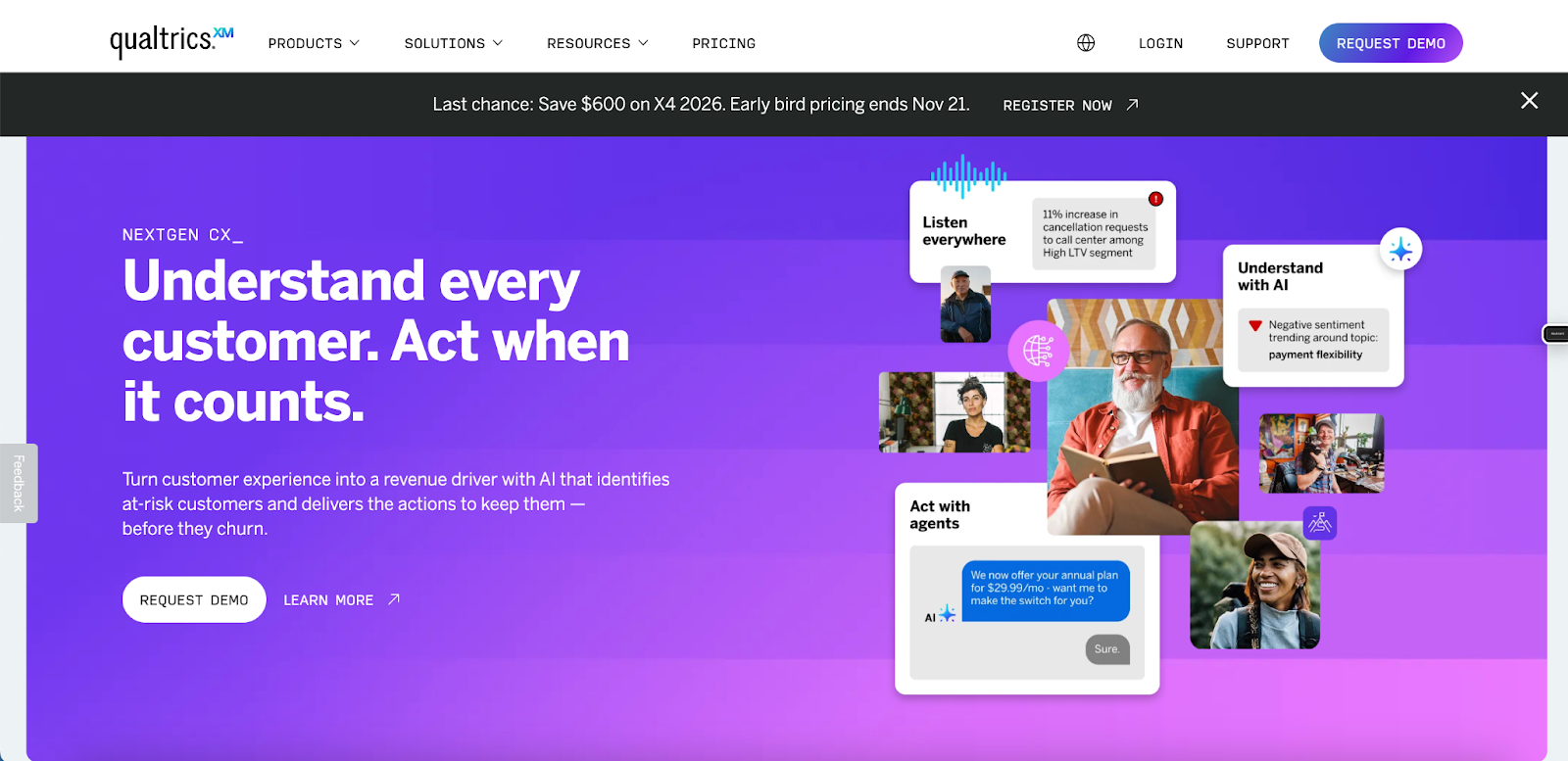
Qualtrics is an enterprise-grade experience management platform built for large organizations that need to collect, analyze, and interpret feedback across multiple customer and employee touchpoints. Designed for complex environments, Qualtrics centralizes insights from surveys, digital interactions, and operational data to help companies understand sentiment, identify trends, and benchmark performance at scale.
Qualtrics – Key products and features
Multi-experience feedback collection: Gather input from surveys, social channels, websites, embedded widgets, and more — giving enterprises a unified view of customer and employee experiences.
Advanced analytics: AI-driven text, sentiment, and predictive analytics surface patterns in large datasets, helping teams identify risks and opportunities faster.
Survey customization: Build highly tailored surveys with advanced logic, branching, and branded design options to fit complex enterprise needs.
Employee experience tools: Capture employee sentiment, track engagement, and analyze workforce insights to improve culture and performance.
Benchmarking capabilities: Compare internal metrics with industry standards to understand how your organization stacks up.
Qualtrics – Key use cases
Enterprise-level feedback management: Ideal for organizations that need to manage feedback programs across multiple business units, regions, or lines of service.
Deep analytics and research: Supports teams conducting complex quantitative and qualitative research requiring advanced statistical tools.
Customer and employee sentiment tracking: Monitor experiences at scale and measure how changes in service, product, or operations affect overall satisfaction.
Industry benchmarking: Evaluate performance against sector benchmarks to guide strategy and resource planning.
Qualtrics pricing
Pricing is available by request and varies based on organizational size, feature requirements, and deployment scope.
Who they’re ideal for
Large enterprises across industries, including those in the finance, government, healthcare, and retail industries, that need to:
Conduct large-scale research and sentiment analysis
Benchmark performance across regions or units
Centralize customer and employee experience management
Pros of Qualtrics
Comprehensive platform coverage: The platform provides extensive capabilities across customer, employee, and research domains, enabling organizations to manage all experience data in a single, centralized location.
Strong analytics and reporting: Users benefit from powerful analytical tools that help uncover insights and track trends across various data sources.
Integration capabilities: The solution integrates well with existing enterprise systems, enabling seamless data flow and workflow automation.
Complexity for simple needs: Organizations with straightforward survey requirements may find the platform overly complex for basic use cases.
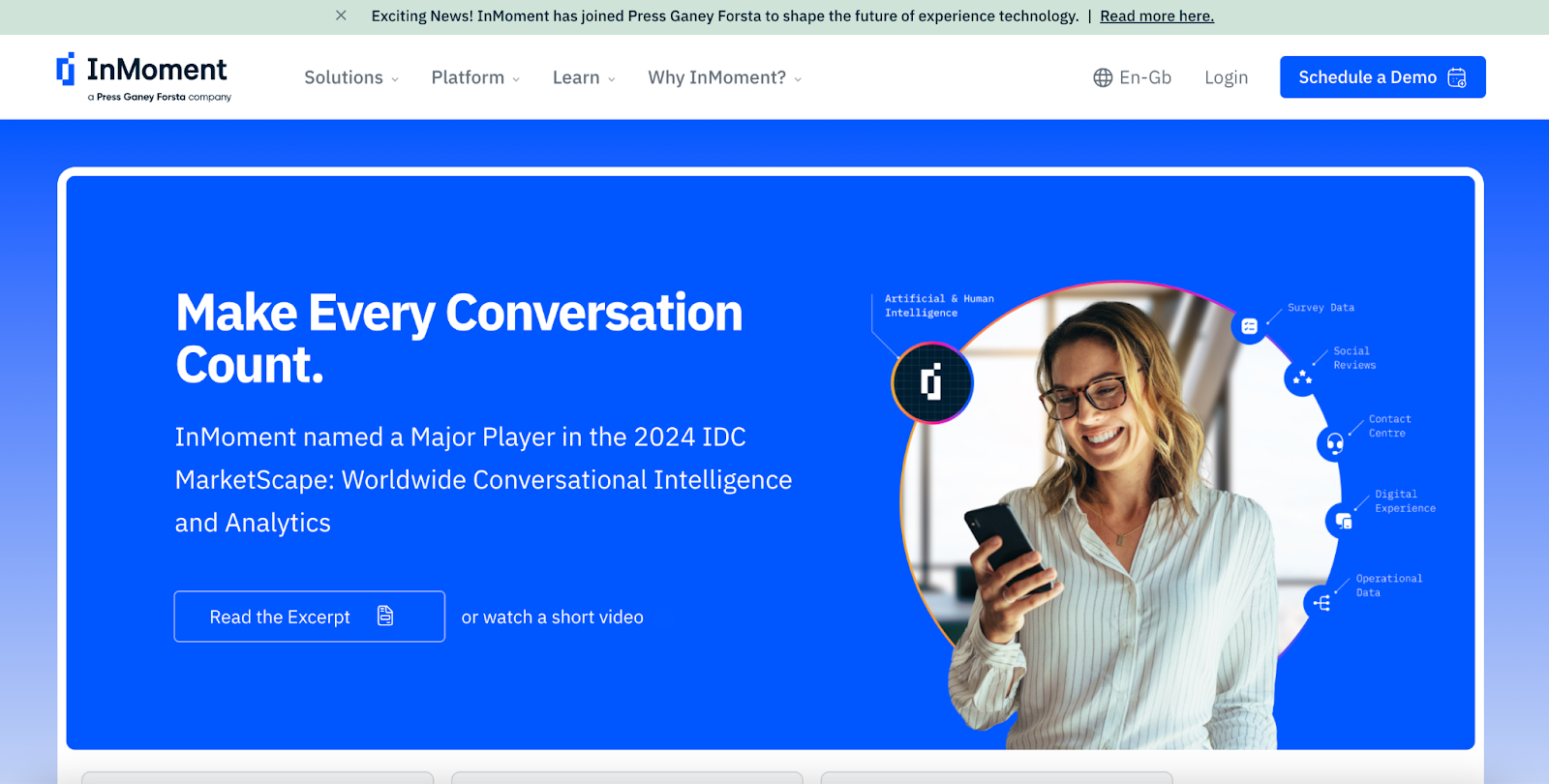
What is InMoment?
InMoment is a customer experience management platform that combines AI-powered analytics, omnichannel feedback collection, and action management tools to help organizations improve customer and employee experiences.
InMoment - Key products and features
InMoment - Key products and features
XI platform: The core experience management platform integrates customer signals and provides AI-powered operational guidance for real-time feedback. It includes capabilities for listening, reporting, analyzing, and optimizing experiences across the entire customer journey with advanced analytics.
AI-powered active listening: Patented conversational survey technology uses real-time text analytics and generative AI to intelligently respond to customers, eliciting richer feedback than traditional survey tools while improving response rates.
Text analytics engine: Powered by the Lexalytics acquisition, this functionality combines 19+ years of AI and NLP expertise with over 100 machine learning models to analyze structured and unstructured survey data, extracting themes, sentiment analysis, emotion, effort, and intent from customer feedback.
Closed-loop management: Enables organizations to create, search, and update cases with automated alerts, ensuring customer issues are addressed immediately at every level, with AI-generated response capabilities for streamlined resolution and improved retention.
Reputation management: Helps organizations generate, respond to, and amplify online reviews using AI, while optimizing business listings to improve search visibility and build customer satisfaction.
Conversational intelligence: Ingests and analyzes conversational data from calls, chats, and email threads to understand contact reasons and improve both team and user experience through multi-speaker text analytics.
InMoment - Key use cases
Omnichannel feedback collection: Collecting customer experience data from surveys, social reviews, call transcripts, chat logs, and operational systems provides a complete view of touchpoints throughout the customer journey.
Predictive customer analytics: AI detects customer intent and predicts next actions (purchase, recommend, complain, or churn), enabling proactive intervention to prevent negative experiences.
Automated issue resolution: Natural language processing automatically resolves customer issues in real-time through the Rapid Resolution Engine, reducing call center volume and support tickets.
Employee experience management: Collecting employee feedback, combined with HRIS data, predicts and prevents employee churn, with analytics showing a reduction of up to 70% in turnover at participating locations.
Action planning and coaching: Provides automated, role-based recommendations based on customer data, helping managers create standardized workflows across the organization.
InMoment pricing
InMoment offers multiple packages, including Customer Feedback Surveys, Conversational Intelligence, Reputation Management, Advanced Analytics and AI, Digital Listening, and Employee Experience, with an Integrated CX package that bundles all these solutions. The company offers flexible pricing models, including self-service, guided approach, and fully managed options. Pricing flexibility is rated 4.8/5 on Gartner Peer Insights compared to other Qualtrics competitors.
Who they're ideal for
InMoment suits enterprise-level organizations across retail, financial services, healthcare, transportation, and hospitality, managing complex, multi-channel customer experiences. The platform particularly fits companies with mature CX programs seeking to integrate feedback tools from multiple sources, leverage AI for predictive insights, and demonstrate measurable ROI from experience improvements, unlike solutions better suited for startups or small businesses.
Pros of InMoment
Strong text analytics capabilities: The platform's NPS, CSAT, and CES analysis engine effectively analyzes unstructured user feedback, providing deep sentiment analysis beyond basic categorization.
Comprehensive integration options: InMoment integrates seamlessly with CRM systems, including Salesforce, Zendesk, Marketo, HubSpot, Microsoft Dynamics, and Slack, enabling automated survey invitations and data flow.
Complexity for small businesses: Extensive features and enterprise focus may overwhelm smaller organizations. Companies without dedicated CX teams might struggle to leverage full platform capabilities effectively.
Integration requirements: While offering extensive API connectivity with Salesforce, Zendesk, and other enterprise tools, technical setup requirements can extend deployment timelines for complex tech stacks.
Challenges in customisation and speed of changes: Feedback includes complaints about slow turnaround for small tweaks, difficulty in doing ad‑hoc reports or integrations without technical support
What is Forsta?
Forsta is a human experience platform providing comprehensive tools for gathering, analyzing, and acting on customer, employee, and market insights, enabling organizations to understand the full human experience through surveys, feedback management, and advanced analytics.
Forsta - Key products and features
Survey software and feedback management: Customizable surveys with voice of customer and voice of employee capabilities, capturing feedback across touchpoints and channels.
Advanced analytics and text analytics: Centralized data hub with exploratory analysis, voice sentiment analysis, and emotion detection, uncovering the 'why' behind customer behaviors.
Interactive dashboards and reporting: Data visualization tools including infographic storytelling, interactive dashboards, and mobile reporting, delivering insights as compelling stories.
Digital communities and diaries: Platform capturing in-the-moment insights through activity-based diary entries and mini social media-style communities with 80% completion rates.
Online focus groups and digital interviews: Tools including Forsta Discussions, InterVu, and Vision, conducting DIY or full-service online focus groups and one-on-one interviews.
Action workflow and automation: Mobile notifications, automated workflows, and management trackers, getting insights to the right people for immediate action.
Enterprise branding: White-label capabilities allowing organizations to brand surveys, dashboards, and invitations with their visual identity.
Forsta - Key use cases
Customer journey mapping: Track and optimize every interaction from search to post-purchase, enabling personalized digital journeys and reducing cart abandonment.
Brand perception management: Measure awareness, track net promoter score, monitor social sentiment, and manage customer reviews at national and local levels.
Product development and testing: Test market viability, pricing strategies, product names, and packaging designs before launch, reducing risk and optimizing market fit.
Employee experience management: Conduct engagement surveys, 360-degree feedback, and lifecycle assessment, improving retention and productivity.
Operational efficiency: Connect feedback with operational and financial data, reducing costs, improving service performance, and accelerating time-to-market.
Market research and competitive analysis: Investigate new markets, analyze competitor positioning, and understand target audiences through comprehensive research tools.
Forsta pricing
Forsta does not have a public pricing page, with pricing available via request.
Who they're ideal for
Enterprise organizations and mid-to-large businesses needing comprehensive platforms managing customer and employee experiences, particularly CX professionals, insights leads, market researchers, and CMOs requiring advanced analytics, breaking down data silos, and understanding customers as complete humans rather than datasets.
Pros of Forsta
Comprehensive platform integration: All research and experience management tools in one unified platform, eliminating the need for multiple point solutions.
Strong analytics capabilities: Advanced analytics and data visualization tools uncover deep insights and create compelling reports.
Flexible and customizable: Extensive customization options for surveys, dashboards, and reporting, matching specific business needs.
Professional services support: Expert support teams assisting with everything from onboarding to managing entire Voice of Customer programs.
High cost for full functionality: Some users report that even after implementation, the full-featured modules (e.g., advanced reporting or dashboard licences) incur additional fees.
Performance and stability issues with large datasets: Users have noted sluggish performance or “clunky” behaviour when working with very large datasets or complex analytics tasks.
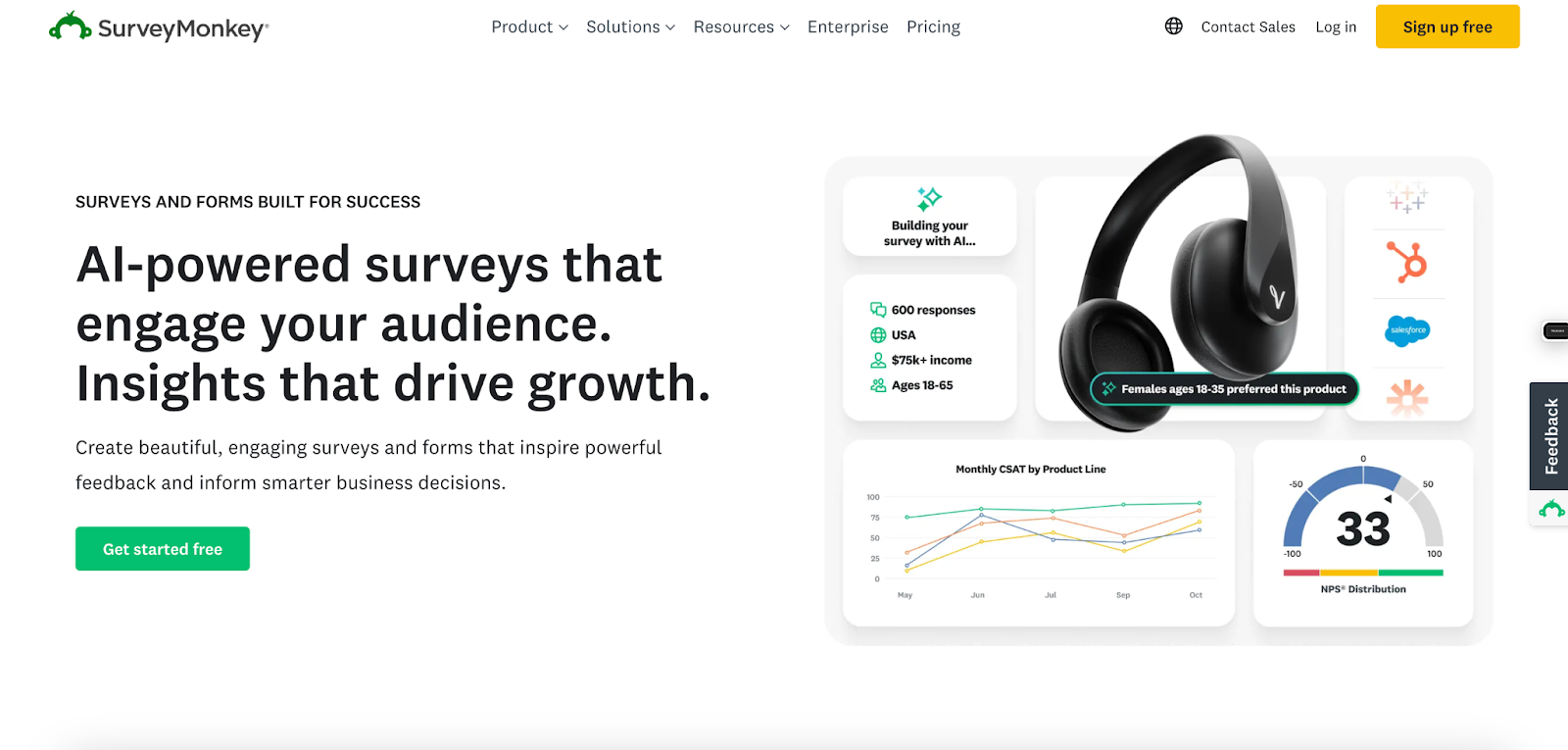
What is SurveyMonkey?
SurveyMonkey is a global leader in online survey software, providing data-driven insights through surveys, forms, and market research solutions. As a Medallia alternative, SurveyMonkey provides comprehensive tools for collecting and analyzing feedback on customer experience, employee engagement, and market research across various industries.
SurveyMonkey - Key products and features
SurveyMonkey Genius with AI: Built-in AI that helps create better surveys, spots potential errors, recommends optimal question types and answer choices, and filters out low-quality responses. The AI Analysis Suite enables users to ask questions about results and automatically analyze open-ended feedback.
Market research solutions: Purpose-built solutions, including package and product concept testing capabilities that help organizations gather insights from targeted audiences. These solutions ensure product appeal and performance through comprehensive testing methodologies.
SurveyMonkey forms: Customizable online forms that collect information and process payments directly. Forms can be embedded on websites and integrated with payment processing through Stripe.
Integrations platform: Connects with 200+ popular apps, including Salesforce, Office 365, Google Drive, Slack, Mailchimp, and Zapier. These integrations enable automatic survey triggers, data synchronization, and workflow automation across business systems.
Advanced analytics features: Includes sentiment analysis, statistical significance testing, text analysis for open-ended responses, and thematic analysis (beta), which utilizes AI to categorize responses into key themes. Multi-survey analysis allows comparison and combination of results across multiple surveys in interactive dashboards.
SurveyMonkey - Key use cases
Customer satisfaction and NPS measurement: Measure customer satisfaction and loyalty through Net Promoter Score surveys and customer satisfaction templates. Track customer sentiment over time and compare results against industry benchmarks.
Employee feedback and engagement: Collect employee feedback through engagement surveys, onboarding checklists, and 360-degree evaluations. Uncover insights to boost engagement and drive better organizational results.
Website and product feedback: Gather actionable insights to improve user experience through website feedback forms and product testing surveys. Test new product ideas and concepts before launch.
Event management: Handle event registration through customizable forms, collect RSVPs, and gather post-event feedback. Improve future events based on attendee insights and preferences.
Market research and audience targeting: Access a global panel of 335M+ respondents in 130+ countries with over 200 unique targeting options. Conduct package testing and product concept testing with specific demographic segments.
SurveyMonkey pricing
Team advantage: $30 per user per month (minimum 3 users, billed annually) - Unlimited surveys with unlimited questions and up to 50,000 responses per year.
Team premier: $92 per user per month (minimum 3 users, billed annually) - Includes 100,000 responses per year, phone support, and advanced features
Enterprise: Custom pricing - Includes HIPAA compliance, SSO, unlimited API access, dedicated customer success manager, and advanced security features
Who they're ideal for
SurveyMonkey is ideal for organizations of all sizes seeking comprehensive feedback solutions, from small businesses using the free plan for basic surveys to enterprises requiring advanced security and compliance features. It's particularly well-suited for marketing teams, customer experience professionals, HR departments, product managers, and market researchers who need to collect and analyze feedback across multiple touchpoints with robust integration capabilities and AI-powered insights.
Pros of SurveyMonkey
User-friendly interface: The platform is highly intuitive and easy to navigate, making survey creation accessible even for users with no technical experience. The Build with AI feature particularly streamlines the survey creation process.
Extensive template library: Access to expert-written templates and a question bank with methodologically sound questions saves significant time in survey development. Users appreciate the variety of pre-built templates for different use cases.
Reliable performance: The platform consistently demonstrates technical reliability with minimal downtime and technical issues. Users report smooth functionality across desktop and mobile devices.
Comprehensive feature set: The combination of survey creation, distribution, and analysis tools in one platform provides excellent value. Advanced features, such as skip logic, branching, and multiple question types, offer flexibility for addressing complex survey needs.
Cons of SurveyMonkey
Limited free plan: The free version restricts users to 10 questions per survey and 25 responses, which can be insufficient for more comprehensive research needs. Users must upgrade to paid plans for unlimited questions and higher response limits.
Pricing for advanced features: Many essential features, such as data exports, custom branding, and advanced analytics, are only available in higher-tier plans. The cost can become substantial for teams that require multiple user licenses.
Learning curve for advanced features: While basic survey creation is straightforward, mastering advanced features such as complex logic, API integrations, and multi-survey analysis requires a significant time investment. Some users find the abundance of features overwhelming initially.
Response limitations: Even paid plans have annual response limits (15,000-100,000 responses) with additional charges of $0.15 per response over the limit. This can create unexpected costs for high-volume survey programs.
SurveyMonkey’s low upfront price comes with a high cost when it’s time to take action, close the loop, and actually improve your customer experience.
What is GetFeedback?
GetFeedback is a customer experience management platform enabling businesses to collect customer feedback across various touchpoints, providing real-time feedback collection through in-app, mobile, and web surveys.
GetFeedback - Key products and features
In-app and mobile feedback collection: Captures feedback at the exact moment users engage with products through iOS, Android, and web applications, gathering contextual insights while customers actively use products.
Advanced user targeting and segmentation: Targets specific product users at particular touchpoints using Nudge technology, segmenting based on pricing tiers, tenure, trial status, page visits, and activity levels.
AI-powered analytics and insights: Utilizes artificial intelligence to uncover problems and opportunities within feedback data, automatically identifying trends and patterns for data-driven decisions.
Real-time feedback dashboard: Provides immediate visibility into customer feedback, offering page-level insights and conversion funnel mapping, which enables teams to act on results promptly.
Intelligent question branching: Dynamic survey capabilities adapting based on user responses, drilling down on specific needs, uncovering detailed insights about purchase barriers and feature preferences.
GetFeedback - Key use cases
Product development and feature prioritization: Helps product teams understand which features customers want most, validates hypotheses, tests prototypes, and makes informed roadmap decisions based on user feedback.
Conversion rate optimization: Identifies and removes conversion barriers, understanding what prevents purchases, uncovering user intent on high bounce-rate pages, and optimizing journeys based on real-time insights.
Voice of customer programs: Facilitates systematic feedback collection across the customer journey, maintaining continuous dialogue with customers and responding quickly to feedback trends.
Customer experience improvement: Measures and enhances satisfaction by capturing contextual feedback at critical touchpoints, identifying pain points, tracking experience metrics, and implementing improvements based on key findings.
GetFeedback pricing
GetFeedback does not publicly list pricing on its website.
Who they're ideal for
Small to medium-sized businesses and startups looking for a cost-effective customer feedback solution. Product teams, UX designers, and CX managers who need real-time, contextual insights from users engaging with digital products. Organizations aiming to improve conversion rates and customer satisfaction without significant budget commitments.
Pros of GetFeedback
In-product capture: Quick, contextual feedback in web/mobile apps at the moment of behavior.
Precise targeting: Segment by plan tier, lifecycle stage, page, or event to ask the right question at the right time.
Fast time-to-value: Lightweight setup and modern UI help small teams launch quickly.
Clear dashboards: Real-time views and funnel overlays make it easy to spot drop-offs and wins.
Entry options: Lower-cost tiers (including free) help startups test and learn before scaling.
Cons of GetFeedback
Limited frontline guidance: The platform collects and reports feedback but offers minimal support for helping teams take immediate action.
Basic follow-up automation: Personalized follow-ups and automated nudges are not as robust, requiring more manual effort.
Manual data interpretation: Dashboards show insights, but identifying trends and actionable items often requires extra analysis.
Slower response loop: Real-time alerts are limited, making it harder to address issues as they happen.
Integration complexity: Connecting multiple systems or creating custom workflows can require technical setup and additional resources.
Not NPS-focused: The platform is survey-general, so programs centered on customer loyalty or Net Promoter Score may need extra configuration.
What is Alchemer?
Alchemer is a versatile survey and feedback platform built for organizations that need advanced survey logic, strong integration options, and robust data collection without the cost or complexity of enterprise experience management suites. While it provides comprehensive survey-building capabilities and AI-powered text analytics, Alchemer remains primarily a feedback tool — best for teams focused on gathering insights rather than driving frontline action or transforming CX programs.
Alchemer – Key products and features
Alchemer survey: 40+ question types, advanced logic, multilingual deployment, and multichannel delivery for highly customizable surveys.
Alchemer digital: Real-time, in-app, and website feedback that captures user sentiment during critical moments in the digital journey.
Alchemer pulse: AI-driven text and sentiment analysis that auto-categorizes open-ended responses into insight themes.
Integration capabilities: Connects with 400+ platforms (Salesforce, Tableau, Microsoft Dynamics) with bi-directional data flows for workflow automation.
Research solutions: On-demand research services including survey design, project management, and advanced analysis.
Alchemer – Key use cases
Customer experience management: Collect omnichannel customer feedback to track NPS, monitor CSAT, and identify friction points.
Market research: Run global studies (Conjoint, MaxDiff) without per-response fees.
Product development: Capture user input to guide roadmap decisions and shorten development cycles.
Support team optimization: Send automated CSAT surveys after support interactions to validate performance and identify training needs.
Digital experience improvement: Gather in-the-moment insights to modernize services across web and app experiences.
Alchemer pricing
Collaborator plan: $55/month or $315/year per user (max 3 users), 75k responses
Professional plan: $165/month or $1,075/year per user (max 3 users), 100k responses
Full Access plan: $275/month or $1,895/year per user (max 3 users), 125k responses
Business platform: Custom pricing with CSM, API access, and enterprise support
Additional options include nonprofit discounts, a 14-day free trial, and a limited free plan.
Who they're ideal for
Mid-size to enterprise teams — especially CX/VOC, marketing, and product groups — that need flexible, advanced survey tools with strong integrations and high response volumes, but do not require full CX transformation capabilities or frontline enablement.
Pros of Alchemer
Exceptional customer support with fast response times.
User-friendly interface for quick survey creation.
Reliable platform performance with consistent uptime.
Fast implementation allows teams to launch within hours.
Comprehensive survey functionality with advanced logic and integrations.
Cons of Alchemer
Primarily a survey builder, not a CX platform: Alchemer’s strength lies in surveys, not in transforming customer experience. It lacks core CX capabilities such as frontline coaching, location-level performance tools, real-time case management, or actionable playbooks — meaning it can tell you what customers said, but not how your team should improve.
Cost considerations: Alchemer is cited as expensive, with third-party trackers noting that its listed starting prices exceed those of many peers and advising that costs can deter smaller teams.
Analytics limitations: Users highlight constraints in reporting, including limited customization, the need for improvement in export links, and a desire for more advanced analytics without upgrading to higher-tier subscriptions.
Learning curve: Several reviewers mention a steep learning curve, noting that complex conditions make it easy to misconfigure surveys, which increases setup effort and rework.
Support and onboarding friction: Some users report slow issue resolutions and initially unclear instructions (e.g., regarding privacy settings) during the onboarding process.
What is UserVoice?
UserVoice is a customer feedback management platform that helps product teams collect, analyze, and prioritize customer insights to inform product strategy and roadmap decisions through centralized feedback analysis.
UserVoice - Key products and features
Feedback collection and management: Captures customer feedback across multiple channels to create a centralized repository of user insights and feature requests.
Customer feedback analytics: Provides analytics tools that identify top improvement areas and quantify the impact of requests by customer segment for data-driven decisions.
Product strategy framework: Aligns initiatives with business objectives by evaluating CRM data alongside user signals for data-backed prioritization.
Roadmap management: Creates and maintains always-up-to-date roadmaps across the organization to ensure alignment on product strategy.
Salesforce and data integrations: Enriches feedback with user traits through Salesforce, data warehouses via open API, Fivetran, and Stitch.
FullStory integration: Track users' journeys before and after feedback submission by seamlessly transitioning from ideas to recent session recordings.
UserVoice - Key use cases
Product prioritization: Confidently prioritize features by evaluating CRM data alongside user signals to identify quick wins and marketplace trends.
Customer retention and satisfaction: Increase retention by alerting users when requested features go live, promoting adoption and engagement.
Team alignment: Reduce inefficiencies through data-driven stakeholder meetings and transparent roadmap planning sessions.
Feedback segmentation and analysis: Filter feedback by custom cohorts to identify retention drivers and understand the needs of target customers.
Risk mitigation: Automated notifications and Slack updates help teams iterate quickly when bugs occur or launches underperform.
UserVoice pricing
Engage: $899/month; includes up to 1,000 unique end users giving feedback, idea grid, auto-merge, feedback dashboard, web portal and in-app widget, SSO, public status updates, contributor tools, and Slack/Zendesk/MS Teams integrations.
Prioritize: $1,349/month; everything in Engage plus up to 5,000 unique end users, advanced white-labeling, data enrichment, idea lists, advanced segmentation, internal roadmap, and Salesforce/Jira/Azure DevOps integrations.
Enterprise: Custom pricing; built for complex orgs with 5,000+ end users, advanced security, premium support, and AI features like AI Idea Insights, AI Impact Reports, and AI Theme Detection.
Who they're ideal for
UserVoice suits product teams and managers at SaaS companies needing to make data-driven product decisions, manage customer feedback at scale, and align initiatives with business objectives while maintaining user transparency.
Pros of UserVoice
Closes the loop with customers/stakeholders: Built-in public status updates on ideas and internal status updates help teams communicate progress and keep contributors and end-users informed.
Ecosystem coverage: Native integrations with key systems, including Salesforce, Jira, Azure DevOps, Microsoft Teams, Slack, Zendesk, and more, streamline feedback capture and delivery workflows.
Ease of collecting feedback: Reviewers frequently describe UserVoice as intuitive for capturing and organizing ideas across sources.
Cons of UserVoice
Reporting depth: Users commonly desire richer reporting and analytics; current options are perceived as limited for providing deeper insights and traceability.
Performance and mobile gaps: Some users report slow dashboard loading and note the lack of a dedicated mobile app for agents.
Learning curve: While basic capture is straightforward, several users flag the need for more intuitive workflows around analytics and integrations as usage grows.
Final verdict
If you want a single platform that turns feedback into frontline action across multi-location service teams, without building a complicated, cross-departmental XM stack, AskNicelyis the most complete, low-friction choice. It combines multi-channel surveys with automation, case management, and employee activation tools (dashboards, TVs, coaching playbooks, and recognition) so your teams can improve service consistency today and scale earned growth over time.
That said, the right platform depends on your goals:
Qualtrics is best for enterprises standardizing CX, EX, and research in a single suite, with deep analytics.
InMoment shines for AI-driven “active listening,” text analytics, and reputation management programs, backed by white-glove support.
Forsta blends CX/EX with robust market research and online qualitative insights for analytics teams.
SurveyMonkey is perfect for fast, DIY surveys or on-demand audience research.
GetFeedback works well for Salesforce-centric journey feedback.
Alchemer offers advanced survey flexibility without the complexity of a full EM platform.
UserVoice is ideal when product feedback, prioritization, and roadmap communication are the main focus.
AskNicely isn’t just about collecting feedback — it’s about transforming insights into action. Unlike traditional survey tools, AskNicely is the only CX management platform designed to proactively address challenges caused by inconsistent service delivery. By giving businesses the ability to gather, analyze, and act on customer feedback in real time, AskNicely ensures that every interaction is an opportunity to improve.
The platform empowers teams to resolve issues before they escalate, providing proactive problem resolution that keeps customers satisfied and loyal. At the same time, AskNicely motivates and activates employees by giving them clear, actionable insights and coaching opportunities, helping them consistently deliver exceptional service. As a distributed CX management solution, it allows organizations to track net promoter scores (NPS), monitor customer sentiment, and identify areas for improvement — all within an intuitive, user-friendly interface.
With AskNicely, companies can prioritize feedback, take meaningful action across all touchpoints, and build consistent, scalable customer experiences that drive loyalty, retention, and growth.
FAQs
How do I migrate my existing feedback data from Medallia to a new platform?
Most enterprise feedback platforms offer migration services as part of their onboarding process. Typically, you'll work with a customer success team to export your historical survey data, sentiment analysis, and customer profiles from Medallia, then map them to your new platform's data structure. The migration timeline usually ranges from 2-8 weeks, depending on data volume and complexity. It's recommended to run both platforms in parallel for 1-2 months to ensure data integrity before fully transitioning.
Can I use multiple Medallia alternatives simultaneously for different use cases?
Yes, many organizations adopt a "best-of-breed" approach by using different platforms for specific needs. For example, you might use AskNicely for frontline service feedback, UserVoice for product feedback, and Qualtrics for enterprise-wide experience management. However, this requires careful integration planning to avoid data silos and ensure a unified view of customer insights across platforms.
Do these Medallia alternatives support multilingual surveys and global deployments?
Yes, most enterprise-grade alternatives (like Qualtrics, InMoment, Forsta, and AskNicely) support multilingual surveys with automatic translation capabilities and region-specific compliance features. However, the number of supported languages varies by platform—enterprise plans typically support 50+ languages, while mid-tier plans may support 20-30. Always verify specific language requirements during your evaluation, especially for less common languages.
What level of technical expertise is required to implement and manage these platforms?
Implementation complexity varies significantly. Platforms like SurveyMonkey and AskNicely are designed for business users with minimal IT involvement and can be deployed in days. Mid-tier platforms like Alchemer and GetFeedback require some technical knowledge for advanced integrations, but are manageable by power users. Enterprise solutions like Qualtrics and InMoment often require dedicated XM professionals or IT support for initial setup, complex workflows, and ongoing optimization.
Can these alternatives integrate with my existing tech stack (CRM, helpdesk, BI tools)?
Integration capabilities vary widely. Enterprise platforms like Qualtrics and InMoment offer extensive native integrations and open APIs for connecting with virtually any system. Mid-tier options like GetFeedback (Salesforce-native), Alchemer, and UserVoice provide solid integration options with major CRM and helpdesk platforms. Before selecting an alternative, create an inventory of your must-have integrations and verify that the platform supports them natively or through API connections to avoid custom development costs.