Online reviews used to matter for one reason: they told a prospective customer whether to trust you. That reason still holds, but a second one has overtaken it. Large language models now read your reviews, your business listings, and your online presence to decide what to tell people who ask about businesses like yours. Google search isn't going anywhere, but a growing share of the people looking for a roofer, a dentist, or a personal trainer are asking ChatGPT, Gemini, or Claude instead of scrolling a results page. A messy, inconsistent, unmonitored online presence now has larger repercussions than ever before.
That shift was the starting point for a recent AskNicely webinar led by VP of Marketing Brian Fravel, who spent years as a CMO running marketing and reputation for a 25-branch home services company before joining AskNicely. He walked customers through Reputation Manager, the platform's review management add-on, and Review Manager, the lighter-weight feature that ships with all AskNicely plans. The session covered what each tool does, how they connect to NiceAI, and where a fragmented review strategy quietly costs businesses money and customers.
Watch the full webinar replay below:
Most businesses without a dedicated tool are logging into Google and Facebook manually, responding to reviews when someone remembers to check, and hoping nothing slips through the cracks. That approach breaks down fast once a business operates across multiple locations or depends on review sites beyond the obvious two. Fravel pointed to his own experience in home services, where HomeAdvisor, Angi, and Thumbtack mattered as much as Google or Yelp, even though most businesses outside that industry have never heard of them. Every vertical has its own set of review sites that matter, and AskNicely pulls from hundreds of them.
Managing reviews site by site is unscalable. A business's name, address, phone number, and website need to match exactly across every listing and review site it appears on, including ones it never claimed. Sites scrape and generate listings automatically, and small variations between them, a dropped word in a business name, an old phone number, a slightly different address, damage both search rankings and how confidently an LLM can describe a business to someone asking about it.
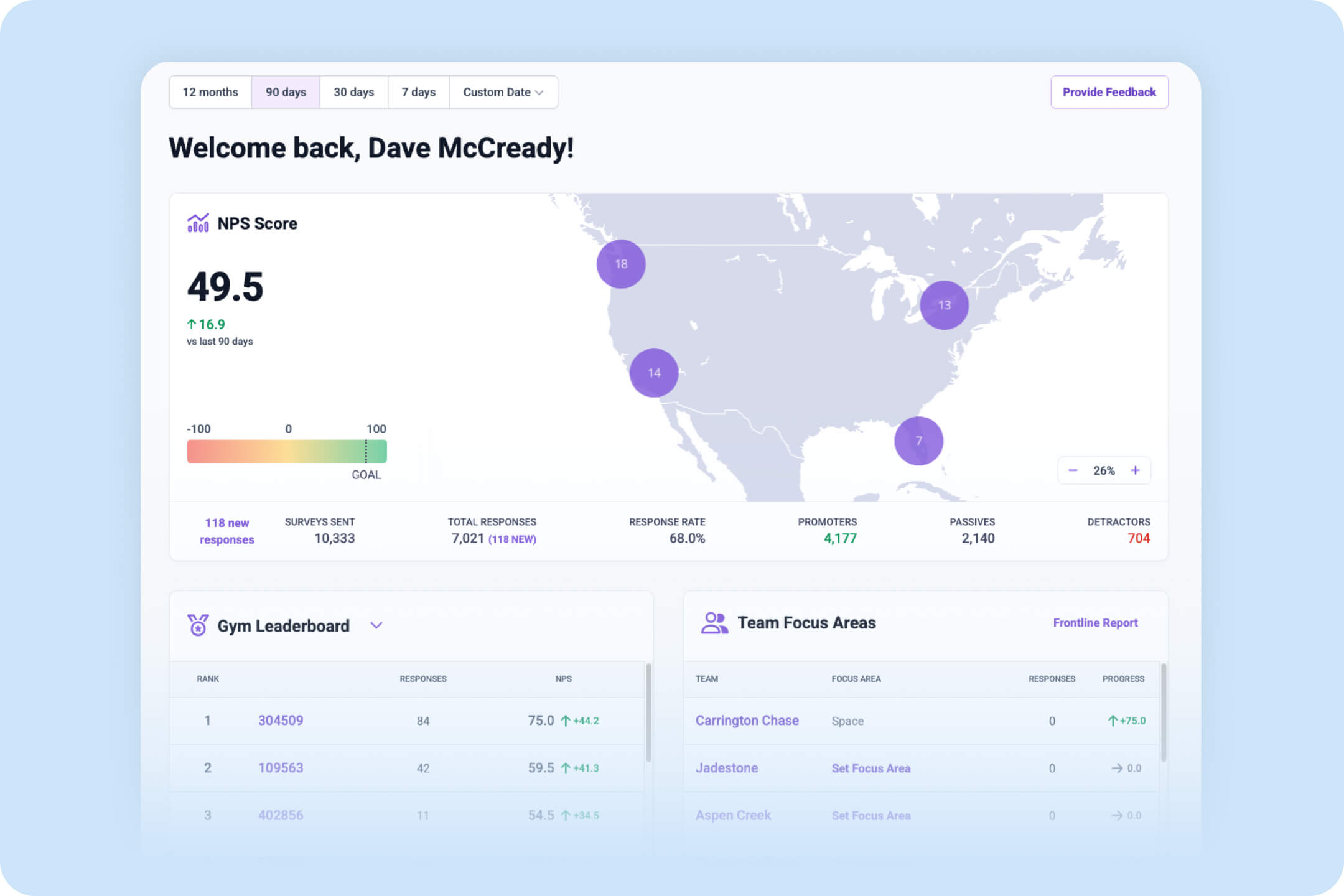
Reputation Manager consolidates reviews from hundreds of platforms into a single AskNicely inbox alongside NPS and CSAT survey data. Responses can be sent directly from AskNicely to most platforms*.
NB*: Yelp doesn't allow third-party API access for replies, a restriction every reputation management vendor runs into equally. For Yelp, AskNicely surfaces a Nice AI-suggested reply and a direct link to the review so the response can be posted manually.
Workflows carry over from the NPS and CSAT side of AskNicely. A five-star review can trigger an automatic thank-you and a request to leave a review. A one- or two-star review can open a case and assign it to a general manager for a personal follow-up. Fravel shared an example from a pest control customer: a technician's truck clipped a homeowner's mailbox while pulling out, went unnoticed, and the homeowner left a one-star review within the hour. The automated workflow routed the review to the technician who was still five minutes away. He turned around, apologized, and arranged for the mailbox to be fixed that day. The homeowner updated the review to five stars. Speed, not just sentiment, decided the outcome.
The platform also manages business listings from one place, flags mismatches between what a business wants its profile to say and what's actually live on each site, and includes a local grid tool that shows how a business ranks for "near me" searches across surrounding suburbs, not just its home city. That last piece matters more for service businesses with a real service radius than it does for a coffee shop someone will only walk to.
The bigger shift happens once review data sits next to survey data in the same platform. Fravel ran a simple prompt asking NiceAI for the correlation between branch NPS scores and online review scores across 52 locations, with no formatting instructions attached. The output included a scatter plot and a plain-language summary, and it surfaced a pattern worth investigating on its own: some of the lowest NPS branches had five-star review averages, while one of the best-performing NPS branches had a comparatively weak rating.
Both directions point to something a business would otherwise have to dig for manually. A low NPS score with strong online reviews can mean feedback is showing up in surveys before it reaches the public, an early warning that hasn't resulted in a negative review yet. On the other hand, a high NPS score with a weak review average often points to a simpler explanation: the business isn't asking its happiest customers to leave a review at all. NiceAI can be asked to check that directly, pulling click-through rates on review request buttons without anyone building a report.
The same approach scales down to a single location. A prompt asking for an executive dashboard for one branch, combining review and NPS data, returned a summary flagging a split between five-star and one-star reviews with nothing in between, along with themes and quotes pulled from the underlying feedback. That kind of gap usually means one service line or one team is dragging down an otherwise strong location, and it's the sort of thing that gets missed in a spreadsheet built for branch-level averages.
Review Manager pulls in Google and Facebook reviews as a daily batch, generates NiceAI reply suggestions, and supports workflows and analysis. Reputation Manager extends that to hundreds of additional review sites in real time, adds listing management and SEO tools, and includes competitive comparison features. Pricing is per location, per month, separate from AskNicely's survey-response-based pricing.
For a business only concerned with Google and Facebook, Review Manager may cover everything needed. For a business managing dozens of listings across niche, vertical-specific review sites, or one that wants visibility into how it ranks against competitors locally, Reputation Manager is built for that scale.
AskNicely customers can turn on Review Manager at no cost, and any customer who signs a one-year Reputation Manager contract by September 30 2026 gets the first two months free.
Reach out for a deeper walkthrough.
Up next: Customer story - Big Blue Bug Solutions achieves new heights with AskNicely