


A pest problem doesn't wait for a convenient time. When homeowners spot termites, discover rodents in the roof, or realize ants have taken over the kitchen, they want someone who can fix it, and fast.
So they search for a local pest control company and start comparing their options. And while price, availability, and service area all matter, there's another factor doing a lot of the selling before a technician ever knocks on the door: online reviews.
For local pest control businesses, reputation can be the difference between getting the call and getting overlooked. A steady stream of recent, positive reviews signals that a company is reliable, professional, and capable of doing the job right. But here's the catch: even companies delivering excellent service can't rely on happy customers to leave reviews on their own.
That's because there's a difference between a customer having a great experience and a customer taking the time to tell the internet about it. Ensuring the latter requires more than adding “please leave us a review” to an invoice. It requires a system.
The smartest pest control companies are building that system directly into the customer journey: collecting feedback after every job, acting quickly when something goes wrong, recognising the technicians who deliver great experiences, and making it effortless for satisfied customers to share those experiences publicly.
The result is more than a stronger online reputation. It's a feedback loop that helps businesses retain customers, generate referrals, improve frontline performance, and earn the reviews that bring the next customer through the door.
For pest control businesses, the customer journey often starts online long before it starts at the front door. When someone searches for a provider, they're not just looking for a company that services their suburb. They're looking for evidence that the company can be trusted in their home, will turn up when promised, and will actually solve the problem.
Reviews provide that evidence.
A strong review profile can reassure a potential customer that other people have already taken the risk of choosing you and were happy with the result. Recent reviews can also show that the business is consistently delivering good experiences, rather than relying on a handful of positive comments from years ago. And on sites like Google and Facebook, your review scores and frequency help determine what order you show up in the results.
You can check out the strength of your business’s review profile and how you compare to competitors by generating a free reputation report >>
But there's an important distinction between having happy customers and having a strong online reputation.
A pest control company could complete hundreds of successful jobs every month and still have relatively few reviews if it simply waits for customers to leave them voluntarily. Most satisfied customers aren't actively thinking about reputation management. Once the technician leaves and the pest problem is under control, they're getting on with their day.
That creates a review gap: the space between a positive customer experience and a customer taking the extra step to share it publicly.
The companies that close that gap don't leave reviews to chance. They build a process around the moments when customers are most likely to engage, starting immediately after the job is complete.
And importantly, that process shouldn't begin with a review request. It should begin with listening.
A pest control company can do everything right and still have an underwhelming online reputation.
The technician arrives on time, explains the treatment, solves the problem, and leaves the customer happy. The customer might even say, “You guys were fantastic.” Then the technician drives away, the customer gets on with their day, and that five-star experience never makes it onto Google.
The answer isn't to simply ask every customer for a review and hope for the best. A blanket request sent after every job treats a delighted customer exactly the same as someone whose technician was late or whose pest problem wasn't properly resolved. Worse, it misses an opportunity to fix those problems before they become public.
Instead, pest control businesses need to connect feedback and review generation into the same post-service workflow.
Ask customers how their experience went while it's still fresh. Use that feedback to identify customers who are happy, customers who need a little more attention, and customers who need immediate service recovery. Then make it simple for satisfied customers to share their experience publicly.

That's the approach that turns review generation from an occasional marketing task into a repeatable part of every job.
The easiest way to lose reviews is to make review requests an add-on to someone’s existing job.
If technicians have to remember to ask, office staff have to remember to follow up, or managers have to manually check which customers should receive a request, reviews will always be inconsistent. Some customers will get asked. Others won’t. And the opportunity to capture feedback while the experience is fresh can disappear quickly.
Instead, make review generation part of the standard post-job workflow.
When a job is marked complete, trigger a short feedback survey automatically. Keep the first question simple: How did we do? A customer might rate their experience, provide an NPS score, or leave a quick comment. From there, follow-up questions can adapt to what they say.
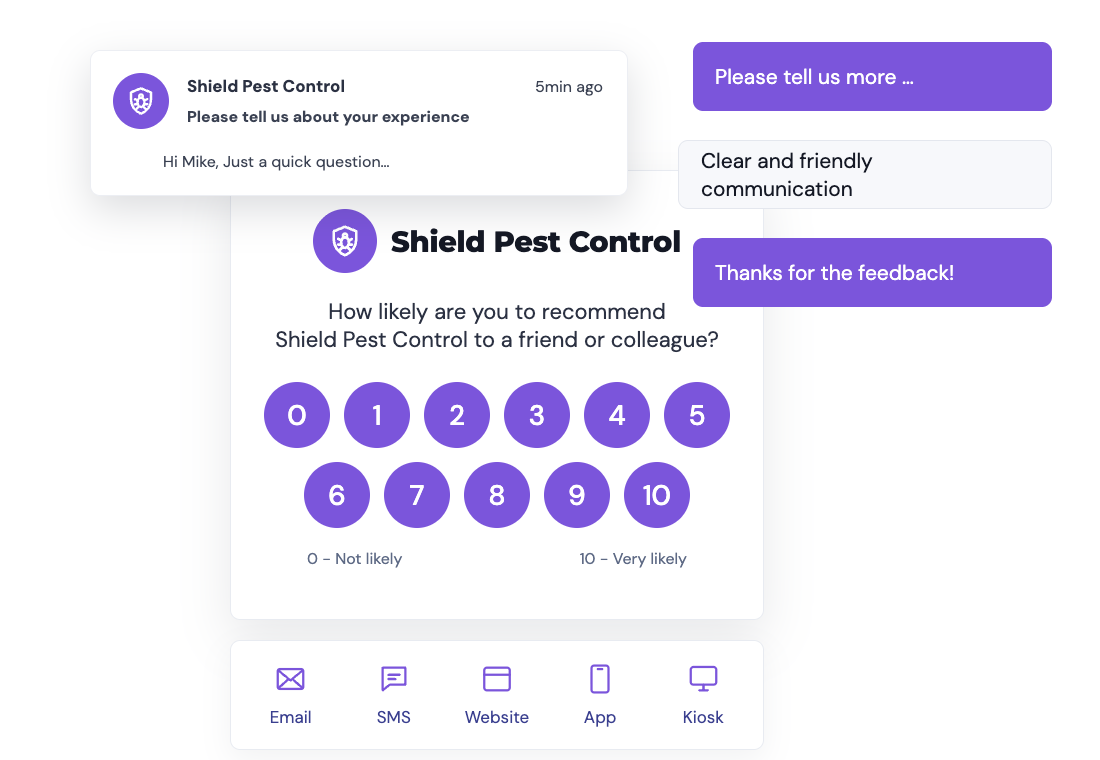
For example, a customer who gives a low score might be asked what went wrong, while a customer who gives a glowing response might be asked what stood out about their experience (and to immediately leave a review from the survey with one click, if you’re using AskNicely). This gives the business more useful information than a generic review request ever could, and gives the customer a reason to engage beyond simply being asked for a favour.
The timing matters, too. Sending the survey shortly after the technician leaves means customers can still remember whether the technician arrived on time, explained the treatment clearly, treated their home respectfully, and left them confident the problem had been handled.
Most importantly, feedback should determine what happens next.
A positive response can lead naturally to a review request. A customer who has had a poor experience can instead be flagged for follow-up before their frustration turns into a public complaint. And the feedback collected from every job can be used to identify patterns that help the business improve.
That turns review generation into something much more valuable than a marketing campaign. It's a system that connects every completed job to the next action: listen, respond, improve, then earn the review.
Once you've captured feedback, the next step is making it easy for happy customers to share it.
The key word is easy. A customer who has just had a great experience isn't necessarily going to open Google, search for your business, find the review button, and write something from scratch. Even when they're genuinely delighted, that's a lot of friction.
That's where a well-timed review request can make the difference.
When a customer gives positive feedback, give them a clear, direct path to leave a public review. Rather than sending everyone the same generic “please review us” message, connect the request to the experience they've just had: Glad to hear your treatment went well. Would you mind sharing your experience with others?
Again, the timing is important. A review request sent immediately after a successful job catches the customer while the experience is still fresh. They remember the technician who arrived on time, explained what they were doing, answered their questions, and left the property in good shape. Those details are what turn a generic five-star rating into a review that actually builds trust with the next potential customer.
This is also where automation becomes valuable. A platform like AskNicely can connect feedback collection and review requests within the same survey or workflow, so teams don't have to manually identify happy customers or remember to follow up.
The result is a simple but powerful sequence:
Job completed → feedback requested → positive experience identified → review request sent.
Instead of hoping satisfied customers remember to leave a review, you're creating a consistent opportunity for them to share what went well.
And those reviews do more than improve a star rating and search engine visibility. Over time, they create a public record of the experiences your customers value most, which can help the next homeowner feel confident choosing your business.
More reviews are useful. But more reviews shouldn't be the end goal.
A pest control company could increase its review volume while still having recurring issues with late arrivals, poor communication, missed follow-ups, or inconsistent service. If those problems continue, a bigger review count won't fix the underlying customer experience. In fact, it may simply make the weaknesses more visible. We see this often with pest control companies that forgo feedback feedback collection in favor of only asking for reviews.
The goal should be to build a reputation that accurately reflects the experience you're delivering, and then continuously improve that experience.
That means looking beyond the star rating to understand what customers are actually saying.
Are customers consistently praising certain technicians for being friendly and professional? Are multiple people mentioning how clearly treatments were explained? Are complaints clustering around appointment scheduling or follow-up visits? Are some locations consistently outperforming others?
These patterns matter because reviews are more than marketing content. They're a source of customer intelligence.
With tools such as AskNicely's AI-powered analysis, pest control businesses can analyze feedback at scale to identify sentiment and recurring themes without relying on managers to manually read every response. Instead of simply knowing that customers are happy or unhappy, leaders can start to understand why.
That creates a much stronger feedback loop. A business can recognize the behaviors customers value, coach teams where experiences are falling short, and track whether those changes actually improve customer sentiment over time.
The result is a healthier approach to reputation management: don't manufacture a better-looking reputation, or focus on quantity of reviews over quality. Build a better experience, then make it easier for customers to tell people about it.
For a local pest control company, the technician is the brand.
Customers may find the business through Google, but their impression is formed by the person who arrives at their door. Did they turn up on time? Were they professional and respectful? Did they explain what they were doing? Did they answer questions without making the customer feel rushed? Did they leave the property as they found it?
Those details can have a bigger impact on the eventual review than any marketing campaign.
That's why review generation shouldn't sit entirely with the marketing or customer service team. Frontline technicians need visibility into the experiences they're creating, too.
But technicians don’t want to chase reviews from customers after every job. In fact, taking the manual responsibility away from technicians can make the process more consistent. Their job is to deliver an excellent experience; the system can take care of collecting feedback afterwards.
What technicians do need is a clear view of how customers are responding to their work.
When feedback is visible in real time, managers can recognize technicians who consistently receive positive comments, identify coaching opportunities, and celebrate the behaviours customers value most. A technician who repeatedly gets praised for being thorough and explaining treatments clearly feels valued and can even become an example for the wider team.
It also creates a stronger sense of ownership. Instead of customer feedback disappearing into a monthly report, technicians can see the direct connection between their work and customer sentiment.
And that matters because recognition can reinforce the behaviors that generate great experiences in the first place.
The result is a virtuous cycle: technicians deliver better experiences, customers provide better feedback, great work gets recognized, the technician feels more valued as an employee, and more satisfied customers are given an easy opportunity to share their experience publicly.
That is far more sustainable than simply telling the team to “get more reviews.”
A customer who leaves a one-star review is rarely the first person to experience a problem.
More often, the public review is the end of a longer chain of missed signals. A technician arrived late, the treatment didn't seem to work, the customer wasn't sure what would happen next, they tried to contact the business and didn't hear back…
By the time they write an angry Google review, the opportunity to resolve the issue privately may already have passed.
That's why negative feedback shouldn't simply be treated as a reputation risk. It should be treated as an early warning system.
A post-job survey gives pest control businesses a chance to hear from customers before frustration turns into a public complaint. If someone reports a poor experience, the right team member can follow up quickly, understand what happened, and take action while there's still an opportunity to put things right.
That might mean sending the technician back to address an unresolved pest problem, having a manager call to apologize, clarifying what the treatment included, or simply making sure the customer knows their concern has been heard.
The goal isn't to prevent customers from leaving negative reviews. It's to earn the opportunity to resolve problems before they reach that point.
The feedback also becomes valuable beyond the individual customer. If several people report that appointments are running late, that technicians aren't explaining follow-up treatments clearly, or that customers are confused about pricing, you've found a pattern worth addressing.
This is where closed-loop feedback becomes more powerful than review management alone. Every negative response creates two opportunities: recover the individual customer and improve the process that caused the problem.
Over time, that can have a compounding effect. Fewer recurring problems mean better customer experiences, fewer reasons for customers to complain, and more genuine positive experiences worth sharing publicly.
The strongest review strategies don't really start with reviews at all. They start with a simple question: what happens after every customer interaction?
For a pest control business, the answer should be a consistent feedback loop:
Complete the job → collect feedback → identify the next action → follow up → improve the experience → invite satisfied customers to review.
The important part is that every customer enters the same process, regardless of whether their experience was great, average, or disappointing.
A promoter might receive a review request and an invitation to recommend the business to friends or family. A customer who is reasonably satisfied might be asked a follow-up question to understand what could have made the experience better. A detractor can trigger an alert so a manager or technician can step in before the issue escalates.
This creates a much more useful system than simply tracking the number of Google reviews coming in. It connects customer feedback to action.
It also means managers don't have to wait for a monthly report to discover that something is going wrong. If several customers suddenly start mentioning missed appointments, confusing communication, or problems with treatment effectiveness, the business can see the signal and respond while it's still manageable.
Over time, the feedback loop becomes a source of continuous improvement. The business learns which behaviours drive satisfaction, which issues create friction, which technicians are delivering standout experiences, and where processes need to change.
A five-star average looks good on a dashboard. But on its own, it doesn't tell a pest control company much about why customers are happy or where the next problem might come from.
To build a review engine that actually improves the business, track the experience behind the reviews.
Start with a few simple measures:
Looking at these measures together tells a much more useful story than review volume alone.
For example, if review numbers are increasing but customer satisfaction is falling, there's a problem hiding underneath the headline metric. If satisfaction is high but very few customers leave reviews, there's probably a review gap to address. And if one technician consistently receives glowing feedback while another generates recurring complaints, managers have a clear opportunity for recognition or coaching.
The real goal is to create a feedback loop where the public reputation reflects the customer experience and the customer experience keeps getting better.
For a small pest control business with a handful of technicians, manually checking feedback and asking for reviews might be manageable.
For a growing company operating across multiple suburbs, branches, or hundreds of jobs each week, it quickly becomes difficult to do consistently. The more jobs a business completes, the more opportunities there are to capture feedback and the more time it takes to manage what happens next.
This is where automation can make a real difference.
With AskNicely’s Review Routing Agent, the review request can become part of the customer journey rather than another task for the team to remember. After a job, customers can be invited to share feedback, with satisfied customers routed to the right public review platform, such as Google, Yelp, Angi, or Facebook, based on the business's rules.
Because the process sits within the existing survey flow, technicians don't need to remember who to follow up with, and managers don't have to manually sort through responses and send review requests one by one. For multi-location businesses, reviews can also be attributed to the right location and employee, helping teams build a more accurate picture of who's delivering great experiences.
A strong system can flag negative feedback for follow-up, surface recurring issues across locations or technicians, and give happy customers a straightforward path to share their experience publicly. Over time, that creates a much more useful cycle: listen to customers, resolve problems, recognize great service, and turn positive experiences into reviews.
The result is more than a higher review count. It's a reputation management process connected directly to the customer experience that created the reputation in the first place.
For local pest control companies, online reputation isn't built one review at a time. It's built through the hundreds of customer experiences happening every week.
The opportunity is to stop treating reviews as something that happens after the customer journey and start making them part of it.
Every completed job is an opportunity to listen. Every piece of feedback is an opportunity to recognize great work or recover a customer who's had a poor experience. And every genuinely happy customer is an opportunity to turn a great experience into a public recommendation.
The businesses that get this right don't leave review generation to chance. They build a system that connects service, feedback, action, and reputation, then use the insight from that system to keep improving.
That's where AskNicely can help. By bringing customer feedback, real-time alerts, frontline visibility, AI-powered insights, and review requests into one workflow, pest control businesses can create a repeatable process that works after every job and at every location.
Ready to turn customer feedback into a competitive advantage? Book a demo with AskNicely and see how you can build a closed-loop feedback system that helps your team listen, act, and grow.
How Aptive delivers exceptional service every time
Frontline accountability and appreciation: The secret weapon driving awesome CX at Moxie
How using AskNicely helped Platinum Pest see major improvements in just months


