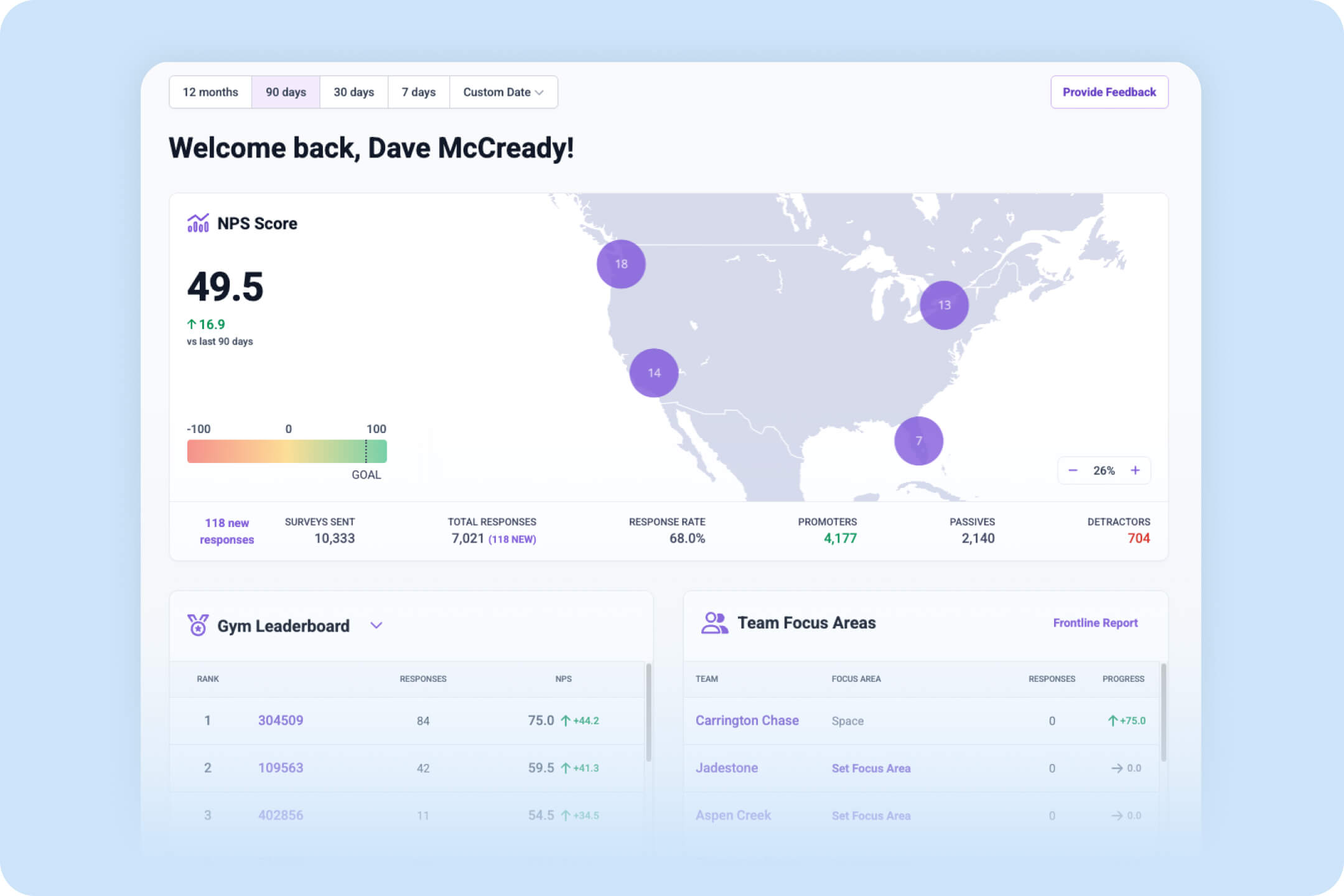
A customer gives you a 9 out of 10. Another gives you a 4. Those scores tell you something important, but they leave a critical question unanswered: why?
Enter customer sentiment analysis.
By analyzing the language customers use in surveys, reviews, support interactions, and other feedback, CX teams can understand how customers feel about their experiences and, more importantly, what is shaping those feelings. Positive sentiment can reveal what’s working well, and negative sentiment can expose friction before it becomes a larger customer or business problem.
The opportunity becomes even greater when sentiment is analyzed alongside experience metrics such as net promoter score (NPS) and customer satisfaction score (CSAT). A score tells you what happened. Sentiment and theme analysis can help explain why it happened.
For CX teams managing hundreds or thousands of pieces of feedback, that distinction is critical. Reading every comment manually might work for a small sample, but it quickly becomes difficult to maintain as feedback volumes grow. Important patterns can get buried in individual responses, while teams spend hours sorting comments instead of acting on what they reveal.
Modern AI is changing the equation. AI-powered sentiment and theme analysis can process large volumes of customer feedback, identify recurring topics, surface emerging issues, and connect those insights back to experience scores. That gives teams a faster way to move from a mountain of customer comments to a clear set of priorities.
This guide explores how customer sentiment analysis works, how to measure it effectively, where CX teams commonly go wrong, and how to turn sentiment insights into meaningful improvements across the customer experience.
Customer sentiment analysis is the process of examining customer feedback to understand the feelings, opinions, and attitudes behind what customers say. It gives CX teams another layer of context alongside quantitative measures such as NPS, CSAT, and five-star ratings.
At its simplest, sentiment analysis categorizes feedback as positive, negative, or neutral. More sophisticated approaches can go further, identifying the strength of a customer’s sentiment and the specific aspects of their experience driving it.
Consider a customer who gives a support interaction a 9/10 and writes:
“The agent was friendly and solved my problem quickly, but I had to explain the issue three times before it reached the right person.”
The score suggests a highly positive experience. The comment tells a more nuanced story. The customer appreciates the frontline service, but there is also friction in the process that led them there. If a CX team looked only at the score, that operational issue could easily go unnoticed.
The same applies to negative feedback. A customer might give a 6/10 and describe a frustrating experience with wait times, billing, or product usability. When similar comments appear repeatedly, they can point to a systemic issue rather than an isolated complaint.
This is where sentiment analysis becomes particularly useful. By looking across large volumes of feedback, teams can distinguish individual opinions from broader patterns. They can see where customers are consistently positive, where frustration is building, and which parts of the experience are influencing those perceptions.
For CX leaders, the goal is to connect how customers feel with what is causing those feelings, so the business knows where to focus its attention.
AI-powered theme analysis makes this possible at scale, helping teams automatically uncover recurring topics and patterns across customer feedback that would be difficult and time-consuming to identify manually.
NPS, CSAT, and customer effort score (CES) are valuable because they give teams a consistent way to track experience over time. They can reveal whether satisfaction is improving, identify teams or locations that need attention, and provide leadership with a clear measure of customer health.
But a score is a signal, not an explanation.
Two customers can give the same score for completely different reasons. A customer who rates an experience 7/10 might be happy with the product but frustrated by slow support. Another might have received excellent service but found the product difficult to use. Treating those responses as the same experience can lead teams towards the wrong solution.
The comments behind those scores provide the missing context.
Imagine a customer gives a delivery experience a 9/10. They were happy with the product, the price was right, and their order arrived safely. But their comment says:
“Really happy overall, although I was disappointed that I couldn't change my delivery time.”
The customer is satisfied with the outcome, yet there is a clear point of frustration within the experience.
If a business only tracks the 9/10 score, there is little reason to investigate further. But if similar comments appear across hundreds of responses, the business may have uncovered an opportunity to improve delivery flexibility.
Sentiment analysis helps bring those nuances into view. It can identify the positive, negative, or neutral feelings expressed in feedback, while allowing teams to connect those feelings to the specific parts of the customer journey that generated them.
A score can tell a CX team where to look. It rarely tells them what to fix.
Take a support team whose CSAT falls from 88% to 76% over a quarter. That's a meaningful change and a clear reason to investigate. But the score alone doesn't explain whether customers are unhappy because response times have increased, agents aren't resolving issues on the first contact, product information is difficult to find, or a recent product change has created new problems.
Without the underlying feedback, teams are left to interpret the number.
That creates a risk of solving the wrong problem. A leadership team might respond to declining CSAT by adding more support staff, for example, when customer comments reveal that the real issue is confusing product documentation.
The same limitation applies to NPS and CES. These metrics are excellent for tracking trends and benchmarking performance, but they compress complex customer experiences into a single number. That makes them useful indicators of performance, but incomplete sources of insight on their own.
Open-text feedback gives customers space to explain what a score cannot.
A single comment might reveal an unexpected moment of delight: an employee who went above and beyond, a particularly simple part of the onboarding process, or a feature customers genuinely value. Another might expose friction that isn't visible in the headline metrics: repeated billing confusion, a frustrating handoff between teams, or an issue customers have learned to tolerate.
The real value emerges when those individual comments are viewed together.
If 50 customers independently mention long wait times, that's a stronger signal than one complaint. If promoters repeatedly praise the same employee behavior, that could point to a service practice worth replicating. If detractors consistently mention the same product feature, it may deserve attention from product and operations teams.
This is why qualitative feedback should sit alongside quantitative experience data. Scores help teams measure the health of the experience; customer comments help explain what is driving it.
The challenge is volume. As feedback grows across surveys, reviews, support interactions, and other channels, manually reading and categorizing every comment becomes increasingly difficult. That's where sentiment and theme analysis can turn thousands of individual responses into patterns a CX team can actually act on.
Customer sentiment analysis is most useful when it becomes part of the CX operating rhythm, rather than another report that gets reviewed once a month and forgotten.
The process starts with collecting customer feedback, then moves through sentiment and theme analysis to identify what customers care about most. From there, teams can prioritize action, make changes, and measure whether those changes actually improve the customer experience.
That creates a valuable feedback loop: listen, understand, act, measure, repeat.

It also gives CX leaders something increasingly important in the boardroom: evidence. Instead of saying customers seem frustrated with a particular part of the experience, leaders can show how many customers are raising the issue, how sentiment is trending, which segments are most affected, and whether the problem is influencing broader experience metrics.
Sentiment analysis is only as useful as the feedback it has to work with.
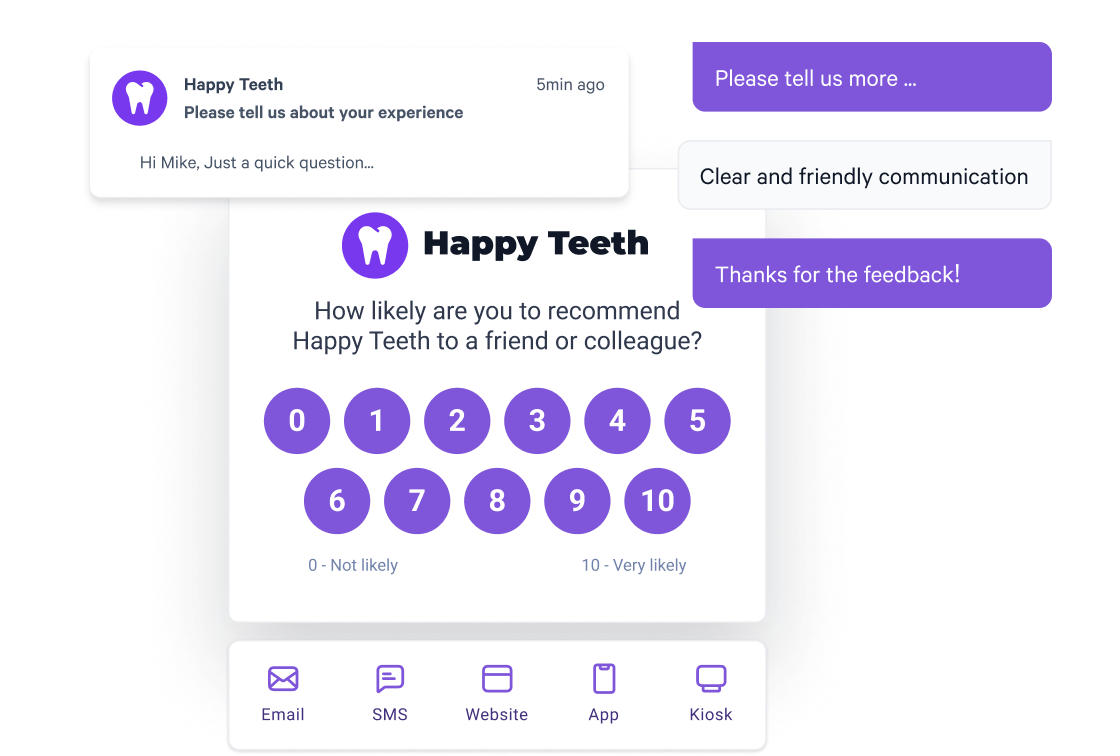
Businesses can gather sentiment data from a range of sources, including NPS and CSAT surveys, online reviews, customer support conversations, social media, and other direct feedback channels. The important thing is creating enough opportunities for customers to explain their experience in their own words.
That makes open-ended questions particularly valuable. A customer might rate their experience a 6/10, but the comment explaining that score could reveal everything from a confusing onboarding process to a support interaction that took too long to resolve.
For example, asking “How would you rate your experience?” gives you a measurement. Following it with “What is the main reason for your score?” gives you context.
The more consistently a business collects that qualitative feedback, the clearer the picture becomes. Instead of relying on a handful of anecdotes, CX teams can analyze patterns across a much broader customer base.
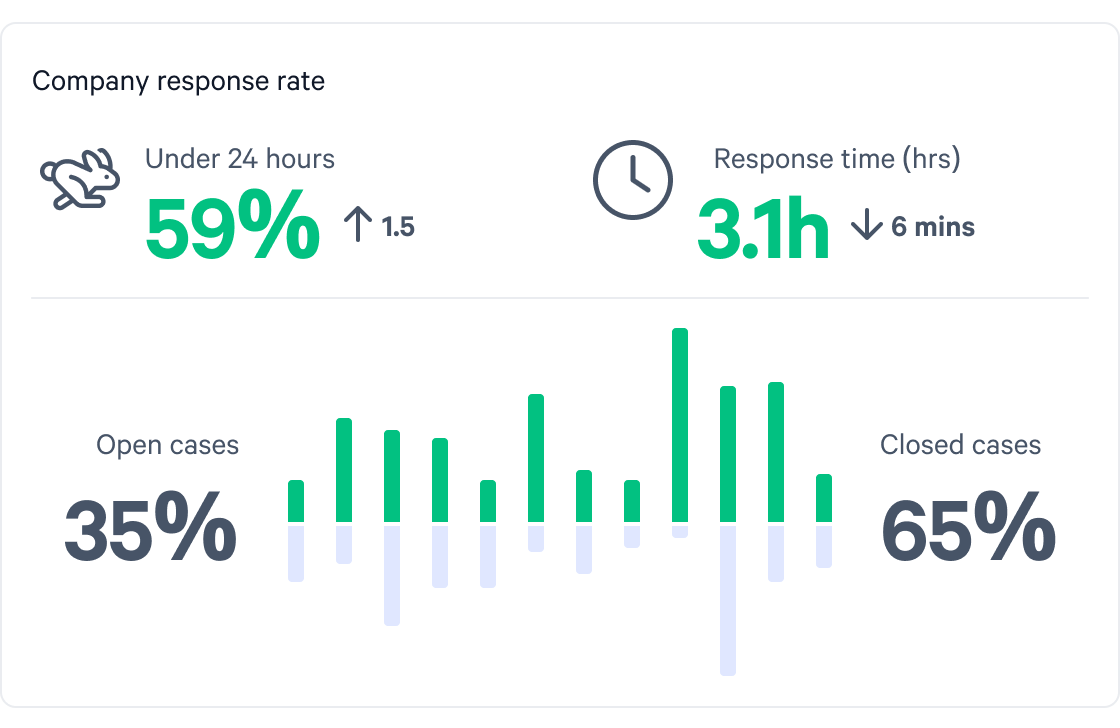
Once feedback has been collected, sentiment analysis can categorize the language customers use according to its overall tone, commonly as positive, negative, or neutral.
Teams can then look at sentiment in several ways. They might track changes over time, compare sentiment across locations or customer segments, or examine whether sentiment is stronger among promoters, passives, or detractors.
This can uncover patterns that a headline score misses. Sentiment trends can therefore act as an early-warning system, helping CX teams spot changes in how customers feel before those changes become obvious in their headline metrics.
Knowing that customers are unhappy is only half the picture. CX teams also need to know what is making them unhappy.
This is where theme analysis adds another layer of insight.
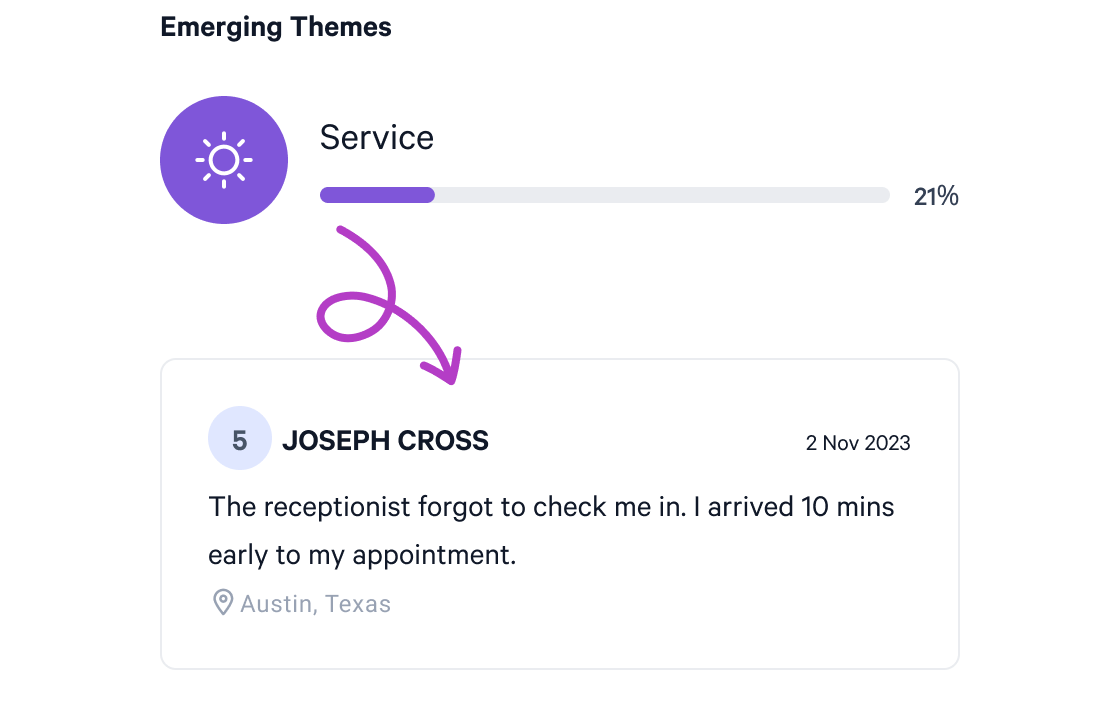
Across hundreds or thousands of comments, customers may repeatedly mention themes such as onboarding, pricing, product usability, response times, billing, or the quality of support. A theme can also be positive: customers might consistently praise a particular feature, employee behavior, or part of the buying experience.
Connecting sentiment to these themes makes the feedback far more actionable.
A CX leader might discover, for instance, that “support” is one of the most frequently mentioned themes, but the sentiment attached to it varies significantly. Customers may be overwhelmingly positive about the expertise of support agents while expressing negative sentiment about how long it takes to get a response.
That is a much more useful insight than simply knowing that support appears frequently in customer feedback.
AI-powered theme analysis can help teams uncover these patterns across hundreds or thousands of comments, reducing the manual effort involved in reading, sorting, and categorizing feedback one response at a time.
Insight only creates value when it changes a decision.
Once CX teams understand which themes are driving positive and negative sentiment, they can begin prioritizing improvements according to their potential impact. A frequently mentioned issue with strongly negative sentiment may warrant more attention than an isolated complaint. Likewise, a consistently praised part of the experience could reveal something worth scaling across teams or locations.
This gives leaders a stronger basis for deciding where to invest time and resources.
Instead of approaching leadership with “We think customers want us to improve onboarding,” a CX leader can show that onboarding is a recurring theme, that sentiment around it is predominantly negative, and that customers who mention onboarding have materially lower experience scores and higher churn rates.
That customer-backed evidence can support a business case for product changes, additional resources, process improvements, or training.
The result is a shift in how customer feedback is used. Sentiment analysis becomes less about producing another dashboard and more about giving the organization evidence for better decisions.
The final step is closing the loop.
After making an improvement, teams can continue monitoring sentiment and themes to see whether customer perceptions change. If a company redesigns its onboarding process, for example, it can track sentiment around onboarding before and after the change, while also monitoring NPS, CSAT, retention, support volume, or other relevant outcomes.
This makes it possible to connect operational changes with customer impact.
Perhaps negative sentiment around onboarding falls by 30%, CSAT increases, and fewer customers contact support for help getting started. Now the business has more than a successful project to report. It has evidence that the change made a measurable difference to customers.
That evidence is particularly powerful at the executive and board level. CX leaders can move beyond reporting that “customers are happier” and demonstrate which issue was addressed, what customers said before and after the change, and how that shift relates to business outcomes.
Done well, customer sentiment analysis creates a continuous connection between the customer voice and business decision-making. The value beyond knowing whether feedback is positive or negative. It's in understanding what is driving that sentiment, deciding what deserves attention, and proving whether the action taken actually improved the experience.
The business case for customer sentiment analysis is straightforward: better understanding of customer feedback leads to better decisions about where to focus time, money, and attention.
For CX teams, that can mean spotting problems earlier, protecting valuable customer relationships, improving products and services, and giving leadership a clearer view of whether customer experience investments are working.
Customers don't always go straight from happy to complaining. Frustration can build quietly across multiple interactions before someone submits a formal complaint, leaves a poor review, or decides to leave.
Sentiment analysis can help teams spot those early signals.
For example, a retailer might notice an increasing number of customers using negative language around delivery, even though overall CSAT hasn't moved significantly. Looking more closely reveals that customers aren't necessarily unhappy with the products themselves. They are frustrated by missed delivery windows and a lack of communication when orders are delayed.
That gives the business an opportunity to address the underlying process before the issue becomes a larger reputation or retention problem.
Early detection can reduce the cost of fixing problems, protect customer satisfaction, and prevent avoidable complaints from reaching more visible channels.
Declining customer sentiment can also provide an early indication that a relationship is weakening.
A customer who consistently expresses frustration about support, reliability, pricing, or product usability may be showing signs of risk even if they haven't explicitly said they intend to leave. When those signals are connected with account data and experience metrics, customer-facing teams have an opportunity to intervene.
That might mean contacting the customer, resolving a recurring service issue, providing additional support, or escalating a product problem internally.
The commercial implications are significant. Retaining an existing customer generally protects more value than winning a replacement, particularly in subscription and relationship-driven businesses where customer lifetime value compounds over time.
Sentiment analysis gives retention teams another source of evidence for identifying where relationships may need attention.
CX teams invest heavily in initiatives designed to improve the customer journey. The difficult part is proving whether those investments actually changed how customers experience the business.
Sentiment provides a useful measure of impact.
Suppose a company invests in simplifying its onboarding process. Internal teams may believe the new journey is significantly better, but customer feedback could tell a different story. If positive sentiment around onboarding increases after the change, that provides customer evidence that the investment is working. If frustration remains concentrated around the same steps, the business knows there is more work to do.
This creates a valuable check against internal assumptions.
Rather than measuring success by whether a project was delivered on time or a process was redesigned, teams can ask a more meaningful question: did customers actually experience an improvement?
Most organizations have more potential improvements than they have resources to implement them.
Customer sentiment can help determine which ones deserve attention.
When the same issue appears repeatedly across customer feedback, particularly alongside consistently negative sentiment, it becomes much easier to make the case for action. Product teams can use these insights to inform roadmaps, operations teams can identify process improvements and service leaders can uncover opportunities to improve support, training, or customer communications.
The advantage is that prioritization starts with customer evidence rather than whoever has the loudest opinion in the meeting.
A product team might have a long list of requested features, for example, while customer feedback reveals that usability issues with an existing feature are generating significantly more frustration. Sentiment and theme data can help bring that distinction into the prioritization conversation.
Sentiment analysis isn't only about finding problems. Positive feedback can reveal what customers value most and help businesses understand which experiences are worth repeating. Customers might consistently praise the speed of support, the expertise of employees, a particular product feature, or the simplicity of a service.
Those insights can become best practices.
If customers repeatedly praise one team's approach to resolving complex issues, for example, managers can investigate what that team is doing differently and share those practices more broadly. If a particular product capability generates consistently positive feedback, marketing and sales teams may have an opportunity to incorporate that customer-validated value into their messaging.
Over time, reinforcing the experiences customers value can strengthen loyalty and create more opportunities for advocacy, referrals, and positive reviews.
Customer feedback can also make coaching more relevant and constructive. Managers can look at sentiment and recurring themes to understand where customer-facing teams are excelling and where customers are encountering friction. A pattern of positive comments about an employee's empathy or problem-solving, for example, can identify behaviours worth recognizing and sharing. Recurring negative feedback around communication or resolution times can highlight opportunities for coaching.
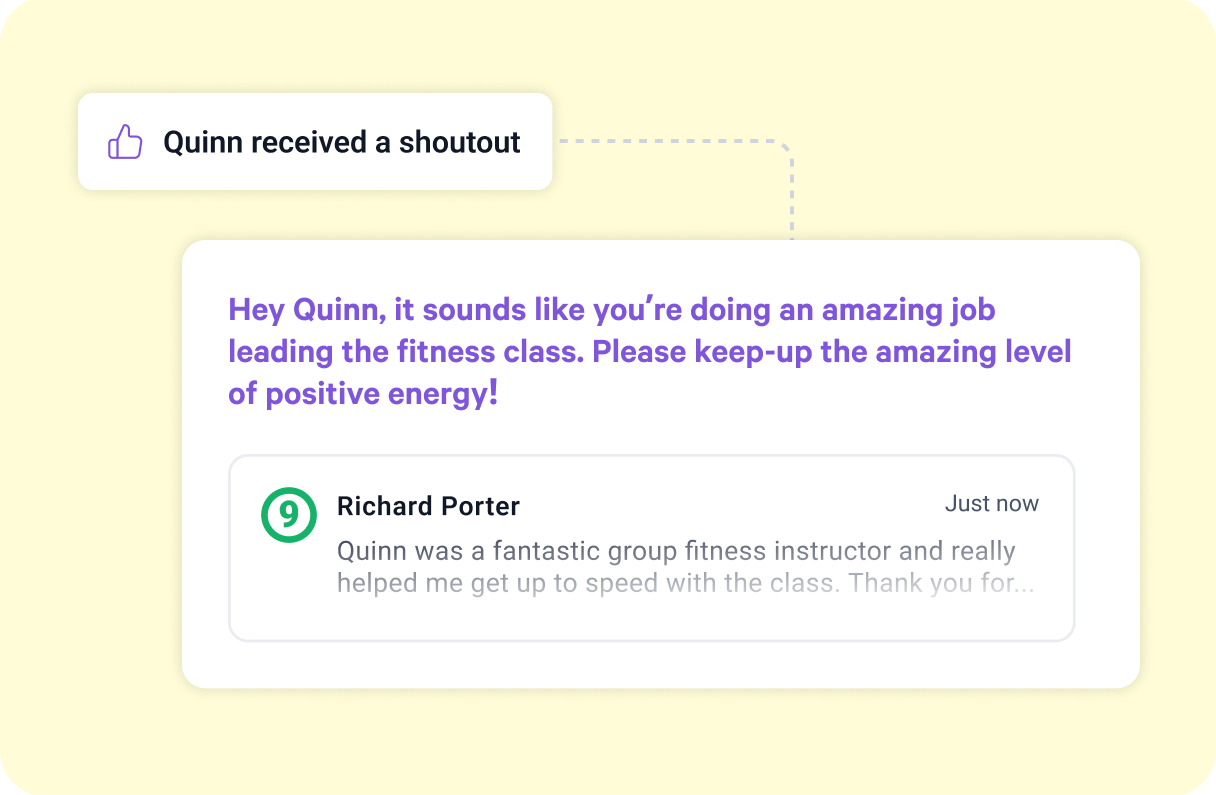
Used well, customer feedback gives managers real examples of how service behaviours affect customers. That makes coaching more specific, helps recognize what is working, and gives employees a clearer connection between their work and the experience they create.
Sentiment and theme analysis answer two different questions. Used together, they provide a much more useful picture of customer feedback.
There is a deceptively difficult part of customer feedback analysis: deciding what to look for in the first place.
When teams manually create themes and tag responses, they inevitably bring assumptions to the process. A CX manager might decide that “support,” “pricing,” and “product” are the categories that matter, then organize feedback accordingly. That approach can be useful, but it also creates blind spots. Teams may unconsciously look for evidence that confirms what they already believe, or feedback that doesn't fit the predefined categories can be overlooked. Take feedback about a location that’s difficult to find or access, for example: a potentially solvable frustration point that could be overlooked simply because it doesn’t fit cleanly into a category..
Manual tagging also struggles with scale. A team can reasonably categorize hundreds of responses, but doing that consistently across thousands of comments and continually updating the categories as customer concerns change is a different proposition.
AI-powered theme analysis offers a way to approach the problem from the feedback itself.
NiceAI automatically analyzes open-ended survey responses to identify the topics customers are talking about and understand how those topics relate to customer experience metrics. Rather than requiring teams to build an exhaustive taxonomy upfront, NiceAI generates suggested themes from the actual language customers are using.
That matters because customers don't necessarily describe their experiences using the terminology a business expects.
A company might think of an issue as “delivery performance,” for example, while customers talk about “late orders,” “missed time slots,” or “having no idea when my package would arrive.” AI can recognize the relationship between those responses and surface the broader theme without requiring someone to manually create and maintain every possible keyword or tag.
NiceAI continuously analyzes feedback and automatically updates and categorizes themes as new responses come in. That removes much of the manual work involved in maintaining keyword lists, tagging responses, and reorganizing categories as customer conversations evolve.
The result is a more dynamic view of what customers are actually saying.
A CX manager might discover that customers frequently praise employee helpfulness, while negative feedback is concentrated around wait times. Another team might find that onboarding is a relatively small theme overall but has an outsized impact on NPS among new customers.
Those distinctions are difficult to uncover when feedback is treated as a collection of individual comments. Theme-level analysis turns them into patterns that managers can investigate.
The real value comes from connecting themes with the metrics CX teams already use to measure performance.
A theme can tell you what customers are discussing. Sentiment can indicate how they feel about it. NPS or CSAT can show how that experience relates to their overall assessment of the business.
Put those pieces together and the picture becomes considerably more useful.
For example, a CX leader may see that “support” is mentioned frequently across feedback. On its own, that doesn't tell them whether support is a problem. But if the theme is associated with predominantly negative sentiment and lower NPS scores, it becomes a much stronger candidate for investigation.
The same analysis can uncover the opposite: a theme that consistently appears in positive feedback and is strongly associated with high scores. That can reveal what customers value most and where successful experiences could be replicated.
For managers, this creates a practical way to answer three questions:
What do customers love? What frustrates them? And which issues are having the greatest impact on the experience?
That is where AI-powered theme analysis moves beyond simply making feedback analysis faster. It helps CX teams see the patterns within their customer data and focus their attention on the issues most likely to make a difference.
For multi-location businesses, the challenge is rarely a lack of customer feedback. It’s knowing where to focus when the data is spread across dozens or even hundreds of locations.
A company-wide sentiment view can tell leadership whether the overall customer experience is moving in the right direction, but averages can hide important differences between locations. One branch might be delivering consistently excellent service while another is seeing a steady rise in frustration around wait times, staff availability, or communication.
That makes location-level context essential.
Breaking sentiment and themes down by location, team, and key service moments gives CX leaders a much clearer picture of where the experience is working and where consistency is starting to break down. Instead of simply seeing that negative sentiment has increased, they can identify where it is concentrated and what customers are talking about.
For example, a business might discover that customers across most locations are positive about staff helpfulness, while negative feedback about wait times is concentrated in a handful of branches. That points to a very different response than a company-wide decline in service sentiment. Leaders can investigate what is happening at those locations, understand the underlying causes, and determine whether the issue is related to staffing, processes, training, or something else.
The same analysis can uncover what top-performing locations are doing differently. If one team consistently receives positive feedback about communication or service speed, those insights can become useful examples for managers elsewhere in the network.
This is where sentiment analysis becomes more than another reporting layer. Location-level insights give managers something they can actually act on.
Regional and location leaders can use customer feedback to have more specific coaching conversations with frontline teams: what are customers praising, where are they experiencing friction, and what behaviours or processes could be changed? The conversation moves away from simply reporting a score and towards understanding the customer experience behind it.
For large service organizations, centralised data helps leadership see the bigger picture. Localised sentiment and theme analysis helps the people closest to the customer understand what to do next.
There’s a common failure point in customer sentiment programs: the insight gets found, but nothing happens next.
A dashboard might show a spike in negative sentiment around wait times. A report might identify a recurring complaint about communication. Leadership might even discuss it in the next CX meeting. But if that insight never reaches the manager or frontline team responsible for the experience, it remains just another data point.
For CX teams, that means building a simple path from insight to action.
Start by looking for the sentiment and themes that need attention. A sudden increase in negative feedback, a recurring complaint, or a theme associated with lower NPS can signal an experience that needs investigation.
The goal isn't to react to every negative comment. It is to identify patterns that are meaningful enough to warrant action.
Once an issue is identified, someone needs to be responsible for addressing it. That might be a location manager, customer service leader, operations team, or product owner, depending on where the problem sits.
Clear ownership turns feedback from something the business has seen into something someone is accountable for improving.
When appropriate, the next step is to close the loop directly. A frontline employee or manager can acknowledge the customer's experience, understand what went wrong, and take action to resolve the immediate issue.
This is particularly important when negative sentiment represents a customer who is already at risk of disengaging. A timely response can turn a poor experience into an opportunity to rebuild trust.
Closing the loop doesn't end when the customer has been contacted. Teams should also monitor the underlying theme and sentiment to see whether the problem is actually improving.
If negative sentiment around response times falls after a process change, that's useful evidence that the intervention worked. If it doesn't, the business has a reason to investigate further rather than assuming the problem is solved.
Over time, this creates a continuous feedback loop: identify, act, follow up, measure, repeat.
And the outcomes extend beyond sentiment itself. Fewer unresolved negative experiences can reduce churn risk. Better experiences can create more opportunities for positive reviews and referrals. Consistently acting on customer feedback can also help frontline teams build the habits that drive stronger experiences in the first place.
The real value of sentiment analysis becomes clear when it is used to answer practical questions: Where are customers getting stuck? What is frustrating them? Which improvements would make the biggest difference?
For CX teams, the goal is to use patterns in customer feedback to make better decisions across onboarding, support, product, and the broader customer journey.
Here are four common ways businesses can put sentiment analysis to work.
Onboarding can have an outsized impact on how customers perceive a business. If the first few interactions are confusing, slow, or overly complicated, frustration can build before a customer has had a chance to experience the value of the product or service.
Sentiment analysis can help teams pinpoint where that friction is happening.
Imagine a software company receives hundreds of comments from new customers after onboarding. Overall satisfaction looks reasonably healthy, but sentiment analysis reveals a recurring negative theme around setup. Customers repeatedly mention confusing instructions, difficulty connecting integrations, and uncertainty about what to do next.
Rather than redesigning the entire onboarding experience based on assumptions, the CX and product teams have specific evidence to work from. They might simplify setup instructions, introduce clearer guidance, or add proactive support at the point where customers are most likely to get stuck.
The impact can then be measured through changes in onboarding sentiment, CSAT, NPS, activation rates, or support requests from new customers.
Support teams are often dealing with a high volume of feedback, making it difficult to distinguish one-off complaints from recurring problems.
Sentiment analysis can surface patterns that point to a process or capacity issue.
For example, a customer service team might notice an increase in negative sentiment despite relatively stable ticket volumes. Looking at the underlying feedback reveals that customers aren't necessarily unhappy with the support they receive. They're frustrated by how long they have to wait for a response or how many times they need to explain the same issue.
The solution might not be additional product training. It could be changes to staffing, routing, escalation processes, or communication throughout the support journey.
After making those changes, the team can track whether negative sentiment around response times declines and whether satisfaction or loyalty metrics improve alongside it.
This creates a much stronger feedback loop than simply reporting that support CSAT has fallen. The team can identify the specific source of frustration, address it, and measure whether customers actually notice the difference.
Customer feedback can also reveal product opportunities that aren't obvious from usage data or feature requests alone.
A single customer asking for a feature may be easy to dismiss as an isolated preference. But when hundreds of customers describe similar frustrations in different ways, a recurring theme starts to emerge.
For example, customers might describe a reporting feature as “hard to navigate,” “too complicated,” or “difficult to find what I need.” These comments may point to a broader usability problem rather than a request for one specific feature.
Theme and sentiment analysis can help product teams identify those patterns across large volumes of feedback. They can see which product issues are mentioned most frequently, which generate the strongest negative sentiment, and which are associated with lower customer experience scores.
That gives product teams a more evidence-based way to prioritize their roadmap. Instead of simply responding to the loudest individual request, they can focus on improvements that address recurring problems affecting a meaningful portion of the customer base.
Sentiment becomes even more useful when it is tracked over time.
A single snapshot can tell you how customers feel today. A trend can tell you whether the experience is getting better or worse, and whether changes made by the business are actually having an impact.
Consider a company that introduces a new billing process. In the weeks that follow, overall NPS remains relatively stable, but sentiment analysis shows a gradual increase in negative feedback around billing questions and unexpected charges.
That trend gives the CX team an early signal that something may be going wrong before it becomes a broader satisfaction or retention problem. The team can investigate the feedback, work with the relevant department to address the issue, and then monitor sentiment after the changes are made.
The same approach works for positive trends. If sentiment around a new onboarding process improves steadily after a redesign, leadership has evidence that the investment is making a difference.
For CX leaders, this makes sentiment analysis useful beyond day-to-day problem solving. Trends can help demonstrate the customer impact of operational changes, support leadership reporting, and provide a clearer picture of whether CX initiatives are delivering the intended results.
Ultimately, the most useful sentiment analysis is a way to see what is changing, why it is changing, and where the business can intervene to improve the experience.
Good sentiment analysis should make customer experience teams more effective, not simply give them another metric to report on.
The difference comes down to how the insights are used. Teams that get the most value from sentiment analysis connect it to the scores they already track, look for meaningful patterns, close the loop with customers, and make sure the people responsible for the experience actually see what the data is telling them.
A few best practices can help keep sentiment analysis focused on action.
Combining quantitative scores with qualitative feedback gives teams a more complete picture of the customer experience. Scores highlight trends and identify where performance is changing, while comments reveal the reasons behind those results, helping teams understand what’s working, what isn’t, and where to focus improvements.
Not every negative comment signals a major problem, just as one enthusiastic response doesn't necessarily mean a process is working perfectly.
The more useful signal is repetition.
If five customers mention a confusing billing process, that's worth investigating. If hundreds of customers mention it over several months, it becomes much harder to dismiss. Looking at sentiment and themes over time helps teams separate isolated experiences from recurring issues.
Regular trend reviews can make this easier. For example, CX teams might assess sentiment and recurring themes quarterly, looking for meaningful shifts across customer segments, locations, products, or service teams.
This also helps prevent businesses from overreacting to short-term fluctuations. The goal is to understand the direction of the customer experience and identify patterns that warrant action.
Customers are more likely to engage with feedback programs when they can see that their input leads somewhere.
That doesn't mean every suggestion needs to become a product change or every complaint requires a lengthy response. It means customers should feel heard, particularly when they have taken the time to explain a problem.
For a frontline team, that might mean following up with a customer after a poor experience and resolving the immediate issue. For a product team, it could mean communicating when a frequently requested improvement has been made. For leadership, it might mean sharing how customer feedback influenced a broader change.
Customer sentiment shouldn't belong exclusively to the CX team. The feedback customers provide can be just as valuable to support leaders trying to reduce recurring issues, operations teams looking for process improvements, product managers prioritizing their roadmap, and executives deciding where to invest.
That makes how insights are shared just as important as how they are analyzed.
Instead of sending every team a large report of customer comments, CX leaders can surface the themes that are most relevant to each group. A support team might need to know that customers are frustrated by long response times. Product might need evidence that a particular feature is difficult to use. Operations might need to see that one location is generating significantly more negative sentiment than others.
The closer the insight gets to the person who can act on it, the more valuable it becomes.
Collecting customer feedback is only the beginning. The real value comes when teams can quickly understand what customers are saying, identify what matters most, and get those insights to the people who can act on them.
That’s where AskNicely can help.
AskNicely brings customer feedback, experience metrics, and action together in one place, giving CX teams a clearer view of what is shaping the customer experience. Instead of manually sorting through thousands of comments or relying on disconnected reports, teams can use AI-powered analysis to surface the patterns that deserve attention.
With NiceAI, teams can ask questions of their customer data in plain language, uncover recurring themes, understand sentiment, and identify trends across their feedback. Rather than simply showing that NPS or CSAT has changed, NiceAI helps teams investigate what is behind that movement.
NiceAI also helps teams prioritize where to focus. Not every negative comment represents a systemic problem, and not every recurring theme deserves the same level of investment. Connecting themes and sentiment with experience metrics gives teams more context for deciding which issues are having the greatest impact.
The result is a more practical feedback workflow: listen, understand, prioritize, act, and measure.
Curious? Check out our customer success stories here.
Absolutely. NPS and customer satisfaction score (CSAT) tell you what customers are rating, while sentiment analysis adds context about how they feel and why. For example, a CSAT score might remain steady while negative sentiment around response times increases, giving a support team an early signal that a problem may be developing. Used together, quantitative scores and qualitative feedback give CX teams a more complete picture of the customer experience.
There isn't a fixed number of responses required. The more feedback you have, the easier it becomes to identify recurring themes and distinguish meaningful patterns from isolated comments, but even smaller datasets can reveal useful insights when the feedback is specific and relevant. As feedback volumes grow, AI-powered analysis becomes particularly valuable because manually reviewing thousands of responses quickly becomes impractical. The key is having enough feedback to represent the customer experiences you're trying to understand, rather than chasing an arbitrary response count.
Leadership teams can use sentiment data to understand which parts of the customer experience are improving, deteriorating, or having the greatest impact on loyalty. For example, if overall NPS is declining and sentiment analysis shows that frustration is concentrated around billing across several regions, leaders have a clearer starting point for investigation and investment. Sentiment trends can also help demonstrate whether major CX initiatives are delivering results by showing how customer perceptions change before and after an operational or product improvement.
Customer feedback analysis is the broader process of examining customer comments and other feedback to identify insights, patterns, and opportunities for improvement. Sentiment analysis is one component of that process, focused specifically on the emotional direction of the feedback, such as positive, negative, or neutral sentiment. Theme analysis adds another layer by identifying what customers are talking about, while sentiment shows how they feel about it. Together, these approaches can help teams move from individual comments to a clearer understanding of the issues shaping the customer experience.
The first step is to connect sentiment insights to clear ownership and action. If negative sentiment around onboarding is increasing, for example, the business should identify the team responsible, investigate the underlying feedback, make a targeted change, and then monitor whether sentiment improves. It also helps to prioritize issues based on factors such as frequency, sentiment, customer impact, and their relationship to metrics like NPS or CSAT. The strongest feedback programs create a continuous loop of identify, prioritize, act, and measure, ensuring customer sentiment influences decisions rather than simply appearing in another report.