A customer leaves a one-star review on Friday. By Monday, the team is discussing it in a weekly meeting. By the end of the month, leadership has a neat report showing that customer satisfaction dipped.
The problem is that the customer needed someone to act on Friday.
That gap between an experience happening and a business understanding it can be expensive. PwC’s 2025 Customer Experience Survey found that 52% of consumers had stopped using or buying from a brand because of a bad experience with its products or services, while 29% had stopped because of poor customer experience specifically. When feedback arrives after the customer has already churned, complained publicly or quietly decided to go elsewhere, the opportunity to recover the experience may have passed.
Real time feedback is part of the solution. This means capturing customer or employee input and surfacing it close enough to the experience that the organization can still do something useful with it, in the moment. For example, a customer can flag a problem while the details are fresh, a manager can see a recurring issue across their location or a frontline employee can understand what customers are experiencing and make a change before the same problem reaches the next person.
The value, then, comes from what happens after the feedback is collected. Sending a survey five minutes after an interaction is useful only if the response reaches someone who can do something with it. Speed matters because it creates a larger window for action.
This guide focuses primarily on customer feedback: when to collect it, which moments are worth capturing, how to get it in front of the right people, and how to build a reliable feedback-to-action loop. We’ll also look at employee feedback and how timely insight from the frontline can give leaders a clearer view of engagement, coaching and operational health.
Because the ultimate measure of real time feedback is simple: did it help someone make the experience better while there was still time to change the outcome?
Real time feedback is customer or employee input captured and surfaced close enough to an interaction that an organization can act while the insight is still useful.
The timing will vary by business. A hotel might collect feedback immediately after checkout, while a field service company might ask for it after a technician completes a job. What matters is the connection between the experience and the response. The closer those two things are, the more context a team has and the more opportunity it has to influence what happens next.
That makes real time feedback particularly valuable for businesses where experiences are shaped one interaction at a time.
Traditional feedback programs often operate on a reporting cycle. Customers might receive a quarterly NPS survey, while employees are asked for their views once or twice a year. These surveys can reveal important patterns, particularly around longer-term changes in satisfaction or engagement, but the distance between the experience and the response can make individual issues harder to resolve.
Real time feedback works on a shorter feedback loop. Instead of asking customers to recall an experience weeks later, a business can capture and analyze their perspective soon after a meaningful interaction. The response retains more of the context that made the experience good, frustrating or memorable, giving the team a clearer starting point for action.
That does not mean every real time survey needs to appear the moment an interaction ends. The right timing depends on what you are trying to understand. For some experiences, an immediate response makes sense. For others, giving the customer a little time to use a product, settle into a service or reflect on an outcome will produce more useful feedback.
The important question is less “How quickly can we send the survey?” and more “How quickly can we do something useful with what we learn?”
Customer feedback has a short shelf life. The longer a business waits to understand what happened, the harder it becomes to do anything about it, and the less relevant the feedback becomes.
Real time feedback creates a narrower gap between the experience and the response. That matters because customer experience is built through hundreds of small micro-moments: a technician arriving late, a receptionist handling a difficult request, a delivery turning up early, a manager fixing a billing error. Given the chance to respond while those moments are still fresh, teams can often change what happens next.
A negative experience does not always have to become a lost customer. Sometimes the difference is simply whether someone notices in time.
Imagine a pest control technician finishes a job and the customer reports that they were happy with the service but frustrated by the technician's late arrival. A real time feedback process can flag that response to the relevant manager immediately. The manager can acknowledge the problem, explain what happened and offer a practical resolution before the customer decides to leave a one-star review.
That intervention will not rescue every unhappy customer. It creates a better opportunity to recover the ones whose experience is still recoverable.
A dashboard full of customer feedback can tell leadership what happened without necessarily changing what happens next.
The people closest to the customer need access to feedback they can actually use. A technician who sees that customers consistently appreciate how clearly they explain a job can reinforce that behavior. A store manager who notices repeated complaints about long waits can investigate staffing or process issues while the pattern is still emerging.
This is where timing and relevance work together. Feedback becomes operational when the right person sees it soon enough, with enough context to decide what to do.
Customers generally do not expect every interaction to be perfect. They do expect businesses to take problems seriously when they raise them.
A prompt, personal response can show that their feedback reached a real person rather than disappearing into a survey database. It gives the business an opportunity to apologize, resolve an issue or explain what will change. Over time, consistent follow-up can support customer recovery and retention, while positive experiences that are acknowledged and acted on can create stronger conditions for advocacy.
For a business with one location, a recurring issue might be visible from day-to-day conversations. At 50 locations, the same problem can hide inside an aggregate score for months.
Real time feedback gives leaders a more current view of what is happening across teams, locations and customer touchpoints. A cluster of negative responses at one branch might point to a local staffing issue, while repeated comments about the same part of the customer journey could reveal a process problem affecting the wider organization.
That visibility makes it possible to investigate while a pattern is taking shape, rather than waiting for the next quarterly report to confirm that something has already gone wrong.
Timing determines relevance. Ask for feedback too long after an experience and the details start to blur; ask at the right moment and you can capture what actually happened, why it mattered and what should happen next.
The right moment depends on the customer journey. A useful rule is to collect feedback at points where the experience feels fresh for the customer and where the business still has an opportunity to respond.
The end of a purchase or service interaction is often the clearest point to ask how the experience went. The customer has just lived through the process, so their response can be specific rather than a general impression of the brand.
CSAT is particularly useful here. Asking a customer to rate their satisfaction with a particular interaction gives the business a more precise signal than relying solely on an overall relationship metric such as NPS.
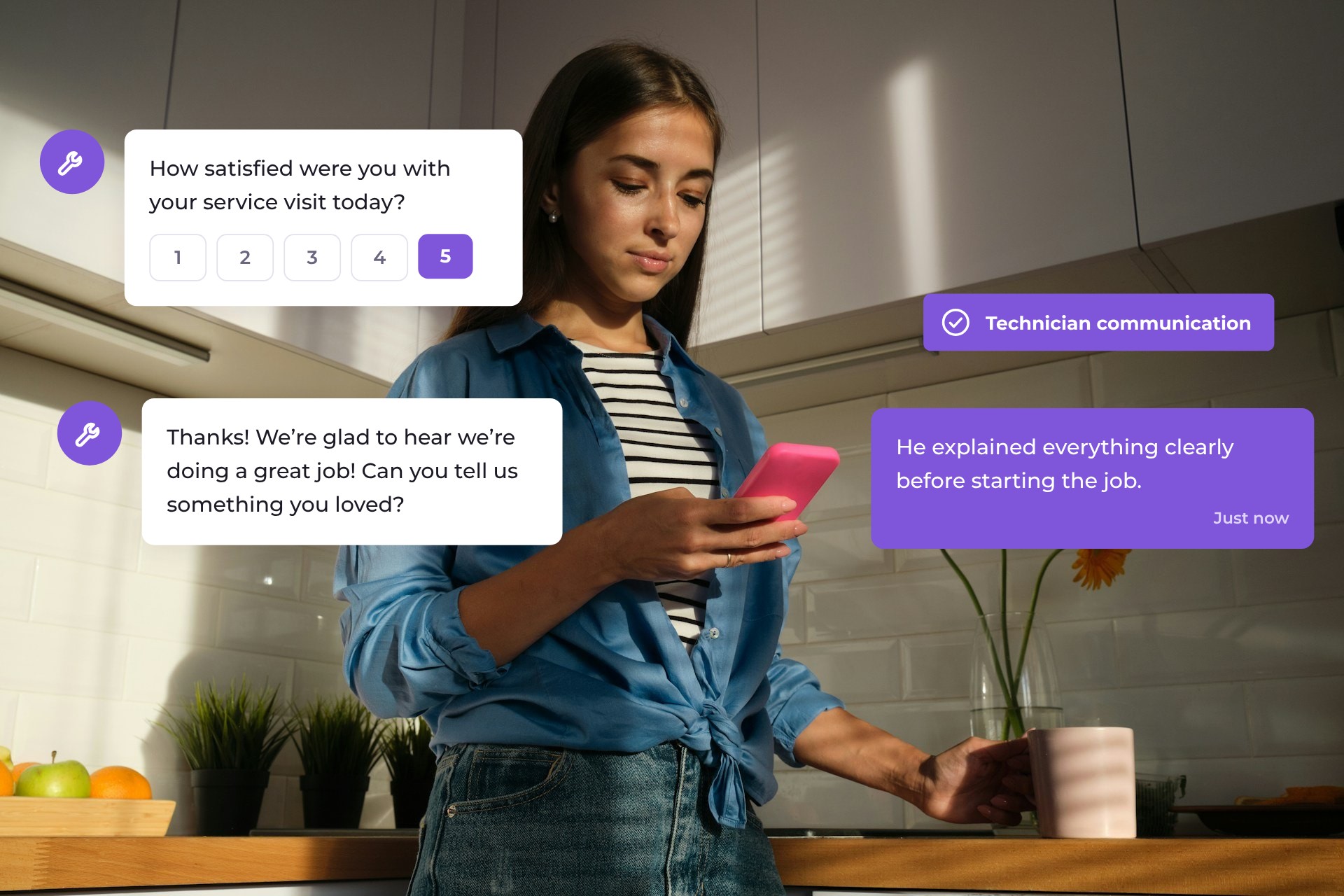
For a home services company, for example, asking for feedback shortly after a technician completes a job can reveal how the customer felt about that specific visit. If satisfaction is low, the business has a clear interaction to investigate and a much better chance of addressing the issue.
A resolved support ticket is not necessarily a successfully resolved customer experience. The customer may still have found the process frustrating if they had to repeat themselves several times or put in more effort than they expected.
Feedback collected after support or service recovery can test both the outcome and the experience of getting there. Customer effort score (CES) can be useful when the goal is to understand how easy or difficult it was for the customer to get their problem solved.
Negative or unresolved responses should have somewhere to go. Routing them to the appropriate manager or team creates a clear path from feedback to follow-up, rather than leaving the customer to assume that their complaint disappeared into the system.
First impressions carry a disproportionate amount of weight. Small points of friction during onboarding or an initial visit can become persistent problems if nobody discovers them until the customer is already disengaged.
Collecting feedback early gives businesses a chance to ask a simple but important question: are customers getting the experience they expected?
A software company might learn that new customers are struggling to complete setup, or a healthcare provider might discover that patients are confused about what happens after their first appointment. These are precisely the kinds of issues that are easier to fix early, before they become reasons to leave.
Cancellation is a feedback moment, too. If a customer is already leaving, there is still value in understanding what pushed them towards that decision.
Ask while the reason is recent and specific. A customer who cancels after repeated service delays can explain that experience far more usefully than a customer responding to a generic win-back survey six months later.
The response can then inform what happens next. Sometimes it identifies an opportunity to save the relationship. Sometimes it points to a win-back approach. And sometimes it reveals a recurring problem that needs to be fixed across the wider customer base.
Real time feedback works best when giving it feels like a natural part of the customer journey, rather than another task customers have been asked to complete. The goal is low-friction capture through channels people already use, at moments when their experience is still fresh and relevant.
Using multiple channels is particularly important. Scientific research institute RCI International reports that using multiple channels to conduct surveys increases response rates, improves coverage across your customer base, and can even control costs.
That also means resisting the temptation to measure everything. More surveys do not automatically produce better insight. A short, well-timed question after a meaningful interaction on the channel the customer used to book their appointment can tell a business more than a long questionnaire sent via a templated email every year..
A useful way to make feedback timely is to trigger it from a customer event rather than a date on a calendar.
A completed appointment, closed support ticket, delivered order or finished service can automatically prompt a survey while the interaction is still fresh. AskNicely, for example, can connect survey delivery to customer events and existing business systems, allowing teams to collect feedback at relevant points in the customer journey rather than relying solely on scheduled sends.
The channel should follow the context. SMS or Whatsapp can work well immediately after a field service visit, while email may make more sense for an ongoing B2B relationship. Web or in-app surveys can capture feedback while someone is already interacting with a digital experience.
The principle is simple: trigger the request from the experience, then deliver it through a channel that feels natural to the customer.
Real time feedback should respect the customer's attention. If the purpose is to understand a specific interaction, ask about that interaction rather than turning a two-minute feedback request into a 15-question research project.
A CSAT question after a service visit might be enough to establish whether the customer was satisfied, with one follow-up asking why. A CES question after support can reveal whether resolving the issue was easy or difficult. NPS can provide a broader relationship signal when that is what the business needs to understand.
Short surveys also make completion more realistic. AskNicely reports that surveys with one to three questions see substantially higher completion than surveys with 15 or more questions.
The question should earn its place. If nobody knows what they would do differently based on an answer, it probably does not belong in a real time survey.
Real time feedback is just as relevant to physical businesses as it is to digital ones. A customer does not need to be sitting at a laptop for a business to understand how their experience went.
Kiosks, QR codes, post-visit SMS and mobile surveys can capture feedback at the point where it makes sense. For example, a healthcare clinic might offer a QR code after an appointment, or a hotel could send a short survey after checkout.
These approaches give businesses a way to connect feedback to individual locations, teams and service moments. AskNicely supports collection across email, SMS, web, mobile app and in-store kiosk, making the same feedback loop possible across different physical and digital environments.
Real time feedback can also create a natural opportunity to strengthen a business's public reputation. When a customer gives particularly positive feedback, the business has a current signal that the experience is worth celebrating.
That can create an appropriate moment to invite the customer to share their experience publicly, whether through Google Reviews or another relevant review platform.
Used thoughtfully, the sequence is straightforward: understand the experience, respond where necessary, recognize the positive moments, and give genuinely happy customers an easy way to advocate for the business.
Collection is the easy part. The harder question is what happens when the response arrives.
A real time feedback program creates value when an answer changes something: a manager follows up with an unhappy customer, a team member adjusts how they work, or a leader identifies a recurring problem worth fixing. That requires feedback to move beyond measurement and into the hands of people who can act on it.
Feedback has a shorter path to action when it reaches the people closest to the experience.
An executive might need to see the overall NPS trend, a regional manager might need to know that one location is falling behind, and a frontline employee needs something much more immediate: what did this customer say, and what can I do about it?
AskNicely is designed around these different levels of action. Feedback can be surfaced through the AskNicely app and AskNicelyTV so teams can see relevant customer responses without relying on an analyst to interpret and distribute a report.
That changes the role of feedback from something reviewed retrospectively to something teams can use during the working day. The customer says something. The right person sees it. Someone has an opportunity to respond.
A low score is a signal, not a resolution. When a customer has had a poor experience, the value of finding out quickly lies partly in the opportunity to recover it. A manager can acknowledge the problem, contact the customer, understand what went wrong and decide whether there is a practical way to put it right.
This is where case management and automated workflows can turn feedback into a repeatable process. Responses can be flagged according to score, sentiment or other criteria, assigned to the right person and tracked through to resolution. The business does not have to rely on someone noticing a negative response buried in a dashboard.
Speed matters here because context fades and frustration can compound. A customer who hears from someone soon after raising an issue has a different experience from one who receives a generic response weeks later.
Real time feedback is useful when the news is good, too. A customer praising a particular employee or describing something that made their experience especially easy gives managers a concrete example of what good service looks like. That can become recognition for the employee and a coaching opportunity for the wider team.
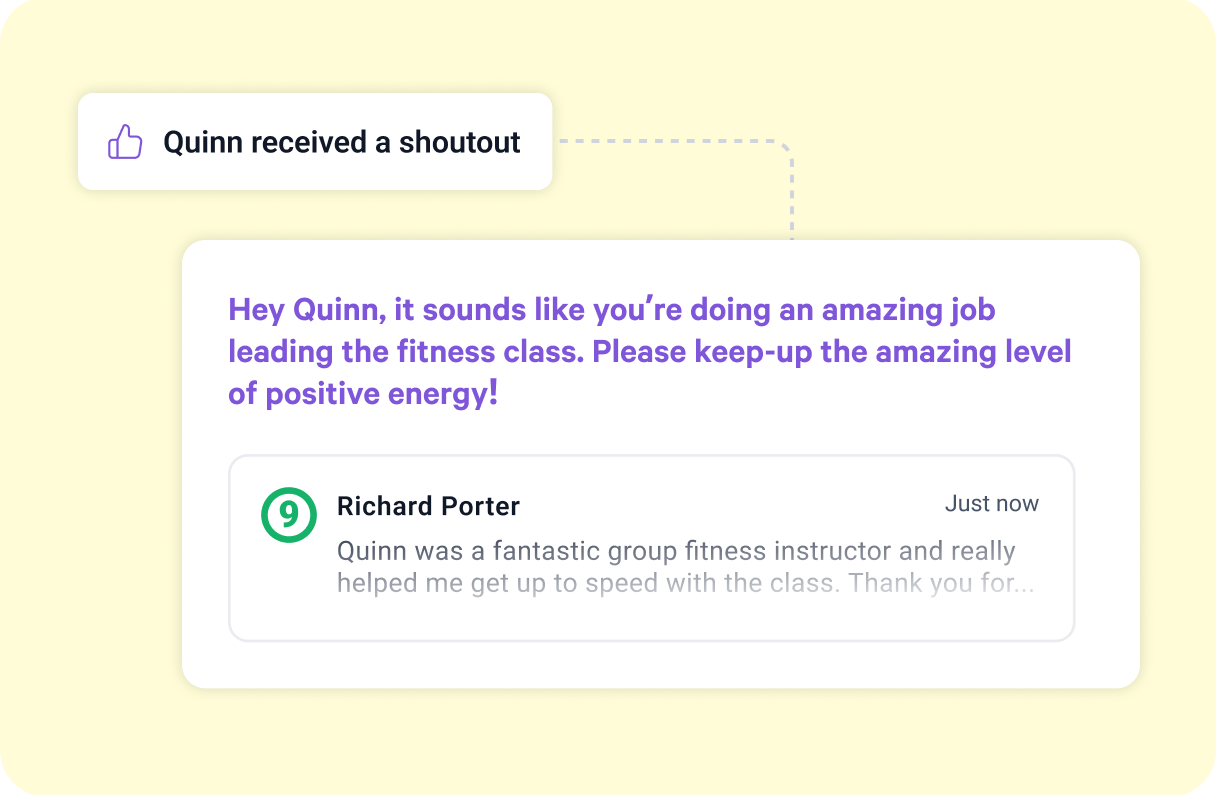
The same applies when feedback reveals a behavior that needs to change. Instead of treating a low score as evidence that an employee or location is underperforming, managers can use the customer's comments to have a more specific conversation: what happened, why did it matter, and what could we do differently next time?
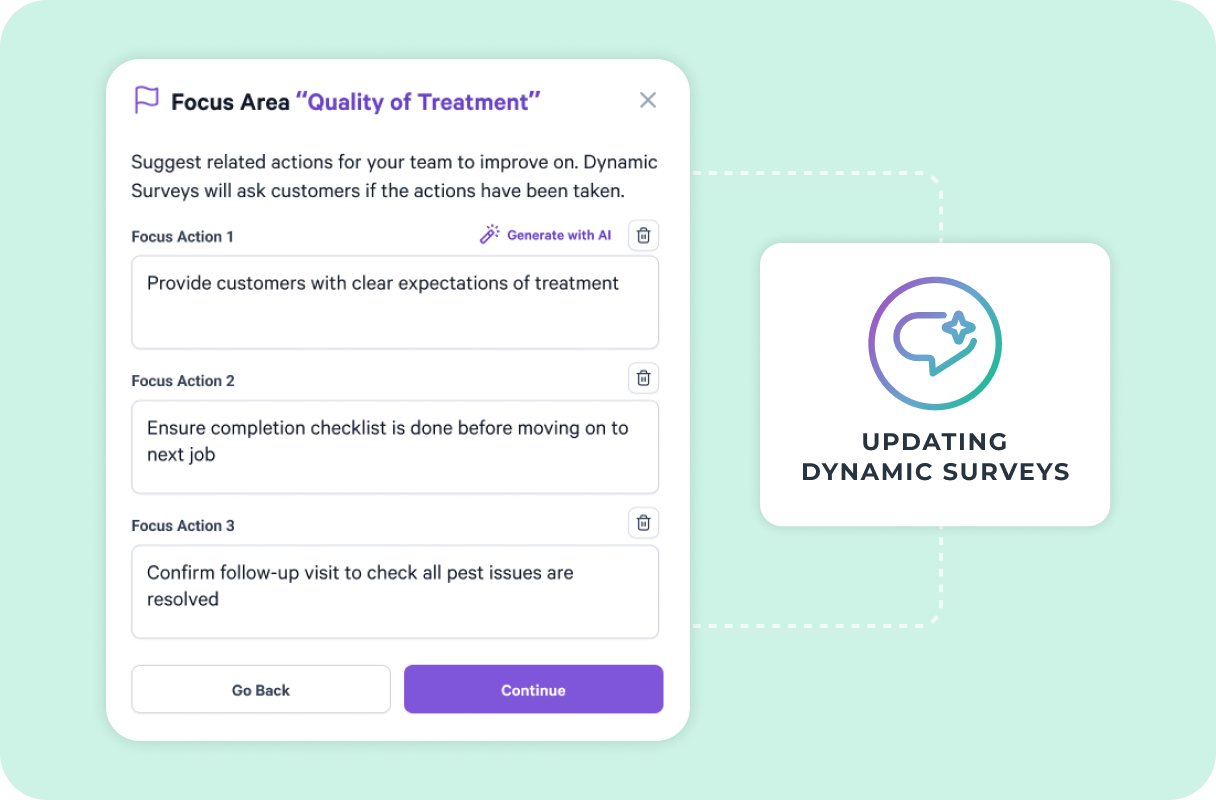
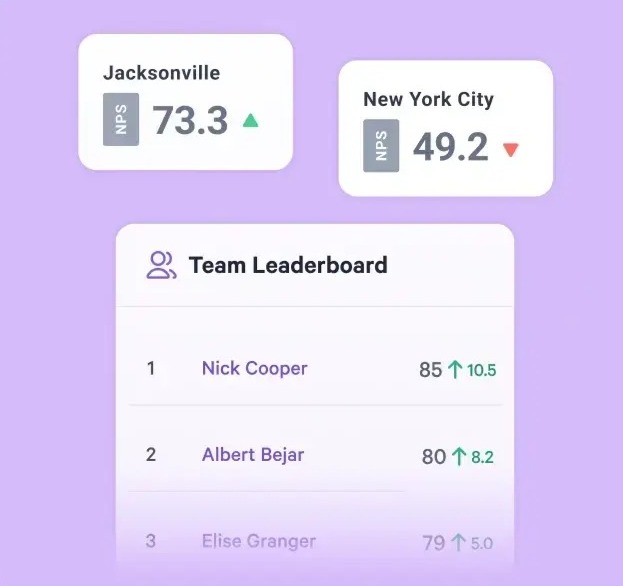
That makes feedback more useful than a number on a leaderboard. It becomes a source of recognition, coaching and employee activation.
Individual responses are valuable because they tell you what happened to one customer. Patterns tell you where the organization needs to change.
If one customer mentions a confusing booking process, that may be an isolated problem. If customers across several locations keep mentioning the same issue, the business has a stronger case for investigating the underlying process.
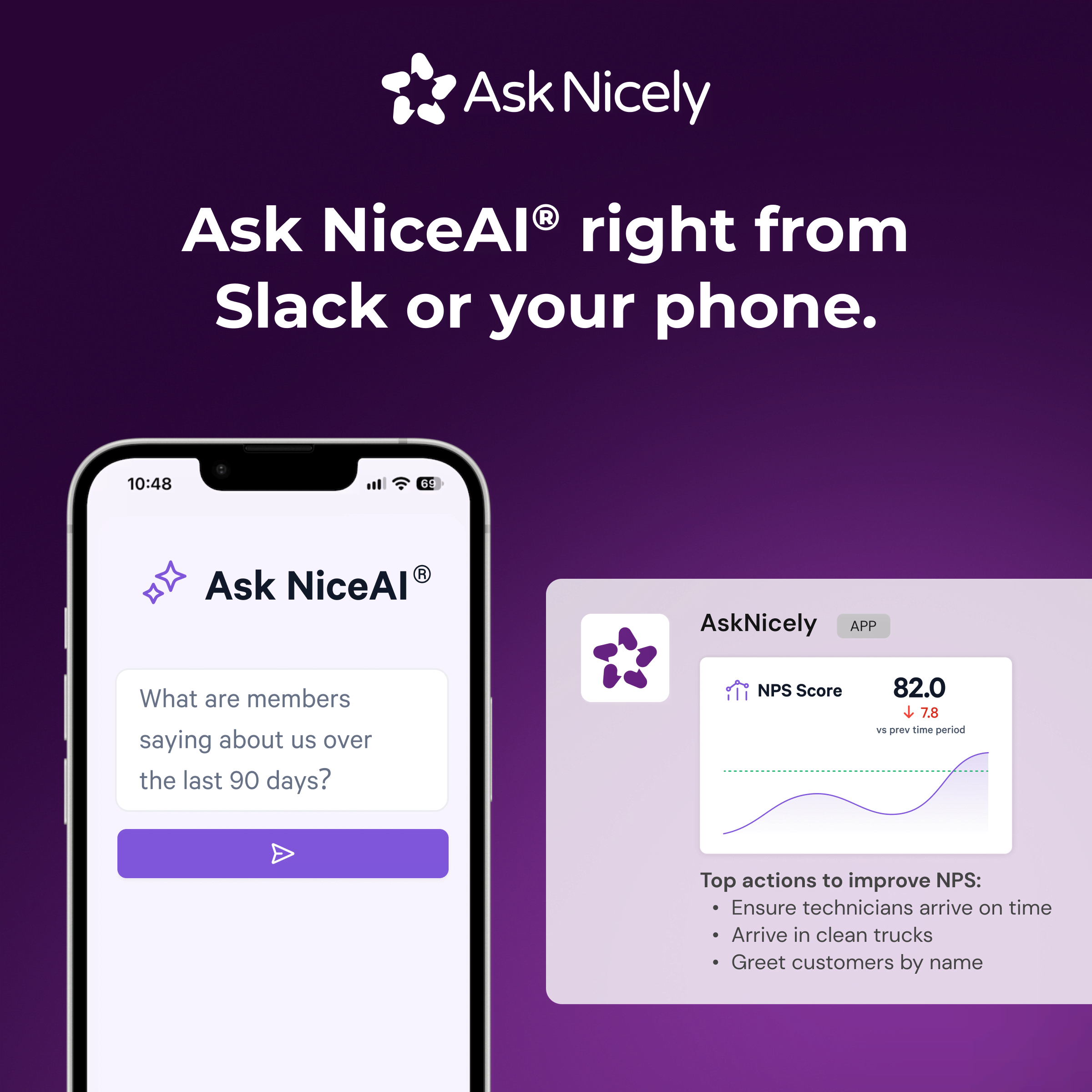
AI-powered analysis can make this easier by identifying recurring themes across large volumes of open-ended feedback, rather than requiring teams to read every comment manually. AskNicely's NiceAI can surface themes and insights across customer feedback, helping teams move from individual comments to the issues that deserve attention.
The result is a more useful feedback loop: capture the experience, route the response, act on the individual issue, then look across the data to find what needs fixing at scale.
Customer experience and employee experience are closely connected, particularly in businesses where the frontline shapes the customer relationship every day.
That makes employee feedback a useful complement to real time customer feedback. A customer might tell you that service has become slower. Employee feedback can help explain why: a staffing gap, an inefficient process, unclear expectations or a team that needs more support.
It is useful to distinguish between eNPS and continuous employee feedback, though. eNPS is typically measured at regular intervals to understand how employees feel about the organization and whether they would recommend it as a place to work. Continuous employee feedback is more frequent and specific, using pulse surveys, check-ins or targeted questions to understand what is happening closer to the moment.
Both have a role. eNPS can provide a consistent engagement signal that leaders can track over time. More frequent feedback can help managers spot emerging issues, understand coaching needs and respond before a small problem becomes a broader operational one.
Gallup's latest Q12 meta-analysis, covering more than 183,000 business and work units, found that employee engagement is associated with customer loyalty, profitability and productivity, among other outcomes. Comparing top- and bottom-quartile business units, Gallup found median differences of 10% in customer loyalty or engagement, 23% in profitability and 18% in sales productivity. The research establishes a relationship rather than proving that engagement alone causes these outcomes, but the connection is substantial and consistent across organizations.
The relationship works in both directions. Timely customer feedback gives employees concrete examples of what customers value and where experiences are falling short. A customer praising a technician's communication can become recognition. Repeated complaints about unclear explanations can become a coaching opportunity. A manager can use the feedback to have a much more useful conversation than simply telling someone their score has dropped.
AskNicely's employee activation approach is built around this connection, surfacing customer feedback directly to frontline teams and using it to support recognition, coaching and targeted improvement. Feedback can be delivered through personalized dashboards, the AskNicely app and AskNicelyTV, keeping customer sentiment visible during the working day.
Employee feedback adds another layer. If several employees report that a process is slowing them down, managers have an early indication that the issue may eventually affect customers too. If frontline teams feel unsupported, overloaded or unclear about expectations, customer experience can suffer long before the problem appears in a quarterly CX report.
The most useful approach is therefore a connected one: listen to customers to understand the experience, listen to employees to understand the conditions behind it, and use both signals to decide where action is needed.
That keeps employee feedback in its proper place within a real time CX strategy. It is not a second measurement program running alongside customer experience. It is another source of context that can help leaders understand why the customer experience looks the way it does, and give frontline teams the support and coaching they need to improve it.
A real time feedback program needs a little more design than simply switching on a survey tool. The strongest programs make three things deliberate: what you ask, what happens when someone responds, and who gets to see the answer.
Every question should have a reason for being there. If a customer has just completed a service appointment, ask about that appointment. Do not use the moment to collect five unrelated opinions that might be useful to someone else in the business.
Enchant reports that 74% of customers are only willing to answer five or fewer survey questions. Its research also found that moving from three questions to four can reduce completion rates by 18%.
The practical takeaway is simple: ask the smallest set of questions that will give you enough information to act. Start with the signal you need, then use conditional follow-ups when more detail is genuinely useful. A customer who gives a low CSAT score may need a “what went wrong?” question. Everyone else may not.
Before sending your first survey, decide what happens when the answers come back.
A low score might trigger a manager follow-up, a comment mentioning a billing problem might go to the relevant team, a customer praising an employee might create an opportunity for recognition. Define these paths before launch, including who owns the response, how quickly they should act and what counts as resolved.
This turns feedback into an operating process rather than another stream of data. It also prevents the familiar situation where everyone agrees that negative feedback is important, but nobody is quite sure whose job it is to respond.
Feedback should travel as far down the organization as the action needs to go.
Leadership may need an overall view of customer sentiment. Regional managers may need to compare locations. Frontline employees need to know what their customers are saying and what they can do differently.
Design the program around those different needs. If every response has to pass through an analyst before reaching the person who can resolve the issue, the feedback loop will inevitably slow down.
An overall score can tell you that something changed. Segmentation helps explain where and why.
Break feedback down by the dimensions that matter to your operation: location, team, service type, customer journey stage, product, technician or other relevant touchpoint. A 10-point drop in satisfaction across an entire organization requires a different response from a 10-point drop at one branch.
The goal is not to create an impressive collection of dashboards. It is to give each owner enough context to recognize the problem and decide what to do next.
Good segmentation should answer a practical question: who needs to see this, and what can they change?
Collecting feedback quickly is becoming easier. The harder problem is making sure that feedback reaches someone who can do something with it.
That is where AskNicely fits. It connects the feedback a business collects with the people, workflows and decisions that can improve the customer experience.
Automated, event-triggered surveys can capture feedback through email, SMS and web at relevant moments in the customer journey. From there, responses can be surfaced to frontline teams through the AskNicely app and AskNicelyTV, so customer feedback is visible where the work is happening rather than confined to an executive report.
For a customer who has had a poor experience, that speed matters. AskNicely can automate close-the-loop workflows and case management, helping businesses route detractor feedback to the right person and track the response through to resolution. The aim is to make follow-up part of the process, rather than something a manager has to remember to do after spotting a bad score.
The same feedback can also be useful at a larger scale. AskNicely's AI-powered theme analysis helps teams identify recurring issues across customer comments and surface the trends that deserve attention. For multi-location businesses, feedback can be segmented by location, team or touchpoint, giving managers the context they need to understand where a problem is happening and who owns it.
And because customer experience ultimately depends on people, the loop extends to the frontline. Customer feedback can support recognition and coaching, while employee feedback gives leaders a clearer view of engagement, operational health and where teams need support.
That is the difference between a feedback program that measures customer experience and one that helps improve it. AskNicely bridges the gap between hearing what customers say and giving the people responsible for the experience the information, context and tools to act on it.
Want to peek under the hood? Book a demo with AskNicely.
Real time feedback refers to the timing and usability of feedback: information is captured and surfaced close enough to an experience that the business can still act on it. Continuous feedback describes an ongoing approach to collecting feedback rather than relying on occasional surveys or annual programmes. A business can therefore have continuous feedback without every response being actionable in real time, and real time feedback can be collected at specific high-value moments rather than constantly.
There is no universal response time because the right window depends on the type of feedback and the severity of the issue. A serious service failure or explicit request for contact should generally be routed for prompt human follow-up, while broader trend analysis can happen over days or weeks. The important principle is to set response-time expectations before launching the program, so a customer does not receive a survey immediately but wait days for someone to acknowledge the problem. AskNicely's State of CX research illustrates the gap businesses still face: 96% of respondents said they act on feedback, but only 36% said they act within 24 hours.
Make the feedback relevant, visible and actionable. A technician is more likely to act on a customer's comment about their service visit when it reaches them with enough context to understand what happened, rather than appearing months later in an organization-wide report. Managers should also connect feedback to specific coaching, recognition or follow-up actions, and make ownership clear.
The goal is to make feedback part of the normal operating rhythm rather than another report employees are expected to check.
eNPS measures how employees feel about their organization and whether they would recommend it as a place to work, and is often collected at regular intervals. Continuous employee feedback is broader and can include frequent pulse surveys, targeted questions and in-the-moment check-ins about engagement, workload, coaching or operational issues. Real time customer feedback focuses on the customer's experience and is typically triggered around specific interactions or moments in the customer journey.
The three approaches can work together. Gallup's 11th Q12 meta-analysis found that top-quartile employee-engagement units had median differences of 10% in customer loyalty/engagement, 23% in profitability and 18% in sales productivity compared with bottom-quartile units.
A survey tool primarily helps you create questions, distribute them and collect responses. A real time feedback platform connects that collection process to what happens afterwards: routing feedback, triggering follow-up, giving frontline teams visibility, identifying recurring themes and tracking action. The distinction matters because a high response rate does not automatically mean a business is improving its customer experience.
The useful test is what happens after someone submits a response. If it simply becomes another data point in a report, you have collected feedback. If it reaches the person who can respond and contribute to a decision or action, you have started a feedback loop.
Start by connecting the program to business outcomes rather than measuring survey activity alone. Depending on the business, that could include customer retention, repeat purchases, review volume and ratings, service recovery, NPS or CSAT improvement, complaint resolution times, employee turnover or productivity. Establish a baseline before introducing changes, then track how those measures move alongside the feedback program.
It is also useful to measure operational improvements, such as how quickly detractors receive follow-up or how many recurring issues are resolved. This creates a clearer picture of value than response rates alone and helps separate a program that generates data from one that changes outcomes.