A loan consultant in North Georgia checks her phone between appointments. A customer she helped last week left a note: not a star rating, but a sentence about how she'd explained the repayment schedule multiple times with patience, without making them feel rushed. She screenshots it and sends it to her team lead.
That single interaction – small, unscripted, easy to miss – is where trust in financial services actually gets built. Not in the rate sheet, not in the marketing, but in the moment someone hands over their financial life to a stranger behind a desk or a phone line, and finds out whether that trust was warranted.
Financial services firms spend heavily on positioning themselves as trustworthy: security messaging, compliance credentials, brand campaigns built around stability and integrity. Most of that messaging tells customers what a firm claims to be. Very little of it is shaped by what customers actually experience when they interact with the firm's frontline. That's the part firms tend to leave to chance, and it's exactly the part that determines whether trust holds up.
This piece looks at how three financial services organizations – a debt management provider, a credit union, and a consumer finance company, used customer experience data to earn that trust deliberately, and what their results reveal about how it gets built at scale.
Picture a customer who's just been declined for a loan extension. It's the kind of conversation nobody enjoys having, and nobody enjoys receiving. But two very different things can happen next. In one version, the loan consultant explains why, walks through what would need to change, and points to a realistic path forward. In the other, the customer gets a form response and a closed door. The financial outcome is identical. The trust outcome is not.
That's the part of financial services that doesn't show up in a rate comparison or a product spec sheet: customers aren't just evaluating whether a firm's offer is competitive. They're constantly testing whether the firm will treat them fairly when something goes wrong, when a decision doesn't go their way, or when they need help outside of business hours. Every one of those moments is a small test. Pass enough of them and a customer stays for decades. Fail one at the wrong time and they're gone, telling their story to anyone who'll listen.
This is what makes financial services CX fundamentally different from most industries. In retail, for example, a poor interaction may cost a sale, but in financial services, it costs the belief that the institution is competent with something the customer can't afford to get wrong. That belief only gets rebuilt slowly, through a string of interactions that go the way they're supposed to.
The firms that struggle with this usually aren't short on good intentions. They're short on visibility. Leadership sees quarterly reports in a deck, but frontline staff don’t get to see how things are tracking in real-time. Nobody in the middle can tell whether the thousands of small tests happening every day are being passed or failed until a churn report shows up months later with the damage already done.
The three companies below took a different approach: making trust measurable and actionable in the moment, not after the fact. Starting with the most foundational piece, consistency.
Debit Success, one of the largest full-service direct debit management providers in Australia and New Zealand, ran into a problem that's easy to overlook until it starts costing you renewals. What "good service" meant depended entirely on which office picked up the phone. A customer calling the Auckland team could have a completely different experience than one calling Brisbane: same brand, same product, but inconsistent outcome.
For a company initiating over 22 million transactions a year across more than 3,000 business accounts, that inconsistency was a direct threat to renewals, referrals, and ultimately revenue.
Debit Success used AskNicely to give every frontline agent across every location visibility into their own customer experience score, ranking, and shoutouts, and gave managers real time feedback to coach from instead of vague direction to "do better." The result: agents who ranked in the bottom third increased their NPS by 21.5 points on average, closing most of the gap with their highest performers. Company-wide NPS rose 20.8 points.
The lesson is simple: consistency doesn't come from telling everyone to deliver great service. It comes from giving every team the visibility, feedback, and coaching they need to understand what great service actually looks like. When the customer experience is measured consistently, leaders can spot gaps between locations, recognize what's working, and give teams the support to close those gaps. That's how a consistent experience becomes a repeatable one, and ultimately, a competitive advantage.
Learn more about the DebitSuccess success story here.
Consistency sets the baseline, but trust is built in the details. A customer can receive the same process every time and still walk away feeling like nobody really listened. In financial services, where customers often need reassurance as much as they need an answer, feedback only creates value when it reaches the people who can act on it, and reaches them quickly.
First Commonwealth Federal Credit Union understood this. The credit union already collected member feedback, but frontline teams weren't getting enough detail to understand what was driving the experience or what they could do differently. Data existed, but it wasn't yet useful.
That created a familiar gap: leadership could see the numbers, but the people having the conversations with members didn't have the context they needed to improve them.
First Commonwealth used AskNicely to provide frontline teams with direct access to member feedback alongside personalized praise and coaching. Each financial center could see its member experience performance, while individual associates could see what members were saying about their interactions. Feedback stopped being something reviewed after the fact and became part of the daily coaching conversation.
The impact was immediate. In just five months, First Commonwealth increased its NPS from around 59 to more than 70, an 11-point gain. More tellingly, members began sending unsolicited testimonials, or what the team called "love letters," describing the experiences that had made an impression on them.
Those responses became more than nice messages to pin on a wall. They gave First Commonwealth a clearer picture of what great service actually looked like from the member's perspective, and a tangible way to recognise and coach the behaviours that created it.
“We can now coach and develop our teams to excel at service delivery, based on what actually matters to our members.” — Damaris Sirop, VP Director Member Experience
The distinction matters. Trust isn't built simply because a financial services firm asks for feedback. It's built when customers can see that their feedback changes how the business operates. A fast response to a problem says, "we heard you." A specific coaching conversation says, "we're doing something about it."
That is how a transaction becomes a relationship, and how a relationship becomes loyalty.
Learn more about the First Commonwealth success story here.
Consistency and responsiveness become harder to maintain as a financial services business grows. What works across 10 locations can quickly break down across hundreds, especially when every branch has its own managers, teams, customers, and local ways of working.
Lendmark Financial Services faced exactly that challenge. With more than 450 branches across 21 states and over 2,000 employees, the company had plenty of customer feedback, but no unified view of what was happening across the customer journey. Feedback was often ad hoc, complaints were handled reactively, and frontline teams lacked a consistent way to understand what "good" looked like.
For Lendmark, the answer wasn't simply to collect more data. It was to build a system around it.
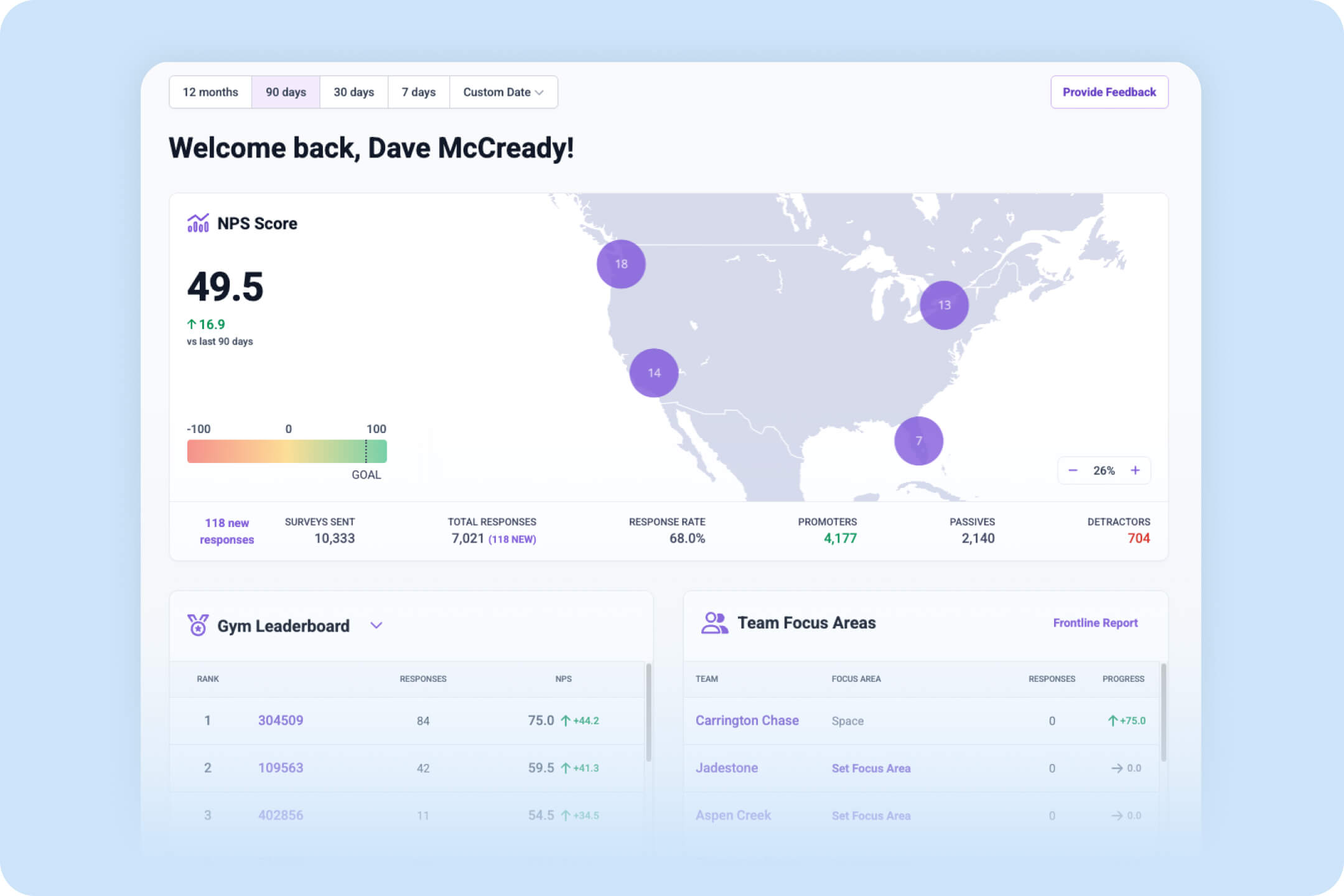
Using AskNicely, Lendmark created a real-time view of customer experience across its branches and gave managers visibility down to individual loan consultants. Customer feedback became a trigger for coaching, recognition, and action. Teams could see when they were getting things right, understand where they were falling short, and spot trends before they became bigger problems.
That mattered because trust at this scale can't depend on individual managers remembering to ask the right questions or individual employees knowing instinctively what customers expect. It has to be designed into the operating rhythm of the business.
The results showed what that can look like in practice. During its initial pilot, 80% of locations increased their NPS, with an average gain of 15 points. As the program expanded, 450 branches began using AskNicely, with 50% seeing an increase in NPS and an average increase of 39 points across those locations.
Just as importantly, the program gave frontline employees a more active role in improving the experience. Loan consultants had instant access to customer feedback, managers had a clear view of where coaching was needed, and employees were recognized when they delivered great service, not only when something went wrong.
That creates a powerful feedback loop: customers provide the signal, frontline teams act on it, managers reinforce the right behaviours, and the organization learns what consistently drives a better experience.
At scale, trust isn't something you can leave to culture alone. You need the systems, visibility, and feedback loops that make a trusted experience repeatable across every branch and every interaction.
Learn more about the Lendmark success story here.
The stories of Debit Success, First Commonwealth, and Lendmark point to the same conclusion: trust isn't built through one big CX initiative. It's built through the thousands of frontline interactions that happen every day and the systems that help teams learn from those interactions.
For financial services leaders, that means moving beyond measuring whether customers are satisfied and focusing on whether the organization is equipped to consistently earn their trust.
If different branches, teams, or managers have different ideas of great service, customers will feel that inconsistency. Establish shared benchmarks for the experience you want to deliver, then give frontline teams visibility into how they're performing against them.
A customer complaint reviewed three months later is data. A customer issue surfaced today and put in front of the right person is an opportunity. Real-time feedback allows managers and frontline teams to address problems while they can still influence the relationship.
Feedback shouldn't stop with leadership. The people actually having conversations with customers need to see what customers are saying about their experiences. When frontline employees can connect their behavior to customer outcomes, coaching becomes more specific, relevant, and actionable.
When customers call out an employee for going above and beyond, that feedback is a powerful coaching and recognition tool. Celebrating those moments shows teams what great service looks like, and makes it more likely they'll repeat it.
Ultimately, the goal is to create an organization that can see where trust is being won or lost, respond quickly, and continuously get better. That is what turns customer experience from a measurement exercise into a competitive advantage.
Go back to that loan consultant in North Georgia. A customer leaves a note about an interaction that could easily have been forgotten: someone took the time to explain a repayment schedule, answer the questions, and make a difficult conversation feel a little easier.
On its own, it's a small moment. Multiply it across hundreds of branches, thousands of employees, and millions of customer interactions, and those moments become the customer experience.
That's the real opportunity for financial services firms. Trust doesn't need to be left to chance, and it can't be created by a brand promise alone. It can be measured, understood, coached, and reinforced at the frontline, where customers actually experience the organization.
Debit Success shows what happens when that starts with consistency. First Commonwealth shows the value of responding to feedback with speed and specificity. Lendmark shows how those principles can become a repeatable system across hundreds of locations.
The common thread is simple: listen to customers, give frontline teams the insight to act, and make improvement part of how the business operates every day.
See how AskNicely helps financial services teams turn customer feedback into action.