One location is at 4.8 stars. Another, three miles away, running the same playbook, is at 3.6. Head office sees both numbers on the same dashboard and asks the same question every quarter: why isn't this fixed yet?
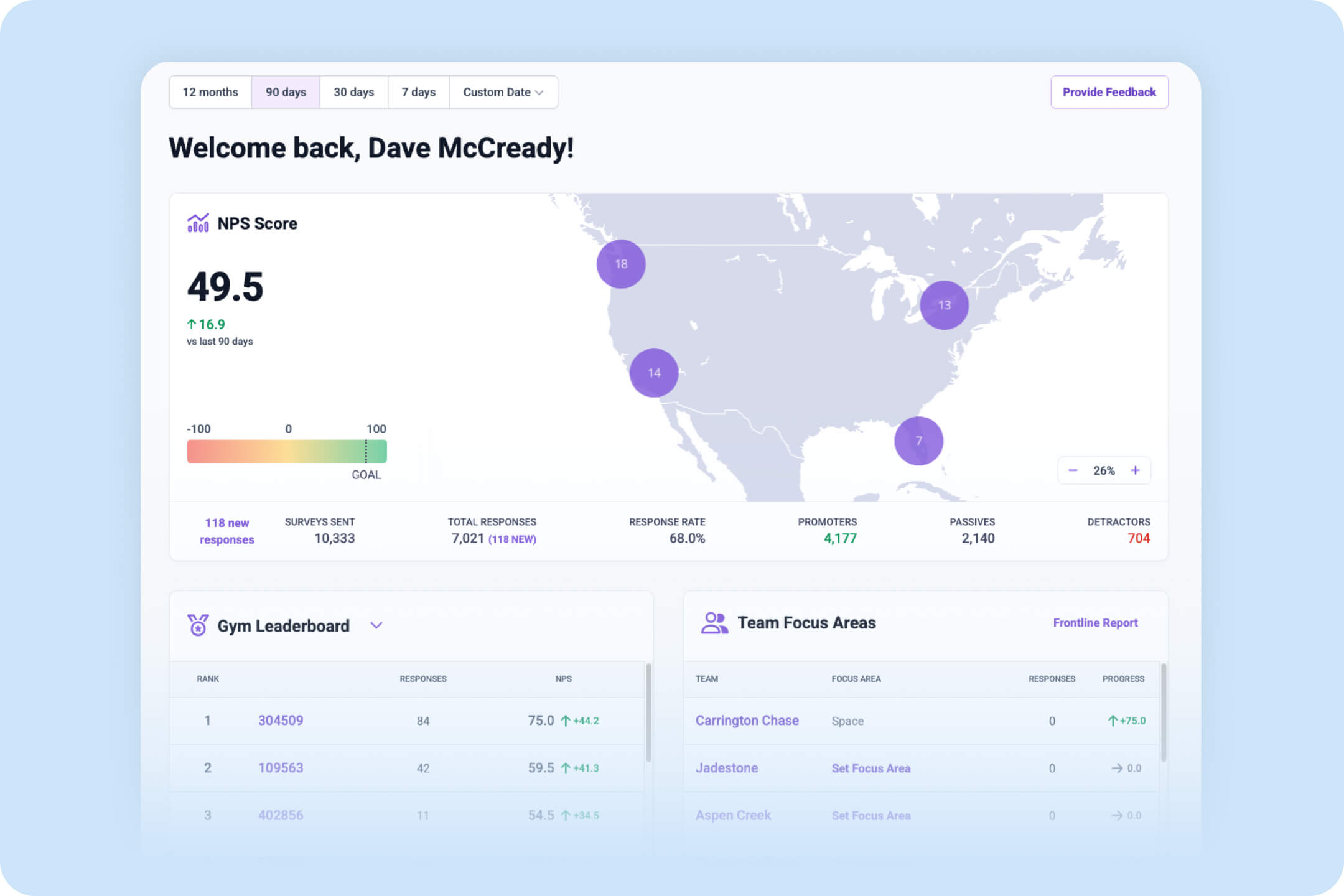
The honest answer is that dashboards were never built to fix it. They were built to report it. Multi-location review management usually starts as a monitoring problem: pull every location's Google, Yelp, and Facebook ratings into one view, flag the laggards, escalate to a regional manager who's already managing twelve other fires. That workflow surfaces the problem, but it doesn't solve it.
For operations leaders running distributed businesses, the stakes are direct. A low-rated location loses local search visibility and, with it, lead volume, while franchisees and corporate treat the number as a referendum on the whole brand. Marketing gets blamed for a problem that's actually happening on the floor, at the moment of service, location by location.
So how can we solve this all too familiar problem, sustainably? Routing feedback to the person who can act on it, assigning real ownership of the score, and treating review inconsistency for what it is (a readout on operational consistency, not a reputation problem to manage from the top down) are all great places to start.
Let’s go back to these differing locations. Say a healthcare group running 35 clinics has the same review-request tool live at every site, the same corporate marketing behind every location, the same intake forms and the same brand standards on paper. One clinic in Michigan sits at 4.8 stars and another in Ohio at 3.6.
What we’re talking about here is an experience problem. The 4.8 clinic and the 3.6 clinic are delivering two different patient experiences, and the reviews are just the record of that difference: shorter waits, warmer front-desk staff, a provider who explains things clearly etc. Reviews are a telling measure of what happened in the room.
This is where dashboards run out of road. The head office can watch that 3.6 score all day, filter it by region, put it in a slide for the quarterly review, but none of that shortens a wait time in the Ohio clinic or retrains the front-desk hire who's souring every third visit. Monitoring identifies the problem location but it has no mechanism for fixing what's happening inside it.
Harvard Business School research found that a one-star increase in rating drives a 5-9% increase in revenue – a finding grounded in restaurant data, but the mechanism generalizes to any local business where customers choose based on nearby reviews. For a 35-location group, the spread between the best and worst performer is a measurable revenue gap, compounding at every location still sitting on the wrong side of the line.
Which points to the actual fix. Scores move when feedback reaches the person delivering the experience. Ownership has to sit at the location, with the frontline employee who can act on a specific complaint before the next patient walks in.
Take two locations in the same auto service chain, same brand standards manual, same POS system. One has a service advisor who's been there six years and knows every regular by name. The other lost its advisor eight weeks ago and is running on a new hire still learning the estimate software. Same intake script, same warranty terms, same loyalty program, but one location is fast and personal, and the other is slower, and customers notice.
Staffing turnover does this. So does a manager who's three weeks into the role and still learning which corners can't be cut. So does a location mid-renovation, running a reduced bay count with the same appointment volume booked in. Brand standards describe the intended experience but they don't actually deliver it. The person on shift that day does. And on any given day, the person on shift is different at every location.
When a customer at that auto shop location with the new service advisor leaves a three-star review mentioning the wait, here's the typical path it takes: it lands in a shared inbox or a reputation dashboard, gets triaged once a week by someone in marketing who's covering forty other locations' worth of reviews, and gets logged as "addressed" once a templated reply goes out.
The service advisor who ran that appointment never sees it. Neither does the location manager, unless the review is bad enough to trigger an escalation email days or weeks later. The person best positioned to fix the actual problem ( coach the new hire, adjust the schedule, flag the parts delay, etc.) is usually the last person in the loop, if they're in it at all.
This isn't a resourcing failure so much as a math problem. One person monitoring, requesting, and responding to reviews across 60 locations onGoogle, Yelp, and Facebook daily is managing hundreds of brand-level actions a week. None of this work results in fixes at the branch level.
The workload scales with the number of locations. But headcount doesn't scale the same way – it scales with budget, and budget grows in steps, not in a straight line. A business that added ten locations this year may not need to add extra marketing or customer service headcount to monitor them. So the backlog grows, the response time grows with it, and monitoring becomes a full-time triage job rather than an ownership and action structure.
A single bad experience is recoverable. Three of the same complaints, from three different customers in one month, is a pattern. And that pattern only exists because the first occurrence wasn't flagged to the branch manager fast enough to fix before the second and third customers walked in.
This is the mechanism that actually determines whether a location's score recovers or keeps sliding: not how thoroughly head office monitors the reviews coming in, but how fast the first signal gets back to the person who can change what happens on the floor. A weekly digest is too slow to stop a pattern from forming. By the time the report goes out, the same issue has already repeated and now it's not one review, it's a trend line.
The head office's job is to set the standard every location is expected to hit and to watch for patterns that a single location manager can't see from inside their own building.
That's a different skill than reputation monitoring. A single three-star review at one clinic is a local issue, so the branch manager handles it. Three locations in the same region dropping half a star in the same month is a regional issue, and it's the kind of signal only head office is positioned to catch. It might point to a supplier change, a policy update that's landing badly, or a regional manager who needs support. Head office's value is in spotting that second pattern, not in personally managing the first.
Ownership means the branch manager sees their location's feedback in real time, the same way they see their daily revenue or their safety numbers, not once a quarter, and not only when corporate forwards something bad enough to warrant an email.
Gallup's research found that management quality explains roughly 70% of the variance in team engagement, and that business units in the top quartile for engagement see 23% higher profit than those in the bottom quartile. Review scores move for the same reason engagement moves, through the person managing the team day to day. Centralized monitoring can flag a problem but crucially it can't coach the front-desk hire or fix the scheduling gap that's actually causing it.
A technician who does great work should know about it, ideally in the moment.
A five-star mention that names the technician, delivered within a day, reinforces the exact behavior that earned it while the appointment is still fresh in their mind. A quarterly scorecard can't do that. By the time it lands, the employee has run hundreds of other appointments and has no way to connect the score to a specific decision they made. Recognition works because it's close to the action. Delay is what turns it into a formality nobody reads.
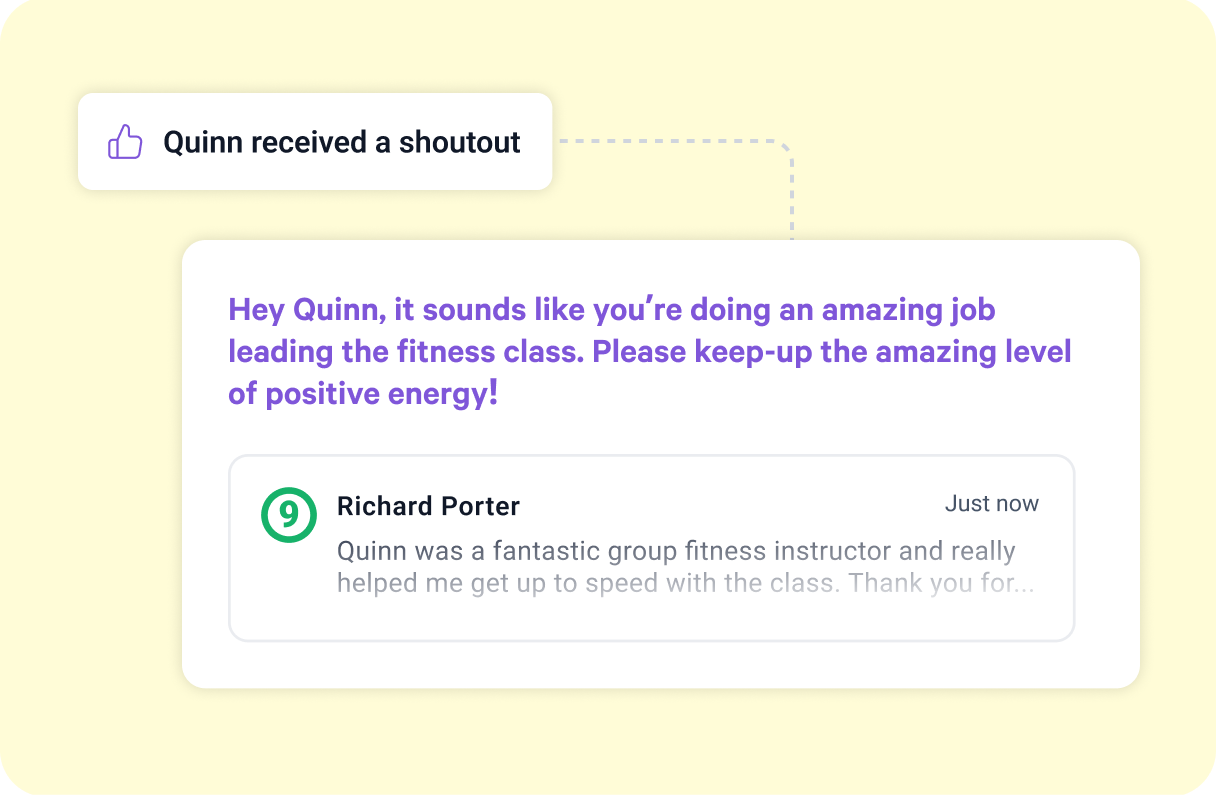
Some of this workload was never a good use of a manager's time. Requesting a review from a satisfied customer right after a good appointment, drafting a first-pass response to a routine review, flagging which comments need a human versus which are a quick acknowledgment – that's repetitive, pattern-based work, and it's exactly what should be automated.
What shouldn't be automated is the judgment call. Coaching a technician who's had two rough weeks in a row, sitting down with a customer who's escalated a complaint, deciding whether a pattern of three-star reviews reflects a training gap or a staffing gap – those still need a manager who knows the location and the people in it. The goal of automating the repetitive layer is to clear enough of the manager’s time that they're spending it on the calls that actually require them.
The workflow only works because speed and ownership are attached to every step. Remove either one (route feedback to a person without giving them ownership, or assign ownership without giving them timely feedback) and it collapses back into the reactive, monitoring-only model.
Trigger the request off the interaction. A customer who just had a good experience (an appointment that ran smoothly, a support call that resolved their issue) should get a review request within hours, while the experience is still fresh. A generic monthly email blast to everyone in the CRM has none of that context and converts at a fraction of the rate.
Not every location gets discovered the same way. A dental clinic in a suburban strip mall likely lives or dies by Google or Zocdoc reviews, since that's where nearby patients search. A hospitality business might get more of its bookings influenced by Yelp or Facebook. Defaulting every location to "send them to Google" is easy to set up, but it leaves visibility on the table anywhere a different platform is actually driving discovery.
The AskNicely Review Routing Agent identifies customers and asks them for a review at the right moment, on the review platform you need it most.
For example, let's say you already have a great review score on Google, with plenty of recent reviews. Rather than sending more customers to leave Google reviews, you can use the Review Routing Agent to maintain a steady stream of reviews to other review sites that are important to your brand, like Facebook, Yelp, Angi, Zocdoc, G2, or anywhere else. The agent constantly analyzes your presence across review sites to route your happy customers to the place that their review will have the greatest impact.
Speed and consistency don't have to trade off against each other, but only if the guardrails are explicit. A useful setup: AI drafts the first-pass response for five-star reviews in an approved tone, flags anything touching an off-limits topic (refunds, legal language, medical claims, low scores) for manual handling, automatically escalates anything below a set star threshold instead of auto-responding, and routes every draft to a manager for approval before it goes live. The AI handles the volume, and the manager still owns what actually gets published.
Track the signals that move first: response time to negative feedback, the percentage of satisfied customers who actually get asked for a review, and service standard scores by location. These move faster than the star rating and tell you whether the workflow is working before the public number catches up.
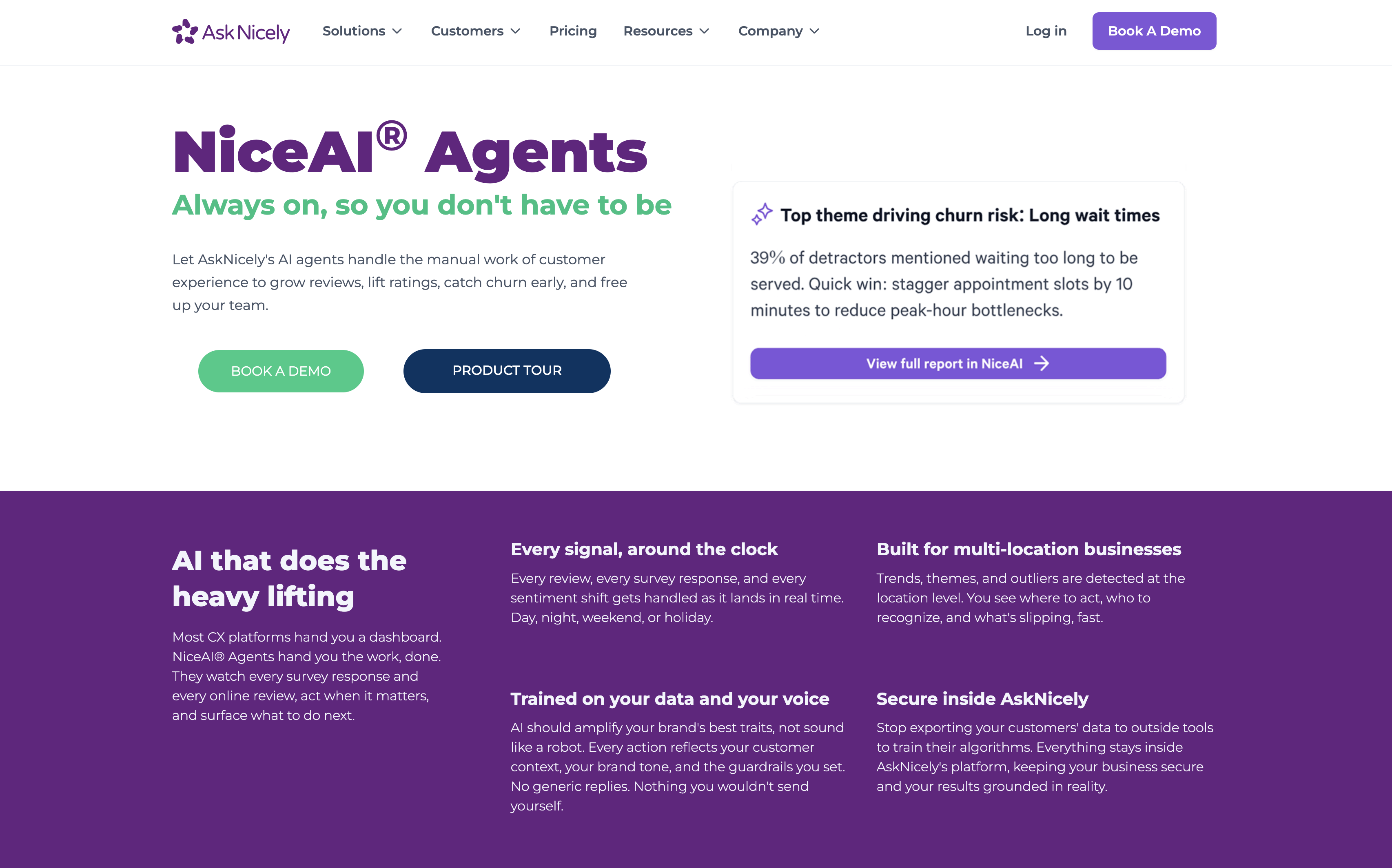
Most reputation platforms solve the same half of the problem. Tools like Birdeye and Podium are genuinely good at what they're built for — pulling every location's reviews into one dashboard, alerting head office when a score moves, giving marketing a single view across the network. That's real, useful work. It's also where the value stops. The dashboard tells corporate what happened but it doesn't tell the branch manager or the technician what to do differently tomorrow. Frontline teams stay exactly as blind to the feedback as they were before the tool was installed, and nothing actually changes..
AskNicely's position is different. Instead of centralizing reviews for head office to watch, we route feedback directly to the branch manager and the employee involved, in real time, so the people who can actually change the next customer's experience are the ones who see it first.
Reputation tools manage reviews after they exist: collect, monitor, respond. AskNicely is a customer experience platform built to improve the service delivery that produces the reviews in the first place.. So the honest comparison isn't review tool versus review tool. It's a reputation-only stack versus an integrated CX-and-reviews platform where the review layer is connected to the operational layer that actually moves the score.
Centralized monitoring will always have a place – the head office needs the aggregate view, the regional trend, the outlier flag. But monitoring alone was never going to close a gap that's caused by inconsistent service delivery at the location level. Closing that gap takes getting feedback to the person who delivers the next appointment, not just the person who reads the report.
5 and 15 locations.
Manual review management starts breaking down somewhere between 5 and 15 locations, depending on business complexity. A single person or small team monitoring Google, Yelp, and Facebook daily can no longer read, triage, and route every review without a multi-day lag once volume crosses that threshold. Below it, manual monitoring is inefficient but survivable. Above it, response times stretch and patterns get missed until they've already become three or four repeat complaints.
This breakdown point also depends on the size and complexity of the business. Some business models won't be able to handle manual review management with just one location: high review volume per site, multiple platforms, or tight response-time expectations can push the ceiling much lower.
Most businesses see measurable movement in leading indicators (response time, review request volume, internal complaint resolution) within four to six weeks, since those change as soon as the workflow does. The star rating moves slower because it's a rolling average built from recent reviews, so a meaningful shift typically shows up over one to two quarters. Locations with lower starting scores tend to move faster, since a run of fixed experiences has more room to pull the average up.
As mentioned above Harvard Business School research found that a one-star increase in rating drives a 5–9% increase in revenue, which gives operations leaders a concrete way to model the upside of closing the loop at underperforming locations. Beyond the top-line number, the ROI shows up in reduced manual monitoring hours, fewer escalations reaching corporate, and faster onboarding for new managers who inherit a structured feedback process instead of a dashboard they have to learn to interpret. The compounding effect matters most: a location that recovers a full star doesn't just gain revenue once, it keeps that gain as long as the underlying service holds.
Reviews are a lagging, public indicator of the customer experience a location actually delivers – they're one data point in a broader CX program, not a program on their own. A mature CX setup captures feedback immediately after the interaction, routes it internally before it becomes public, and uses it to coach the team in near-real time; the review request is just the last step in that sequence, triggered for customers who signal satisfaction. Treating review management as a standalone workstream, separate from CX, is exactly what leaves it stuck in monitoring mode.
Ownership has to be explicit and structural, not just suggested. That means the employees’ scores are tracked the same way as revenue or safety metrics, feedback reaches them within a day rather than a monthly digest, and they have a defined next step (a coaching playbook, a follow-up call) rather than a raw number with no guidance attached. Gallup's research found that management quality explains roughly 70% of the variance in team engagement, which is the same lever that determines whether a manager engages with review feedback or lets it sit unread.
Marketing typically owns the brand-level view (overall reputation, aggregate response strategy, platform presence) while operations should own the location-level fix, since that's where the actual service gap lives. The mistake most businesses make is leaving the whole function with marketing by default, which keeps the feedback loop centralized and disconnected from the frontline teams who can act on it. The stronger model splits it: marketing manages the public-facing brand signal, operations owns getting feedback to branch managers and closing it at the source.
Look past the dashboard and ask whether the tool routes feedback to branch managers and frontline employees, not just to a central team. Check whether it separates internal and public feedback channels, so unhappy customers get a chance to be resolved before a review goes live, and whether it supports per-location platform prioritization rather than defaulting everyone to the same review site. Finally, evaluate whether it's built as a customer experience platform that connects reviews to service delivery, or a standalone reputation tool that only manages reviews after the fact.
The mechanics are similar, but the ownership structure is different for franchises. The franchisee, not a corporate-appointed manager, usually controls staffing and day-to-day execution. That makes the feedback loop even more important: corporate can set brand standards, but it can't mandate a fix inside a franchisee's business, so getting timely, specific feedback directly to the franchise owner is often the only real lever available. Franchise agreements sometimes also need explicit reporting cadences or shared scorecards to keep review performance visible without corporate overstepping into franchisee operations.