How AI can prioritize the CX issues that actually matter most
For many customer experience (CX) teams, the challenge is no longer collecting enough feedback. It’s knowing what deserves attention first..
When every issue looks equally important, teams end up chasing noise instead of addressing what can actually move the customer experience forward.
This is where artificial intelligence (AI) has the potential to change the role of customer feedback. The real opportunity isn't simply using AI to analyze more data, summarize more comments or generate another report. It’s using AI to understand the relative importance of different customer signals, and help teams focus their time where it can have the greatest impact.
The question for CX leaders is no longer, “What are customers saying?”
It’s:
“Of everything customers are telling us, what matters most right now?”
That shift, from collecting insight to intelligently prioritizing it, could be one of the most important applications of AI in CX.
Not every piece of customer feedback carries the same weight. Yet without the right tools to separate signal from noise, CX teams can easily fall into the trap of prioritizing whatever issue appears most frequently.
That might mean spending weeks addressing a relatively minor friction point while a smaller, but more consequential, issue continues to affect customers behind the scenes.
Consider two scenarios. Fifty customers mention that a particular feature is slightly difficult to use. Ten customers report that their experience with a specific service team has deteriorated significantly and they’re about to cancel. Which should take priority?
The answer isn't necessarily the issue with more mentions.
To make smarter decisions, CX teams need to look at context, impact and momentum, not just volume. An issue that is rapidly increasing, strongly associated with detractor feedback or concentrated across a particular location could deserve far more attention than a higher-volume issue that's having little measurable effect on the overall experience.
This is where AI can become more than a faster way to analyze feedback. By looking across large volumes of customer signals simultaneously, AI can help uncover the patterns humans might miss — and distinguish between what's simply being said a lot and what is actually affecting the customer experience most.
A useful AI-powered prioritization approach should consider several dimensions at once:
Impact: How strongly is an issue connected to customer satisfaction or dissatisfaction?
Momentum: Is the issue becoming more common or more negative over time?
Scale: How many customers are actually affected?
Concentration: Is the problem isolated to a particular location, team, product or stage of the customer journey?
Risk: Could a seemingly small issue develop into a larger customer or business problem if left unresolved?
Opportunity: Are there positive patterns that could be replicated elsewhere?
The result is a more intelligent view of customer feedback. Instead of simply asking “What are customers talking about?”, teams can start asking the more useful question: “Which of these issues has the greatest potential to improve the customer experience if we act on it?”

If prioritization is the goal, simply identifying recurring themes isn't enough. AI needs to understand the context around those themes.
A complaint about wait times, for example, could mean very different things depending on where, when and how often it occurs. Is it a one-off? Is it happening at one location? Has it suddenly increased? Are customers mentioning it alongside lower satisfaction scores? And, most importantly, is it actually affecting the metrics the business cares about?
This is where AI can offer an advantage over manual analysis. Rather than asking teams to piece together patterns across spreadsheets, dashboards and individual comments, AI can analyze multiple signals at once and connect them to the broader customer experience.
That means looking beyond frequency to understand impact, momentum and context.
A useful AI-powered prioritization system should help teams answer:
The answers create a much more useful hierarchy of issues. Instead of handing a CX team a list of everything customers have mentioned, AI can help create a shortlist of the things that warrant action now.
Once AI can understand the context behind customer feedback, its role changes. It no longer needs to simply tell teams what customers are saying and it can help determine what they should pay attention to first.
That means continuously analysing feedback as it arrives and looking for changes that might otherwise take a human team weeks or months to spot.
For example, an AI system might detect that:
Individually, these signals might not trigger an alarm. Together, they can tell a very different story.
This is where always-on AI analysis becomes particularly valuable. Instead of waiting for a monthly report or manually searching through thousands of comments, CX teams can have AI continuously monitor their feedback and flag meaningful changes as they happen.
AskNicely's NiceAI® is designed around this principle. Its AI Insights continuously analyses customer feedback across surveys, reviews and locations to identify what's changing and why, while Focus Areas surface the CX issues that deserve attention.

For multi-location businesses in particular, this can turn a huge volume of customer feedback into a much more actionable picture, highlighting where performance is slipping, which issues are emerging and where teams have an opportunity to make the biggest difference.
And when those insights arrive in the channels teams already use, such as email, Slack or Teams, prioritization doesn't have to mean another dashboard for someone to check.
The best AI-powered CX systems surface the information most likely to change what a team does next.
Knowing that something has changed is useful. Knowing why it matters is what makes that information actionable.
An announcement that sentiment around wait times declining is useful, but frontline teams need to understand what is driving the change, where it is happening, which customers are affected and whether it is having a meaningful impact on the overall experience.
Without that context, AI risks becoming another source of alerts, just with more of them.
The most useful AI-powered CX analysis connects the dots between customer feedback and the bigger picture. It should help teams move from: “Customers are mentioning this more.” to: “This issue is increasing at three locations, is strongly associated with lower satisfaction, and is being driven by longer-than-usual wait times. Here’s where it is happening and what you can investigate next.”
This is where natural-language AI can make CX analysis more accessible. Instead of relying on teams to build complex reports or know exactly which dashboard to open, they can ask questions in plain language and explore the answers as they emerge.
For example:
AskNicely's NiceAI brings this approach together by allowing teams to explore customer feedback across surveys, reviews and locations, with dynamic analysis and explanations that help connect changes in CX performance to the underlying customer signals. This gives teams the evidence and context they need to decide what deserves attention and why.
The best AI shouldn’t just point at the fire. It should help you understand where it started, how quickly it's spreading and how you can prevent it from sparking again.
A problem can emerge on Monday, spread across a handful of locations by Wednesday and start appearing in negative reviews by Friday. By the time it shows up in a monthly CX report, teams may already be playing catch-up.
That's why effective AI-powered prioritisation needs to be continuous.
Rather than analyzing customer feedback in periodic batches, AI can keep watch across incoming surveys, reviews and other customer signals, looking for meaningful changes as they happen.
That might mean spotting a sudden drop in scores, detecting an emerging theme before it becomes widespread or identifying a location that is starting to perform differently from the rest of the network.
If teams can see a problem while it's still small, they have a much better chance of addressing the underlying cause before it becomes a bigger customer experience issue.
Of course, continuous monitoring shouldn't mean bombarding CX teams with notifications every time a metric moves.
That's just another version of information overload.
The intelligence lies in knowing which changes are worth bringing to someone's attention.
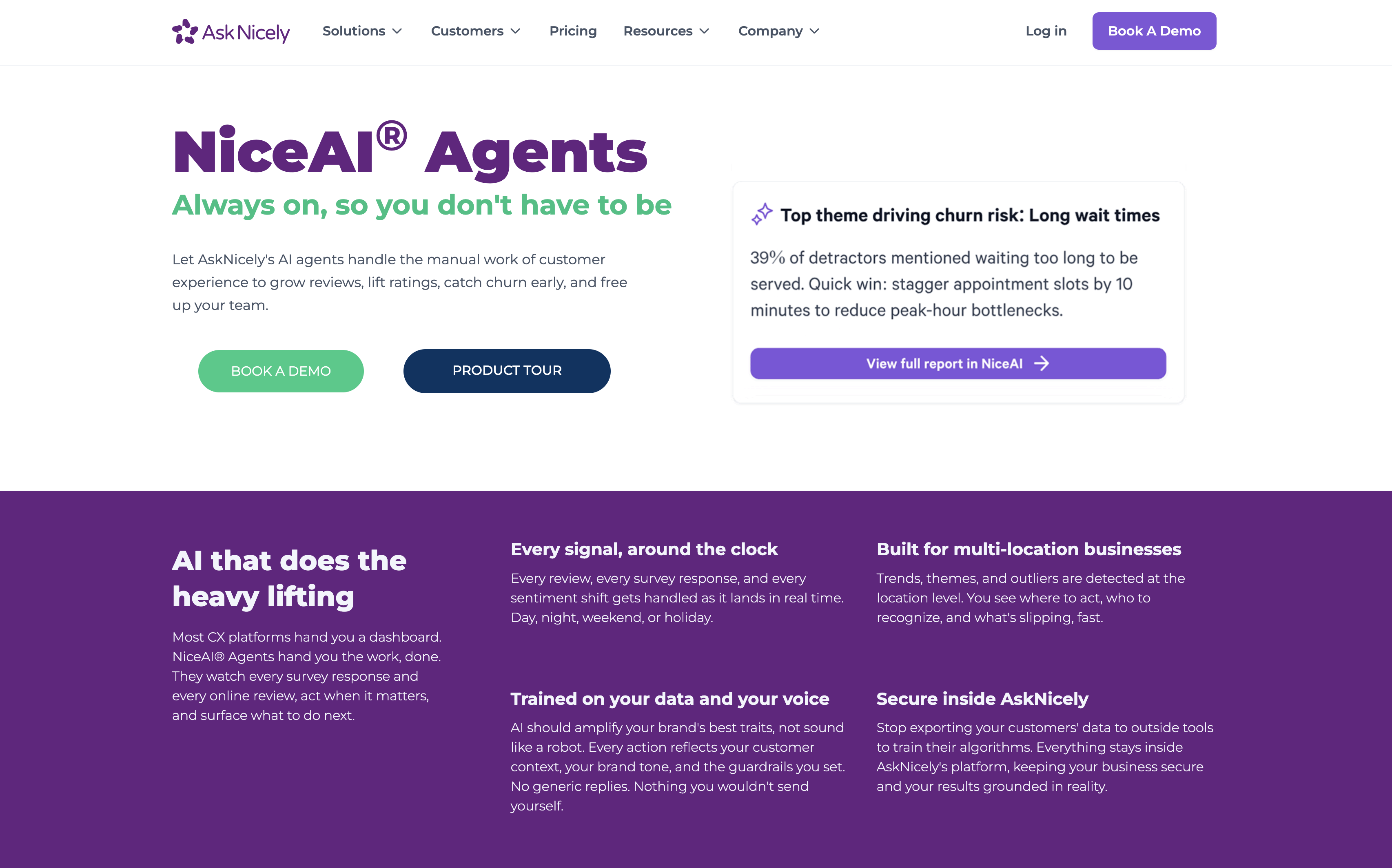
NiceAI Agents are designed around this idea, continuously monitoring customer feedback and online reviews and surfacing important changes, emerging themes and outliers. The Insights Agent can deliver relevant answers, evidence and recommended next steps through channels teams already use, including email, Slack and Microsoft Teams.
This creates a different model for CX management.
Instead of:
Collect → report → review → react
teams can move towards:
Monitor → prioritize → act
And when customer expectations can change faster than a reporting cycle, that shift from periodic analysis to continuous intelligence could be one of AI's biggest advantages.
The ultimate test of AI-powered CX is what happens next.
A perfectly identified customer issue is of little value if it gets buried in a dashboard, added to a spreadsheet or discussed in the next quarterly meeting without anyone taking ownership.
This is where CX teams need to think beyond insight generation. AI should help create a clear path from customer signal to action.
NiceAI's Focus Areas are designed to turn the most important CX issues into clear areas for teams to focus on. Rather than asking managers to work through every theme emerging from customer feedback, the goal is to direct attention towards the issues with the greatest potential impact.
And the action doesn't always have to mean fixing something.
Sometimes the right response is to recognize what's working and replicate it. AskNicely's Shoutouts, for example, can highlight standout teams and positive customer experiences, helping organizations understand not only where CX is breaking down, but where it's already working well.
Other actions might involve responding directly to customers, investigating an operational issue or directing review-generation efforts towards locations that need them most.
The important thing is that AI-powered prioritization should connect insight to the workflows where decisions actually happen, without adding extra operational steps.
There’s a natural concern that if AI becomes better at interpreting customer feedback, it could make CX teams less important.
The opposite is more useful to consider.
AI is at its most valuable when it removes the menial tasks that prevent people from doing the work that matters.
Sorting thousands of comments. Comparing locations across spreadsheets. Looking for emerging themes based on hunches. Monitoring sentiment changes across monthly reports. Finding outliers. Repeating the same analysis every week.
These are tasks AI can help handle at scale.
But deciding what a business should actually do about what customers are saying still requires human judgement.
A CX leader understands the operational realities behind a problem. A frontline manager knows why a particular process is frustrating customers. A product team understands what can realistically be changed. And customer-facing employees bring the empathy and context that no dashboard can replicate.
The role of AI, then, isn't to make those decisions in isolation. It's to make sure the right people are looking at the right problems.
Instead of giving a CX leader 50 themes to investigate, AI can help narrow that list to the handful most likely to have a meaningful impact.
Instead of asking a manager to discover that their location is becoming an outlier, AI can bring it to their attention.
Instead of forcing teams to spend hours finding the evidence behind a declining score, AI can help connect the dots.
That creates a healthier relationship between AI and CX expertise:
AI finds the signal. People provide the context. Together, they decide what happens next.
And that's ultimately what intelligent CX prioritization should be about. Not handing decision-making over to a machine, but giving people better information, sooner, so they can make better decisions.
Not all AI-powered CX tools are solving the same problem.
Some are built to design surveys faster, others summarize feedback, generate reports or answer questions about customer data. These capabilities can all be useful, but they don't necessarily help a team decide what deserves attention first.
For CX leaders evaluating AI, the more important question is whether the technology can turn a large volume of customer signals into a clear set of priorities. That’s how you actually improve customer experience.
A useful system should be able to:
Ultimately, the measure of an AI-powered CX platform shouldn't be how much data it can process.
It should be whether it helps a team answer three deceptively simple questions:
What matters most?
Why does it matter?
What should we do about it?
If AI can consistently answer those questions, it moves beyond being an analysis tool and starts becoming something much more valuable: a system for directing attention where it can have the greatest impact.
Ready to spend less time digging through feedback and more time improving the customer experience?
Book a demo of AskNicely and see how AI-powered CX intelligence can help your team focus on what matters most.