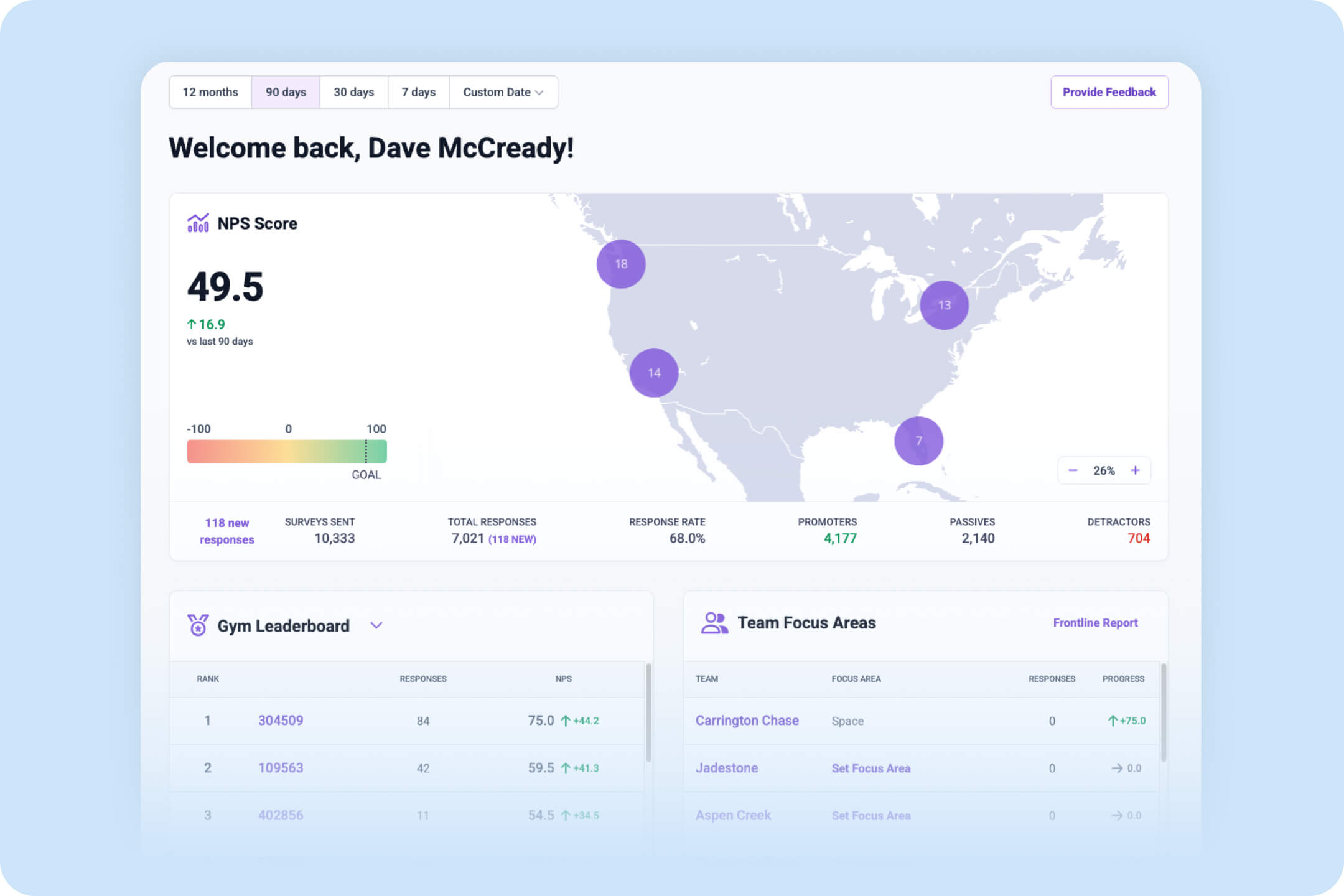
A new hire's first two weeks decide more than most managers realize. Confidence built early sticks. Confidence delayed costs you months of hesitant service, second-guessed decisions, and customers who notice the gap. Most onboarding programs hand new team members a manual and a shadow shift, then leave them to figure out whether they're actually doing well. That disconnect between effort and proof is where confidence stalls.
From our experience working with thousands of people powered businesses, we’ve learnt that frontline teams don't need more training modules. They need fast, direct evidence that their work is landing with customers (or not). Here are five ways to fix that disconnect and get new hires performing with confidence in weeks, not months.
Most onboarding holds feedback back until a new hire has "settled in." That's backwards. Gallup research found employees who get daily feedback are 3.6 times more likely to feel motivated to excel compared to those who wait for an annual check-in. Speed matters more than most training programs account for. Nearly all employees, 96%, believe that regular feedback is beneficial for their performance, yet the standard onboarding model still runs on a 30-60-90 day review cycle. That's not fast enough for someone who needs to know today whether they handled a customer interaction well.
In practice, this means connecting a new hire to live customer responses as soon as they're taking calls or shifts, not after a probation period ends. A new starter at a service desk sees the CSAT score and comment from the customer they helped that morning, and knows exactly what went well and what they can improve on.. The feedback loop closes in hours, not weeks, so the new hire is calibrating against reality instead of guessing.
This works because it replaces a manager's opinion with a customer's actual experience, and customer experience carries more weight for someone new. It also takes pressure off managers who don't have time to sit down with every new hire after every shift. Surfacing the feedback directly does that job automatically.
Standard onboarding treats every new hire like they need the same fixes, but that’s completely untrue. Generic training solves for the average new hire, and the average new hire doesn't exist. One person might be strong on empathy but slow on process, another might know the process cold but rush through calls. A one-size-fits-all module misses both.
What to do instead: Use customer feedback data to identify exactly where a specific new hire needs support, then coach to that gap instead of running them through a standard checklist. If a new hire's feedback consistently flags long resolution times but strong customer rapport, the coaching conversation is about efficiency, not tone. If the pattern is the opposite, the coaching goes the other way. AskNicely's Focus Areas surface this automatically by analyzing individual feedback and pointing to the specific area that will move the needle most, so managers aren't guessing which module to assign next.
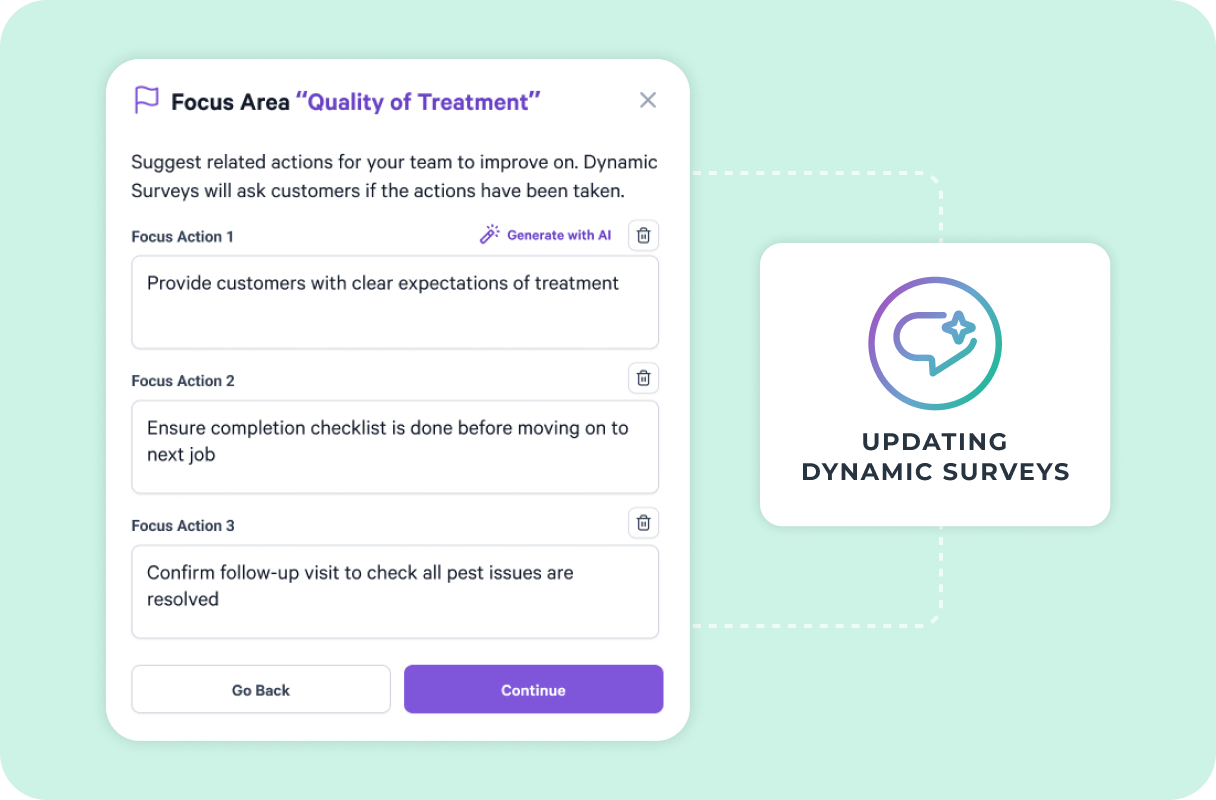
This matters because generic training wastes time on skills a new hire already has, while the actual gap goes unaddressed. Targeted coaching gets to competence faster because it's solving the problem that's actually there, not the problem a training calendar assumes is there. It also gives managers a defensible answer when a new hire asks why they're being coached on one thing and not another: the data said so.
Confidence needs proof, and proof loses its power the longer it takes to arrive. Nectar's research found daily recognition makes 98% of employees feel valued, compared to just 37% when recognition only happens annually. This matters most in the first few weeks, when a new hire has no track record to fall back on and no sense yet of whether they're actually good at the job. A quarterly review can't tell someone they're on the right track fast enough to matter.
A new hire who earns the company a strong NPS score on their third day should hear about it on their third day, not in a performance summary a month later. Catching good customer interactions as they happen and acknowledging them on the spot beats saving them up for a monthly meeting any day. AskNicely's shout outs feature makes this possible by surfacing real-time recognition tied to specific customer feedback, so a manager can flag a win the moment it shows up in the data instead of trying to remember it later.
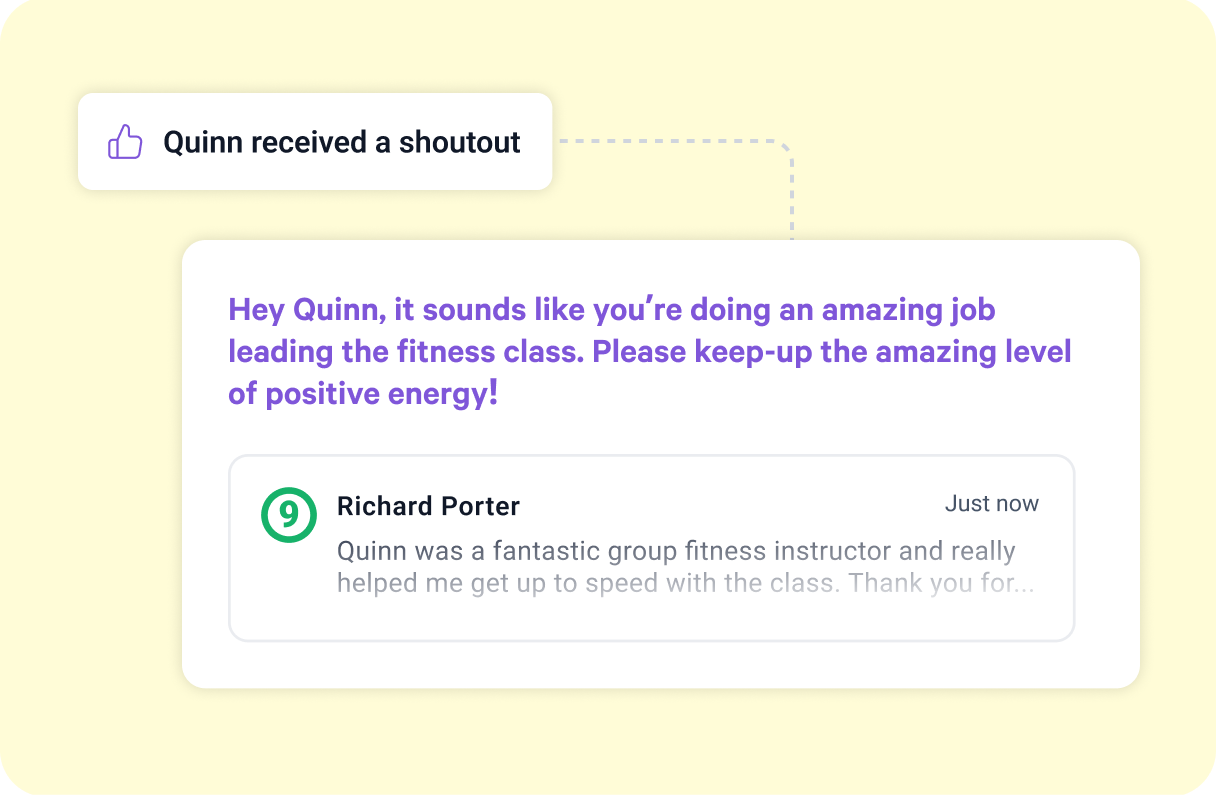
There's a broader case here too. 85% of employees believe recognition should happen whenever good work occurs, not just at scheduled check-ins, so delayed recognition is already working against what people expect. For a new hire specifically, timely recognition earns its keep twice over: it confirms they're doing something right, and it shows them early that good work gets noticed here. Both build confidence faster than any training module.
Uncertainty thrives in isolation, and new hires spend most of their first weeks unsure how they stack up against everyone else. A new hire working in the dark, only hearing from their manager occasionally, has no way to gauge whether they're on pace. Visibility answers that question before it has to be asked.
A break room display showing CX scores by location does this well: a new starter at one branch sees how their team's numbers stack up against the branch across town. That framing turns performance into a shared goal instead of a personal test. AskNicely TV is built for exactly this, filtering live feedback by team or location so the comparison stays at the group level, where it builds camaraderie instead of individual pressure.
The team framing does something individual scorecards alone can't: it gives a new hire an instant sense of belonging. They're contributing to a number the whole branch owns together. Multi-location businesses that make this visible tend to see healthier competition between branches, not just better numbers within them. While individual rankings can be a strong motivator, having feedback scores roll up into a shared team goal can reduce pressure.

Confidence doesn't grow in an environment where every decision has to be run past a manager first. One study found 81% of employees felt increased energy, happiness, and productivity when their employer demonstrated trust in them, and research on workplace autonomy has linked it to higher general trust and stronger task performance. New hires feel this acutely. Being handed a script and told to follow it exactly signals the opposite of trust, even when it's meant to protect against mistakes.
Direct customer feedback is what makes trusting a new hire early actually feel safe rather than risky. When a manager can see the same customer comments and scores a new hire is seeing, both sides have shared, objective evidence of how things are going, instead of the manager having to guess whether a new hire is ready to handle a call without a script. That shared visibility is what lets a manager step back sooner. AskNicely's approach to surfacing customer feedback directly to frontline staff, rather than filtering it through layers of management, is built for exactly that: letting customers' own words show a new hire is ready, so a manager doesn't have to be the only one deciding.
Trust given early tends to be repaid. A new hire who's handed some latitude, backed by real feedback rather than a rigid rulebook, starts making judgment calls sooner and feels the weight of being trusted to make them. That's a different kind of confidence than being told what to do. It's confidence built on being believed in.
None of this depends on hiring people who happen to be naturally confident. It depends on giving new hires proof, fast: real feedback from day one, coaching aimed at their actual gaps, recognition that arrives on the spot, visibility into how their team is doing, and enough trust to make their own calls. Put those five together and confidence stops being something a new hire has to develop alone over months. It becomes the natural result of a system built around them from their first shift.
That system only works if frontline teams have direct access to the customer feedback driving it. When new hires see what customers are actually saying about their work, and managers can see the same thing at the same time, the guesswork disappears from both sides of the relationship. That's the case for frontline activation generally, and it's just as true for someone three days into the job as it is for a ten-year veteran.
Learn more about how AskNicely can help you on this journey here.