Customer survey apps for healthcare: Top tools in 2026
How to turn patient feedback into frontline action
Healthcare organizations face a critical blind spot: they're collecting patient feedback, but most survey tools aren't built for the unique demands of healthcare delivery, where real-time insights, HIPAA compliance, and frontline action can be the difference between a loyal patient and a lost one.
This guide examines seven leading patient survey platforms in depth: AskNicely, NRC Health, Sogolytics, SurveyMonkey, Qualtrics Health, Formstack, and Jotform. We cut through the feature-sheet noise to show you which tools help healthcare organizations maintain regulatory compliance, improve satisfaction scores, and most importantly, empower frontline teams to act on feedback when it matters most.
The problem most healthcare survey tools don't solve
Collecting patient feedback is easy. Turning it into behavior change at the point of care, that's where most platforms fall short.
Ask any healthcare operations leader and they'll describe the same frustration: dashboards full of satisfaction data, and frontline staff who never see it. According to AskNicely's 2026 State of Customer Experience in Healthcare report — which surveyed hundreds of executives worldwide — only 53% of healthcare organizations give frontline employees real-time access to patient feedback. That means nearly half the people most responsible for delivering excellent care are flying blind.
The response time picture is just as stark. While 96% of healthcare organizations say they act on patient feedback, only 34% do so within 24 hours. Another 17% take a month or longer. Surveys go out, scores come back, reports get built, and by the time the data reaches anyone who can act on it, the patient has already formed their opinion, left their review, and decided whether to come back.
The best customer survey platforms for healthcare solve both halves of the problem: capturing feedback from patients at the right moment, and routing those insights to the people who can act on them, not just executives in a quarterly review. Because as the data shows, good intentions aren't the gap, infrastructure is.
What are customer survey apps for healthcare?
Customer survey apps for healthcare are platforms built to help providers systematically collect, analyze, and act on patient feedback throughout the care journey. Unlike generic survey tools, the best healthcare-specific options offer:
HIPAA-compliant data collection through SMS, email, and patient portals
Multi-channel outreach from appointment scheduling through post-visit follow-ups
EHR integrations to trigger surveys automatically and centralize data
Regulatory compliance support for CAHPS, HCAHPS, and other CMS programs
Frontline dashboards and coaching tools that put insights in the hands of providers, not just management
Why invest in patient feedback technology?
Healthcare organizations prioritizing real-time patient feedback often see dramatic improvements in both clinical outcomes and business performance because customer survey apps for healthcare tend to:
Accelerate quality improvement and patient safety initiatives: Real-time dashboards and automated notifications alert healthcare professionals to critical issues immediately, enabling rapid intervention before problems escalate into adverse events or compliance violations.
Drive competitive differentiation through superior patient experience: Organizations systematically collecting feedback and empowering frontline teams to act consistently achieve higher NPS scores, better online reviews, and increased referrals—supporting growth in competitive healthcare markets.
Optimize operational efficiency while ensuring regulatory compliance: Automated data collection streamlines workflows, reduces documentation burden, and maintains HIPAA and GDPR compliance while providing benchmarking data for value-based contracts and quality reporting.
Transform frontline engagement to reduce turnover: When healthcare teams receive regular patient feedback tied to recognition programs, employee engagement can soar, satisfied staff deliver better patient care, leading to improved satisfaction scores and reduced recruitment costs.
Take Schweiger Dermatology Group as an example. Schweiger Dermatology uses AskNicely’s customer experience management platform to evaluate patient feedback and coach their teams to improve the patient experience.
Using AskNicely, 50% of patient providers have improved their individual NPS scores by 12 points in one year.
Schweiger shares positive feedback with their providers and celebrates their wins to reinforce behaviors and earn their 4.5-star rating.
They provide real-time patient sentiment to help offer daily improvements for patients.
They experienced 3x increase in positive reviews on Google.
How to choose customer survey apps for healthcare
The biggest challenge in selecting customer survey software for healthcare is finding a platform that drives real improvements in patient satisfaction and quality of care. From that perspective, here are some must-haves to look for in your solution to deliver measurable impact on the patient experience:
Real-time feedback collection and action capabilities: Your platform must capture patient feedback immediately after appointments through multiple touchpoints (SMS, email, web) and enable rapid response to concerns before they escalate into complaints or negative social media reviews.
Frontline staff enablement and coaching tools: Look for survey tools that connect patient feedback directly to healthcare providers through personal dashboards, coaching insights, and recognition features that motivate continuous improvement in patient care delivery, not just management software for headquarters.
HIPAA compliance and healthcare-specific integrations: Ensure the platform helps maintain strict HIPAA compliance and data security standards while integrating seamlessly with EHR systems, appointment scheduling software, and existing workflows to create unified patient data insights.
Advanced analytics with emerging issue detection: The system should use AI-powered data analysis to identify patterns in survey responses, surface emerging concerns across departments, and provide actionable insights through automated notifications and customizable dashboards that enable data-driven decision-making.
Multi-location performance management: For healthcare systems with multiple facilities, the platform must enable location-specific patient satisfaction tracking, benchmark NPS scores between sites, and monitor patient experience goals at the team, department, or facility level to improve response rates and quality of care.
Top customer survey apps for healthcare
The right customer survey app will help you streamline administrative work and ensure that every touchpoint is managed with speed and accuracy. Here's a quick breakdown of the best survey apps for healthcare, outlining their features, use cases, and pricing so you can focus on what drives value for your organization:
AskNicely
NRC Health
Sogolytics
SurveyMonkey
Qualtrics Health
Formstack
Jotform
Products
EHR integrations, multi-channel surveys, AI analytics, dashboards
CAHPS surveys, omni-channel listening, EHR integration, AI engine
Easy to use, large template library, robust analytics
Unified platform, deep analytics, compliance
Drag-and-drop builder, integrations, support
Mobile capabilities, integrations, quick setup
Cons
No free trial, annual contracts, volume-based pricing
No transparent pricing, complex, needs alignment
Limited customization, integration challenges
Advanced features require paid tiers, caps
Complex, expensive, limited customization
High price for small practices, learning curve
HIPAA on higher plans, submission limits
What is AskNicely?
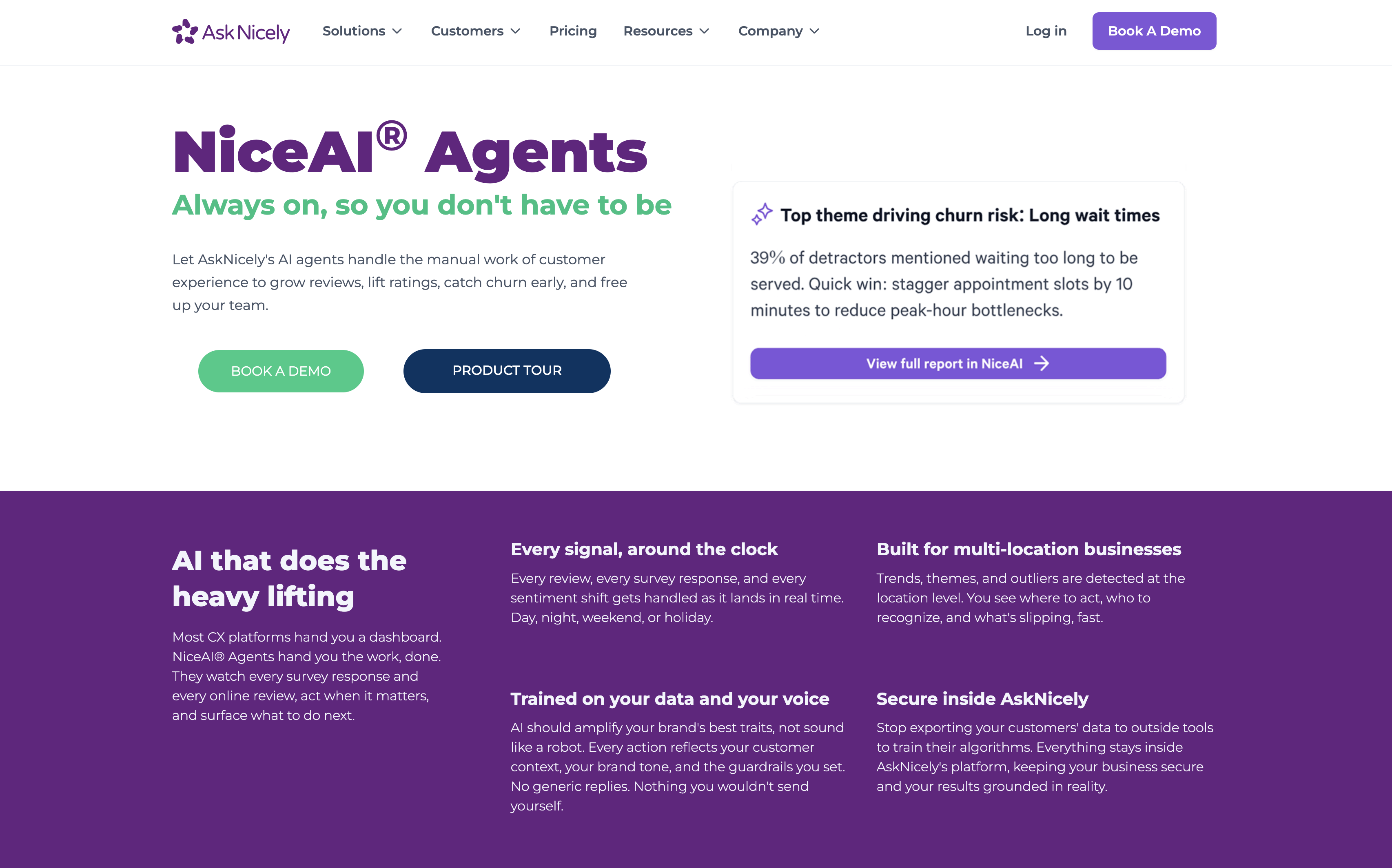
AskNicely is a customer experience management platform that helps healthcare organizations capture real-time patient feedback and turn it into action. Through NPS, CSAT, and 5-star surveys, frontline teams gain the insights they need to improve patient experiences, strengthen loyalty, and deliver better care.
AskNicely - Key products and features
Healthcare-specific integrations: Integrations automatically trigger patient satisfaction surveys after appointments, streamlining the collection of feedback in healthcare settings.
Multi-channel feedback collection: Collect patient feedback through various channels, including email, SMS, web surveys, mobile apps, and kiosks, ensuring accessibility across different patient preferences and touchpoints.
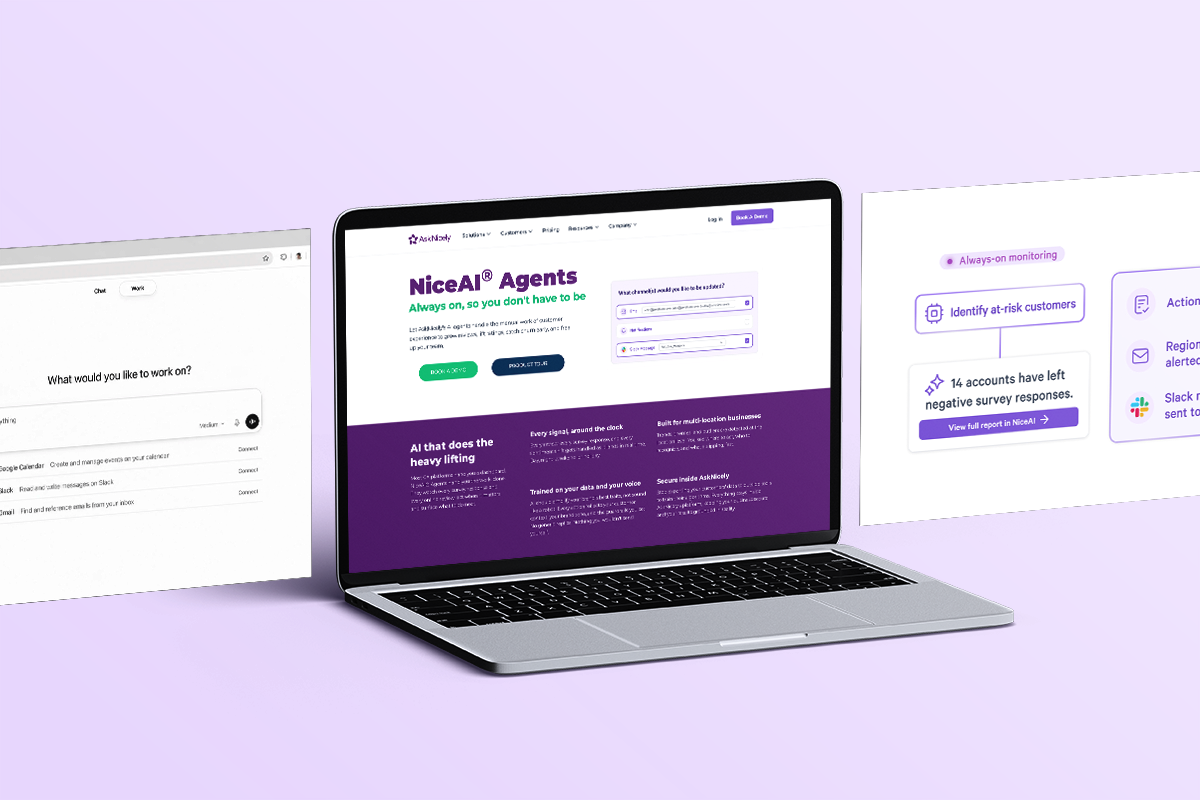
AI-powered analytics (NiceAIⓇ): Uses natural language processing to analyze patient feedback at scale, identify sentiment patterns, and provide actionable insights specific to healthcare service quality.
Real-time performance dashboards: Centralized dashboards track NPS, CSAT, and 5-star scores across locations and teams, allowing healthcare organizations to continuously monitor patient satisfaction metrics.
Automated workflow management: Automatically routes patient feedback to appropriate staff, tracks case resolution, and offers timely follow-up on patient concerns through integrated workflows.
AskNicely - Key use cases
Post-appointment patient satisfaction: Automatically send surveys after appointments to measure satisfaction with care quality, wait times, and overall patient experience.
Multi-location performance tracking: Monitor and compare patient satisfaction across facilities, departments, or practitioner teams to ensure consistent care quality.
Patient issue resolution: Quickly identify and respond to negative feedback through automated alerts and case management, preventing escalation.
Staff performance improvement: Use patient feedback to identify training needs, coach healthcare teams, and recognize high performers through personalized dashboards and coaching playbooks.
Reputation management: Convert satisfied patients into online reviewers by automatically requesting reviews from promoters, improving online presence.
“We chose AskNicely versus something more traditional in healthcare. It helps spot trends that may seem like one-off incidents or track positive trends” — Julie Gessin, Chief Operating Officer, Schweiger Dermatology Group
AskNicely pricing
Flexible plans that grow with your business - whether you're just getting started or looking to scale your customer experience.
AskNicely is ideal for healthcare organizations, dental practices, wellness centers, and health systems with multiple locations that depend on frontline workers to deliver patient experiences and struggle with inconsistent service quality between teams or locations.
Case study: Leveraging customer feedback to drive growth and retention at Caci
Since implementing AskNicely, Caci has been able to make transformational changes to the experience they offer their customers, they did this by:
Developing a consistent set of service standards and embedding them into the company culture is crucial for driving long-term customer loyalty.
Empowering and incentivizing frontline employees to deliver exceptional experiences.
Leveraging data and analytics to identify areas for improvement and track progress can help sustain and enhance the customer experience over time.
Pros of AskNicely
Healthcare-specific features: Purpose-built integrations with major healthcare platforms make implementation seamless for medical practices.
Ease of use: The platform is intuitive, allowing for quick survey setup and straightforward data analysis without the need for extensive training.
Automated feedback collection: Saves time by automatically sending surveys based on appointment completions, eliminating manual distribution.
Real-time insights: Live dashboards and instant alerts enable healthcare teams to address patient concerns immediately and track performance continuously.
Strong integration capabilities: Seamless integration with CRMs and communication tools ensures feedback reaches the right team members quickly.
Limited customization at lower tiers: Advanced features such as white-label surveys and unlimited API access are only available in the highest-priced Transform plan.
What is NRC Health?
NRC Health is a healthcare experience management company that provides comprehensive survey solutions for capturing insights from patients, consumers, employees, and communities. The platform specializes in helping healthcare organizations collect, analyze, and act on experience data across the entire healthcare journey.
NRC Health - Key products and features
CAHPS compliance surveys: Administers CMS-required CAHPS surveys (HCAHPS, HHCAHPS, OAS CAHPS) through mail, phone, and mixed methodologies, ensuring regulatory compliance while capturing patient feedback for quality improvements and reimbursement eligibility.
nGage cross-journey listening: Captures feedback across multiple touchpoints using omni-channel outreach, including SMS, email, IVR, phone, and paper surveys for comprehensive patient journey insights.
MyView and MyStory: Integrates patient-generated contextual data directly into the EHR, providing care teams with personalized patient summaries in 15 seconds while allowing patients to share preferences through appointment reminders, portals, and QR codes.
nQuire AI-powered analytics: Uses natural language processing to analyze patient comments in seconds, extracting meaningful insights from unstructured data through simple prompts.
Predictive rounding solutions: Utilizes proprietary algorithms predicting patient experience scores while patients are admitted with high accuracy, including heatmaps, journey mapping, and analytics for prioritizing rounds and service recovery.
Huey AI engine: Healthcare's first AI engine built specifically for experience management, providing secure AI capabilities powering multiple solutions, including nQuire, Rounding, and nAct for assisted service recovery.
NRC Health - Key use cases
Regulatory compliance and reimbursement: Helps organizations meet CMS requirements for CAHPS programs while maximizing value-based revenue through higher HCAHPS scores.
Real-time patient experience management: Enables hospitals to identify and address experience issues before discharge through predictive scoring and rounding tools for proactive interventions.
Care personalization: Helps teams deliver personalized interactions by providing contextual information about patient preferences without additional clicks or time investment through EHR integration.
Post-discharge transitions: Supports patient transitions through automated calls and digital outreach, identifying those who need clinical care or service recovery, and reducing readmissions.
Employee engagement and culture: Measures and improves healthcare employee experience through periodic, pulse, and lifecycle surveys, uniting the workforce around a shared purpose while meeting AHRQ/Culture of Safety and Magnet compliance.
NRC Health pricing
NRC Health does not publish pricing. Offerings (e.g., CAHPS programs, nGage listening, rounding, MyView/MyStory, Huey AI) are sales-led and quote-based. Contact NRC Health for a customized proposal.
Who they're ideal for
NRC Health is ideal for hospitals, health systems, home health agencies, hospices, and ambulatory surgery centers needing to meet CMS CAHPS requirements while improving patient experience scores. The platform suits organizations seeking comprehensive experience management across patient, consumer, employee, and market dimensions with integrated AI-powered analytics and EHR connectivity.
Pros of NRC Health
End-to-end, healthcare-specific stack: Native CAHPS administration plus real-time listening (SMS, email, IVR, phone, paper) unifies regulatory and experiential feedback in one platform.
EHR-embedded patient context: MyView/MyStory summarizes what matters to each patient inside the EHR (reviewable in ~15 seconds), reducing clicks and speeding personalization.
AI across the journey: Huey (NRC’s healthcare-specific AI) powers nQuire/nGage analytics and assisted service recovery to surface themes and “next best actions.
Predictive rounding & service recovery: Rounding solutions use predictive analytics to flag at-risk experiences and streamline recovery. NRC Health+1
Cons of NRC Health
Pricing transparency :No public price tiers; evaluation typically requires a sales conversation and scoping.
Sogolytics provides comprehensive survey and experience management with HIPAA-compliant data collection and analysis for healthcare organizations. The platform delivers secure survey solutions with enterprise-grade certifications, including ISO 27001, enabling healthcare providers to gather patient feedback while maintaining strict privacy compliance.
Sogolytics - Key products and features
HIPAA-compliant data centers: Enforced through Tier III/IV data centers with signed BAAs, 256-bit encryption, SOC 2/3 audits, and detailed HIPAA-required audit trails. Ensures 99.9% availability, maintaining the highest security for PHI.
256-bit encryption: All transmission uses 256-bit SSL encryption, and customer data is encrypted at rest. Dual-layer encryption ensures survey responses with sensitive health information remain completely secure throughout lifecycles.
ISO 27001 certification: Maintains certification through rigorous third-party audits. Internationally recognized standard validates professional security practices suitable for sensitive healthcare data.
GDPR compliance: Full compliance ensures proper handling of EU personal data. Essential for healthcare organizations operating internationally or serving patients from multiple jurisdictions.
SogoCX healthcare platform: Specialized customer experience platform for healthcare, including HCAHPS-ready surveys. Integrates with EHR/CRM systems via API, centralizing patient experience data collection.
Sogolytics - Key use cases
Patient satisfaction surveys: Collect HCAHPS-compliant patient feedback through secure omnichannel distribution, including email, SMS, chat, and web forms. Enables comprehensive patient experience measurement, maintaining HIPAA compliance.
Healthcare staff performance evaluations: Conduct secure staff feedback and 360-degree reviews within compliant environments. Supports engagement surveys and performance assessments specific to healthcare settings.
Clinical quality assessments: Perform hospital/clinic evaluations with guaranteed data security. Assessments help facilities monitor quality metrics, identifying improvements.
Patient risk assessments: Gather critical patient data informing decisions on care, safety, and risk management. Secure platform enables the collection of sensitive health information for comprehensive risk evaluation.
Sogolytics pricing
Basic Plan: Free for life with basic features, limited to 100 email invitations/responses per survey yearly, 200 total maximum.
Trial accounts: Free 10-day trials for Plus, Pro, Premium packages, no credit card required. Includes all features, limited to 100 invitations/responses.
Paid plans: Multiple tiers (Plus, Pro, Premium, Enterprise+) with transparent monthly/annual pricing. Payment via credit cards, wire transfer, or purchase order for Enterprise.
Non-profit discounts: Significant discounts for educational institutions and non-profits.
Who they're ideal for
Sogolytics suits healthcare organizations from individual practices to large hospital systems requiring HIPAA-compliant survey and feedback tools. Particularly suited to organizations conducting HCAHPS surveys, managing patient experience programs, performing staff evaluations, collecting sensitive health data, and maintaining strict regulatory compliance.
Pros of Sogolytics
Comprehensive security features: Robust infrastructure, including ISO certification, HIPAA compliance, and multiple encryption layers. The platform's data protection commitment gives healthcare organizations confidence in handling sensitive patient information.
Versatile healthcare applications: Successfully serves diverse healthcare needs from patient satisfaction to staff evaluations. Organizations value a single compliant platform for multiple survey/assessment requirements.
Integration capabilities: API integration with EHR/CRM systems streamlines data collection workflows. Connectivity eliminates manual transfer, creating unified patient experience data views.
Cons of Sogolytics
Limited free plan capabilities: The Basic plan's 100 responses per survey annually are insufficient for healthcare organizations. Many facilities require higher volumes for meaningful patient feedback programs.
No downgrade options: Once upgraded, users cannot downgrade, only freeze accounts for fees. Inflexibility is problematic for organizations with fluctuating survey needs.
Complex feature packages: Features bundled in fixed packages cannot be customized or purchased individually. Healthcare organizations may purchase higher tiers, accessing specific required features.
What is SurveyMonkey?
SurveyMonkey leads online survey software, providing data-driven insights through surveys, forms, and market research. The platform offers healthcare-specific features and HIPAA-compliant capabilities for organizations collecting and managing PHI through surveys.
SurveyMonkey - Key products and features
HIPAA-compliant features: Only available on Enterprise plans with a signed BAA. Includes encryption at rest and in transit, role-based access, audit trails, and SSAE-16 SOC II data centers to protect PHI.
SurveyMonkey Enterprise: Advanced security, governance, and compliance capabilities. Includes SSO authentication, data encryption, access controls, and SSAE-16 SOC II-compliant data centers.
AI-powered survey creation: Build with AI, generating questions and expert templates. SurveyMonkey Genius creates better surveys, spotting insights quickly with built-in AI.
Data security and compliance: Data encryption, SAML 2.0 SSO, and the ability to limit PII requests. Ensures meeting governance standards and compliance with HIPAA and GDPR requirements.
Advanced analytics and reporting: AI Analysis Suite, custom dashboards, statistical/sentiment/thematic analysis. Multiple export formats, including CSV, XLS, PPT, PDF, and SPSS.
SurveyMonkey - Key use cases
Healthcare data collection: Collecting patient feedback, healthcare surveys, managing PHI HIPAA-compliant. Healthcare organizations gather sensitive medical information, maintaining regulatory compliance.
Employee feedback and engagement: Creating engagement surveys, 360-degree evaluations, and onboarding assessments. Measure satisfaction, gather insights, boost engagement, and drive better results.
Registration and event management: Building registration forms, event feedback, and collecting contact information. Easily collect RSVPs, track attendance, and gather post-event feedback.
Market research: Product testing, concept testing, accessing a global panel of 335M+ respondents in over 130 countries. Quickly tap targeted audiences with 200+ unique targeting options.
SurveyMonkey pricing
Basic Plan: Free forever, unlimited surveys with 10 questions each, 25 responses per survey.
SurveyMonkey suits healthcare organizations requiring HIPAA-compliant survey tools, enterprises needing advanced security/governance, marketing teams conducting research, HR managing feedback programs, and educational institutions gathering evaluations. Serves small businesses using free plans to large enterprises requiring comprehensive compliance and integration.
Pros of SurveyMonkey
User-friendly interface: Intuitive platform with no technical issues, enabling any experience level to create/manage surveys. Built with AI makes survey creation effortless, even for those with zero AI experience.
Comprehensive feature set: Robust tools gathering insights from customers/peers. Everything needed for creation, distribution, and analysis in one place.
Reliable performance: Minimal technical difficulties operating smoothly and consistently. Ahead of other solutions in stability.
Cost for advanced features: HIPAA compliance and enterprise features require expensive custom-priced plans. Essential features like exports/analytics are only available in higher tiers.
Response limits on paid plans: Even paid plans have response limits (15,000-100,000 yearly), with additional responses costing $0.15 each. High-volume organizations face unexpected costs.
What is Qualtrics Health?
Qualtrics Health is an AI-powered healthcare experience management platform enabling providers, payors, and life sciences organizations to collect, analyze, and act on patient and member feedback in real-time. The platform helps healthcare organizations understand patient emotions and needs across touchpoints while meeting regulatory requirements like CAHPS and Star ratings.
Qualtrics Health - Key products and features
Patient experience management: Captures patient feedback across digital, chat, and call center channels, ensuring compliance while enabling real-time understanding of patient emotions to improve care delivery.
CAHPS solutions: Provides regulatory-compliant survey programs for CAHPS, OAS, and ANCC Magnet Recognition requirements, ensuring accreditation standards while gathering actionable insights.
Digital experience analytics: Monitors patient interactions across websites and mobile apps, identifying friction points, helping improve online patient experiences, and reducing abandonment rates.
EMR integration: Seamlessly integrates with electronic medical records, connecting patient feedback with clinical data for a comprehensive view of experiences alongside medical information.
Contact center experience: Analyzes patient interactions across call centers, improving service quality and reducing wait times with real-time insights, helping agents better serve patient needs.
Employee experience tools: Addresses provider burnout and improves retention through engagement surveys creating action culture by empowering caregivers with work environment insights.
AI-powered analytics: Uses artificial intelligence to automatically analyze feedback and identify trends, delivering automated recommendations and predictions, and personalizing patient experiences.
Qualtrics Health - Key use cases
Patient satisfaction measurement: Healthcare organizations continuously monitor satisfaction scores, identifying improvement areas with real-time feedback, helping clinical teams enhance positive experiences and reduce friction.
Regulatory compliance management: Hospitals leverage the platform, meeting CAHPS, Star ratings, and regulatory requirements, ensuring compliance while providing insights beyond basic reporting.
Digital patient journey optimization: Health systems use digital analytics to understand how patients navigate portals and telehealth platforms, identifying and fixing friction points impacting engagement.
Member experience enhancement (Payors): Insurance companies understand member journeys, identifying satisfaction drivers with AI-powered solutions, predicting needs, and automating personalized experiences.
Clinical research and lifecycle management: Life sciences organizations gather insights across research stages and commercialization, addressing experience gaps from medical communications through the product lifecycle.
Qualtrics Health pricing
Pricing based on interactions (data records collected/processed), varying by product suite. Organizations purchase individual products or full suites with flexible consumption across interaction types. Specific pricing requires contacting sales for custom quotes based on usage volume and selected solutions.
Who they're ideal for
Qualtrics Health is ideal for large healthcare providers, hospital systems, health insurance companies, and life sciences organizations needing enterprise-grade experience management capabilities. The platform best serves organizations requiring regulatory compliance (CAHPS, Star ratings), managing multiple locations or touchpoints, and those integrating patient feedback with existing EMR and operational systems.
Pros of Qualtrics Health
Comprehensive platform coverage: Users appreciate managing patient, employee, and customer experiences within one unified platform, eliminating multiple point solutions and providing holistic organizational insights.
Strong analytics and reporting: Platform's robust analytics and real-time dashboards help healthcare teams quickly identify trends and take action with a valued depth of insights.
Regulatory compliance features: Healthcare organizations benefit from built-in CAHPS support and regulatory programs handling requirements while providing actionable insights beyond basic reporting.
Integration capabilities: System integrates well with existing healthcare IT infrastructure, including EMRs, enabling connection of feedback data with operational metrics.
Cons of Qualtrics Health
Complexity and learning curve: Platform can overwhelm new users due to extensive features, with training and onboarding time-intensive for teams fully utilizing functionalities.
High cost for smaller organizations: The Enterprise pricing model is prohibitive for smaller providers, with a platform over-engineered for simpler survey needs.
Response rate challenges: Organizations struggle with low survey response rates despite capabilities, noting that the tool alone doesn't solve engagement challenges without proper implementation strategies.
What is Formstack?
Formstack is a no-code workplace productivity suite that provides HIPAA-compliant forms, documents, and eSignature solutions for healthcare organizations. The platform enables healthcare providers to digitize patient data collection, automate workflows, and maintain compliance with the Health Insurance Portability and Accountability Act (HIPAA) while eliminating manual paperwork.
Formstack - Key products and features
Intellistack streamline for Healthcare: Integrates with EHR systems to build secure workflows that prefill protected health information (PHI) into patient intake, referrals, waitlists, equipment requests, and financial agreements. It’s designed to reduce missing information, illegible handwriting, and broken processes.
Forms for Salesforce (Native): Built within Salesforce, allowing healthcare data to be collected, processed, and stored directly in Salesforce orgs. Uses Salesforce's data security model and matches compliance standards, including HIPAA and GDPR.
HIPAA-Compliant data security: Provides end-to-end encryption, signed BAAs, audit logs of all PHI access, and role-based user controls. Meets HIPAA technical safeguard requirements while digitizing patient data collection.
Document generation and automation: Creates documents with data populated from forms and integrated systems. AI-powered form builder generates templates instantly and routes documents using conditional logic.
Digital signature collection (formstack sign): Provides legally-binding eSignature functionality with comprehensive audit trails. Supports multi-participant signing and maintains HIPAA compliance throughout the process.
Formstack - Key use cases
Patient intake and onboarding: Streamlines registration by creating prefilled forms that reduce data entry errors. Integrates with EHR systems to automatically populate patient information and update records in real-time.
Medical claims processing: Enables automated claims workflows with file uploads for documentation. Generates claims reports and routes them to appropriate parties while maintaining security compliance.
Patient referral management: Facilitates secure data sharing between healthcare providers through automated workflows that prefill referral forms with existing PHI. Reduces administrative burden and ensures accurate information transfer.
Medical office management: Automates appointment scheduling, consent forms, and financial agreements. Helps practices reduce manual data entry and streamline workflows.
Healthcare surveys: Creates patient satisfaction surveys and feedback forms with conditional logic and automated follow-ups. Enables organizations to collect patient feedback while maintaining HIPAA compliance for sensitive responses.
Formstack pricing
Forms Plan: Starting at $83/month (billed annually). Includes 1 builder user, 25 forms, storage for 1,000 submissions per form, and 25,000 total submissions.
Suite Plan: Starting at $250/month (billed annually). Includes access to Forms, Documents, and Sign with 3 builder users, 100 forms, 250 document merges, and 100 templates.
Enterprise Plan: Custom pricing for organization-wide implementations with a dedicated customer success manager and single sign-on features.
Forms for Salesforce Native Plans: Native Standard for small businesses, Native Essentials for growing businesses (includes Experience Cloud Sites), and Native Professional for larger teams (compatible with Salesforce Shield).
Add-ons: Additional users starting at $20, usage expansions starting at $50, and feature add-ons available for all plans.
Who They're Ideal For
Healthcare organizations, medical practices, and healthcare IT teams need HIPAA-compliant survey tools and workflow automation. Particularly suited to organizations using Salesforce, those requiring EHR integration, and providers eliminating paper-based processes while maintaining data security and compliance.
Pros of Formstack
User-friendly interface: The drag-and-drop form builder requires no coding expertise, making it accessible for non-technical staff. Users can create complex healthcare surveys without technical knowledge.
Strong customer support: Provides responsive support teams that understand partner needs and prioritize implementation requirements accordingly.
Salesforce integration excellence: Native integration simplifies secure data collection directly within Salesforce. Users report significant time savings when gathering patient information.
Flexibility and customization: Offers extensive flexibility in form settings with various field types. Users achieve more with their healthcare data through adaptable features that solve diverse problems.
Cons of Formstack
Limited advanced features in lower tiers: Advanced functionality like analytics, custom domains, and partial submissions is only available in higher-priced plans. Basic plans may not meet sophisticated healthcare organizations' needs.
Learning curve for complex workflows: While basic forms are easy, setting up automated workflows and conditional logic requires time to master. Some users need additional training for advanced features.
Pricing for small organizations: Cost structure may be prohibitive for smaller healthcare practices with limited budgets. Monthly fees add up quickly when additional users or features are needed.
What is Jotform?
Jotform is an online form builder offering HIPAA-compliant features for healthcare organizations to create secure survey tools and collect data. The platform provides comprehensive tools for building, managing, and analyzing forms while maintaining compliance with healthcare privacy regulations and protecting PHI.
Jotform - Key products and features
HIPAA compliance features: Only available on Gold and Enterprise plans, which include signed BAAs, 256-bit SSL encryption, audit trails, and dedicated HIPAA servers for PHI management.
Form Builder with security features: Drag-and-drop creation with 256-bit SSL data encryption, PCI DSS Service Provider Level 1 certification, and GDPR/CCPA compliance. Forms are encrypted with secure data transmission across all platforms.
Jotform tables: Secure data management for organizing form submissions centrally. Teams collaborate on data collection while maintaining security protocols and access controls.
Jotform workflows: Automated approval system for form responses with task assignment. Teams create custom approval processes while maintaining data security and audit trails.
Mobile Forms: An offline-capable application for collecting survey data on any device. Teams assign forms and gather submissions without internet connectivity.
Jotform - Key use cases
Healthcare data collection: Collecting patient information, medical histories, and consent forms while maintaining HIPAA regulations. Organizations securely gather sensitive patient data through encrypted online forms.
Survey distribution and management: Creating surveys with conditional logic and automated notifications. Organizations collect patient feedback and analyze responses through secure channels with real-time insights.
Team collaboration on forms: Multiple users work together on form creation and data management through Jotform Teams. Departments share workspaces while maintaining permissions and access controls.
Secure payment processing: Collecting payments through forms with 40+ payment gateway integrations while maintaining PCI compliance. Healthcare organizations process payments while protecting cardholder data.
Enterprise: Custom pricing, unlimited usage, HIPAA compliance available, multiuser platform with dedicated support
Who they're ideal for
Healthcare organizations, medical practices, and businesses need HIPAA-compliant survey software. Particularly suitable for organizations requiring secure data collection, team collaboration, and integration with existing healthcare workflows while preventing HIPAA violations.
Pros of Jotform
User-friendly interface: Drag-and-drop builder creates professional forms quickly without technical expertise. Users build forms in minutes and customize branding.
Strong customer support: 24/7 support provides responsive assistance. Support staff helps resolve issues promptly.
Extensive template library: Over 10,000 survey templates for various industries. Users start with pre-built templates and customize them to their needs.
Mobile accessibility: Forms work seamlessly across devices with offline data collection capability. Users appreciate the flexibility to collect data anywhere.
Cons of Jotform
Limited features on lower tiers: HIPAA compliance is only available on Gold and Enterprise plans, making it expensive for smaller healthcare organizations. Advanced features require upgrading to higher-priced plans.
Learning curve for advanced features: While basic forms are easy, mastering conditional logic and workflows requires time investment. Some users find advanced customization overwhelming initially.
Performance issues with complex forms: Forms with many fields or complex logic load slowly. Users report occasional lag with data-heavy forms or large submission volumes.
The bottom line: Feedback without action is just data
Every platform reviewed here can help you collect patient feedback. The real differentiator is what happens next.
As Emily Stevenson, Chief Experience Officer at Caci, puts it: "Feedback alone doesn't matter if you don't do anything with it." It's a deceptively simple observation — and one that exposes the central failure of most patient feedback programs. The surveys go out, the scores come back, and the insights quietly die in a dashboard that frontline staff never see.
Healthcare organizations that close the loop — routing insights to frontline teams in real time, coaching providers on the findings, and acting within hours rather than months — consistently outperform those that treat surveys as a reporting exercise. The technology is only as powerful as the infrastructure built around it. "The only way you transform the business is by actually acting on the feedback," Stevenson said. That transformation doesn't happen in quarterly reviews. It happens at the point of care, in the moments between a provider and a patient.
For smaller practices or those just starting their patient experience journey, Jotform and SurveyMonkey offer accessible entry points. Organizations navigating complex regulatory requirements like CAHPS and HCAHPS will find NRC Health or Qualtrics Health purpose-built for that challenge. Those prioritizing workflow automation and Salesforce integration should look hard at Formstack or Sogolytics.
But if your goal is to transform patient feedback into frontline behavior — to make every provider and care team member feel the direct connection between their actions and patient outcomes — AskNicely is built for exactly that problem. It's the platform designed not just for the executive dashboard, but for the people actually delivering care.