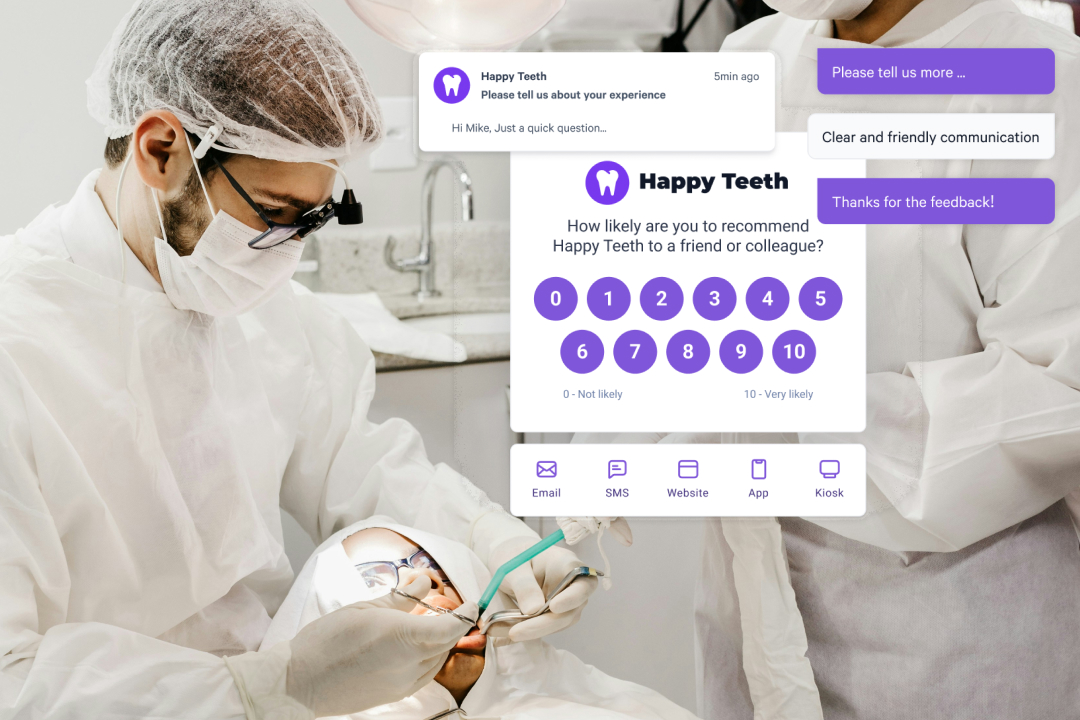
Opportunities for healthcare providers to elevate patient experience
Few industries carry the same emotional weight or personal impact as healthcare. Whether it’s a cosmetic treatment, a complex diagnosis, or a life-changing procedure, every interaction between a patient and their provider shapes how they feel about their care, and the organization behind it. That’s why customer experience (CX) in healthcare (a.k.a patient experience) isn’t just about satisfaction scores; it’s about trust, outcomes, and loyalty.
But according to new research from AskNicely, the healthcare industry is still missing critical opportunities to turn patient feedback into measurable improvement.
We surveyed over 3,000 executives worldwide, including VP-level and above healthcare leaders, to understand how they collect, use, and act on patient feedback. What we found shows both progress and potential.
When it comes to collecting feedback, email remains the most popular, with 81% of healthcare providers using it to survey patients. Meanwhile, SMS (55%) and in-app surveys (55%) are gaining traction as patients increasingly expect convenience and immediacy from their healthcare experiences.
Social media (64%) is also an emerging feedback channel, reflecting the growing influence of patient reviews and online reputation in provider selection. Yet, phone interviews (50%), which allow for richer, more personal insights, are only used by about half of providers.
Encouragingly, no respondents said they don’t collect feedback at all. But the key question is: How fast do they act on it?
When it comes to metrics, customer satisfaction score (CSAT) leads the pack at 78%, followed by customer retention rate (54%) and customer lifetime value (48%). Net promoter score (NPS), the gold standard for loyalty measurement, is tracked by only 37% of organizations. That means most healthcare providers are focusing on short-term satisfaction, not long-term loyalty.
The overwhelming majority (96%) of healthcare organizations say they act on patient feedback. But only 34% do so within 24 hours, the same day patients share their experience.
Here’s how the rest break down:
While healthcare slightly outpaces other industries, like home services, in response speed, it still lags behind patient expectations. Digital convenience sets the standard, so waiting days or weeks to address issues can cost both trust and retention.
Acting faster on feedback doesn’t just improve satisfaction; it can directly impact clinical adherence, staff morale, and even patient outcomes.
Collecting patient feedback is just the start. The next step is using it to drive tangible change. Most healthcare organizations report taking multiple actions based on feedback:
That’s encouraging, but it still points to a largely reactive culture. Feedback shouldn’t just fix what’s broken; it should shape everyday operations and empower care teams in real time.
Only 53% of healthcare organizations report that their frontline employees (nurses, technicians, administrators, clinicians, and receptionists) have real-time access to patient feedback. That means nearly half of the people most responsible for delivering excellent care can’t see what patients are saying.
However, the majority of providers are making strides to involve staff more deeply in the process:
The best-performing healthcare organizations treat feedback not as a scorecard, but as a coaching tool. Recognizing great service and learning from constructive feedback helps create a culture of continuous improvement, which in turn, reduces burnout in high-pressure care environments.
Despite the growing commitment to CX, most healthcare organizations still lack the infrastructure to connect the dots. Only 13% have a centralized feedback management system, and just 18% use advanced analytics to identify trends or predict satisfaction.
Instead, data often lives in silos; marketing monitors reviews, operations tracks wait times, and clinical teams focus on post-visit surveys. Without integration, it’s nearly impossible to get a complete picture of the patient journey.
59% of leaders cited data integration as their biggest challenge in linking CX to growth, followed by department alignment (51%) and limited analysis capabilities (37%).
Until healthcare organizations unify their feedback systems, the insights that could transform care will remain trapped in spreadsheets and disconnected dashboards.
An overwhelming 90% of healthcare leaders believe there’s a direct link between CX and business growth. The top metrics tied to success include:
Providers who make CX a priority consistently report higher patient retention, better staff engagement, and stronger reputation growth. Simply put: when patients feel cared for, they stay, and they tell others.
Whether their patients need specialized cosmetic care, pediatric dermatology, or skin cancer treatment, Schweiger Dermatology Group has become the go-to name across New York, New Jersey, Connecticut, and Pennsylvania.
With over 250 providers and 1 million patient visits annually, Chief Operating Officer Julie Gessin leads the group with a mission: deliver not just excellent dermatology, but exceptional experiences.
As Julie observed, traditional medical training didn’t include much on patient experience. Providers knew how to perform procedures, but not necessarily how to create trust, empathy, and comfort.
Patients today expect both expertise and experience. They want to feel seen, heard, and valued every time. So Julie set out to build a team of dermatology providers who were not only clinical experts but also “professors of patient experience.”
Julie knew that reviews played a central role in patient decision-making. In dermatology, where health and appearance are deeply personal, online reputation carries enormous weight.
Positive experiences drive referrals and retention, but they start with feedback. “Whether a review is one star or five,” Julie says, “it all comes down to the feedback, coaching, and empowerment our providers receive.”
As Schweiger grew to over 90 offices, maintaining a consistent patient experience became a challenge. The team needed a feedback platform that could scale, engaging patients seamlessly while empowering providers.
Enter AskNicely:
Julie discovered AskNicely while searching for a simple NPS tool, but found much more. AskNicely helped Schweiger collect patient feedback in real time, coach providers, and celebrate wins across the organization.
“We chose AskNicely versus something more traditional in healthcare. It helps spot trends that may seem like one-off incidents or track positive trends.”
— Julie Gessin, Chief Operating Officer, Schweiger Dermatology Group
With AskNicely:
Nearly 50% of Schweiger providers improved their individual NPS scores by 12 points in one year, a testament to the power of feedback-driven coaching.
The results speak for themselves:
“Your feedback is only as good as your ability to act on it,” says Julie. “AskNicely helps us do that every single day.”
Healthcare is at a turning point. The demand for personalized, transparent, and compassionate care is only growing, and CX is the bridge between good intentions and great experiences.
Our research shows that healthcare providers can lead the next wave of CX excellence by focusing on three priorities:
AskNicely’s customer experience platform is built for healthcare teams that want to deliver world-class care at scale. With AskNicely, you can:
You’ll be up and running in 30 days, with measurable results in 90. Because when your teams have the tools to act on patient feedback, they don’t just improve surveys, they transform care.
Book a demo today to see how AskNicely can help your organization deliver the ultimate patient experience.