
Why every review is now a visibility signal, not just a reputation one.
Buyers used to check one review site before making a decision. Now they start inside AI tools, and those tools pull from whatever reviews and responses are public. A business with a thin or outdated review presence on Google, Yelp, or Facebook not only looks less credible, but disappears from AI search results entirely.
This changes what a review response is for. A reply used to be aimed at the person who wrote the review, and maybe the next few people who happened to read it on that page. Today, every response becomes part of a public record that AI tools draw on when they recommend a business. Good responses build trust at scale. Bad ones, or no response at all, quietly erode visibility in places a business can't see or control.
Multi-location service businesses feel this most. A single location can manage its reputation by hand, but fifty locations can't. Response quality, speed, and consistency all break down without a system behind them, and the businesses that get this right are pulling ahead in a search landscape most companies haven't adjusted to yet.
This best practices guide covers what good review responses look like, for both positive and negative reviews, and how AskNicely's new AI suite helps businesses respond at scale and build a stronger review base to respond to in the first place.
Get your score: see what your customers are saying about you with the free Reputation Grader>>
A five-star review with a generic reply wastes the moment. "Thank you for your feedback!" tells the reader nothing and signals no one actually read the review. Specificity is what makes a response worth writing.
A negative review is the moment a business's response strategy actually gets tested. Anyone can write a good reply to a happy customer. The businesses that stand out are the ones that handle criticism in public.
Everything above is straightforward at one location. A single owner or manager can read every review, remember every customer's name, and reply within the hour. That doesn't survive multiplication.
At ten locations, response quality starts to vary by whoever's on shift. At fifty, it varies by region, by manager, by how busy a location happens to be that week. Some locations respond fast and well. Others go quiet for days. A few might not respond at all. From the outside, this looks inconsistent, because it is.
The harder problem sits one step earlier: getting reviews in the first place. Manual review requests depend on staff remembering to ask, at the right moment, on the right platform. That doesn't scale any better than manual responses do. A location with thin review volume gives a business's response strategy very little to work with, no matter how well-crafted the replies are.
Both problems come from the same root cause: relying on individual people to execute a process consistently across dozens or hundreds of locations. That's a systems problem, not a training problem, and it's the gap the AskNicely AI agents were built to close.
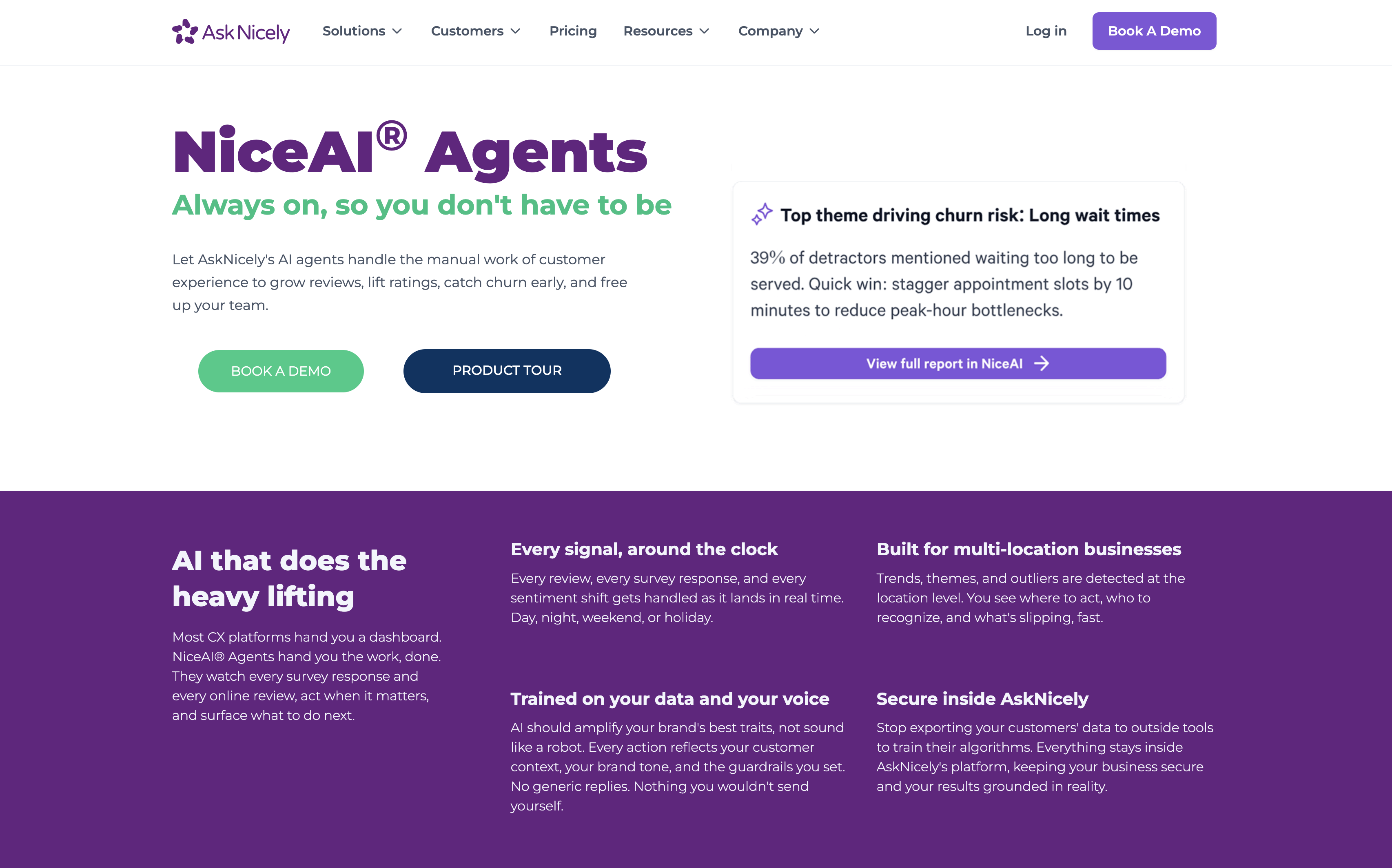
Getting more reviews and responding to them well used to require different fixes. AskNicely's NiceAI® suite now covers both.
Review Routing Agent solves the volume and distribution problem. After a customer submits feedback through an AskNicely survey, the agent presents a review request at the same moment, while the experience is still fresh. No separate email campaign, no follow-up required from staff. For multi-location businesses, the agent applies configurable rules to route each request to whichever platform needs it most. A business can direct a set percentage of requests to Google, Yelp, Facebook, or any other important review sites, adjusted by region, performance, or platform gap, and every review lands attributed to the correct location and team member.
Response Agent solves the response problem. It writes and sends on-brand replies to survey responses and online reviews automatically. A business sets the tone, the context, and the guardrails, and the agent handles the volume from there. It won't reply to customers outside those specifications. Full control stays with the business, both over how the agent operates and how it communicates with customers.
Together, the two agents remove the two points where manual process breaks down at scale: responding to every review with the speed and consistency covered earlier in this piece, and getting enough reviews in the first place.
The results of stronger review volume alone are already visible. One large North American shoe retailer improved their Trustpilot rating from 2.7 to 4.6 within 30 days of adopting AskNicely. Google review volume increased 161%, with a 4.7-star average sustained across their store network.
“We're seeing a shift in buyer behavior - buyers no longer rely on just one review site. Instead, they start their search within AI tools, pulling from any available public reviews. If your presence is weak on platforms like Google, Yelp, or Facebook, you're not just losing stars - you're losing visibility in AI searches.” – Tony Ward, AskNicely CEO.
Do:
Don't:
Review responses and review volume are the same system wearing two different hats. Solve one without the other and the effort doesn't pay off: a great reply nobody sees doesn't move visibility, and a flood of reviews met with slow or defensive responses undercuts the trust that volume was supposed to build.
One location can do this by hand. Fifty can't. Response Agent and Review Routing Agent close both sides at once, so every customer gets asked at the right moment, and every review gets a reply that's fast, on-brand, and consistent, without depending on any one person to remember to do it.