.png)
Every customer experience platform claims to use AI now. Most of it is the same feature with a new label: a chatbot bolted onto a survey tool, a sentiment score added to a dashboard, a summary button at the top of a report.
But that's not where AI adds true value. It's where vendors found the easiest place to put it. Real value, shows up somewhere else: in the gap between a customer's feedback and the action a team takes because of it. That gap is where most CX platforms stall. They collect feedback faster, sort it into categories, and hand teams a dashboard to interpret. The work of figuring out what matters and what to do about it still falls on a person.
AI changes that equation when it closes the gap instead of widening the dashboard. This piece looks at where AI in CX is mostly noise, and where it's actually doing the work: personalizing surveys so feedback is sharper from the start, turning raw data into plain-language answers, prioritizing the issues that move the needle, and increasingly, acting on what it finds without waiting for someone to log in and read a report.
A lot of "AI-powered" CX tools add a layer without removing any work.
Generic chatbot replies are the clearest example. A response that's clearly templated tells the customer they're talking to a system, not a brand. It saves a team the time of writing a reply and costs them the trust that reply was supposed to build.
Dashboards with AI summaries have the same problem. The summary tells a team that NPS dropped in three regions last month. It doesn't tell them why, what changed, or what to do next. An analyst still has to dig through the underlying data to find the real story. AI added a paragraph, but it didn't remove the bottleneck.
Sentiment analysis without follow-through is another version of this. Flagging that a customer is unhappy is not the same as doing anything about it. Without a next step attached, sentiment scores become one more metric on a dashboard nobody acts on in time.
And then there's the question of where customer data actually goes. Some AI tools train on customer feedback to improve their own models, which means sensitive data is leaving the platform a business pays for and feeding someone else's product. For multi-location brands handling feedback at volume, that's not a minor detail. It's a reason to ask exactly how a vendor's AI works before trusting it with real customer signals.
The pattern across all of these: AI that performs intelligence without producing an outcome. It looks sophisticated but it doesn't change what a team does on a Tuesday morning.
The flip side is AI that removes a step instead of adding one. Three places this shows up clearly:
Most surveys ask every customer the same questions regardless of what they actually experienced or how they’ve responded so far. That's friction for the customer and noise for the team reading results. Dynamic Surveys change the question set in real time based on who the customer is and what happened in their interaction. A customer who had a smooth checkout gets different questions than one who waited on hold for twenty minutes. The result is feedback that's relevant by default, captured without extra effort on either side, and AskNicely customers see up to 3x the response volume because of it.

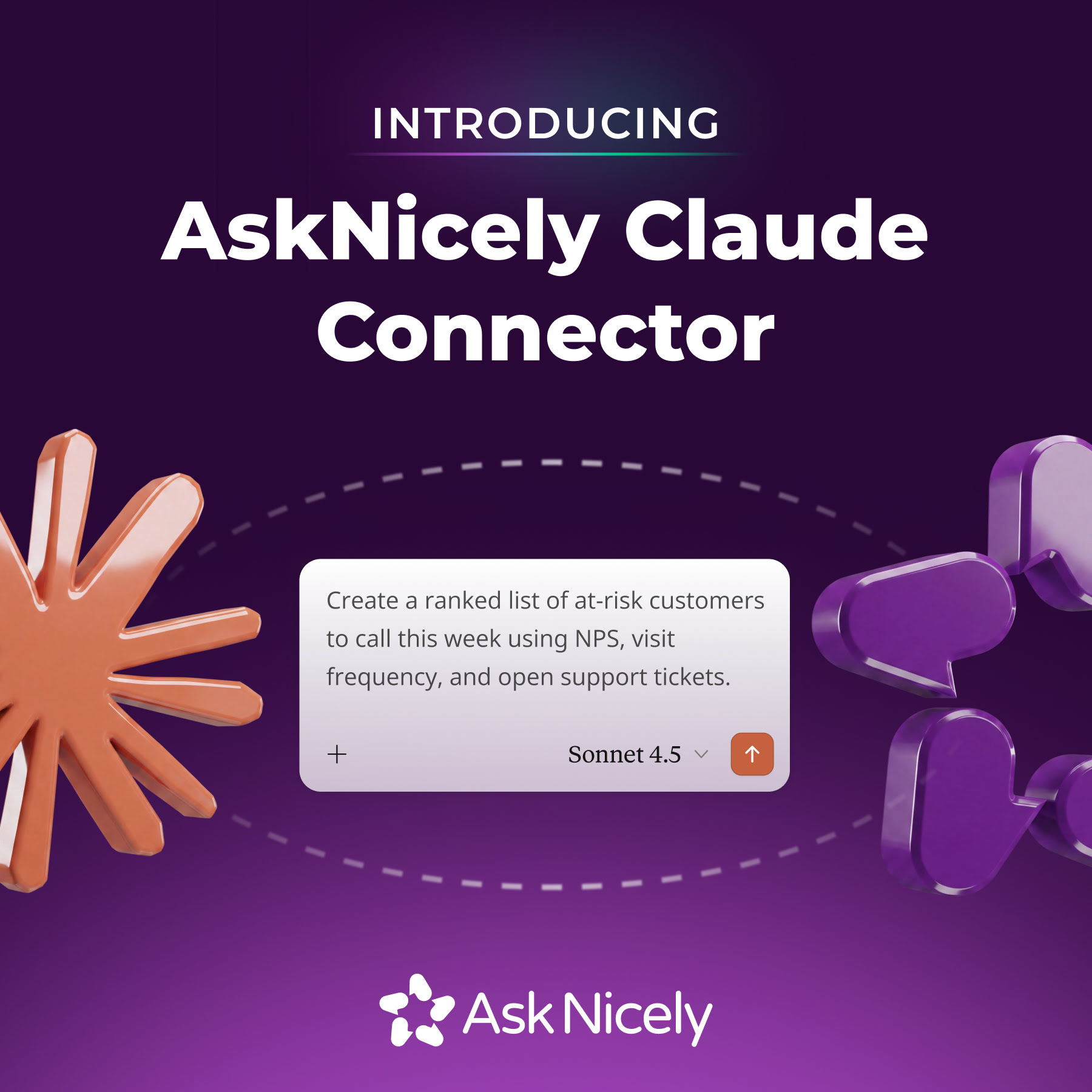
Asking a question in plain language and getting an answer back sounds simple. It replaces a process that usually takes a request to an analyst, a wait for a report, and a meeting to interpret it. Ask NiceAI lets teams query customer data directly, surface trends across surveys, reviews, and locations, and see the answer as a chart instead of a paragraph someone has to decode. The time between a question and an answer shrinks from days to seconds.
For example, a user could ask an AI assistant, what are the top themes driving church risk at the moment? And within an instant, the answers and actions are at their fingertips.

Multi-location teams are usually buried in more feedback than they can act on. Focus Areas filter that volume down to the issues with the biggest impact on customer experience, so a team knows what to fix first instead of guessing. AI Insights does the same thing for performance shifts, explaining why a score moved at a specific location instead of just reporting that it did. Shoutouts close the loop on the other side, recognizing the people delivering standout experiences so good work doesn't go unnoticed just because nobody had time to read every response.
What ties these together is the same idea from the intro: AI is valuable when it shortens the distance between feedback and action. Personalization makes the feedback better. Insight makes the data usable. Prioritization makes sure attention goes to what matters.

Insight is necessary, but it's not the finish line. Knowing what matters still leaves a team with the work of doing something about it, and for most CX teams, that work doesn't scale. A handful of people can't read every review, reply to every survey response, and chase every review request across dozens of locations. Something has to give, and usually it's speed, consistency, or both.
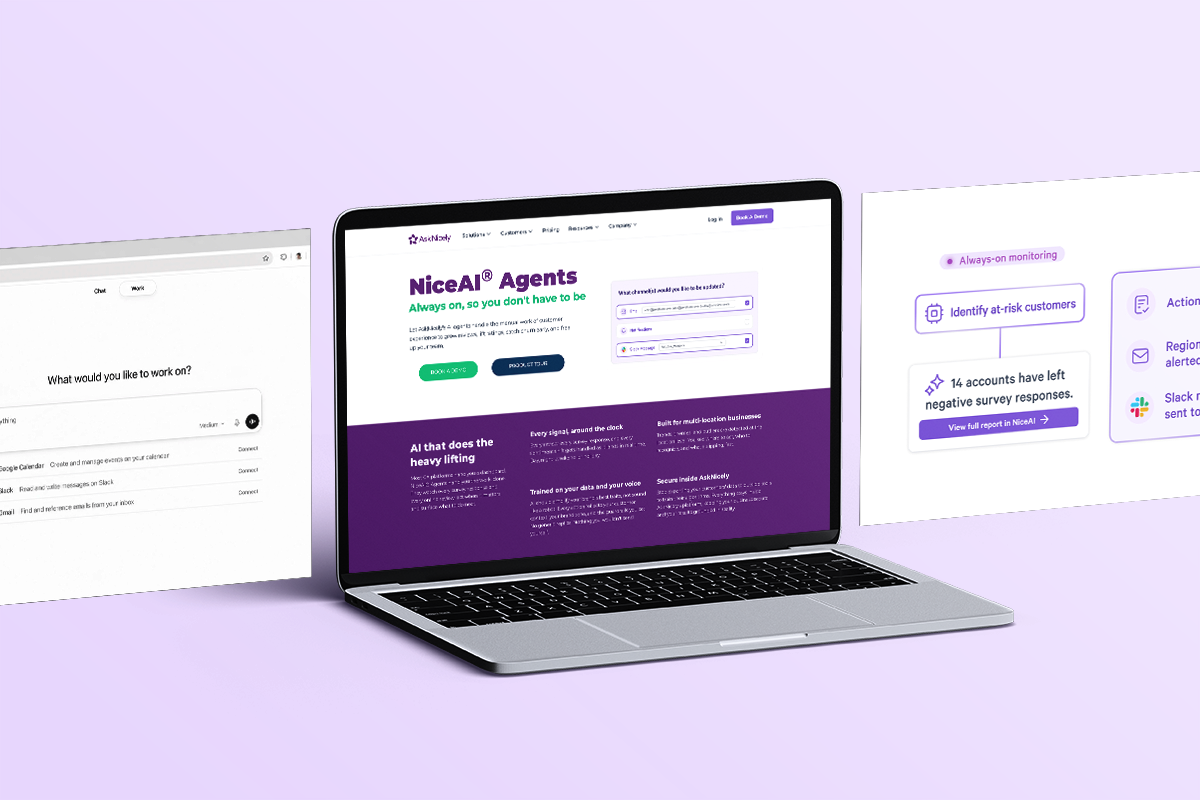
That’s what the NiceAI Agents are built for. Instead of surfacing information for a person to act on, they do the acting.
Insights Agent watches feedback and reviews continuously and flags what's changing before a team would catch it manually. Score drops, emerging themes, regional outliers – they get detected automatically, with evidence and a recommended next step delivered straight into Slack, Teams, or email. No one has to remember to check a dashboard for it to get caught.
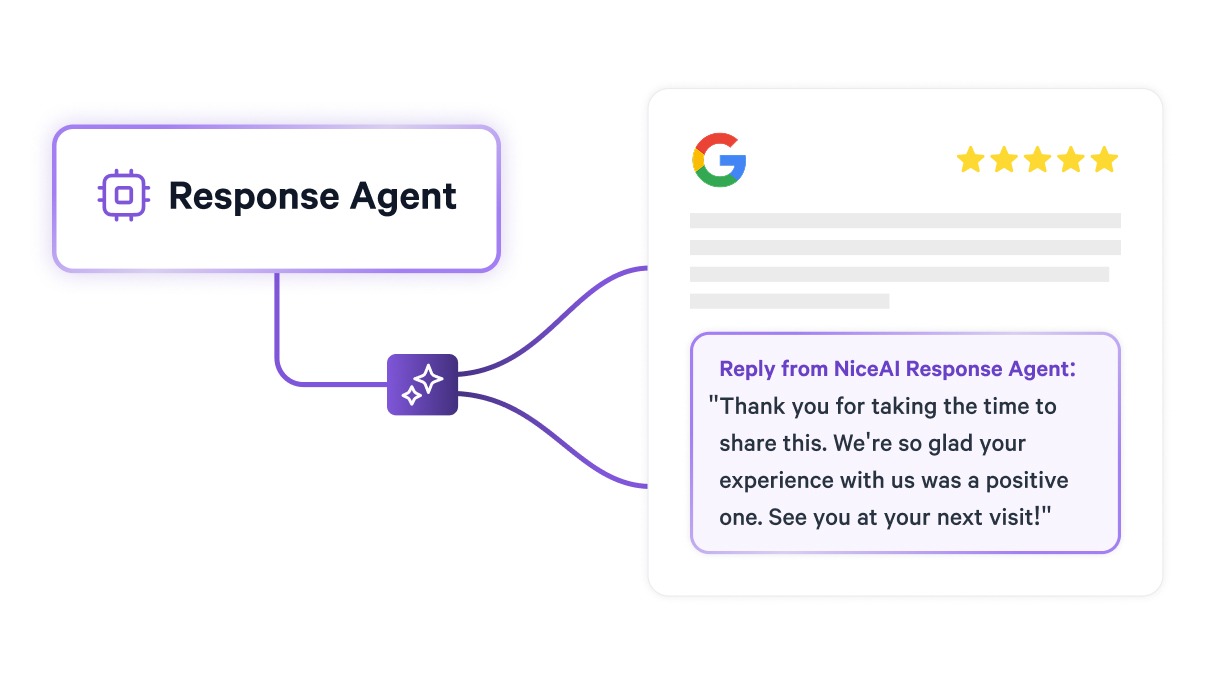
Response Agent handles the volume problem on the reply side. It drafts responses to reviews and survey feedback in a brand's own voice, with guardrails and approval workflows a team sets and controls. The output isn't a generic "we're sorry to hear that", it's a reply that sounds like the brand actually wrote it, at a speed no team could match by hand.
Review Routing Agent solves a different version of the same problem: getting reviews where they'll do the most good. It asks for a review at the moment a customer is most likely to leave one, then routes the request to whichever platform (Google, Yelp, Facebook, even AI search engines) needs it most based on review count and recency. That's a constant, granular decision most teams don't have the bandwidth to make manually across every location.
The common thread is that none of this requires a person to notice something first. The agents are always on, which matters most for multi-location brands, where problems and opportunities surface at the location level, often outside business hours, faster than any team can monitor by hand.
This is also where the data question from section 2 comes back around. Agents trained on a brand's own data and tone, operating inside the platform a business already trusts, are a different proposition than sending customer feedback out to train someone else's model. The action only works if the data behind it stays secure and grounded in reality.
Strip away the marketing language and the test is simple: does this AI produce an outcome, or does it just perform intelligence?
A sentiment score is intelligence. A flagged churn risk is intelligence. A summary at the top of a dashboard is intelligence. All of this is highly valuable, but look further to outcomes: an automatic shoutout to a frontline team member that helps them strive for continuous improvement, a review request that landed exactly where the business needed it, a problem caught and flagged before it shows up in next quarter's NPS.
Where this leaves CX teams
The CX teams getting the most out of AI right now aren't the ones with the most AI features. They're the ones who've closed the gap between what a customer says and what happens next, automatically, consistently, across every location, without adding headcount to do it.
As an AskNicely team member recently said:
AI is transforming customer experience. Not in some vague, futuristic way, but right now, today, in real, measurable ways.
The businesses that thrive in this new era will be those that don’t just collect feedback, but act on it fast, at scale, and with a frontline-first approach. The ones who give their frontline teams the tools and insights to shine. The ones who embrace the power of AI not as a gimmick, but as a true performance engine.
See how NiceAI and NiceAI Agents work together: Book a demo