Customer feedback management software: Top tools & benefits
Customer feedback is only as valuable as the action it triggers. Most organizations collect plenty of it (surveys, reviews, support tickets, NPS scores) and still watch customers churn for reasons buried in their own data.
Good customer feedback management software is centred around quick action. It turns raw signals into operational movement: routing insights to frontline teams in real time, flagging at-risk accounts before they leave, and giving managers the visibility to coach on what actually matters to customers. The organizations winning on customer experience aren't the ones gathering the most feedback. They're the ones acting on it fastest.
This guide compares seven leading platforms in depth, so you can choose the one built for how your business operates:
These solutions go beyond basic survey tools by creating closed feedback loops, capturing everything from NPS and CSAT scores to social media mentions and in-app feedback widgets, then routing that data through automated workflows to the teams who need it most. Modern feedback management software integrates easily with your existing tech stack (such as Salesforce, HubSpot, Zendesk, Slack, Jira, etc.), ensuring customer data flows directly to product management for feature requests, customer support for pain point resolution, and stakeholders for strategic product decisions that drive business growth.
Benefits of customer feedback management software
The most effective service leaders recognize that customer feedback can be a roadmap to sustainable business growth and offer a competitive advantage through enhanced customer satisfaction and retention.
Drive retention through proactive intervention: Real-time alerts and AI-powered sentiment analysis identify at-risk customers immediately after negative experiences, enabling follow-up actions that prevent churn while strengthening customer loyalty through demonstrated responsiveness to customer needs.
Accelerate product decisions with validated priorities: Omnichannel feedback collection aggregated into unified dashboards helps stakeholders prioritize feature requests based on actual user feedback rather than assumptions, ensuring your roadmap reflects genuine customer journey pain points that impact satisfaction metrics.
Turn frontline teams into CX champions: Automated workflows can deliver actionable insights directly to service teams, providing clear coaching opportunities and empowering them to optimize performance and close the feedback loop without waiting for top-down directives.
How to choose customer feedback management software
When evaluating customer feedback management software, look beyond surface features to ensure long-term strategic value:
Frontline empowerment capabilities: The platform should distribute real-time feedback directly to team members and locations, rather than just aggregating dashboards for headquarters. Look for personal scorecards, location-specific insights, and coaching tools putting actionable insights in frontline hands.
Multi-channel collection with smart routing: Evaluate whether the solution captures feedback across email, SMS, web, and social media with triggered workflows automatically routing responses to appropriate teams and enabling case management with resolution tracking.
AI-powered analytics and theme detection: Beyond basic NPS and CSAT metrics, seek platforms offering intelligent sentiment analysis, identifying emerging themes and patterns, surfacing trends across locations, teams, and time periods to spot issues before escalation.
Recognition and gamification systems: Look for built-in features that automatically celebrate positive feedback through team leaderboards, praise mechanisms, and goal tracking, making feedback a motivation engine, reducing churn, and improving retention.
Seamless CRM and workflow integrations: The platform should integrate with existing tech stacks, including Salesforce, HubSpot, Zendesk, Slack, and Jira. API access enables custom workflows while automated follow-up templates streamline the feedback loop between customer insights and action.
Comparing the top customer feedback management software
Here's a quick breakdown of the top customer feedback management software, outlining their features, use cases, and pricing so you can focus on what drives value for your organization:
👉 Compare at a glance: Scroll horizontally to view all vendors, features, pricing, ideal customers, pros, and cons.
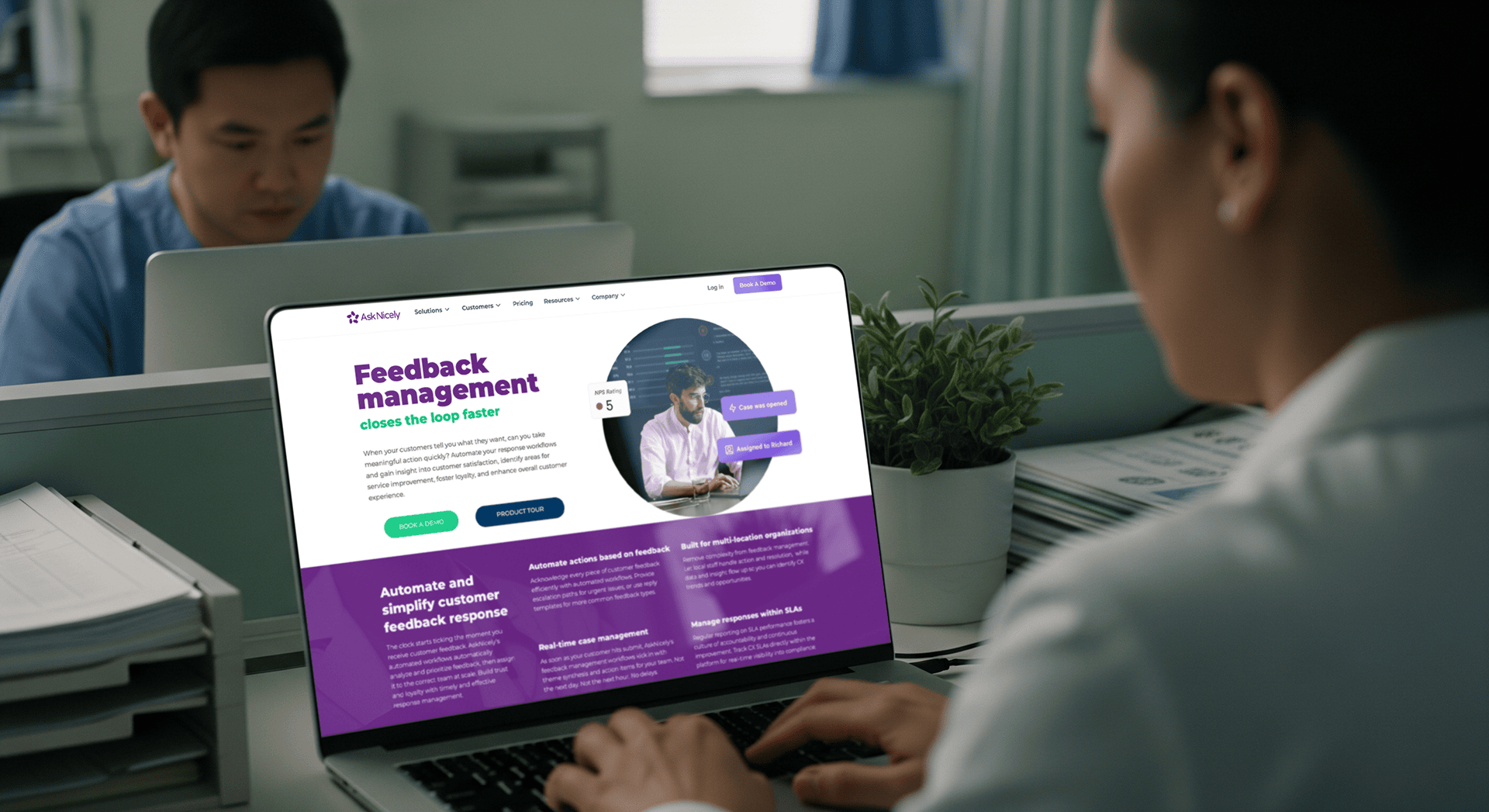
AskNicely
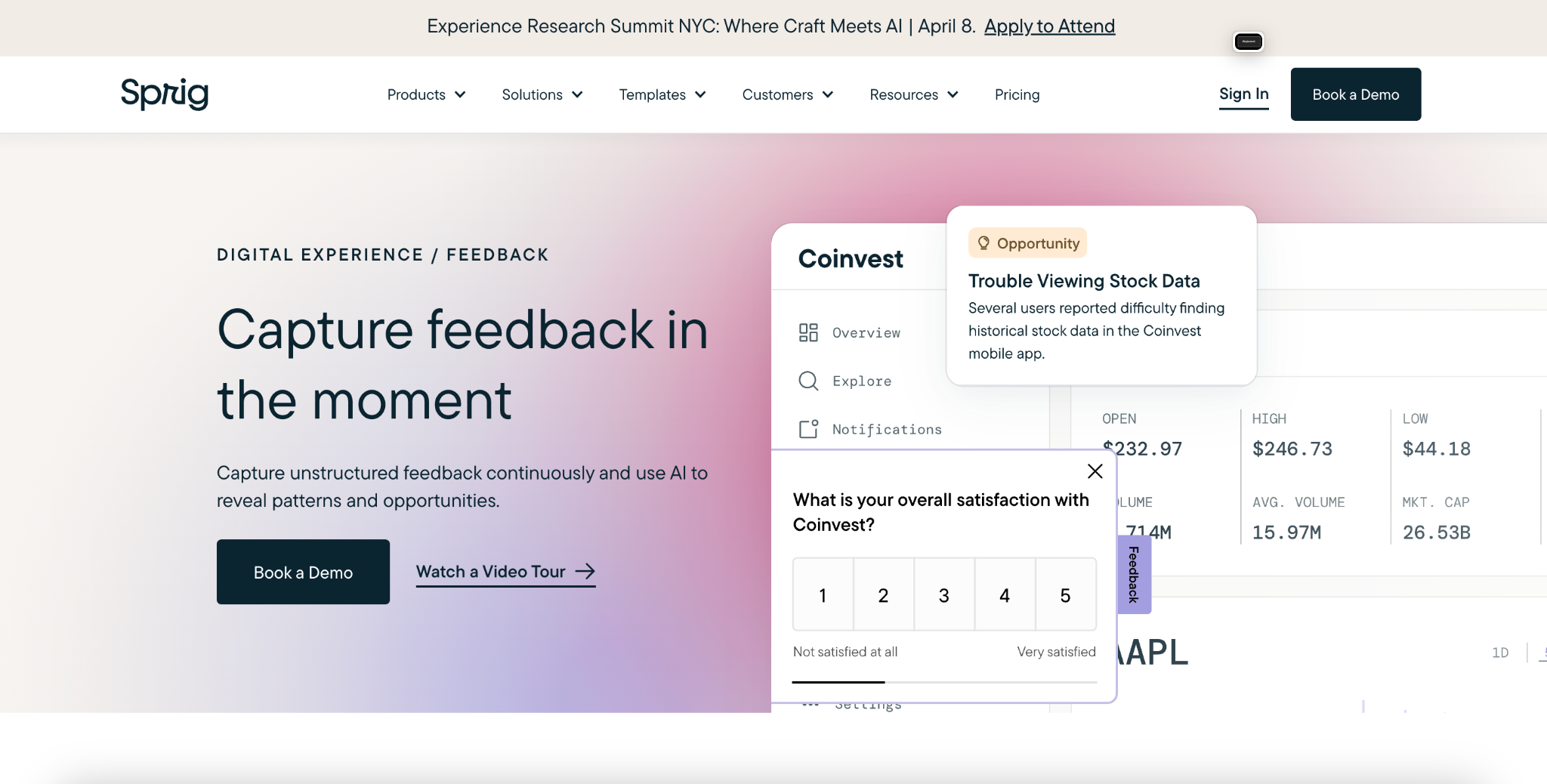
Sprig
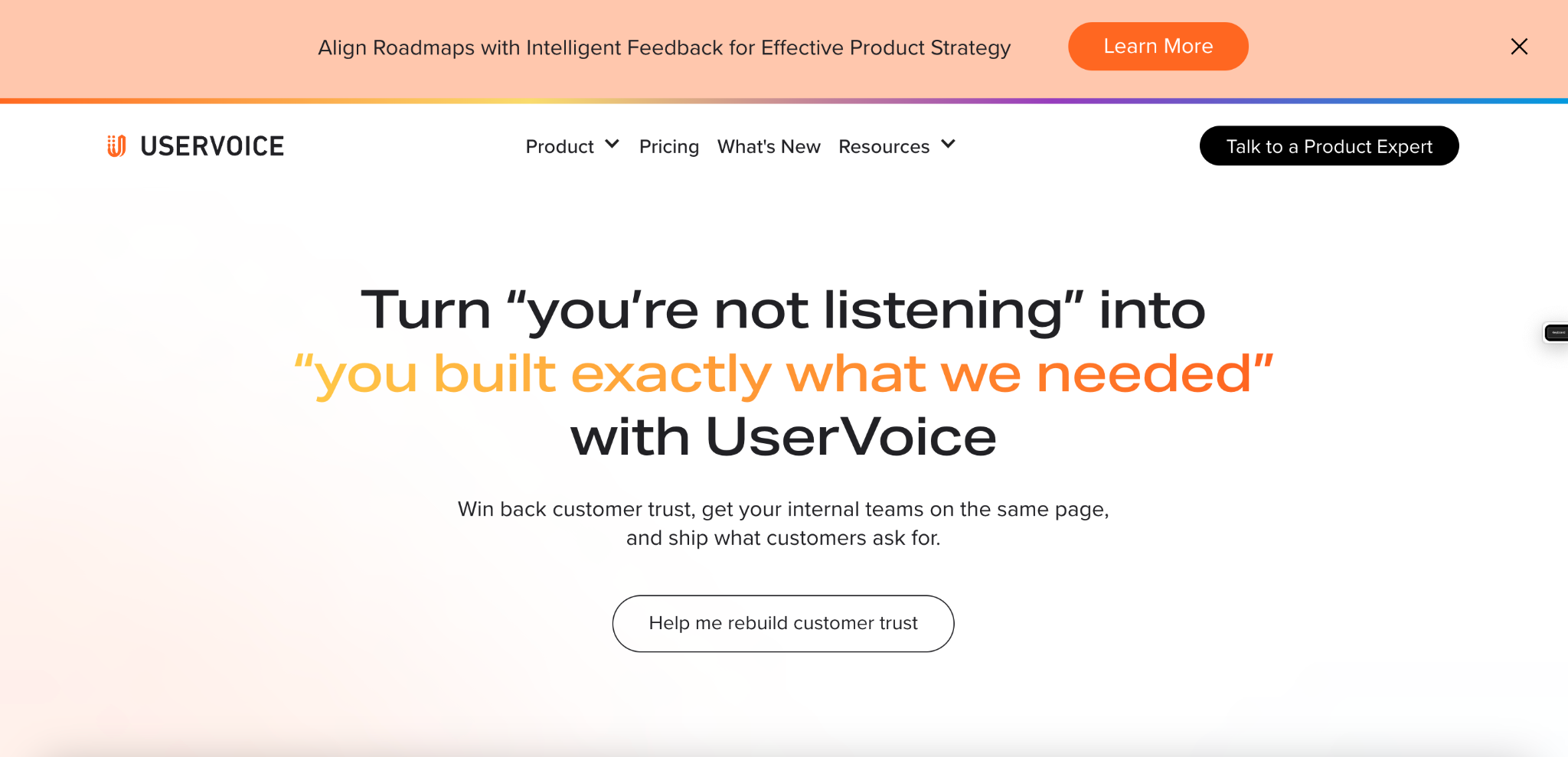
UserVoice
InMoment
Qualaroo
GetFeedback
Alchemer
Products
NiceAI; multi-channel surveys; dashboards; frontline tools; case management
In-product surveys; feedback buttons; session replays; AI insights
Multi-channel feedback; AI matching; roadmaps; microsurveys
XI Platform; AI listening; text analytics; reputation tools
AskNicely is a customer experience platform that uses AI-powered surveys, analytics, and automation to help service businesses collect, understand, and act on customer feedback at scale. Built for metrics like NPS, CSAT, and 5-star programs, it goes beyond measurement by connecting customer insights directly to frontline teams so they can improve service in real time.
At the core of the platform is NiceAI®, a generative AI engine that turns customer feedback into clear, quick, actionable direction. Instead of relying on static dashboards or manual analysis, teams can ask questions in natural language, uncover what’s changing across locations, and instantly understand what to do next. Combined with AI-powered automation, AskNicely helps organizations move from feedback collection to continuous improvement.
AskNicely: Key products and features
NiceAI® - The intelligence layer behind AskNicely that transforms how teams interact with customer feedback. NiceAI® enables users to ask questions in plain language and instantly receive answers, dynamic charts, and explanations across surveys, reviews, and locations. It personalizes surveys in real time through Dynamic Surveys, prioritizes the issues that matter most, and continuously analyzes sentiment to detect emerging risks before they impact churn. It also helps teams focus on the next best action by surfacing key drivers of customer experience and guiding improvement efforts across the business
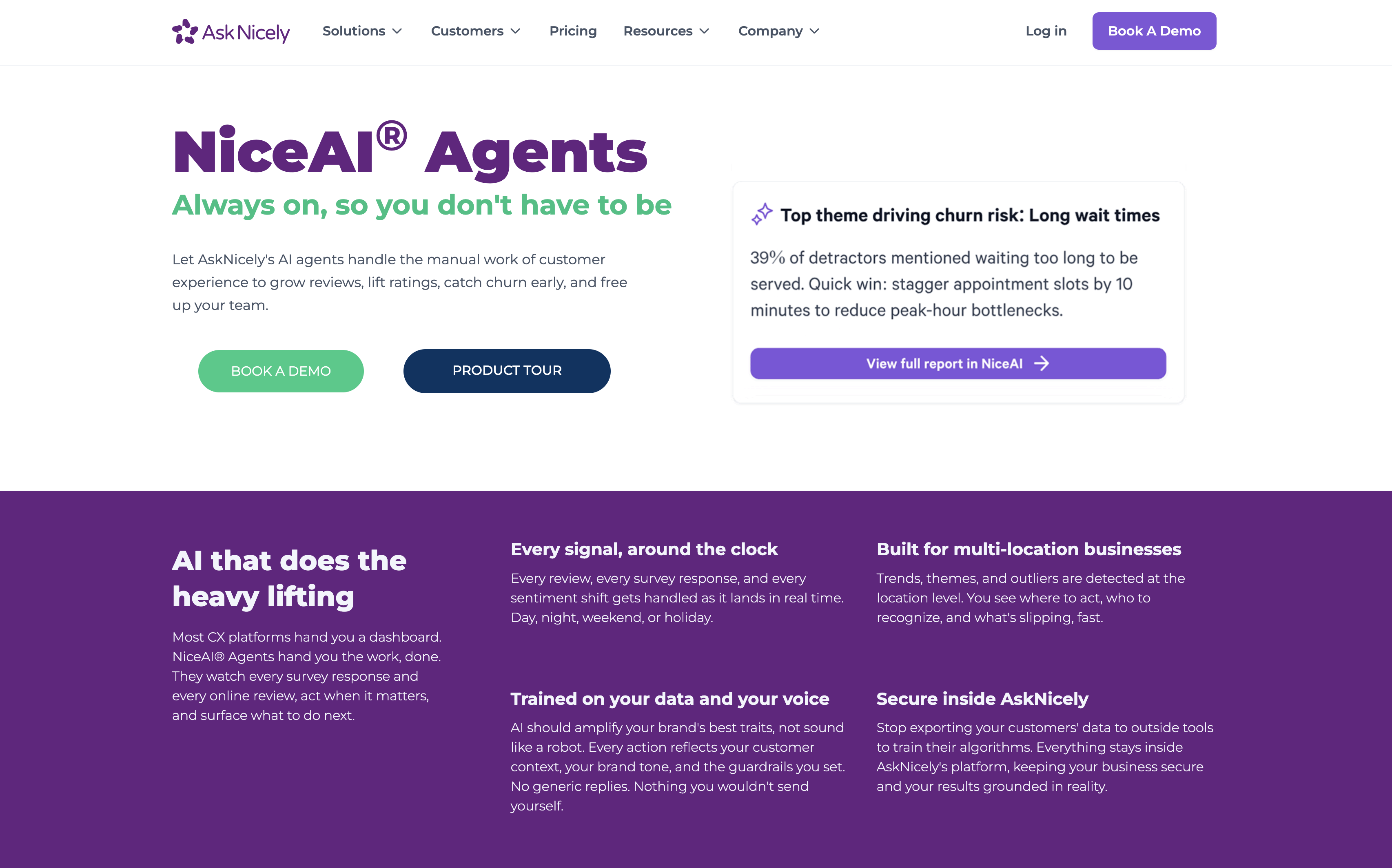
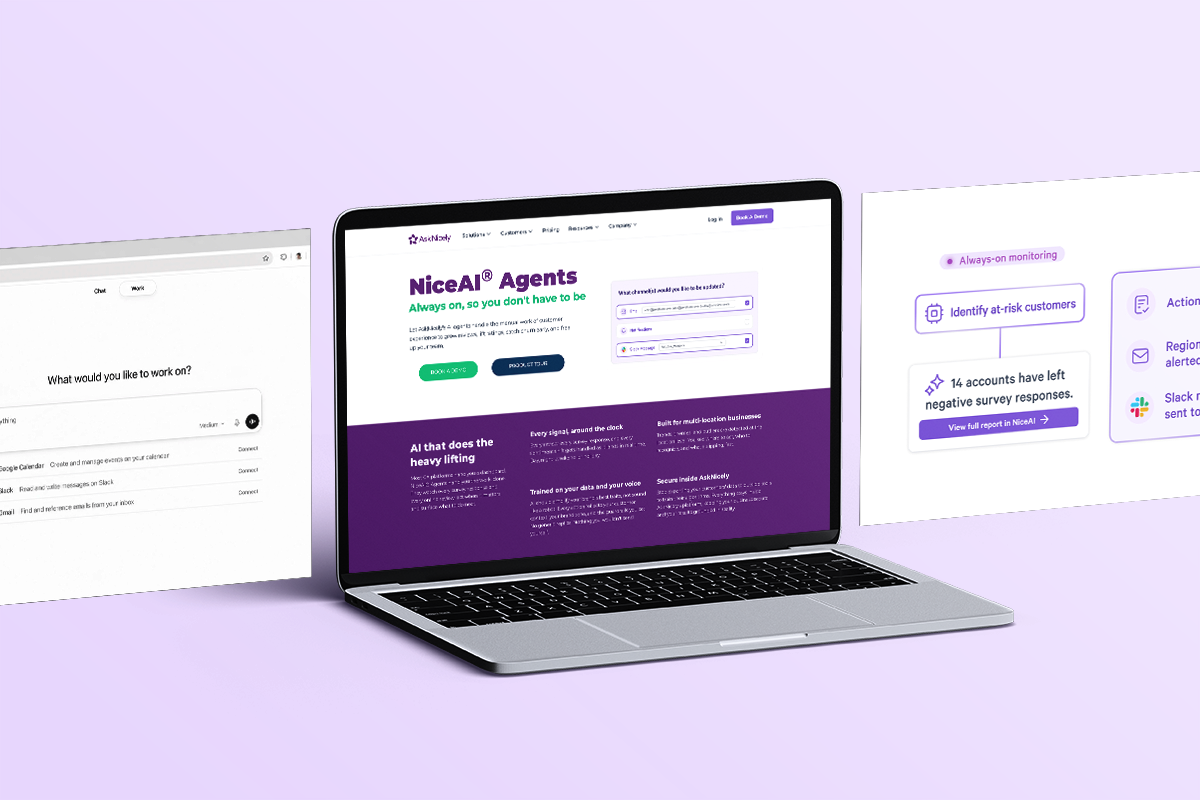
NiceAI® Agents - Always-on AI agents that actively manage the operational side of customer experience. These agents monitor every survey response and online review in real time, detect trends and anomalies, and take action where needed. The Insights Agent delivers ongoing alerts, recommendations, and summaries directly into tools like Slack or Teams. The Response Agent drafts on-brand replies to customer feedback and reviews, helping teams scale personalized communication without increasing headcount. The Review Routing Agent ensures customers are guided to the most relevant review platforms, improving visibility and reputation across channels. Together, these agents shift CX from manual work to automated execution.
AI text analysis - Uses natural language processing to automatically identify themes, sentiment, and patterns across customer feedback. It groups responses by topic and sentiment, highlights what matters most to customers, and tracks how preferences and experience drivers change over time.
Multi-channel survey collection - Collects feedback across email, SMS, QR codes, web embeds, mobile apps, and in-store kiosks. Surveys are dynamic and conversational, adapting in real time based on customer context and responses to reduce fatigue and improve response quality.
Performance analytics dashboards - Real-time dashboards track NPS, CSAT, and 5-star performance across all teams and locations. Powered by NiceAI®, users can explore data using natural language queries, instantly visualize trends, and understand what’s driving changes in performance without manual reporting.
Employee activation tools - Connects customer feedback directly to frontline teams through personalized dashboards, coaching playbooks, and recognition tools. AskNicely TV surfaces live performance data in shared spaces, helping reinforce great service and create visibility across teams.
Automated workflows - Automates the entire feedback loop by triggering surveys based on customer events, routing insights to the right teams, and managing follow-ups. Integrates with 100+ tools including Salesforce, Slack, and Zendesk to embed customer experience into everyday workflows.
AskNicely: Key use cases
Customer feedback management - Automates collection and response to customer feedback across multiple touchpoints. Enables teams to quickly identify and address service issues while tracking satisfaction trends over time.
Frontline team performance - Connects customer feedback directly to individual employees and teams for coaching and recognition. Helps identify training needs and motivates staff through leaderboards and achievement tracking.
Reputation management - Automatically prompts satisfied customers to leave online reviews on Google, Yelp, and other platforms. Generates testimonials and monitors online sentiment to build a positive brand reputation.
Multi-location service consistency - Provides visibility into performance across different locations and regions. Helps standardize service quality and identify best practices to replicate across the organization.
Data-driven CX improvements - Analyzes feedback to uncover inefficiencies and prevent service emergencies. Enables teams to make informed decisions based on customer insights rather than assumptions.
AskNicely pricing
AskNicely offers tiered plans that grow with organizational needs. All plans include core survey capability and automated workflows, while higher‑tier plans add advanced analytics, real‑time dashboards, integration options, review and testimonial generation, in‑app and white‑label surveys, API access, and frontline coaching tools. Pricing scales based on survey response volume and feature set, and plans are typically quoted through AskNicely’s sales team. A product tour is available to help organizations choose the right plan.
Who they're ideal for
AskNicely is ideal for B2C service businesses with multiple locations, particularly in healthcare, home services, education, finance, and franchise systems. The platform serves organizations that depend on frontline workers to deliver customer experiences, struggling with inconsistent service quality between teams, and wanting to turn feedback into action rather than just gather insights. Companies seeking to improve retention, reputation, and earned growth through customer experience improvements will find the most value.
Pros of AskNicely
AI-powered insights and decision support: At the core of AskNicely is NiceAI®, which transforms customer feedback into real-time answers, trends, and recommendations. Instead of relying on static reports, teams can ask questions in plain language and instantly understand what’s driving customer experience across locations. This reduces analysis time and helps teams focus on actions that improve outcomes.
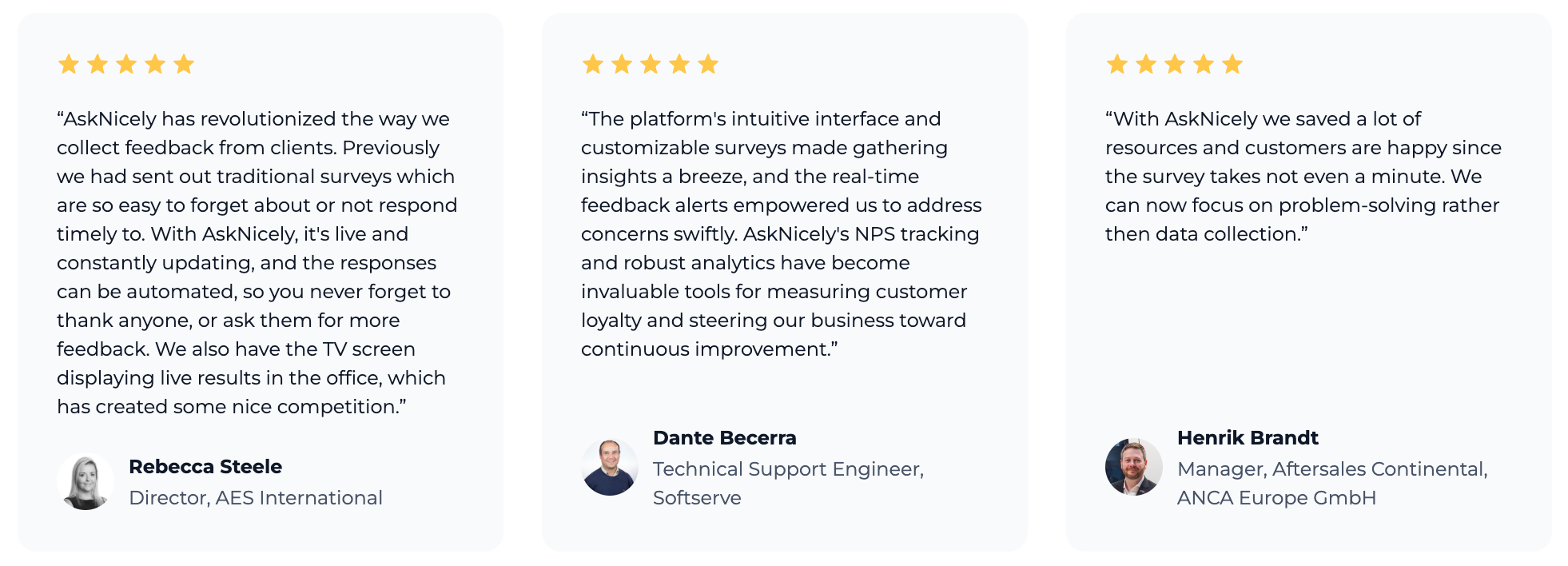
Ease of use and implementation: Intuitive interface with customizable surveys makes gathering insights straightforward. CRM integration is smooth and requires minimal setup time.
Automation capabilities: Automatically imports customer information, sends surveys based on triggers, and provides automated response capabilities. Saves significant time compared to manual processes and ensures timely feedback collection.
Real-time feedback and alerts: Live updates and real-time alerts enable teams to address concerns swiftly. The platform allows direct replies to survey responses, creating opportunities to help customers with poor experiences immediately.
Team engagement features: TV screen display for live results creates motivation through performance visibility. Modernizes and simplifies traditional survey collection by keeping feedback live and constantly updating.
Cons of AskNicely
Demo-based evaluation: Rather than offering a free trial, AskNicely provides tailored demos and guided onboarding for teams to see the platform in action with relevant integrations before committing.
Response-based pricing: Pricing scales with the number of survey responses, making it easy for smaller teams to start affordably. Larger organizations should review projected volume to pick the right tier and avoid unexpected costs.
What is Sprig?
Sprig is a unified platform that helps teams capture and analyze user feedback and behavior at scale to make data-backed product decisions. The platform combines surveys, in-product feedback collection, session replays, and AI-powered insights to help organizations understand user experience and optimize their digital products.
Sprig - Key products and features
AI insights: Automatically surfaces patterns and pain points from study results in real-time. AI clusters feedback and session data into clear themes, enabling teams to focus on analysis rather than manual sorting.
In-product surveys: No-code survey builder allowing teams to launch targeted surveys without developer support. Features precise targeting based on user attributes, behaviors, and events to capture feedback at the right moment.
Feedback buttons: Always-on feedback collection captures unstructured user input continuously. Includes AI-powered theme clustering, revealing patterns and opportunities from open-text responses.
Long-form surveys: Advanced multi-page surveys with features like skip logic, quotas, MaxDiff, and randomization. Shareable via links with zero developer setup required, designed as a modern alternative to legacy survey platforms.
Session replays: Visual recordings of user interactions within products, identifying friction points. Connects directly with feedback data, providing context behind user responses.
Heatmaps: Visual representation of user interactions showing where users click, move, and scroll. AI automatically analyzes heatmap data, surfacing actionable themes in user behavior.
Sprig - Key use cases
Uncover customer pain points: Launch targeted in-product surveys identifying specific areas where users experience difficulty. AI analyzes feedback themes to prioritize high-impact opportunities for improvement.
Measure customer satisfaction: Automatically track NPS and CSAT scores through always-on feedback mechanisms. Capture satisfaction metrics at scale directly within product experience.
Optimize conversion flows: Identify barriers causing user drop-off in conversion funnels. Combine behavioral data with user feedback to understand and address conversion obstacles.
Validate product features: Test new features by capturing real-time feedback as users interact with them. Get specific, contextual input guiding feature iterations and improvements.
Influence product roadmaps: Collect insights from power users about desired features and improvements. Use AI-analyzed feedback to prioritize development efforts based on user demand.
Research Core: Includes long-form surveys and AI insights
Digital Experience: Includes in-product surveys and feedback buttons
Digital Behavior: Includes session replays and heatmaps
Free plan with limited access available. The company offers the Starter plan for smaller teams. Customers can start with one bundle and expand to the full platform over time.
Who they're ideal for
Sprig is ideal for product teams, UX researchers, designers, and customer experience teams at technology companies needing to capture user insights at scale. The platform is particularly suited for teams looking to replace legacy survey tools like Qualtrics or SurveyMonkey with modern, AI-powered alternatives requiring minimal engineering support.
Pros of Sprig
Easy setup and implementation: Users get the platform running quickly, with typically fast mobile app integration. No-code approach means teams launch studies without developer involvement after initial setup.
AI-powered analysis: AI capabilities automatically analyze feedback and surface themes, saving significant time on manual analysis. Teams focus on interpreting insights rather than sorting through raw data.
Real-time insights: Captures feedback at the moment of user interaction rather than relying on recall. Provides more accurate and contextual insights about user experiences.
Scalable feedback collection: Enables teams to gather hundreds of responses per week and achieve 3x more customer feedback. The platform handles high volumes of data efficiently.
Cons of Sprig
Limited customization options: Some users find the customization capabilities restrictive for specific use cases, with the platform not accommodating all unique branding or survey design requirements.
Learning curve: Despite being user-friendly, there's still a learning curve for teams new to the platform, with some features and functionality requiring time to fully understand and utilize effectively.
Pricing transparency: Pricing information isn't always clear upfront, requiring demo calls to understand costs, making it difficult for teams to evaluate budget fit before engaging with sales.
UserVoice is a customer feedback management platform that helps product teams collect, analyze, and prioritize customer insights to inform product strategy and roadmap decisions through centralized feedback analysis.
UserVoice - Key products and features
Feedback collection and management: Captures customer feedback across multiple channels to create a centralized repository of user insights and feature requests.
Customer feedback analytics: Provides analytics tools that identify top improvement areas and quantify the impact of requests by customer segment for data-driven decisions.
Product strategy framework: Aligns initiatives with business objectives by evaluating CRM data alongside user signals for data-backed prioritization.
Roadmap management: Creates and maintains always-up-to-date roadmaps across the organization to ensure alignment on product strategy.
Salesforce and data integrations: Enriches feedback with user traits through Salesforce, data warehouses via open API, Fivetran, and Stitch.
FullStory integration: Track users' journeys before and after feedback submission by seamlessly transitioning from ideas to recent session recordings.
UserVoice - Key use cases
Product prioritization: Confidently prioritize features by evaluating CRM data alongside user signals to identify quick wins and marketplace trends.
Customer retention and satisfaction: Increase retention by alerting users when requested features go live, promoting adoption and engagement.
Team alignment: Reduce inefficiencies through data-driven stakeholder meetings and transparent roadmap planning sessions.
Feedback segmentation and analysis: Filter feedback by custom cohorts to identify retention drivers and understand the needs of target customers.
Risk mitigation: Automated notifications and Slack updates help teams iterate quickly when bugs occur or launches underperform.
UserVoice pricing
UserVoice pricing is not publicly listed, but is available upon request.
Who they're ideal for
UserVoice suits product teams and managers at SaaS companies needing to make data-driven product decisions, manage customer feedback at scale, and align initiatives with business objectives while maintaining user transparency.
Pros of UserVoice
Closes the loop with customers/stakeholders: Built-in public status updates on ideas and internal status updates help teams communicate progress and keep contributors and end-users informed.
Ecosystem coverage: Native integrations with key systems, including Salesforce, Jira, Azure DevOps, Microsoft Teams, Slack, Zendesk, and more, streamline feedback capture and delivery workflows.
Ease of collecting feedback: Reviewers frequently describe UserVoice as intuitive for capturing and organizing ideas across sources.
Cons of UserVoice
Reporting depth: Users commonly desire richer reporting and analytics; current options are perceived as limited for providing deeper insights and traceability.
Performance and mobile gaps: Some users report slow dashboard loading and note the lack of a dedicated mobile app for agents.
Learning curve: While basic capture is straightforward, several users flag the need for more intuitive workflows around analytics and integrations as usage grows.
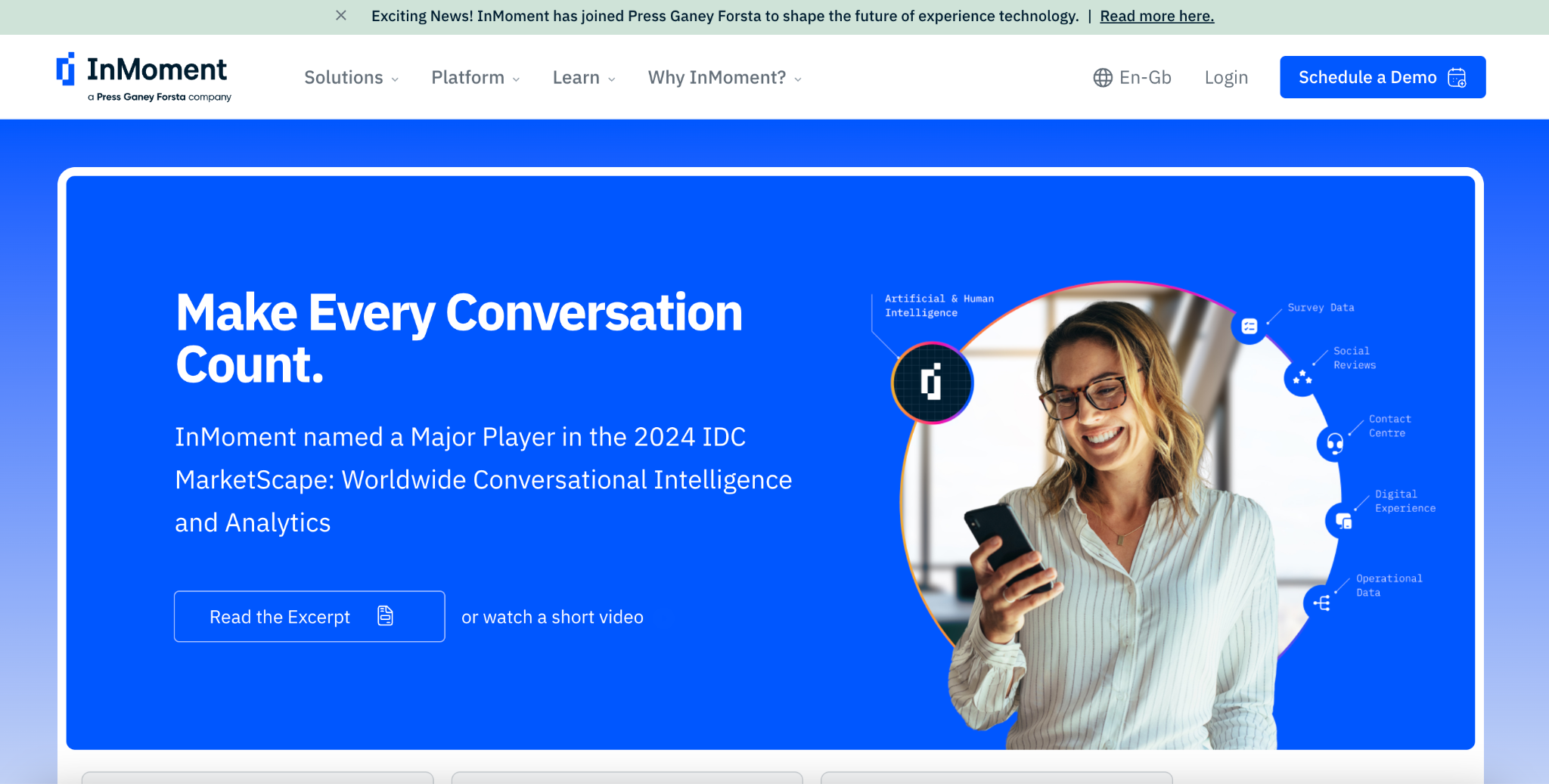
What is InMoment?
InMoment is a customer experience management platform that combines AI-powered analytics, omnichannel feedback collection, and action management tools to help organizations improve customer and employee experiences.
InMoment - Key products and features
XI Platform: The core experience management platform integrates customer signals and provides AI-powered operational guidance for real-time feedback. It includes capabilities for listening, reporting, analyzing, and optimizing experiences across the entire customer journey with advanced analytics.
AI-powered active listening: Patented conversational survey technology uses real-time text analytics and generative AI to intelligently respond to customers, eliciting richer feedback than traditional survey tools while improving response rates.
Text analytics engine: Powered by the Lexalytics acquisition, this functionality combines 19+ years of AI and NLP expertise with over 100 machine learning models to analyze structured and unstructured survey data, extracting themes, sentiment analysis, emotion, effort, and intent from customer feedback.
Closed-loop management: Enables organizations to create, search, and update cases with automated alerts, ensuring customer issues are addressed immediately at every level, with AI-generated response capabilities for streamlined resolution and improved retention.
Reputation management: Helps organizations generate, respond to, and amplify online reviews using AI, while optimizing business listings to improve search visibility and build customer satisfaction.
Conversational intelligence: Ingests and analyzes conversational data from calls, chats, and email threads to understand contact reasons and improve both team and user experience through multi-speaker text analytics.
InMoment - Key use cases
Omnichannel feedback collection: Collecting customer experience data from surveys, social reviews, call transcripts, chat logs, and operational systems provides a complete view of touchpoints throughout the customer journey.
Predictive customer analytics: AI detects customer intent and predicts next actions (purchase, recommend, complain, or churn), enabling proactive intervention to prevent negative experiences.
Automated issue resolution: Natural language processing automatically resolves customer issues in real-time through the Rapid Resolution Engine, reducing call center volume and support tickets.
Employee experience management: Collecting employee feedback, combined with HRIS data, predicts and prevents employee churn, with analytics showing a reduction of up to 70% in turnover at participating locations.
Action planning and coaching: Provides automated, role-based recommendations based on customer data, helping managers create standardized workflows across the organization.
InMoment pricing
InMoment offers multiple packages, including Customer Feedback Surveys, Conversational Intelligence, Reputation Management, Advanced Analytics & AI, Digital Listening, and Employee Experience, with an Integrated CX package that bundles all these solutions. The company offers flexible pricing models, including self-service, guided approach, and fully managed options. Pricing flexibility is rated 4.8/5 on Gartner Peer Insights compared to other Qualtrics competitors.
Who they're ideal for
InMoment suits enterprise-level organizations across retail, financial services, healthcare, transportation, and hospitality, managing complex, multi-channel customer experiences. The platform particularly fits companies with mature CX programs seeking to integrate feedback tools from multiple sources, leverage AI for predictive insights, and demonstrate measurable ROI from experience improvements, unlike solutions better suited for startups or small businesses.
Pros of InMoment
Strong text analytics capabilities: The platform's NPS, CSAT, and CES analysis engine effectively analyzes unstructured user feedback, providing deep sentiment analysis beyond basic categorization.
Comprehensive integration options: InMoment integrates seamlessly with CRM systems, including Salesforce, Zendesk, Marketo, HubSpot, Microsoft Dynamics, and Slack, enabling automated survey invitations and data flow.
Complexity for small businesses: Extensive features and enterprise focus may overwhelm smaller organizations. Companies without dedicated CX teams might struggle to leverage full platform capabilities effectively.
Integration requirements: While offering extensive API connectivity with Salesforce, Zendesk, and other enterprise tools, technical setup requirements can extend deployment timelines for complex tech stacks.
Challenges in customisation & speed of changes: Feedback includes complaints about slow turnaround for small tweaks, difficulty in doing ad‑hoc reports or integrations without technical support
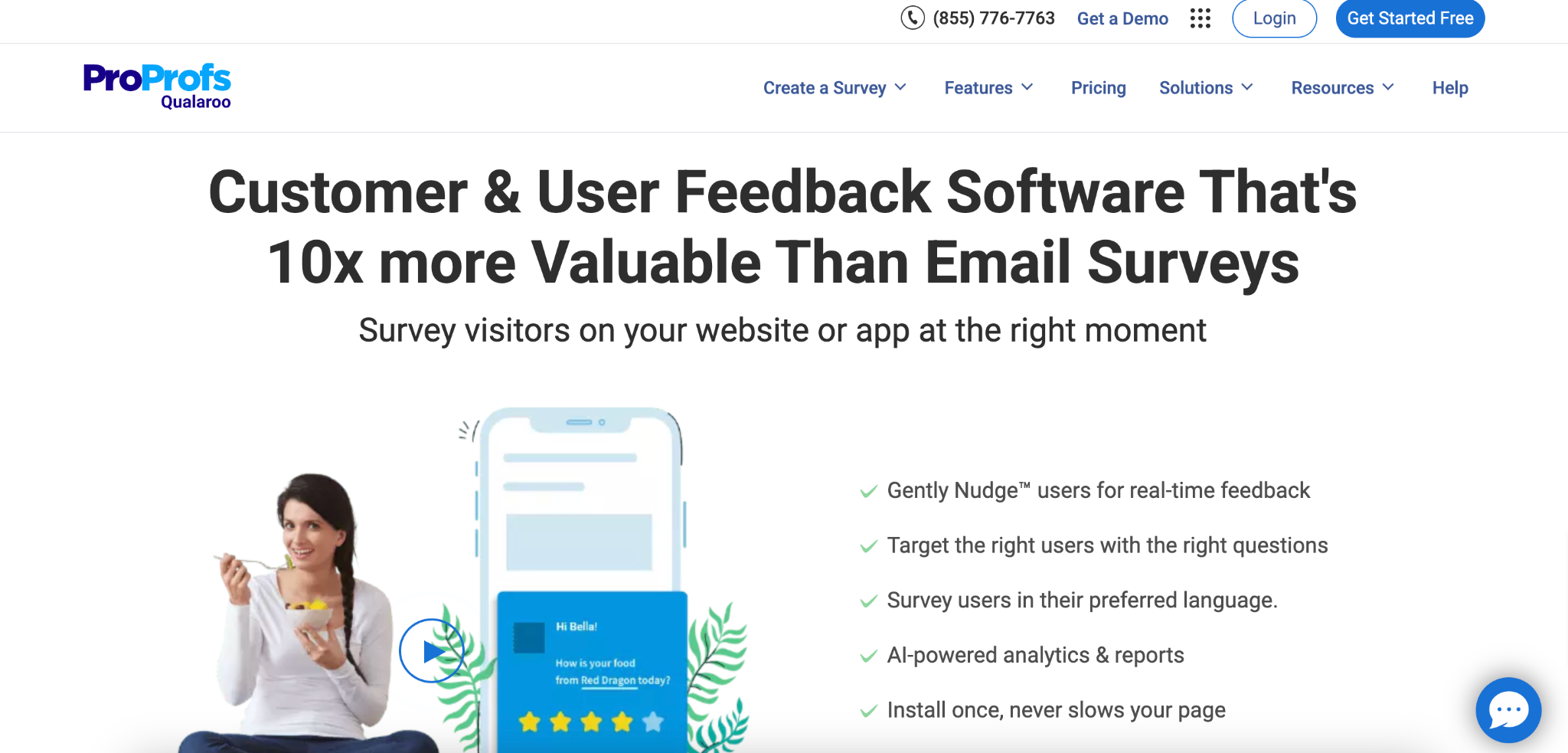
What is Qualaroo?
Qualaroo is an online survey and customer feedback software enabling businesses to collect insights from website visitors, app users, and customers through targeted surveys and feedback forms, specializing in capturing voice-of-customer data at critical moments to improve customer satisfaction and optimize user experience.
Qualaroo - Key products and features
Nudge™ surveys: In-app and website survey tool capturing feedback with higher response rates than email surveys through unobtrusive prompts engaging users while they interact with websites or mobile apps.
IBM Watson AI analytics: Powered sentiment analysis automatically categorizes open-text responses into emotional categories and tracks mood metrics with Word Cloud features, instantly displaying key concepts from free-form answers.
Advanced user targeting: Sophisticated targeting capabilities allowing surveys based on specific behaviors, demographics, page visits, traffic sources, and custom properties, including location, browser, IP address, cookies, and visitor types.
Multi-channel survey deployment: Deploy surveys across websites, mobile apps (iOS and Android), email, and prototypes simultaneously for consistent omnichannel feedback collection across all customer touchpoints.
Question branching and skip logic: Creates personalized survey experiences, directing respondents to specific questions based on previous answers, reducing survey fatigue and improving data quality by showing only relevant question types.
50+ language support: Multilingual capabilities supporting over 50 languages, breaking down language barriers for global customer feedback collection without translation limitations.
Qualaroo - Key use cases
Customer satisfaction measurement: Track NPS, CSAT, and CES scores to measure customer satisfaction over time with automatic metric calculation and trend analysis through comprehensive reporting dashboards.
Exit intent surveys: Understand why visitors leave websites by triggering surveys when exit behavior is detected, identifying friction points and abandonment reasons to reduce bounce rates.
UX and product feedback: Collect user insights on design prototypes and product features during development, testing concepts and validating hypotheses based on real user feedback.
Conversion rate optimization: Identify drop-off points in the customer journey and understand conversion barriers with targeted feedback helping optimize website and app experiences.
Customer insights: Gather contextual feedback at crucial journey moments when experiences are fresh, including post-purchase feedback, feature usage insights, and milestone completion surveys.
Qualaroo pricing
Free plan: $0 for up to 50 responses, includes 500 email sends and 10,000 pageviews with all premium features.
Essentials plan: from $39.99 per month.
Business plan: from $99.99 per month.
Enterprise plan: from $149.99 per month.
Who they're ideal for
Qualaroo is ideal for businesses of all sizes looking to improve customer experience through data-driven insights, particularly startups and established companies with websites or mobile apps seeking to understand user behavior, optimize conversion rates, and measure customer satisfaction. Suits UX researchers, product managers, marketing teams, and customer experience professionals needing feedback without requiring technical expertise.
Pros of Qualaroo
Easy to use interface: Platform requires no coding knowledge, allowing survey creation in minutes with flexible design options and pre-built survey templates.
High response rates: In-app NudgeTM surveys achieve 10x higher response rates compared to email surveys by engaging users at the right moment.
Powerful analytics: IBM Watson integration provides valuable sentiment analysis and automated categorization of responses, extracting actionable insights quickly.
Flexible and customizable: Extensive branding options, multiple question types, and advanced targeting capabilities allow highly personalized survey experiences.
Cons of Qualaroo
Limited free plan responses: The free plan allows only 50 responses in total, which may be insufficient for businesses requiring ongoing feedback collection.
Payment method restrictions: The Platform doesn't accept PayPal, which can be inconvenient for businesses preferring this payment option.
Pageview tracking limitations: Tracked pageviews count only when Nudge™ surveys display, requiring careful plan selection for adequate coverage.
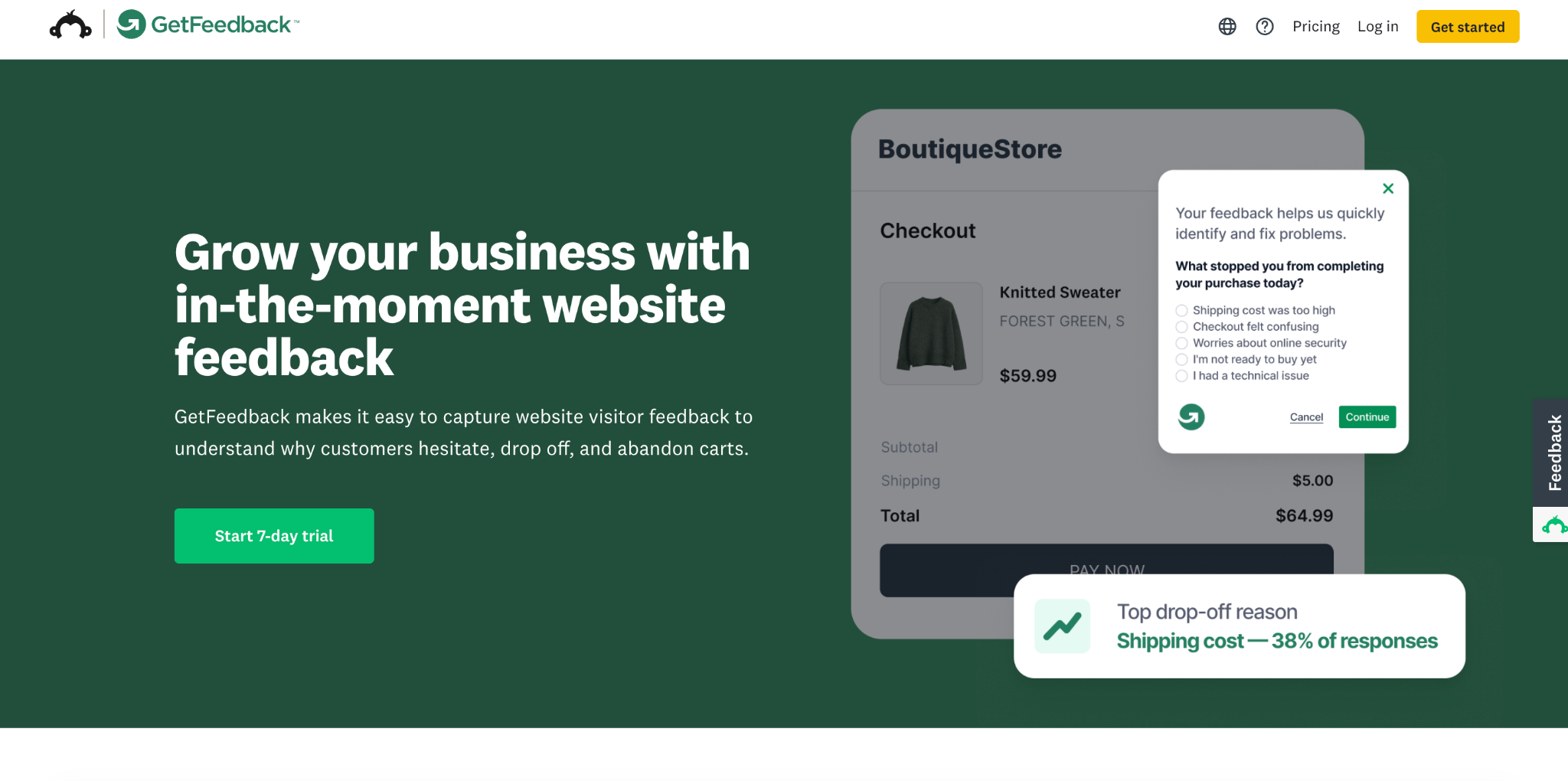
What is GetFeedback?
GetFeedback is a website feedback tool from SurveyMonkey, now live after its June 2026 relaunch. The product has gone through significant changes: the original GetFeedback suite included two products: GetFeedback Direct (a relational/transactional survey tool) and GetFeedback Digital (an in-the-moment, on-site feedback tool). GetFeedback Direct is being sunset on December 31, 2026, after which the Digital product carries the GetFeedback name going forward.
The relaunched GetFeedback is now available for self-serve sign-up. Existing GetFeedback Digital enterprise customers retain their current setup unchanged; the new self-serve tier is a separate offering built for new customers.
GetFeedback - Key products and features
The relaunched GetFeedback is focused on website feedback collection, with a simpler, self-serve setup compared to its predecessor. Live capabilities include:
On-site feedback collection via embedded forms, feedback buttons, and trigger-based surveys
Behavioral targeting based on scroll depth, time on page, and exit intent
Page-level insights tying feedback to specific moments in the visitor journey
Built-in analytics dashboard for spotting trends and prioritizing fixes, including multi-form analysis
Quick setup via a single code snippet - no developer expertise required
Entry-tier plan supports up to 2,000 responses per month
GetFeedback - Key use cases
Conversion rate optimization: understanding why visitors drop off or don't convert
UX and content improvement: capturing in-the-moment reactions to specific pages
Voice of customer program: maintaining a continuous feedback loop with website visitors
GetFeedback pricing
There are two pricing plans for GetFeedback, the Starter for individuals and small teams, starting at $105 for up to 1,000 responses per month, and the Plus plan ideal for teams that need advanced feedback, starting at $285 per month and capping at 2,000 responses per month.
Who they're ideal for
The relaunched GetFeedback is aimed at a broader market than its enterprise-focused predecessor, particularly marketing, CX, and product teams who want website feedback without a complex implementation. Current enterprise customers (typically mid-to-large organizations using GetFeedback Digital for in-app and web feedback) are unaffected by the relaunch.
Pros of GetFeedback
Simple, code-snippet setup: GetFeedback lets teams launch web feedback forms instantly with a simple, low-code setup that requires zero engineering support.
Contextual behavioral triggers: Forms can be launched based on behaviors like scroll depth, time on page, and exit intent, enabling well-timed, targeted feedback collection.
Native SurveyMonkey ecosystem: Existing customers benefit from integration within the broader SurveyMonkey product suite, including release-note updates like Google Analytics 4 connectivity.
Cons of GetFeedback
Narrower feature set: The new self-serve offering doesn't mention mobile SDK, advanced segmentation, or Salesforce integration, features that were part of the legacy GetFeedback Digital product.
Siloed to web feedback: GetFeedback only collects feedback on websites, with no native way to unify on-site responses with survey, email, SMS, or in-app feedback from other channels.
Forced migration for Direct users: GetFeedback Direct customers face a sunset by December 31, 2026, requiring migration to SurveyMonkey Enterprise or another platform.
Plans cap at 2000 responses per month: not well designed for large multi-location service brands.
What is Alchemer?
Alchemer is a user-friendly customer feedback and experience management platform that enables organizations to collect feedback and take action on data across multiple channels. The survey platform provides survey software, digital experience management, and AI-powered text analytics, enabling businesses to understand and optimize customer experiences without the steep learning curve associated with enterprise alternatives.
Alchemer - Key products and features
Alchemer Survey: Comprehensive survey builder with 40+ question types, advanced logic, branching, and multi-channel distribution. Supports everything from simple polls to complex market research with multilingual surveys, custom branding, templates, and a real-time reporting dashboard.
Alchemer Digital: Digital experience management tool captures feedback directly within websites and mobile apps. Enables the collection of real-time feedback at critical touchpoints without disrupting the user experience through customizable widgets.
Alchemer Pulse: AI-powered text analytics transforms open-text responses into actionable insights. Analyzes sentiment, identifies trends, and breaks down customer journeys, enabling teams to understand what respondents truly think.
Integration capabilities: Connects with 400+ business systems, including Salesforce, Tableau, Microsoft Dynamics, Slack, and Google Sheets. Enables automated workflows and bi-directional data exchange, triggering real-time actions based on feedback collection.
Research solutions: On-demand product feedback and market research services, including survey design, project fielding, data processing, custom reporting, and advanced analytics. Designed for marketing teams, product teams, and CX/VOC teams needing expert support.
Alchemer - Key use cases
Customer experience management: Automatically send and follow up on customer surveys, measuring satisfaction and identifying improvement areas. Route feedback to appropriate teams for instant visibility and faster issue resolution, improving retention.
Market research: Conduct global studies with multi-language surveys and millions of respondents. Create advanced reports with predictable pricing, including unlimited surveys and question types without pay-per-response fees.
Product feedback development: Gather real-time customer feedback on new concepts and releases, shortening development cycles. Prioritize roadmap projects based on customer needs, ensuring resources are allocated effectively.
Support team optimization: Collect feedback when tickets are closed and automatically create new tickets based on the responses. Identify training opportunities and track the effectiveness of support, improving response times and customer satisfaction metrics.
Digital experience improvement: Monitor web and app experiences to identify and prioritize digital improvements. Modernize services based on user feedback, delivering the digital transformation customers expect.
Business platform: Custom pricing for teams larger than three users, includes a dedicated Customer Success Manager, 24/7 customer support, SSO, and enterprise-grade security features.
Alchemer suits marketing teams, product teams, CX and VOC teams, and in-house market research teams needing flexible feedback tools and analysis capabilities. The platform serves organizations from small businesses needing basic survey creation to large enterprises requiring advanced integrations, security compliance, and dedicated support. It's particularly suited for businesses wanting quick implementation without lengthy setups, connecting survey data with existing CRM and business systems — one of the best Qualtrics alternatives for cost-conscious teams.
Pros of Alchemer
User-friendly interface: The intuitive, drag-and-drop platform requires no coding for most implementations. Teams launch in hours rather than weeks, making it accessible to those without technical backgrounds and an ideal ease of use level for startups.
Platform reliability and flexibility: Extremely reliable for daily use with flexible features that adapt to various use cases. Users appreciate handling everything from simple surveys to complex research projects.
Time-saving efficiency: Users report 80% less time programming surveys compared to other providers. Intuitive features and survey templates significantly reduce launch time.
Comprehensive feature set: Extensive functionality, including numerous question types, integration options, and customization capabilities, eliminates the need for multiple feedback tools.
Occasional performance lag: Users report slower performance when running extensive surveys with complex logic and analytics.
Poor customer service: Some users report slow, unresponsive customer support.
Dependence on support for advanced features: Advanced question types require intervention from Alchemer’s programming team, creating delays and bottlenecks for survey deployment.
Persistent bugs: The platform has long-standing bugs that remain unresolved over many years, with little concern from support.
Final verdict
Customer feedback management software succeeds or fails on one measure: how fast feedback turns into action. The seven platforms above solve that problem for different organizations.
AskNicely is the strongest choice for multi-location B2C service businesses with frontline teams. NiceAI® and NiceAI® Agents connect feedback directly to frontline teams, automate response and review routing, and turn CX from a reporting exercise into daily operational improvement.
Sprig and UserVoice suit product teams. Sprig fits fast-moving digital product teams needing in-product feedback, session replays, and AI-clustered themes. UserVoice fits teams prioritizing feature requests and managing public roadmaps.
InMoment and Alchemer serve opposite ends of the enterprise spectrum. InMoment is built for large, complex CX programs with dedicated teams and mature analytics needs. Alchemer offers similar breadth at a fraction of the cost, trading some polish and support quality for accessibility.
Qualaroo and GetFeedback both specialize in on-site, in-the-moment feedback. Qualaroo adds broader targeting and sentiment analysis; GetFeedback offers a simpler, self-serve setup but stays siloed to web feedback, with no native way to unify it with other channels.
The right platform depends on where feedback needs to travel once it's collected: to frontline teams, to product roadmaps, or into unified CX dashboards. Match the tool to that destination, not just the feature list.
Curious about AskNicely? Don’t be shy. Book a demo here, we’d love to show you around.